

Algorithmic scalping is no longer the exclusive domain of hedge funds and high-frequency trading desks. Retail traders now have access to platforms, open-source code, and signal tools that bring institutional-grade execution within reach. But there's a real difference between running a bot and running it well. This article walks you through exactly what algorithmic scalping is, which platforms and tools actually matter, what the real risks look like in practice, and how to set yourself up for repeatable results in crypto and forex markets.
Table of Contents
- What is algorithmic scalping?
- Tools and platforms for algorithmic scalping
- Pros, cons, and risks of algorithmic scalping
- Best practices for retail algo-scalpers
- Algorithmic scalping: What most guides miss
- Take your scalping to the next level
- Frequently asked questions
Key Takeaways
| Point | Details |
|---|---|
| Automated speed and consistency | Algorithmic scalping enables rapid, emotion-free trading with pre-set rules to maximize efficiency. |
| Accessible platforms | Retail traders can access a range of tools for crypto or forex, from MT4 EAs to TradingView bots. |
| Key challenges | Thin profit margins, fees, and infrastructure needs can impact effectiveness for retail traders. |
| Best practices matter | Realistic backtesting, risk controls, and broker optimization greatly improve results with algorithmic scalping. |
What is algorithmic scalping?
Algorithmic scalping is a rules-based trading approach where automated systems open and close positions within seconds to minutes, capturing small price movements repeatedly across a session. Unlike discretionary trading, where you read the chart and pull the trigger manually, algo scalping removes the human in the decision loop entirely. The system follows a fixed set of conditions and acts the moment they're met.
Speed is the defining feature. A retail scalper clicking manually might execute three to five trades per hour. An algorithm can screen dozens of instruments, confirm entry conditions across multiple timeframes, and fire an order in milliseconds. That consistency is the core value proposition.
Here's what separates algorithmic scalping from other automated strategies:
- Entry and exit rules are coded precisely, using indicators like RSI, VWAP, or moving average crossovers
- Risk management is baked in at the strategy level, often capping exposure at 0.5% per trade with stop-loss orders placed automatically
- News filters can pause the algorithm during high-impact events when spreads widen and slippage spikes
- Multi-timeframe confirmation layers a trend filter on a higher timeframe while entries are triggered on a lower one
Crypto and forex are the most popular markets for algo scalpers, and for good reason. Crypto runs 24/7, which means an algorithm can work overnight without you watching. Forex pairs like EURUSD and GBPUSD offer deep liquidity and tight spreads during the London and New York sessions, reducing the cost of rapid-fire entries and exits.
Here's a practical example of how a simple rule-based strategy gets coded and executed. Imagine a BTCUSDT bot on a 5-minute chart that enters long when the 9 EMA crosses above the 21 EMA, RSI is between 50 and 65, and ATR (Average True Range) is above a minimum volatility threshold. The exit fires when RSI hits 70 or price hits a 1:1.5 risk-reward target. Every single trade follows these exact rules, no exceptions, no hesitation. You can follow the logic of building setups like this in the Scalping Algo Indicator guide for a concrete TradingView example.
"Effective algorithmic scalping depends on pre-defined rules for entries, exits, and risk management rather than intuition. Platforms like TradingView, MT4, and crypto bots enable 24/7 automation that no manual trader can realistically replicate."
The psychological edge here is significant. You eliminate FOMO entries, revenge trades after a loss, and hesitation at valid signals. The algorithm doesn't care what happened on the last trade. That emotional discipline, which most traders spend years trying to build manually, is automatic from day one.
Tools and platforms for algorithmic scalping
Once you understand the mechanics, the next question is which platform actually fits your workflow. The good news is that retail-accessible tools have improved dramatically. You no longer need a Bloomberg terminal or a team of developers.
TradingView is the most accessible starting point. Using Pine Script, you can code custom indicators and strategies directly in the browser, backtest them on historical data, and connect them to brokers or bots via webhooks. The charting interface is clean, the community library is enormous, and the learning curve is manageable for traders with basic logic skills.
MT4 and MT5 Expert Advisors (EAs) remain the gold standard for forex algo trading. EAs are coded in MQL4/5 and run directly on your broker's server environment, which means execution is tightly integrated. The downside is that MQL has a steeper learning curve than Pine Script, and many brokers have varying levels of EA support.
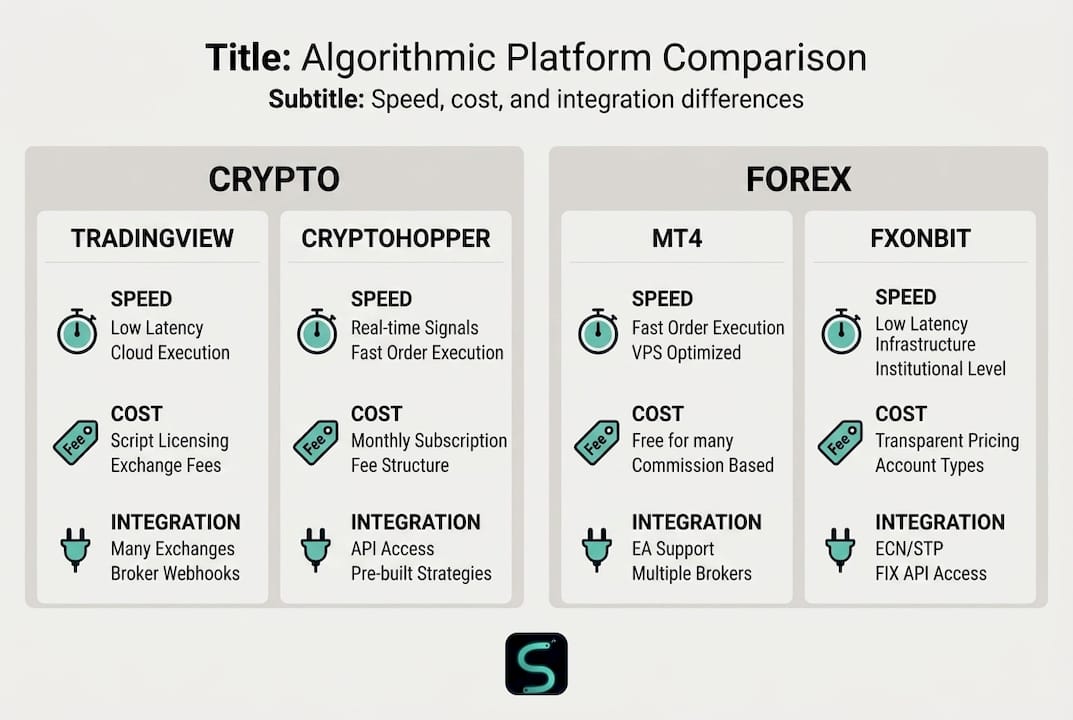
Cryptohopper and FXonbit are bot-based platforms designed for traders who want automation without writing code. These services offer 24/7 crypto automation through visual strategy builders, pre-built templates, and social trading features where you can copy another trader's bot configuration.
Here's a comparison of the four main platforms retail algo-scalpers use:
| Platform | Accessibility | Cost | Integration | Best For |
|---|---|---|---|---|
| TradingView | High | Free to $60/mo | Webhooks, broker API | Indicator-based strategies |
| MT4/MT5 EAs | Medium | Free (broker dependent) | Native broker execution | Forex scalping |
| Cryptohopper | High | Free to $107/mo | Exchange API | Crypto automation |
| FXonbit | Medium | Varies | Exchange API | Crypto copy-bots |
For traders wanting to see multi-timeframe confluence built directly into their dashboard, the MTF Scalping Dashboard overview is a useful technical reference. Pairing that with a curated list of the best scalping indicators gives you a full picture of how to build confluence into your automation layer.
Pro Tip: Run your algorithm on a Virtual Private Server (VPS) located close to your broker's data center. Latency matters in scalping. A VPS in London for EURUSD trading or New York for US equity futures can cut execution delay from 100ms to under 5ms, which directly affects fill quality and slippage.
Backtesting features vary significantly across platforms. TradingView's strategy tester is fast but limited in realistic order modeling. MT4 offers detailed tick data backtesting with spread simulation. For crypto bots, always check whether the platform accounts for exchange fees in its backtests, because many don't by default, and that omission creates dangerously optimistic results.
Pros, cons, and risks of algorithmic scalping
Algorithmic scalping offers genuine advantages, but it also carries risks that most promotional content glosses over. Let's be direct about both.
The real advantages:
- Emotion removal: The algorithm executes without fear, greed, or second-guessing. Consistency across hundreds of trades is where the edge compounds.
- 24/7 coverage: Crypto markets never close. An algorithm captures opportunities during Asian sessions or early morning moves that no manual trader stays awake for.
- Scalable volume: One person can monitor multiple currency pairs or crypto instruments simultaneously through automated scanning.
- Repeatable risk management: Every trade gets the same stop-loss and position size logic. No accidental overexposure after a winning streak.
The genuine drawbacks:
- Fees and slippage erode margins: Scalping targets small moves, often 3 to 10 pips or 0.1% to 0.3% in crypto. With spreads, commissions, and slippage, thin margins collapse fast if the strategy isn't precise.
- Overfitting risk: A strategy optimized to look perfect on past data often performs poorly on new data. This is the single most common reason retail algo strategies fail within weeks of going live.
- Infrastructure costs: A decent VPS, data feed, broker with low-latency execution, and the platform itself add up. High-frequency trading firms spend millions. Retail traders can do it for $50 to $200 per month, but that cost still eats into small accounts.
- Complexity: Something will break. A webhook stops firing, an exchange API changes, or the broker requotes during news. Manual intervention is always eventually required.
| Cost Factor | Estimated Impact | Notes |
|---|---|---|
| Spread + Commission | 0.5 to 2 pips per trade | Varies by broker and instrument |
| Slippage | 0.02% to 0.1% per trade | Higher during news events |
| VPS hosting | $20 to $80/month | Essential for MT4 EAs |
| Platform fees | $0 to $107/month | Depends on tool choice |
"High infrastructure barriers and overfitting risks mean that retail algo-scalpers need to treat every strategy like a small business, not a passive income machine."
The comparison of algorithmic vs manual scalping approaches makes the trade-offs concrete. For a deeper look at signal delivery and cost structures, the signal service pros and cons breakdown is worth reading before committing to any automated solution.
Manual trading still wins in specific situations. During surprise macro events, geopolitical shocks, or illiquid holiday sessions, human judgment can sidestep a catastrophic trade that a rigid algorithm would take. A hybrid approach, where automation handles routine high-probability setups and you manually pause the system during unusual conditions, is often more durable than pure automation.
Best practices for retail algo-scalpers
Knowing the risks matters. Acting on that knowledge with a structured setup is what separates traders who sustain results from those who blow up a promising strategy within a month. Here's a step-by-step approach that works.
1. Start with liquid markets during peak sessions. Focus your algorithm on instruments with consistently tight spreads and high volume. EURUSD and BTCUSDT are the two most reliable choices for retail algo scalpers. The London/New York overlap between 8 AM and 12 PM EST provides the highest forex liquidity. For crypto, Bitcoin and ETH see the most volume and tightest spreads during those same hours plus late US afternoon.
2. Build realistic backtests from the start. A backtest without slippage and fees is fiction. Always include a realistic slippage assumption of 0.02% to 0.1% and add your actual broker commissions. Test across multiple market conditions, ranging from trending to ranging to high-volatility periods. A strategy that only works in a trending regime will underperform for months when the market chops sideways.
3. Validate with forward testing before live capital. Run the algorithm on a demo account for at least three to four weeks after backtesting looks promising. Forward testing exposes execution issues, API errors, and real-world slippage that backtests miss entirely. Only move to a live account once forward test metrics match backtest expectations within a reasonable range.
4. Set hard circuit breakers. Code a daily loss limit directly into the algorithm. If losses exceed 2% to 3% of account value in a day, the bot stops trading. This single safeguard prevents the scenario where a broken strategy or unusual market condition triggers a cascade of losing trades overnight.
5. Use educational and benchmarking resources actively. Sites like ea-forexlab and algotradingspace provide third-party performance benchmarks for popular EAs. GitHub hosts open-source bots that you can study, modify, and test. Investing time in understanding how other strategies are built accelerates your own development far faster than starting from scratch.
6. Review and optimize monthly, not daily. Daily performance noise will lead you to over-optimize. Instead, review results on a monthly cycle, comparing metrics like win rate, average risk-reward, maximum drawdown, and profit factor. Adjust parameters only when statistically meaningful deviations appear.
For lower timeframe-specific guidance, the 1-minute scalping tips article covers the unique challenges of ultra-fast execution. Layering in trend confirmation strategies adds a meaningful filter that reduces false signals without sacrificing trade frequency.
Pro Tip: Combine a multi-timeframe trend filter with a volatility gate. For example, only allow entries when the 15-minute chart shows a clear directional bias AND the ATR on your execution timeframe is above a minimum threshold. This combination cuts trades during choppy, low-volatility periods where scalping edges disappear fast.
Algorithmic scalping: What most guides miss
Most articles about algorithmic scalping sell you on the "set it and forget it" fantasy. Deploy a bot, let it run, collect profits. That framing is why so many retail traders burn capital and walk away thinking algo trading doesn't work for them.
The uncomfortable reality is that every algorithm has a shelf life. Market microstructure shifts. Volatility regimes change. A strategy that performs brilliantly for six months can degrade quietly over the next three. If you're not monitoring performance metrics weekly and willing to pause or rebuild a failing strategy, automation becomes a liability, not an asset.
What works long-term is treating your algorithm like a tool that needs calibration, not a machine that prints money. The traders we see sustaining results are checking their day trading indicators overview, monitoring drawdown curves, and staying engaged with market context even while their bot handles execution.
Algorithms amplify whatever discipline you bring to them. A well-designed risk management framework running on automation creates consistent, controlled results. A poorly designed one with no circuit breakers will hit maximum loss faster than you can intervene manually. The technology is neutral. The judgment behind it is everything. Question every template you find online. Understand why each rule exists before you deploy real capital on it.
Take your scalping to the next level
If this breakdown has shown you the genuine potential in algorithmic scalping, the next step is building your setup with tools that are purpose-built for short-term precision.
At Scalping-Algo, we've built a full suite of premium scalping indicators for TradingView, coded in Pine Script v6 with non-repainting signals, volatility gating, and native webhook support. The Algo Master suite gives you a complete automation framework across crypto, forex, and indices, including backtesting tools, multi-timeframe confluence, and a Discord community with live sessions. For signal-focused traders, Smart Scalping Signals delivers real-time buy and sell alerts optimized for 1-minute to 15-minute charts.
Frequently asked questions
How does algorithmic scalping differ from manual scalping?
Algorithmic scalping relies on automated systems for rapid execution and consistency, while manual scalping trades on human judgment and real-time intuition that algorithms can't replicate during unusual market conditions.
What are common platforms for algorithmic scalping?
The most widely used platforms include TradingView bots, MT4 Expert Advisors, and crypto automation services like Cryptohopper and FXonbit, each offering different balances of accessibility and customization.
Do you need advanced coding skills for algorithmic scalping?
Some trading bots offer visual, no-code interfaces that are approachable for beginners, but building custom strategies with precise logic typically requires at least basic programming knowledge in Pine Script or MQL.
What are the biggest risks of algorithmic scalping for retail traders?
The primary risks are fees and slippage eroding thin profit margins, overfitting strategies to historical data, and the ongoing technical infrastructure required to keep execution reliable across live markets.