

Backtested scalping strategies report win rates between 61% and 72% in ES futures markets, which sounds like a guaranteed path to profit. It is not. Retail traders live in a world of commissions, slippage, emotional decisions, and algorithms that react faster than any human. The gap between a backtest and a live trade is where most scalpers lose their edge. This guide breaks down the mechanics of futures scalping, the strategies with the strongest empirical track records, the obstacles that quietly drain performance, and the tools that give disciplined traders a real shot at consistent results.
Table of Contents
- What is scalping in futures trading?
- Proven scalping strategies and their empirical performance
- Challenges, risks, and the real-world edge dilemma
- Tools and resources to optimize scalping performance
- Hard-earned lessons: Why most retail scalpers miss the real edge
- Advanced scalping tools: Take your futures trading to the next level
- Frequently asked questions
Key Takeaways
| Point | Details |
|---|---|
| Empirical edge is real | Backtested scalping methods show consistent win rates but require flawless execution to benefit. |
| Costs reduce profits | Slippage, commissions, and competition can quickly shrink theoretical scalping profitability for retail traders. |
| Best tools enhance outcomes | Using proven indicators, dashboards, and signal services improves performance and risk management. |
| Mindset matters most | Psychological resilience and discipline are crucial for consistent success in futures scalping. |
What is scalping in futures trading?
Scalping is a short-term trading method where you target small price moves, often just a few ticks, and repeat that process many times throughout the session. In futures markets, it means rapid entry and exit within seconds to a few minutes. The goal is not one big win. It is a stream of small wins that compound into meaningful daily gains.
Futures contracts are particularly attractive for scalpers because of tight bid-ask spreads, deep liquidity, and leverage. Instruments like ES (S&P 500 futures) and NQ (Nasdaq futures) allow retail traders to control large notional values with relatively small capital. Each ES point equals $50, and each NQ point equals $20, meaning even a 2-point scalp on NQ can net $40 before costs.
Compared to other styles, scalping sits at one extreme of the short-term trading spectrum. Here is how it stacks up:
| Style | Holding time | Trades per day | Target move |
|---|---|---|---|
| Scalping | Seconds to minutes | 10 to 50+ | 2 to 10 ticks |
| Day trading | Minutes to hours | 1 to 10 | 10 to 50 ticks |
| Swing trading | Days to weeks | 1 to 5 per week | 50+ ticks |
The appeal is clear: more opportunities, fast feedback, and no overnight risk. But the risks are equally real:
- High transaction costs that erode margins on small moves
- Psychological stress from constant decision-making
- Execution errors when speed is prioritized over precision
- Profitability erosion from costs and market competition
For traders using tools like an ES futures scalping indicator or NQ futures scalping signals, the right setup can narrow that gap between theory and execution.
Pro Tip: Discipline is the single most undervalued skill in scalping. Every extra trade you take outside your setup is a withdrawal from your edge account.
Proven scalping strategies and their empirical performance
Not all scalping setups are equal. Some strategies have been tested across hundreds of trades with documented win rates and profit factors. Here is what the data shows for ES futures.

| Strategy | Win rate | Profit factor | Risk/Reward |
|---|---|---|---|
| Opening Range Breakout (ORB) | 68% | 2.4 | 1:1.9 |
| VWAP Bounce/Reversion | 72% | 2.1 | 1:1.6 |
| Market Profile Value Area | 65% | 1.8 | 1:1.8 |
| Support/Resistance Bounce | 63% | 1.6 | 1:1.5 |
| Volume Spike Momentum | 61% | 1.7 | 1:1.4 |
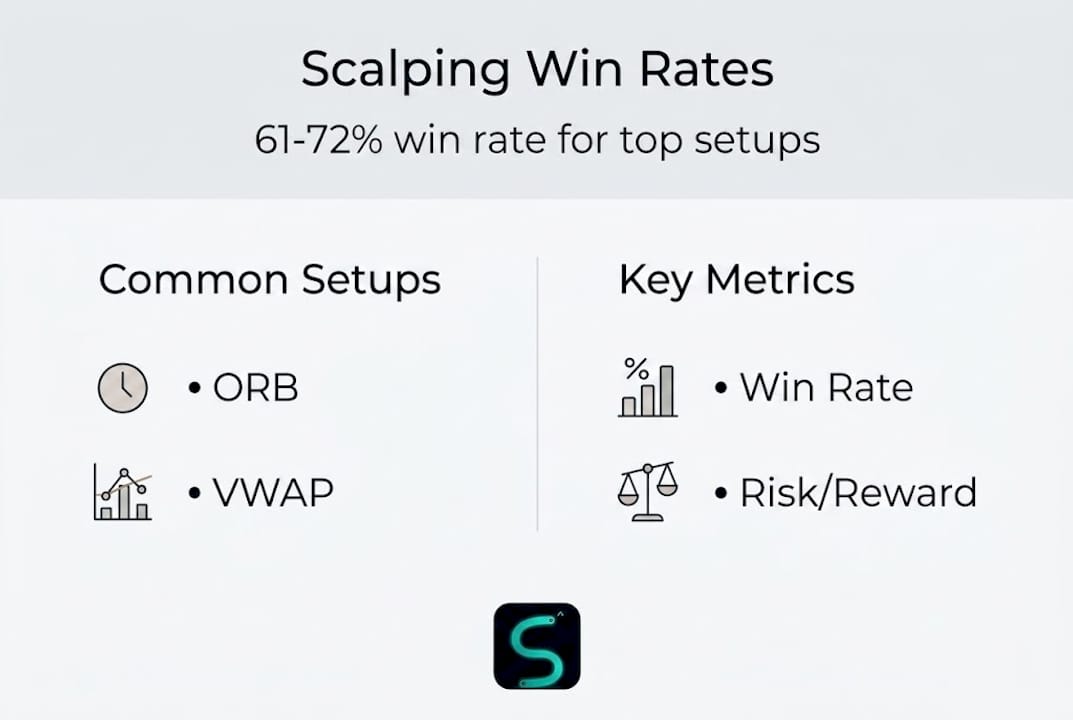
These win rates across 500+ trades represent some of the most well-documented approaches in ES futures scalping. The VWAP Bounce stands out with the highest tested win rate at 72%, making it a go-to for traders who want confluence between price and a dynamic intraday benchmark.
Here is a step-by-step breakdown of how the ORB strategy works in practice:
- Mark the high and low of the first 5 to 15 minutes after the open.
- Wait for price to break above the high or below the low with volume confirmation.
- Enter in the direction of the breakout within the first 1 to 2 candles after the break.
- Set your stop just inside the range (1 to 2 ticks beyond the opposite boundary).
- Target a 1:1.5 to 1:2 reward relative to your stop size.
- Exit if price fails to follow through within 3 to 5 candles.
For VWAP reversion, the approach flips: you fade extreme moves away from VWAP, entering when price overextends and begins pulling back. This requires reading order flow context, not just the indicator line itself.
Using a solid scalping strategy with indicators removes much of the guesswork. Pairing these strategies with futures trading signals on Discord lets you cross-reference setups in real time with other traders who are watching the same levels.
Challenges, risks, and the real-world edge dilemma
Backtest results look clean because they assume perfect fills, zero slippage, and emotionless execution. Live markets are different. Empirical win rates shrink in real-world trading due to slippage, commissions, and the psychological pressure of real money on the line.
Here are the biggest obstacles retail scalpers consistently face:
- Commissions and fees: At $4 to $5 round-trip per ES contract, 20 trades per day costs $80 to $100 before any market loss.
- Slippage: Fast markets and limit order hesitation mean your fill price is rarely the same as your signal price.
- HFT competition: High-frequency algorithms react in microseconds, often picking off retail limit orders before the move develops.
- Emotional overtrading: A losing streak triggers revenge trading. A winning streak triggers overconfidence. Both destroy edge.
- Consistency traps: Prop firms and high leverage environments punish inconsistent behavior with account restrictions or drawdown limits.
"Profitability erodes with costs and competition. Retail scalpers who ignore transaction friction often end up giving back gains to the market, not because their strategy failed, but because the math of small margins did."
The psychological side is where most retail traders underestimate the challenge. A 68% win rate strategy still loses 32% of trades. That means roughly 3 losers in every 10 setups. When those losers cluster, which they statistically will, the discipline to stick to your plan becomes the real test.
Using tools like the best TradingView indicator for scalping or an intraday trading indicator for scalping can help you stay objective by removing ambiguity from your entry criteria.
Pro Tip: Before risking live capital, run your scalping strategy on a demo account for at least 50 to 100 trades. Not to test profitability, but to test your own execution consistency under simulated pressure.
Tools and resources to optimize scalping performance
Having the right infrastructure is not optional for serious scalpers. Scalping profitability at high frequency depends on robust platforms, low-latency data, and tools calibrated for the short-term environment. Platforms like CME Globex and execution software like NinjaTrader set the baseline.
Here are the core tools that give retail scalpers a measurable advantage:
- Multi-timeframe indicators: These confirm signals across 1m, 3m, and 5m charts simultaneously, reducing false entries.
- Volume profile and order flow tools: They show where institutional orders cluster, giving you better context for reversals and continuations.
- TradingView dashboards: Centralized views of multiple instruments and alert conditions keep you organized during fast markets.
- Discord signal communities: Live commentary from other traders and real-time alerts add another layer of confluence.
- Performance journals: Tracking your fills, slippage, and outcome per setup reveals where your actual edge lives.
Here is a practical sequence to build your scalping toolkit:
- Start with a single tested strategy and one indicator suite that generates non-repainting signals.
- Add a multi-timeframe view using an MTF scalping dashboard to confirm higher timeframe bias.
- Integrate a 1 minute scalping indicator for precise entry timing on the lowest timeframe.
- Join a futures signal service on Discord for live market commentary and alert cross-referencing.
- Log every trade with entry price, fill price, target, stop, and outcome to track real vs. theoretical performance.
Pro Tip: Avoid chasing indicators that promise miracle win rates. Focus on tools with transparent backtesting methodology, open-source code, and documented performance across different market conditions.
Hard-earned lessons: Why most retail scalpers miss the real edge
Here is an uncomfortable truth: most retail traders spend 80% of their time hunting for better indicators and 20% practicing execution. That ratio should be reversed.
Empirical data confirms high win rates are achievable, but execution and market adaptability determine who actually captures them. The trader who takes the right setup with perfect sizing, tight stops, and disciplined exits will outperform the trader running five exotic indicators with sloppy execution every time.
Retail scalpers often chase overfitted backtests rather than building real-world edge. A strategy that looks flawless on historical data frequently breaks down when market conditions shift, because it was optimized for the past, not calibrated for the present.
What actually creates an edge is a combination of three things: a statistically sound strategy, disciplined mechanical execution, and the ability to recognize when conditions have changed and step aside. No indicator replaces the third element. That is entirely behavioral. Pairing strong strategy and indicator knowledge with live market practice is the only reliable path forward.
Pro Tip: Spend 80% of your practice time on disciplined execution in live or sim markets. The strategy is only 20% of the equation.
Advanced scalping tools: Take your futures trading to the next level
If you are serious about gaining a measurable edge in futures scalping, the tools you use matter as much as the strategies you apply. Scalping-Algo's premium scalping indicators are built in Pine Script v6 with real-time, non-repainting signals optimized for 1m to 15m timeframes. Every tool in the suite is transparent, backtested, and designed to work across crypto, futures, and forex markets.
The Algo Master suite integrates confluence layers, volatility gating, and divergence detection into a single cohesive system. You can verify performance yourself through the documented performance methodology, which outlines exactly how signals are tested and measured. No guesswork. No black boxes. Just tools built for traders who take execution seriously.
Frequently asked questions
What is the typical win rate for proven futures scalping strategies?
Empirical backtests show win rates from 61% to 72% for top ES futures strategies, though actual results depend heavily on execution quality and transaction costs.
What are the biggest risks for retail futures scalpers?
Commissions, slippage, and emotional overtrading are the primary performance killers, with profitability eroding rapidly in high-leverage and prop firm environments if consistency is not maintained.
Which tools help optimize scalping performance?
Tested TradingView indicators, multi-timeframe dashboards, and live Discord signal services improve both entry precision and real-time decision-making for active scalpers.
Is scalping more profitable than day trading?
Scalping offers more frequent setups and high liquidity, but after costs erode margins, many retail traders find net returns comparable to or lower than disciplined day trading approaches.
Recommended
- ES Futures Scalping Indicator (CME E-mini S&P 500) — Scalping-Algo
- NQ Futures Scalping Signals (Nasdaq E-mini) — Scalping-Algo
- Futures Trading Signals on Discord — Scalping-Algo
- Best Futures Signal Service on Discord — Scalping-Algo
- Forex Swing Trading Strategy: MT4MT5 Indicators, 83% Win Rate | FxShop24 Marketplace