

False signals are the silent account killers in scalping. You get a clean-looking buy signal, enter the trade, and the market reverses immediately, leaving you wondering what went wrong. The answer, more often than not, is that one signal alone is never enough. Trade signal confluence, the practice of stacking multiple independent indicators that all agree before you enter, transforms scalping from a coin-flip exercise into a probability game you can actually win. This guide walks you through the concept, the setup, the execution, and the metrics needed to build a confluence-based system that holds up over time.
Table of Contents
- What is trade signal confluence and why it matters for scalpers
- Preparation: Setting up your tools and confluence checklist
- How to execute a confluence-based scalp trade: step-by-step
- Common pitfalls, advanced tips, and optimizing for long-term edge
- Measuring success and troubleshooting your confluence strategy
- A scalper's perspective: What most traders get wrong about confluence
- Upgrade your confluence strategy with advanced scalping tools
- Frequently asked questions
Key Takeaways
| Point | Details |
|---|---|
| Confluence builds confidence | Combining different trade signals reduces false entries and clarifies setups. |
| Checklist improves speed | A practical confluence checklist enables faster and more consistent scalp decisions. |
| Less is more | Limiting indicator count and focusing on non-correlated tools prevents over-analysis. |
| Continuous review drives results | Measuring results and adjusting confluence methods is key for consistent profitability. |
What is trade signal confluence and why it matters for scalpers
Signal confluence simply means that several independent technical signals all point in the same direction at the same time. Instead of acting on a single RSI crossover or one candlestick pattern, you wait until your trend indicator, your momentum tool, and your volume signal all agree. That agreement is your edge.
For scalpers, confluence is especially critical. You operate on compressed timeframes where a single bad entry can wipe several winning trades worth of profit. Speed and precision are everything, which means your decision framework must be tight. Confluence shifts trading from reactive to evidence-based, giving you a quick checklist instead of gut-feel decisions. Novices can start with three core signals: a trend indicator like a moving average, a momentum tool like RSI or MACD, and a volume signal like OBV. Experienced traders layer in advanced prop tools to tighten that edge further.
Core confluence indicator types:
| Signal Type | Common Tools | What It Confirms |
|---|---|---|
| Trend | EMA, SMA, Ichimoku | Direction of market bias |
| Momentum | RSI, MACD, Stochastic | Strength of price move |
| Volume | OBV, VWAP, Volume Delta | Conviction behind the move |
Using best scalping indicators across these three categories gives you a structurally sound foundation.
Why confluence works for scalpers:
- Reduces false entries by requiring agreement across independent data sources
- Avoids whipsaws caused by low-conviction moves
- Clarifies both entry and exit zones with greater precision
- Improves your risk-to-reward ratio on each trade
- Builds consistency across different market sessions
Backtests across crypto and forex pairs consistently show that confluence-based entries outperform single-signal entries in both win rate and average return per trade. The Edge Finder tool is a practical way to begin automating this kind of agreement check without manually scanning multiple charts.
Preparation: Setting up your tools and confluence checklist
Knowing the theory is step one. Executing it consistently requires a platform setup and a repeatable checklist you can run in seconds, not minutes.
Timeframe selection is foundational. For short-term scalping, apply confluence on lower timeframes (5-15min) and align those setups with a higher timeframe trend bias. That means your 5-minute chart entry should agree with what the 15-minute or 1-hour chart is telling you about overall direction. This multi-timeframe approach filters out noise without slowing you down.
Setup comparison: confluence approaches
| Approach | Speed | Accuracy | Best For |
|---|---|---|---|
| Manual (indicator-by-indicator) | Slow | Moderate | Learning traders |
| Algorithmic (automated confluence signals) | Instant | High | Experienced scalpers |
| Hybrid (alerts + manual confirmation) | Fast | High | All skill levels |
For practical intraday indicators that support a hybrid approach, look for tools that fire alerts only when multiple conditions align simultaneously.
Pre-trade confluence checklist:
- Is the higher timeframe trend clear and pointing in my direction?
- Is price near a key support or resistance level on my trading timeframe?
- Does my momentum indicator confirm the direction (not overbought or oversold against me)?
- Is volume above average, showing real participation?
- Are there any conflicting signals from any of my indicators?
Only enter when all five boxes are checked. A multi-timeframe dashboard can display these checks simultaneously, cutting your pre-trade review from a minute to a glance.
Pro Tip: Color-code your chart zones. Use green for confluence buy zones and red for sell zones. When your eye lands on a green zone with three aligned signals, you know immediately it is worth evaluating without reading individual indicators one by one.
How to execute a confluence-based scalp trade: step-by-step
Prep is done. Now comes the part that separates traders who understand confluence from those who profit from it: actual execution.

A practical checklist for scalpers distills execution into five questions: Is the higher timeframe trend aligned? Are three or more signals confirming at a key level? Is your risk-to-reward ratio at least 1:2? Do volume and momentum confirm? Are there zero conflicting signals? Enter only when every answer is yes.
Execution steps for a confluence scalp:
- Scan for setup: Identify a key S/R level where price is approaching on your 5 or 15-minute chart.
- Run the checklist: Confirm trend alignment, momentum direction, and volume participation.
- Wait for the trigger: A buy/sell signal indicator fires or a clear candle close confirms the move.
- Enter with a defined stop: Place your stop loss just beyond the S/R level that validated your entry, typically 0.3 to 0.5 ATR away on lower timeframes.
- Set a profit target: Aim for at least 2x your risk. On a 10-tick stop, target 20 ticks minimum.
- Trail the stop: Once price moves 1:1 in your favor, trail the stop to breakeven and let the trade run.
- Exit cleanly: Close at your target or when a counter-signal appears. Do not renegotiate your exit mid-trade.
"The best trade is sometimes no trade. When signals conflict, the market is telling you something: clarity is absent. Standing aside is a position, and it is often the most profitable one."
Pro Tip: If even one signal is arguing against your entry, stand aside. A premium scalping script built with volatility gating will often do this automatically, suppressing signals in low-conviction conditions.
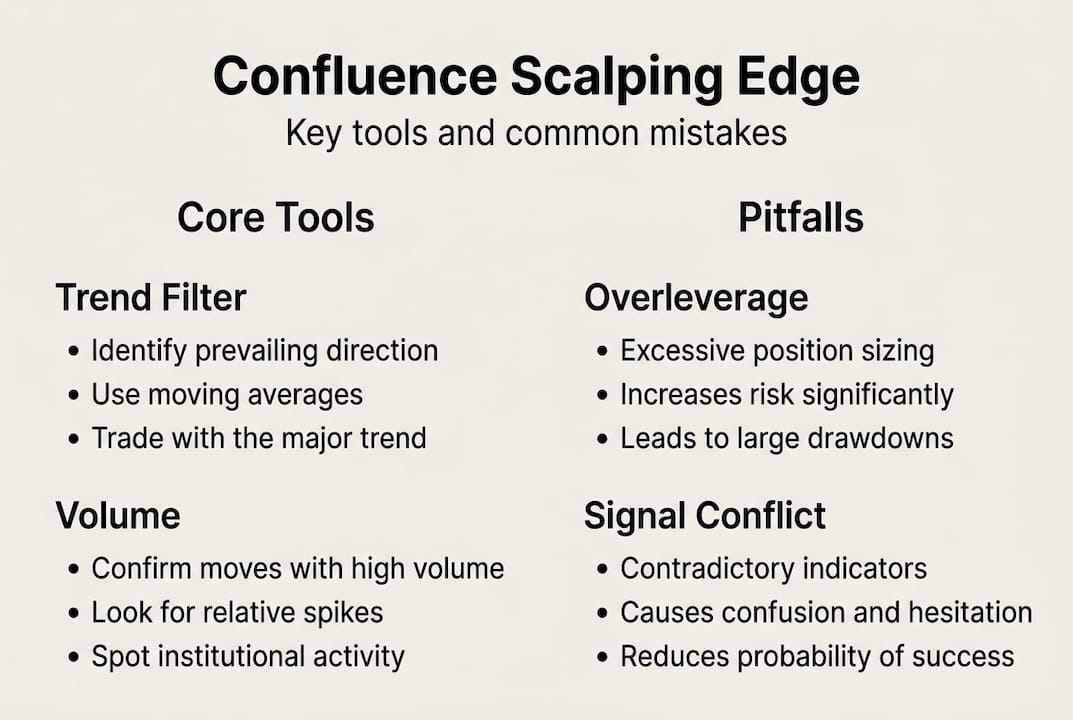
Risk management note: Never risk more than 1 to 2% of your account on a single confluence trade. Overleverage is what turns a solid system into a blown account, even when the logic behind each trade is sound.
Common pitfalls, advanced tips, and optimizing for long-term edge
Most scalpers learn confluence, then immediately make the same handful of mistakes. Knowing them ahead of time saves months of painful tuition.
Top mistakes that kill confluence trading:
- Over-layering: Adding seven indicators does not create seven times the edge. It creates noise. Stick to three or four maximum.
- Correlated indicators: Using RSI, Stochastic, and MACD together feels like strong confirmation, but all three measure momentum. That is not confluence; it is the illusion of confluence with redundant data.
- Confirmation bias: Seeking signals that validate a trade you already want to take, instead of running your checklist neutrally.
- Chasing signals: Entering after a signal has already produced a significant move removes the edge entirely. If you missed it, wait for the next setup.
- Ignoring regime shifts: A confluence system that works in trending markets will struggle in choppy ones. Recognizing when weak trends reduce efficacy is a critical skill.
Pro Tip: Keep a trading journal that tracks not just win or loss, but which specific confluence combination triggered the trade. Over 30 to 50 trades, patterns emerge. You will discover that some confluences consistently outperform others in your preferred market or session.
"Smart Money setups can create fake confluence deliberately, triggering retail entries before reversing. Your journal and backtesting data are your defense against engineered traps."
For optimization, use trend confirmation tools alongside volume-based indicators to separate genuine confluences from manufactured ones. Pair that with a day trading indicator suite that adapts to volatility, so your signals stay calibrated as market conditions shift.
Measuring success and troubleshooting your confluence strategy
Building a confluence system is an ongoing process, not a one-time setup. The traders who sustain long-term profitability are the ones who treat their performance data like a business, reviewing it consistently and adjusting with intention.
Key performance metrics to track:
| Metric | Target Benchmark | Red Flag |
|---|---|---|
| Win rate | 55% or higher | Below 45% |
| Average R:R | 1:2 or better | Below 1:1.5 |
| Max drawdown | Under 10% of account | Over 15% |
| Signal accuracy | 60%+ confluence signals profitable | Below 50% |
| Exception rate | Under 10% checklist bypassed | Over 20% |
Weekly review process:
- Pull your trade log for the week and separate confluence trades from any impulsive entries.
- Calculate win rate and average R:R specifically for confluence-confirmed trades.
- Identify the three trades where confluence was strongest and the three where it was weakest.
- Check whether losses clustered in a specific session, asset, or timeframe.
- Adjust one element of your checklist or indicator settings based on your findings. Only one change at a time.
When drawdowns hit, the first question to ask is whether the market entered a regime shift. Smart Money traps and fake confluence tend to increase in low-liquidity or news-driven sessions. Identifying these periods in your trade log allows you to add a filter, like avoiding entries in the 30 minutes before a major economic release.
Reusing a premium Pine Script scalping setup with built-in backtesting lets you run these adjustments against historical data before applying them live, protecting your capital during the optimization phase.
A scalper's perspective: What most traders get wrong about confluence
Here is the uncomfortable truth we have seen play out repeatedly: traders discover confluence, get excited about the concept, and immediately try to confirm everything before pulling the trigger. They add more indicators. They wait for more signals. They end up watching perfect setups pass by because they need just one more confirmation.
More signals do not equal more edge. They equal more hesitation. The real discipline in confluence trading is knowing when enough is enough and acting with conviction. Three aligned, non-correlated signals on a clean level is better than seven signals that took so long to align that the move is already halfway done.
Another thing most traders ignore: markets change. The confluence setup that printed money in a trending week will chop you up in a mean-reverting week. The mark of a skilled scalper is not rigidity in their system; it is the willingness to adapt which confluence layers they prioritize based on current conditions. Journaling not just your trades but the market context around each trade is how you build that adaptive intelligence over time. Our advanced indicator guide covers the tools that support this kind of flexible, context-aware approach.
Upgrade your confluence strategy with advanced scalping tools
Building a manual confluence checklist gets you started, but at a certain point, speed and consistency require automation. When you are scalping 1 to 15-minute charts, manually checking five conditions before every trade is a competitive disadvantage.

The Smart Scalping Signals suite automates multi-indicator confluence so every alert you receive already has trend, momentum, and volume aligned behind it. For traders who want a complete, institutional-grade system, the Algo Master indicator suite integrates volatility gating, divergence detection, and real-time signal confluence across all major asset classes. Whether you are just building your first confluence framework or optimizing a system that already works, the Scalping-Algo platform gives you tools that make precision execution a repeatable process, not a lucky outcome.
Frequently asked questions
What are the best indicator combinations for trade signal confluence in scalping?
A solid combination includes one trend filter like EMA or MA, one momentum tool like RSI or MACD, and one volume signal like OBV or VWAP on lower timeframes. Novices start with these 3-signal basics before adding complexity.
How do I avoid 'fake' confluence or over-analyzing trades?
Stick to non-correlated indicators, cap your stack at three to four tools, and stand aside when signals conflict. Correlated indicators create an illusion of strong confluence without actually adding new information.
How often should I review my confluence-based strategy?
Review results and adjust your checklist or tools at least once per week, focusing specifically on win rates and drawdown patterns to spot emerging issues early.
Is trade signal confluence suitable for both novice and expert scalpers?
Yes, confluence scales with experience. Novices start with 3-signal basics to reduce false signals, while experts use it to optimize entries with advanced automated suites for greater precision.
Recommended
- Best Buy/Sell Signal Indicator (2026 Guide) — Scalping-Algo
- Trend Confirmation Indicator for TradingView — Scalping-Algo
- Intraday Trading Indicator for Scalping — Scalping-Algo
- MTF Scalping Dashboard for TradingView — Scalping-Algo
- ST‑Scalper V3.0 Indicator + Scanner — Ultimate Trend‑Following System For MT4 | FxShop24 Marketplace