
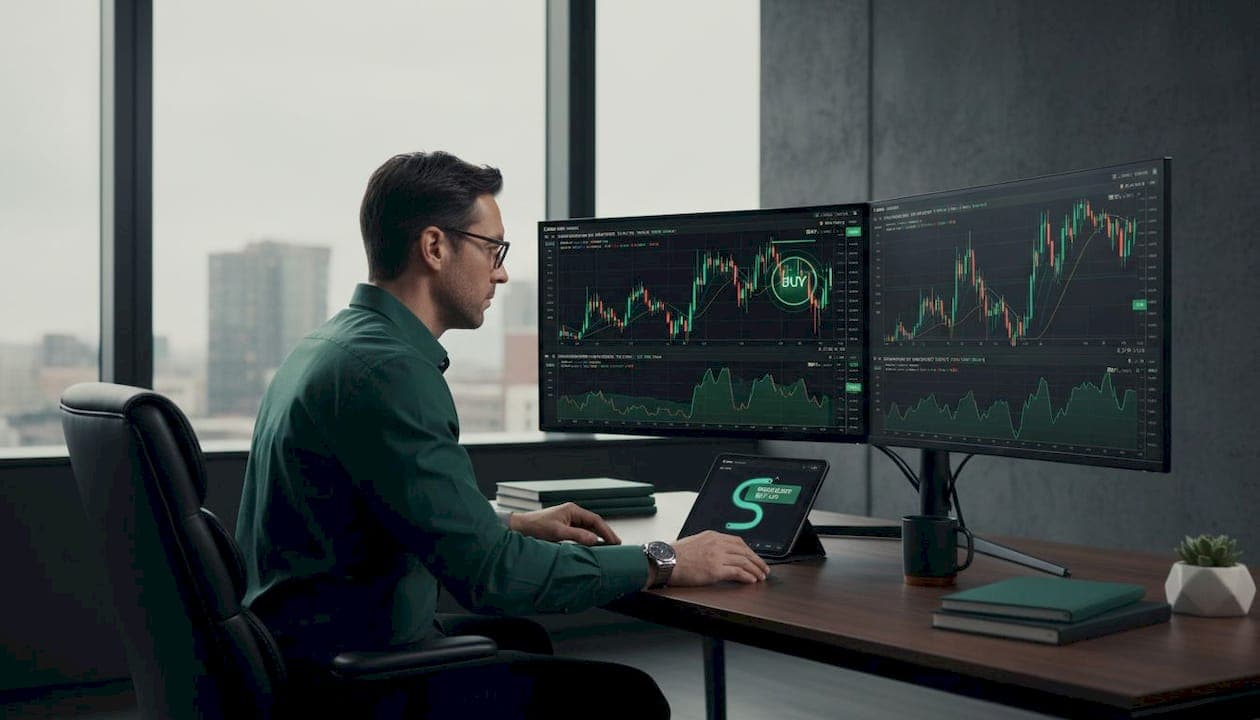
Short-term markets don't wait. A price move that lasts 30 seconds can make or break a scalping session, and traders who rely on delayed alerts or gut instinct quickly fall behind. Real-time trading signals are alerts suggesting buy/sell actions with entry, stop-loss, and take-profit levels, generated via technical analysis like RSI, MACD, and EMA crossovers, or through AI and fundamental data for fast trades in forex, crypto, and commodities. This guide walks through what these signals are, how to set them up correctly, how to act on them, and how to verify that they actually work before trusting them with real capital.
Table of Contents
- What are real-time trading signals?
- Tools, requirements, and setup for real-time scalping
- How to use real-time trading signals for scalping
- Verifying performance and managing signal risks
- Why smart traders question every signal
- Find your edge with advanced scalping signal tools
- Frequently asked questions
Key Takeaways
| Point | Details |
|---|---|
| Signal anatomy matters | Successful scalping relies on signals containing entry, stop-loss, and take-profit levels. |
| Setup is critical | The right tools, platforms, and fast devices reduce latency and improve trading outcomes. |
| Confluence boosts success | Robust trades come from confirming signals across structure, momentum, and sentiment. |
| Skepticism prevents losses | Verifying signal providers and avoiding hype is essential for risk management. |
| Actionable step-by-step workflow | Following a structured signal process maximizes consistency and minimizes errors. |
What are real-time trading signals?
A trading signal is more than just a "buy now" alert. It's a structured piece of information that tells you exactly where to enter, where to place your stop-loss to limit downside, and where to take profit. Timing is embedded too, because a signal that arrives 10 minutes late is practically useless for a scalper on a 1-minute or 5-minute chart.
The anatomy of a strong signal includes:
- Entry price: The specific level or zone to execute the trade
- Stop-loss: A predefined price where you exit if the trade goes wrong
- Take-profit: One or multiple targets to lock in gains
- Timeframe: The chart interval the signal was generated on
- Signal strength: A confidence score or confluence count, if the provider offers it
The engine behind most signals is technical analysis. Indicators like RSI (Relative Strength Index), MACD (Moving Average Convergence Divergence), and EMA (Exponential Moving Average) crossovers generate the raw data. AI models then layer on pattern recognition across thousands of historical candles to refine accuracy. Some platforms also factor in fundamental triggers like scheduled news releases or macro data, especially for forex and commodities scalping.
How signals differ by asset class:
| Asset class | Typical timeframe | Primary signal tools | Key variable |
|---|---|---|---|
| Crypto | 1m to 5m | Volatility heatmaps, EMA, RSI | 24/7 market, high volatility |
| Forex | 1m to 15m | MACD, EMA crossovers, structure | Session timing (London/NY overlap) |
| Commodities | 5m to 15m | Bollinger Bands, RSI, VWAP | News sensitivity, spread cost |
| Indices/Futures | 1m to 5m | Order flow, multi-timeframe EMA | Pre-market gaps, volume spikes |
For scalpers, the most relevant intraday scalping indicators combine momentum and volatility tools to filter low-quality setups. The best buy/sell signal indicators don't just fire on one condition; they require several inputs to align before issuing an alert, which dramatically reduces false positives.
Tools, requirements, and setup for real-time scalping
Knowing what signals are matters. But the tools and setup you use determine whether you can actually act on them in time. Scalping is a speed game, and even minor friction in your workflow costs you money.

The basics of scalping make it clear: milliseconds count. Your hardware, internet connection, and charting platform need to work together without lag.
Device and connection requirements:
- Low-latency internet: Wired connection preferred over Wi-Fi for critical sessions
- Processing speed: Multi-monitor setups with fast CPUs reduce chart load time
- Co-located broker servers: Some brokers offer server locations near major exchange data centers to reduce execution delay
- Backup connection: A mobile hotspot as a failsafe if your primary connection drops mid-trade
For platform selection, you need a broker or execution environment that supports fast order fills and integrates with your signal tools. Most serious scalpers use TradingView for charting because it supports custom Pine Script indicators and multi-timeframe views. The 1-minute scalping indicators available on TradingView let you run confluence checks directly on the chart without switching between multiple apps.
The mechanics for scalping signals involve 1-minute charts using market structure breaks, momentum indicators like EMA and RSI for confirmation rather than entry, volatility tools like heatmaps or Bollinger Bands, and confluence from multi-timeframe analysis. That last point is critical. A signal on a 1-minute chart carries much more weight if the 5-minute and 15-minute charts align with the same direction.
Essential tools for a real-time scalping setup:
- A reliable charting platform with webhook alert support (TradingView is the standard)
- At least two confirmation indicators beyond the primary signal generator
- A volatility filter to avoid trading during extreme spread conditions
- A multi-timeframe (MTF) dashboard to monitor trend alignment across timeframes
- Webhook or Discord integration for instant alert delivery without manual chart monitoring
The best TradingView scalping indicators combine these elements into a single interface, so you're not juggling five separate tools during a fast-moving session.
Quick setup checklist before your first live session:
- Configure broker account for fast execution (no requotes, tight spreads)
- Load your primary signal indicator plus at least one confirmation tool
- Set up webhook alerts to your phone and Discord channel
- Define your risk parameters: max loss per trade, max daily drawdown
- Run the setup on a demo account for at least five sessions before going live
Pro Tip: Test your alert delivery speed by triggering a manual alert and timing how long it takes to arrive on your phone. Any delay over two seconds suggests a webhook configuration issue that needs fixing before you trade live.
How to use real-time trading signals for scalping
Setup is done. Now let's talk execution. The process from signal receipt to trade placement needs to be nearly automatic. The more decisions you make in real time, the more emotional bias creeps in.
Here's the step-by-step workflow we recommend:
- Receive the alert. Your indicator fires, and you get a notification via webhook, Discord, or on-chart pop-up. The alert includes entry, stop-loss, and take-profit levels.
- Confirm with a second indicator. Before placing the trade, check that at least one additional tool agrees. This might be an RSI reading above 50 for a long, or a MACD histogram turning positive.
- Check the higher timeframe. A 1-minute signal is stronger when the 5-minute or 15-minute chart shows the same directional bias. This is confluence, and it's the core filter that separates reliable setups from noise.
- Scan current volatility. If the market just released major news or the spread has widened, hold off. Volatility spikes create false signals at the worst times.
- Place the order with predefined levels. Enter at the signal's entry price and immediately set your stop-loss and take-profit. No manual adjustments mid-trade unless there's a very specific reason.
- Monitor and exit. Let the trade run to target or stop. Avoid the temptation to close early because of minor adverse moves.
Prioritizing confluence, meaning structure plus momentum plus sentiment alignment across multiple timeframes, is what makes scalping signals robust enough to trade consistently. Without it, you're acting on noise.
"A signal without confluence is just a guess with extra steps. Always demand more than one reason to pull the trigger."
For traders using algorithmic signal services, automation handles steps one through five automatically. Bots can execute within milliseconds of signal generation, which is a genuine edge on 1-minute charts where manual execution often lags. But automation isn't set-and-forget. You still need to monitor for volatility shifts, because a bot will happily execute into a news spike that a human would avoid.
Volatility heatmaps excel in crypto scalping for spotting live movers, while intermarket analysis tools like DXY (Dollar Index) and VIX (Volatility Index) add edge for forex and commodities traders. These are the kinds of macro filters that separate intermediate scalpers from professionals.
Using multi-timeframe dashboards keeps all of this visible at once without switching chart tabs. And for traders considering trading automation, combining webhook alerts with bot execution is currently the fastest retail-accessible method for signal-to-order fulfillment.
Pro Tip: Set a personal rule that you will skip any signal where the 5-minute trend direction contradicts the 1-minute signal. This one filter alone removes a significant percentage of losing trades from your journal.
Verifying performance and managing signal risks
Using signals is one thing. Trusting the right ones is another. The signal provider space is crowded with inflated claims, and as a trader, your job is to verify everything before risking capital.
Signal providers commonly claim win rates of 70% to 85%, with some citing figures like Learn2Trade at 76% or 1000pip at 82%. These numbers sound compelling. But verification via MyFXBook or audited public P&L is essential because there are no universal benchmarks due to market variability. Anyone can cherry-pick a winning streak and call it a "track record."
What does realistic performance actually look like? Backtested scalping strategies show win rates between 42% and 55%, profit factors of 2.5 to 3.5, and drawdowns under 10% on instruments like BTC/USDT. A 30-minute chart example generated 52% win rate and 258% P&L even in a bear market. Solid results, but nothing like the 80%+ win rates many providers advertise.
Red flags when evaluating a signal provider:
- Win rate claims above 70% with no independently verified account statements
- No MyFXBook link or verifiable trade history
- Signals only sent in retrospect ("here's what we called yesterday")
- No clear stop-loss levels included with signals
- Guarantees of profit or unrealistic monthly return claims
How to do your own verification:
- Request a live tracked account link on MyFXBook before subscribing
- Paper trade the signals for two full weeks before committing capital
- Calculate the actual risk-to-reward ratio on each signal, not just the win rate
- Check that the signal aligns with your specific asset class (a forex signal service might not translate well to crypto)
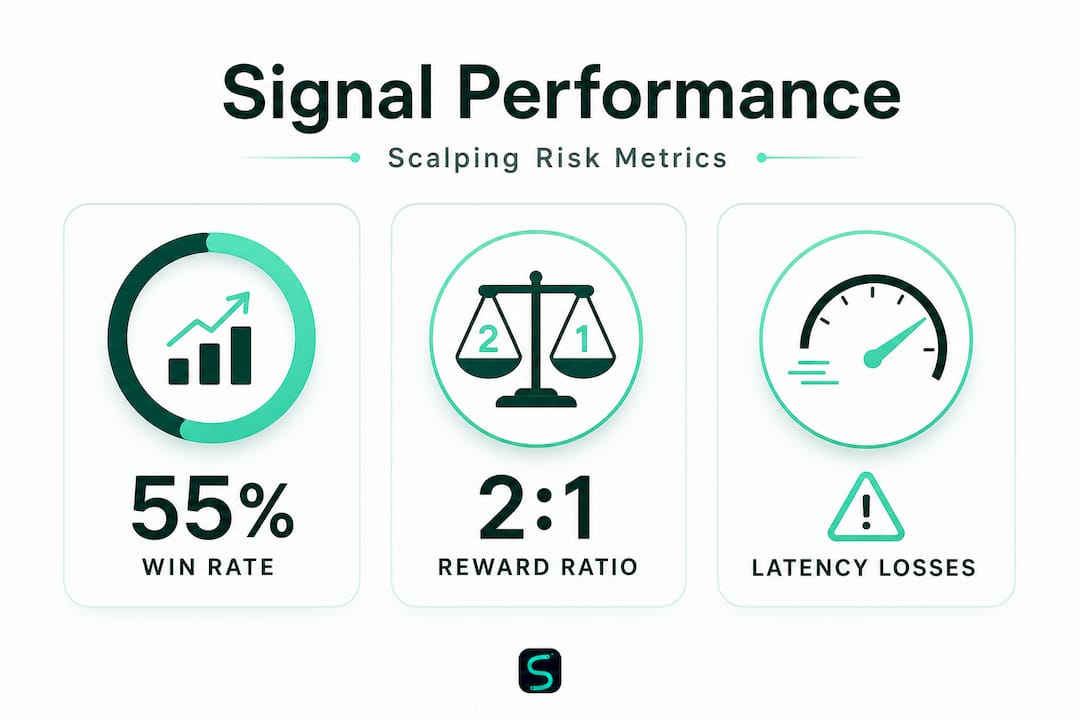
Latency kills scalps, unverified providers overhype win rates, and failing to align signals with the broader trend creates consistent losing setups. These three risks are manageable if you build verification into your routine.
For specific instruments like Nasdaq futures or SPY options, signal performance can vary significantly based on session timing and liquidity windows. Always backtest or paper trade signals on the specific instrument and session you intend to trade, not just on the provider's generic track record.
Understanding the full risks of scalping helps put signal performance in context. Even a 55% win rate with a 2:1 reward-to-risk ratio is highly profitable over hundreds of trades. The goal isn't perfection; it's consistent edge with controlled drawdown.
Why smart traders question every signal
Here's the honest truth: most beginners treat signals like instructions from a higher authority. They see a buy alert, and they buy. No question, no confirmation, no context. This is where most accounts get damaged.
Experienced traders treat signals as a first draft, not a final answer. They use signals to identify a potential setup, then apply their own filters before committing. That discipline is what separates traders who last from those who blow accounts in the first three months.
Blind trust in any provider, no matter how polished the dashboard looks, leads to costly mistakes. Providers face risks like latency and overhyped win rates that traders absorb when they stop thinking critically. Aligning signals with the broader market trend isn't optional; it's the baseline requirement for not getting trapped in a countertrend move that wipes out 10 small wins in a single trade.
The real edge in scalping comes from building your own judgment layer on top of any tool. Use the scalping algo tools that give you transparent, non-repainting signals. Learn what conditions produce strong signals versus weak ones on your specific asset and session. Then you're no longer dependent on a provider's track record; you're developing your own.
That's the standard we hold ourselves to. Tools should make you faster and more precise, not replace your ability to read the market. The traders who thrive are the ones who question every input, test rigorously, and adapt when conditions change. That mindset, combined with high-quality signal tools, is a genuinely durable edge.
Find your edge with advanced scalping signal tools
Ready to move from theory to live execution? The gap between knowing how signals work and consistently profiting from them comes down to using tools built specifically for scalpers, not repurposed swing trading indicators.
At Scalping-Algo, we built our premium scalping indicators from the ground up for low-timeframe trading across crypto, forex, indices, and commodities. Every signal is non-repainting and generated in real time via Pine Script v6 on TradingView. The Algo Master indicator suite includes confluence tools, volatility gating, divergence detection, and native webhook alerts straight to Discord for immediate execution. Transparency is built in with open-source scripts and clear scalping risk disclosure so you know exactly what you're trading with. Explore the suite and take your scalping precision to the next level.
Frequently asked questions
What makes a trading signal "real-time"?
A real-time trading signal is generated and delivered instantly using live price feeds and rapid technical or AI analysis, allowing for immediate trade decisions without delay.
How do I avoid scam signal providers?
Always verify provider claims with tools like MyFXBook and look for independently audited P&L; providers claiming 70 to 85% win rates require strong public proof before you trust them with capital.
What platforms are best for real-time scalping signals?
Most serious scalpers use TradingView, MetaTrader, or proprietary dashboards that support fast execution, multi-indicator plugins, and 1-minute chart mechanics like EMA, RSI, and Bollinger Bands.
What win rate should I expect from real-time scalping signals?
Backtests on reliable scalping strategies show win rates between 42% and 55%; any claimed rate above 70% requires independently verified trade history before you rely on it.
What are the top risks with real-time signals for scalping?
Latency, false signals, and ignoring overall trend direction are the three biggest threats to consistent scalping results, and all three are manageable with the right tools and discipline.