

Manual scalping in fast-moving markets is brutal. You watch price dart through your target level in 200 milliseconds, your finger barely lifting from the mouse, and the opportunity is already gone. Retail scalpers face an almost impossible task: compete against institutional desks, high-frequency systems, and automated algorithms that execute without hesitation, emotion, or fatigue. Algorithmic trading changes that equation by putting rule-based automation in your hands. This article covers the five most important advantages algo trading delivers for scalpers, the real risks you must manage, and a proven process for keeping your strategy sharp over time.
Table of Contents
- 1. Boosting speed and order execution accuracy
- 2. Enhancing liquidity and market access
- 3. Reducing volatility and exposure to market swings
- 4. Risks and system-level trade-offs
- 5. Validating and adapting your scalping algorithm
- Why execution speed alone isn't the full story for scalpers
- Enhance your scalping with premium algo tools
- Frequently asked questions
Key Takeaways
| Point | Details |
|---|---|
| Execution speed advantage | Algorithmic trading achieves faster, more consistent order execution than manual scalping. |
| Liquidity improvements | Algorithms narrow bid-ask spreads and increase fill quality for retail traders. |
| Risk mitigation | Algorithmic trading can reduce volatility and emotional errors, but requires careful strategy adaptation. |
| Systemic risks | Crowding and synchronized algorithms may amplify systemic risks during market stress. |
| Empirical validation | Out-of-sample testing and regime awareness keep your scalping algo robust and profitable. |
1. Boosting speed and order execution accuracy
Having set the stage for automation, let's explore the specific trading advantages algorithmic systems deliver.
Speed in scalping is not just convenient. It is the entire strategy. A 1-minute candle gives you 60 seconds to identify a setup, confirm entry conditions, size the position, and submit the order. Manual traders routinely miss the first 10 to 20 seconds processing the signal. An algorithm fires the order the instant all conditions are met, with no hesitation, no second-guessing, and no fat-finger risk.
Algorithmic trading improves execution speed and consistency for short-term strategies by automating rule-based entries and exits and removing the human reaction delays that bleed edge from every trade. That is not a minor efficiency gain. On a scalping timeframe, a 500-millisecond delay can mean paying 3 to 5 ticks more than the intended price, which, across 50 trades per session, compounds into a serious drag on profitability.
Here are the core execution advantages an algorithm delivers:
- Instant order routing: Orders submit at signal confirmation, not after the trader processes what they saw
- Precise stop and target placement: Bracket orders execute simultaneously, removing the risk of being caught without a stop
- Multi-symbol management: One algorithm can monitor 10 instruments at the same time without cognitive overload
- Consistent position sizing: No emotional oversizing after a winning streak or undersizing after a loss
Using a purpose-built intraday trading indicator that feeds clean signals into your automation layer means you are not relying on discretion during the trade. The rules are pre-coded, and the emotion stays out of the equation.
"The biggest edge an algorithm gives a retail scalper is not raw speed, it is consistency. Human traders have good days and bad days. The algorithm executes the same way at 9:32 a.m. and 3:45 p.m." — Core principle behind automated scalping systems
Coupling a reliable trading signal service with automated execution also eliminates the most common manual errors: entering in the wrong direction, forgetting to place the stop, and closing a winner too early out of fear. These are not rare mistakes. They happen to experienced traders every single week, and each one chips away at expected value.
Pro Tip: Before going live with automation, backtest your scalping strategy playbook on at least 500 trades across different sessions. Speed gains only help if the underlying signal has a positive expectancy.
2. Enhancing liquidity and market access
Speed and accuracy are foundational, but market quality matters as much for reliable execution.
One underappreciated benefit of algorithmic trading is its effect on the broader market environment retail scalpers operate in. When algorithms participate widely, bid-ask spreads tend to tighten. That directly benefits your fills even if you are not running a high-frequency system yourself.

Algorithmic traders narrow bid-ask spreads relative to retail-only markets, improving the liquidity environment for all participants. In practical terms, a tighter spread means you pay less to enter and exit every trade. On high-volume instruments like ES futures or EUR/USD, this can translate to measurable improvement in your net profit per trade.
| Market condition | Manual retail trader | Algo-enhanced market |
|---|---|---|
| Bid-ask spread (typical) | 2 to 3 ticks | 1 tick |
| Fill slippage (per trade) | 1 to 2 ticks | 0 to 0.5 ticks |
| Order cancellation frequency | Infrequent | Constant, dynamic |
| Market depth visibility | Moderate | High, but fluctuates |
| Effective fill cost | Higher | Lower |
The table above reflects the real-world difference between trading in a market with robust algorithmic participation versus one dominated by slow manual order flow. Lower effective fill costs compound significantly over hundreds of trades.
Key liquidity benefits for scalpers operating in algo-active markets:
- Tighter spreads mean your breakeven point on each trade is lower, requiring less price movement to profit
- Better depth gives you more confidence that your order will fill at or near the quoted price
- Reduced slippage protects your edge on strategies that depend on precise entry and exit levels
- More efficient price discovery means prices react to real information faster, reducing false moves
The edge finder indicator is specifically designed to identify moments when liquidity conditions are favorable for entry, helping you avoid trading into thin order books where slippage destroys the setup.
Liquidity depth fluctuates constantly. Order books thin dramatically in the minutes around news releases, at market open, and during lunch sessions. Algorithms respond to these conditions dynamically. Retail scalpers who ignore this dynamic trade into bad fills repeatedly without understanding why their results are inconsistent.
3. Reducing volatility and exposure to market swings
Liquidity and improved fills naturally lead to reduced volatility. Let's break down how this helps scalpers.
Intraday volatility is the scalper's double-edged sword. Enough volatility creates opportunity. Too much volatility destroys setups, triggers stops unnecessarily, and introduces the kind of chaotic price action that makes any edge nearly impossible to realize consistently.
Algorithmic trading reduces price volatility through mechanisms that operate through sentiment and order-book behavior, not just raw liquidity provision. When algorithms absorb order flow efficiently and cancel or replace orders faster than humans can, price moves become smoother and more mean-reverting on shorter timeframes. That is a direct structural advantage for scalping strategies built around small, repeatable moves.
Here is how reduced volatility benefits a scalping system specifically:
- Tighter stop losses: Cleaner price action lets you place stops closer to entry without getting shaken out
- More consistent setup formation: Patterns like breakouts and pullbacks form more reliably when noise is reduced
- Better reward-to-risk ratios: A calmer market allows you to target 2:1 or 3:1 reward-to-risk without needing massive moves
- Lower psychological pressure: Watching wild swings is mentally exhausting and leads to poor decisions mid-trade
"Volatility is not your enemy. Unpredictable, structureless volatility is your enemy. Algorithmic order flow tends to create more structured volatility, which is exactly what a systematic scalper wants." — Scalping-Algo research team
The combination of a precise scalping indicator for TradingView with an understanding of when algorithmic order flow is dominant gives you a significant structural advantage. You are no longer fighting random noise. You are reading structured flow and positioning accordingly.
Choosing the best indicator for scalping matters here because not every tool is calibrated for the volatility conditions that algorithms create. Indicators designed for slower, manual-trading eras often generate false signals in modern, algo-driven markets.
4. Risks and system-level trade-offs
Understanding benefits is essential, but it is just as important to recognize and manage potential risks.
Algorithmic trading is not a guaranteed edge machine. The same systems that provide liquidity and dampen volatility during normal conditions can behave very differently during market stress. This is where retail scalpers get caught off guard.
Algorithms may amplify risk under stress through crowded positions and synchronized behavior. When hundreds of algorithms running similar logic simultaneously detect the same risk signal, they all try to exit at the same time. That creates a feedback loop of selling that can accelerate price moves far beyond what fundamentals justify. The 2010 Flash Crash remains the most cited example, but smaller version events happen regularly in individual instruments.
Key risks every algorithmic scalper must manage:
- Strategy crowding: If your logic is common (RSI crossovers, simple moving average touches), you are likely trading alongside thousands of similar algorithms. Edge decays fast in crowded strategies.
- Regime shifts: A strategy that prints consistent results in a trending market can fail completely during a ranging or high-volatility regime. No algorithm is immune to regime change.
- Tail risk events: Black swan events, central bank surprises, and geopolitical shocks can trigger stop cascades that no historical backtest captures adequately.
- Over-optimization: Fitting parameters too tightly to historical data creates strategies that look great in backtests and fail in live trading.
- Execution failures: API disconnections, broker outages, and latency spikes can cause an algorithm to miss exits, resulting in losses that the backtest never modeled.
| Risk type | Manual trader | Algorithmic scalper |
|---|---|---|
| Emotional trading errors | High | Eliminated |
| Strategy crowding | Low | High if logic is generic |
| Regime adaptability | Moderate (intuitive) | Low (requires recoding) |
| Tail risk exposure | High | High, potentially amplified |
| Execution consistency | Variable | High under normal conditions |
Reviewing scalping algo vs Swift algo performance profiles shows how different algorithmic architectures handle these risks. Not all automated systems are built the same, and choosing architecture that includes volatility gating and regime detection dramatically reduces exposure to the worst-case scenarios.
Pro Tip: Always run your algorithm with a hard daily loss limit. If the system hits that limit, it shuts down for the session. This single rule prevents the kind of runaway losses that happen when an algorithm keeps trading through an unusual market regime.
5. Validating and adapting your scalping algorithm
Before applying these benefits, let's discuss how to ensure your algorithm delivers reliable performance over time.
Building or selecting a scalping algorithm is step one. Keeping it effective is the ongoing work that separates profitable automated traders from those who burn through accounts chasing past performance.
Here is a structured validation process designed specifically for scalping algorithms:
- In-sample backtest: Run the algorithm on historical data to verify the logic produces positive expectancy. Use at least 12 months of data covering different market conditions.
- Out-of-sample test: Reserve 20 to 30 percent of your historical data and test the strategy on data it has never seen. If performance degrades significantly, the strategy is over-optimized.
- Walk-forward analysis: Divide the historical data into rolling windows, optimize on each window, and test on the next period. This simulates how the algorithm would adapt over time and catches strategies that only work in specific conditions.
- Paper trading validation: Before committing real capital, run the algorithm in a paper trading environment for 2 to 4 weeks. This catches execution issues, API problems, and live market behaviors not present in backtests.
- Ongoing regime monitoring: Track performance metrics weekly. If the win rate or average profit per trade drops by more than 15 percent from historical averages, investigate whether a regime shift has made the strategy less effective.
Edge decay is real and often ignored. A strategy that generates 60 percent win rates in one market environment may drop to 48 percent in another. The algorithm does not know the market changed. You must build the awareness into your monitoring process.
Using a structured day trading indicator with built-in volatility filtering gives you an important layer of regime awareness. When volatility expands beyond normal parameters, the indicator suppresses signals rather than generating setups that are unlikely to work in those conditions.
Pro Tip: Track your algorithm's performance by session and by day of week. Many scalping systems perform well on Tuesday through Thursday but struggle on Mondays and Fridays due to different liquidity profiles. Filtering by session can dramatically improve overall results without changing a single line of core logic.
Why execution speed alone isn't the full story for scalpers
Most retail traders discover algorithmic trading and immediately fixate on one thing: how fast can it execute? Speed becomes the obsession, the primary selling point, the benchmark by which every system is judged.
Here is the uncomfortable truth: execution speed is the floor, not the ceiling. Every credible automated system executes faster than any human. Speed is table stakes. What separates consistently profitable algorithmic scalpers from those who burn through accounts is everything that comes after the order fires.
Market adaptability is the real differentiator. An algorithm that fires in 5 milliseconds but is running a strategy that no longer fits current market structure will lose faster than a manual trader with decent intuition. The best-performing scalping systems we have observed maintain a feedback loop between live performance data and strategy parameters. They are not static. They evolve.
Liquidity dynamics are the second ignored factor. Most retail algo traders look at price charts and indicators. Very few look at how order book depth changes throughout the session, how spread behavior signals institutional activity, or how volume clusters indicate smart money positioning. Understanding the intraday market structure beneath the surface of price action is what allows top scalpers to position before the move, not react after it.
Finally, empirical validation separates serious algo traders from hobbyists. It is tempting to run a 6-month backtest, see a nice equity curve, and deploy capital. But out-of-sample performance, walk-forward robustness, and regime sensitivity testing are the only honest ways to know whether your edge is real or a statistical artifact. Traders who skip this step almost always find out the hard way.
Enhance your scalping with premium algo tools
Reading about algorithmic advantages is valuable. Putting them into practice with institutional-grade tools is where real results come from.
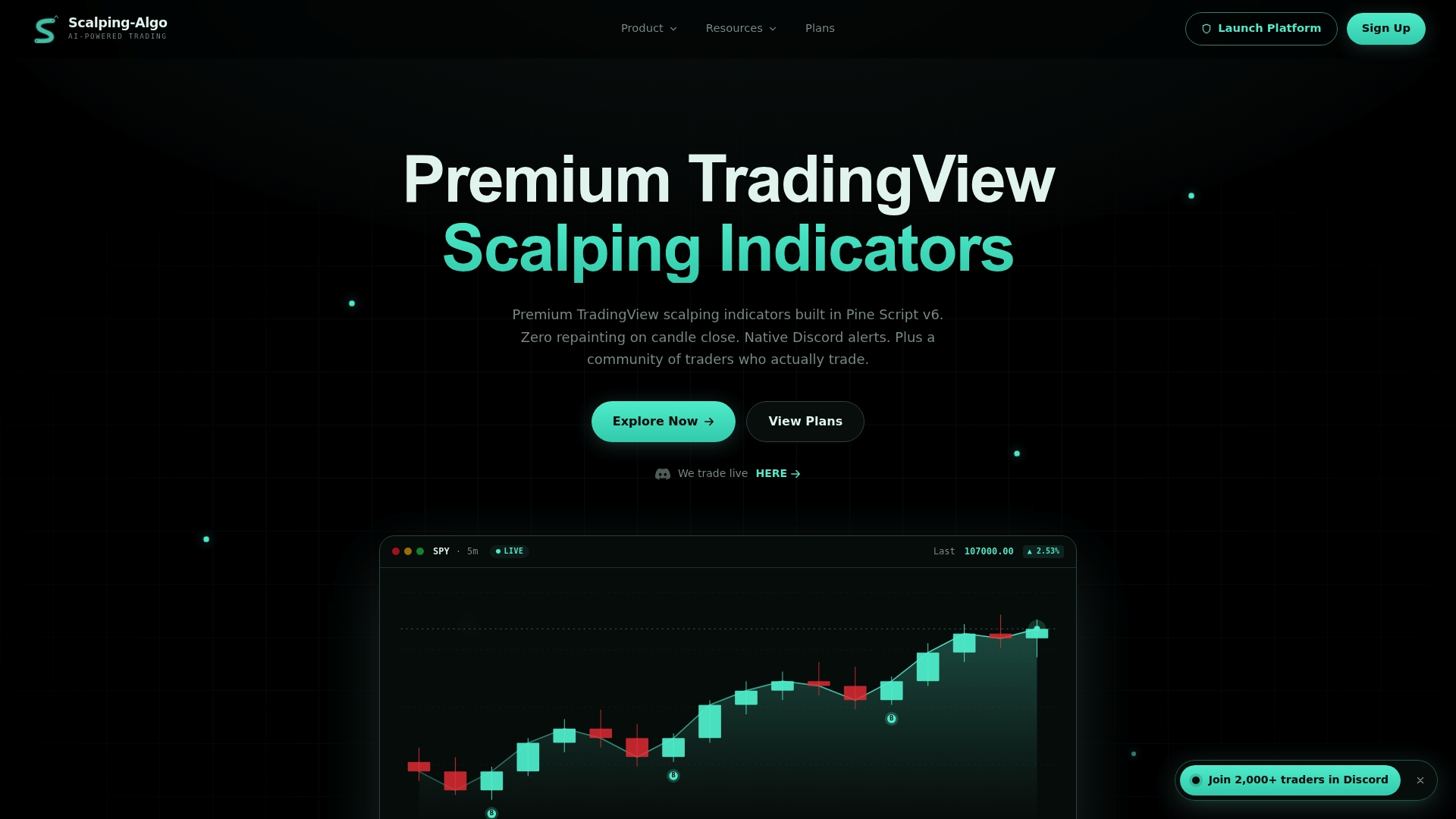
Scalping-Algo builds exactly the kind of adaptive, validated tools this article describes. The Algo Master suite integrates confluence signals, volatility gating, and non-repainting real-time alerts optimized for 1-minute through 15-minute timeframes. The Edge Finder indicator identifies high-probability liquidity windows so you are trading when conditions favor your strategy, not against them. And Smart Scalping Signals delivers precise buy and sell signals with built-in regime awareness, native Discord webhook alerts, and open-source Pine Script v6 code you can inspect and trust. These are not black boxes. They are transparent, tested tools built for serious scalpers.
Frequently asked questions
Does algorithmic trading work for 1-minute scalping strategies?
Yes, algorithmic trading is highly effective for 1-minute scalping because it automates entries and exits with millisecond precision, and automated rule-based entries eliminate the manual reaction delays that cost scalpers edge on the fastest timeframes.
How do algorithms impact bid-ask spreads for retail traders?
Empirical studies show that algorithms narrow bid-ask spreads relative to retail-only markets, giving individual scalpers better fill prices and lower effective transaction costs on every trade.
Can algorithmic trading reduce trading risks in volatile markets?
Algorithmic strategies can lower intraday volatility and reduce the impact of emotional trading because sentiment and order-book effects from automated systems tend to smooth price action and create more structured setups for systematic scalpers.
What is the main risk of algorithmic trading for retail scalpers?
Crowded algorithms can dramatically increase systemic risk during market stress because synchronized algorithmic behavior amplifies price swings and tail-risk contagion when multiple systems exit similar positions simultaneously.
How can scalping algorithms stay effective over time?
Continual validation through out-of-sample testing, walk-forward analysis, and active regime monitoring helps maintain performance as market conditions shift, preventing edge decay from silently destroying a previously profitable strategy.