
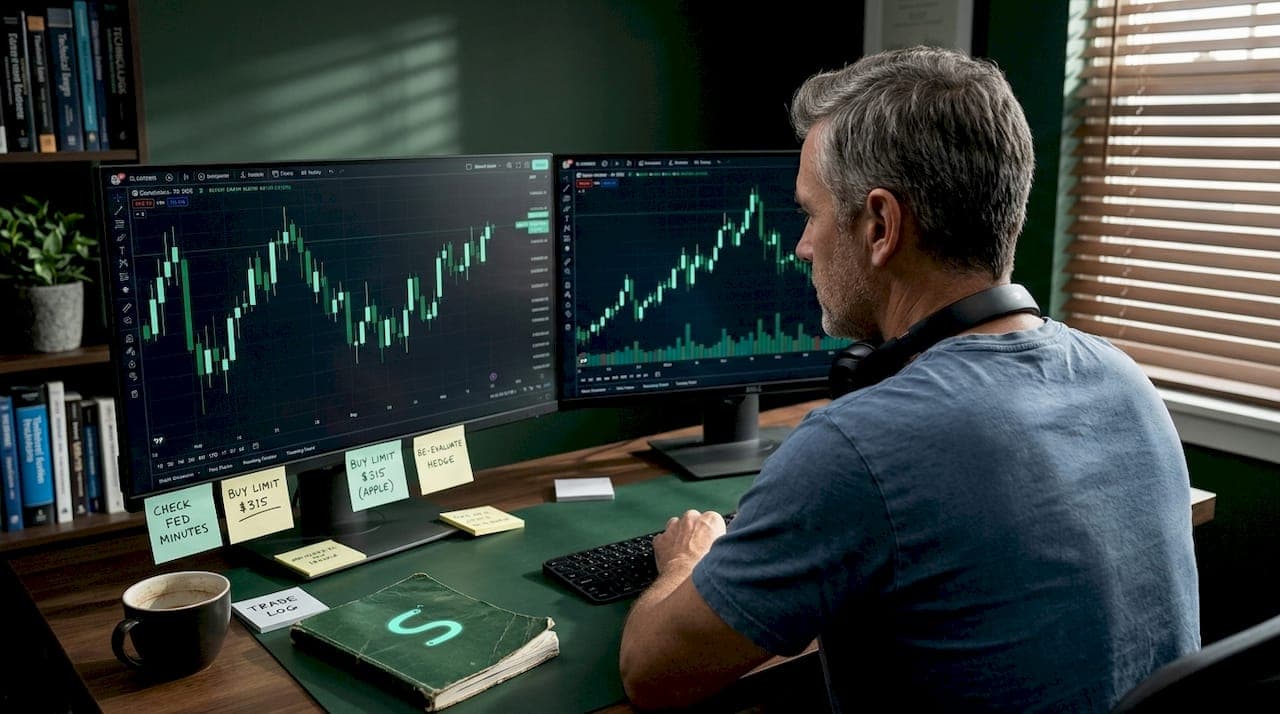
Scalping is not gambling dressed up in charts. Most traders who blow their accounts in the first three months aren't unlucky. They're under-prepared. They jump into one-minute BTC/USDT charts or EUR/USD price action with zero structured education, outdated strategies, and no real toolset to back their decisions. The traders who consistently extract profits from short-term markets do it through deliberate study, tested frameworks, and precision tools. This guide breaks down exactly where to build that edge: the best learning platforms, the strategies that actually work in fast markets, the automation tools that give you institutional-grade execution, and how to build a 30-day learning roadmap you can start today.
Table of Contents
- Core educational resources for scalpers
- Essential scalping strategies explained
- Advanced trading tools and algorithmic resources
- Building your own learning roadmap
- Why elite scalpers never stop learning
- Get more out of your trading journey
- Frequently asked questions
Key Takeaways
| Point | Details |
|---|---|
| Pro-grade education matters | The best scalping traders invest in structured courses and interactive resources for lasting results. |
| Tactical edge requires tools | Advanced indicators and automation boost consistency and manage execution risks in fast markets. |
| Learning is ongoing | Continuous review, adaptation, and hands-on practice are essential for sustained scalping success. |
| Free platforms lower barriers | Free educational academies and demo tools let beginners develop core skills without large investments. |
Core educational resources for scalpers
Whether you're refining your crypto scalping game or just beginning to study forex short-term setups, the platform you learn from matters as much as the content itself. Not all trading education is created equal. Some platforms are built for buy-and-hold investors, not short-timeframe traders who need to understand tick structure, spread management, and momentum reading at the one-minute level.
Paid platforms worth your investment:
Coursera trading courses include structured options like "Practical Guide to Trading" and "Forex: Trading Around the World" by Interactive Brokers. These courses focus on real financial trading mechanics, risk analysis, and forex market structure. They're especially relevant for scalpers because they address position sizing, leverage risk, and execution logic with depth you won't find in a YouTube video. Paid courses on Coursera also include graded assessments and peer-reviewed projects, which force you to actively apply what you're learning rather than passively consuming it.
Investopedia Academy is another paid option that covers technical analysis comprehensively. It works well as a foundation builder before you specialize in short-timeframe scalping setups.
Free platforms that deliver real value:
BitMart Academy recently launched its free financial literacy platform (learnwithbitto.com), targeting crypto traders directly. It covers digital assets, blockchain fundamentals, risk management, and active trading skills including short-term strategies. For anyone focused on crypto scalping, this is a zero-cost starting point with targeted content.
Binance Academy fills a similar role, with free articles, videos, and quizzes organized by skill level. It's particularly strong on crypto-native concepts like on-chain mechanics, liquidity, and exchange-specific execution details that matter when you're scalping with sub-minute holds.
| Platform | Cost | Best for | Content format |
|---|---|---|---|
| Coursera | Paid (audit free) | Forex fundamentals, risk analysis | Video + assignments |
| BitMart Academy | Free | Crypto scalping, digital assets | Articles + modules |
| Binance Academy | Free | Crypto concepts, market structure | Articles + quizzes |
| Investopedia Academy | Paid | Technical analysis, indicators | Video + testing |
How to match resources to your skill level:
Beginners should start with free platforms like BitMart Academy or Binance Academy to build foundational knowledge before spending money on advanced content. Intermediate traders benefit from structured paid courses that include market simulations. Advanced scalpers often get more value from community-based learning, live trading sessions, and real-time backtesting feedback. Before investing in any premium resource, cross-reference it with what you actually need to improve by reviewing your trade journal.
Also dig into a solid scalping strategy playbook as early as possible. Understanding the strategies before you learn the tools prevents the common mistake of buying indicators you don't know how to use.
Pro Tip: Prioritize platforms that include interactive market simulations or live case studies. Reading about RSI divergence is one thing. Watching it play out on a real tick chart and having to make a decision in real time is where retention actually happens.
Essential scalping strategies explained
Knowing where to learn is only half the equation. You also need to know what to learn. The scalping strategies that consistently appear in successful traders' arsenals are not secret. They're well-documented, technically sound, and built on repeatable logic.
Investopedia scalping strategies outlines three core approaches used across forex and crypto markets:
1. Moving Average Ribbon This strategy uses a 5, 8, and 13-period Simple Moving Average (SMA) combination on a 2-minute chart. When all three SMAs align in the same direction and price stays above (for longs) or below (for shorts) the ribbon, it signals trend momentum. Scalpers use the ribbon expansion to enter and ribbon compression or crossover as an exit trigger. It works best in trending markets with clear directional bias, like major forex pairs during the London or New York session.

2. Relative Strength Exit with Stochastics and Bollinger Bands Here, Bollinger Bands define the volatility range while Stochastics (14,3,3) identify overbought or oversold conditions. Traders enter when price touches the outer band and Stochastics confirms a reversal signal, then exit when the indicator crosses back to neutral. This strategy performs well in ranging markets or during consolidation phases in BTC/USDT.
3. RSI and MACD momentum scalping Using the RSI (14) and MACD (12,26,9) together on 1 to 5-minute charts creates strong signal confirmation. The RSI identifies whether momentum is building or fading, while MACD crossovers provide a more specific entry trigger. Divergence between price and RSI is particularly powerful. If you want to go deeper on execution, the intraday indicator guide covers real chart setups using these combinations.
For a broader comparison of tools built around these strategies, the best TradingView scalping indicators article walks through which setups integrate best on the platform most scalpers already use.
Executing a scalp trade step by step:
- Confirm the higher-timeframe trend direction (5m or 15m chart)
- Drop to your execution timeframe (1m or 2m)
- Wait for a pullback to a key level or indicator signal
- Confirm with a second indicator (e.g., MACD cross + RSI below 40 for a long)
- Enter with a pre-defined stop loss (typically 5 to 15 pips or 0.1 to 0.3% below entry)
- Set a realistic target based on recent support/resistance or ATR
- Exit fully or partially at target. Never widen the stop.
The scalping basics on Binance Academy reinforce a critical point about crypto scalping: the 24/7 nature of these markets means volatility spikes at unexpected hours, so your strategy must include time-of-day filters to avoid low-liquidity traps.
Pro Tip: Combining two or three signals builds filter strength and reduces false entries. But there's a limit. Adding more indicators beyond what your strategy requires usually leads to overfitting, where a setup looks perfect on historical data but falls apart in live conditions.
Advanced trading tools and algorithmic resources
Once you understand the strategies, the next frontier is execution quality. A great setup called on a slow platform with manual order entry is a setup half-wasted. Speed, precision, and emotional consistency are where advanced tools pay dividends.
Modern scalpers need more than charts. According to Investopedia's execution benchmarks, effective scalping requires high-liquidity pairs like EUR/USD and BTC/USDT, spreads under 0.5 pips, and execution speeds under 100 milliseconds. News events and low-liquidity windows are the primary causes of slippage. Avoiding them is a tactical decision, not a lucky one.
"Automation via Expert Advisors (EAs) and AI-powered signal generators doesn't just speed up execution. It removes the single biggest variable in scalping: the human trader's emotional state at the moment of decision."
What automation actually solves:
Manual trading under pressure creates a predictable set of problems. You hesitate on entries because you're second-guessing the signal. You move stop losses because the loss feels too real. You overtrade after a loss to chase recovery. These aren't character flaws. They're cognitive patterns that emerge under financial pressure, and automation systematically removes them from your execution process.
Expert Advisors (EAs) in MetaTrader, Pine Script alert systems in TradingView, and AI-generated signal suites all serve different parts of this problem. EAs automate the full trade cycle. Pine Script alerts notify you without forcing you to stare at screens. Signal generators give you external confirmation to reduce second-guessing.
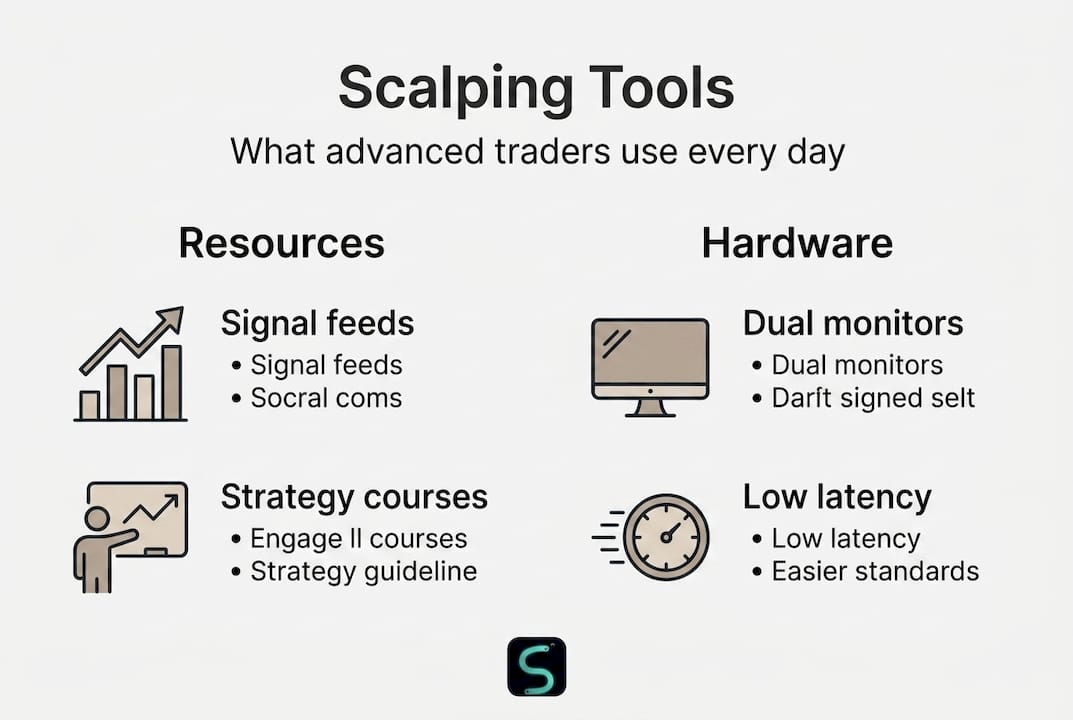
Most-used tools among advanced scalpers:
- Non-repainting signal indicators (critical for honest backtesting)
- Divergence detection overlays (RSI, MACD, OBV)
- Volatility gating tools (filters out low-volatility entries)
- Confluence dashboards (combine multiple signals into a single score)
- Native webhook alerts (send signals directly to Discord or execution platforms)
- Automated backtesting suites with realistic slippage modeling
The best buy/sell signal indicators article covers what separates reliable signal tools from the repainting garbage that looks good in hindsight but fails in live trading. For pure one-minute execution setups, the 1-minute scalping indicator breakdown is worth studying carefully before committing to any tool.
Hardware matters too. Dual monitor setups, a fast internet connection with under 20ms latency to your broker's server, and a dedicated trading machine (not your everyday laptop) all contribute to real execution quality.
Building your own learning roadmap
Strategy knowledge and tools only produce results when applied consistently within a structured learning framework. Most traders have too much information and not enough discipline in how they use it. A 30-day scalping skill sprint solves that by forcing sequential, milestone-based progress.
Your 30-day scalping skill sprint:
-
Week 1: Foundations. Complete at least one structured module on Binance Academy or BitMart Academy's free platform. Focus on market structure, liquidity basics, and risk-to-reward ratios. No live trading yet.
-
Week 2: Strategy selection. Pick one of the three scalping strategies covered earlier. Study its mechanics in depth. Pull up 50 historical chart examples and identify where the setup triggered. Note what worked and what didn't.
-
Week 3: Indicator integration. Add one or two indicators to your setup. Practice reading momentum oscillator signals in demo mode. Execute a minimum of 30 demo trades using your selected strategy with strict entry and exit rules.
-
Week 4: Review and refine. Analyze every demo trade in a journal. Calculate your win rate, average risk-to-reward, and identify your most common mistake. Use the edge finder indicator to assess where your setups are strongest.
Milestone tracking that actually works:
Set measurable goals at each stage. Not "trade better" but "achieve a 55% win rate on demo trades with an average 1.5R reward." Specific targets force honest evaluation. Use a spreadsheet to log every trade: entry reason, exit reason, outcome, and one lesson learned.
Mistake journals are underrated. When you record not just what went wrong but why you made the decision, patterns emerge. Maybe you consistently overtrade between 2 PM and 4 PM EST. Maybe you always cut winners early on Fridays. That granular self-knowledge is the actual edge most traders never develop because they never bother to look.
Pro Tip: Use free platforms for your foundational learning phase. Once you've validated your strategy on demo and understand what signals you're looking for, then invest in advanced indicators and live testing tools. Buying premium tools before you understand your own strategy is like buying a racing car before you've learned to drive.
Why elite scalpers never stop learning
Here's a view most trading education content won't tell you: the resource isn't the edge. You are. Courses, indicators, and platforms are inputs. What you do with them over time determines whether you build a durable trading career or just cycle through setups until your account runs dry.
The traders we see consistently performing across both crypto and forex markets share one characteristic that has nothing to do with their tools. They're relentlessly self-critical. They don't treat a losing week as bad luck. They treat it as data. They adapt their strategies as market conditions shift, because yesterday's high-probability setup can become tomorrow's false signal trap when volatility regimes change.
Markets evolve. In 2021, momentum strategies worked brilliantly in crypto because trend continuations were strong and prolonged. In a choppy, low-volatility environment, those same setups produce endless whipsaws. The scalpers who thrived through both conditions were those who tracked their performance, noticed the degradation, and adjusted before it cost them. Staying connected to fresh expert trading insights isn't about chasing new ideas. It's about maintaining awareness of what's changing in market behavior so your strategies stay calibrated.
The real lesson is this: education is not a phase you complete. It's a practice you maintain. That's what separates traders who scale up from those who plateau.
Get more out of your trading journey
To put your education into action, discover tools designed for traders who want to excel at scalping.
Reading about strategies is only the beginning. The real test is applying them in live markets with tools that match your execution speed and signal quality needs. At Scalping-Algo, every indicator is built in Pine Script v6 with non-repainting logic, real-time alerts, and volatility gating baked in so your setups don't fire in the wrong conditions.
If you're ready to systematize your edge, the Algo Master suite integrates signal generation, backtesting, and a full alert system into one dashboard. For traders who want to start with specific tools, browse the full library of premium scalping indicators built to perform across crypto, forex, indices, and futures on the timeframes that matter most to scalpers: 1m through 15m.
Frequently asked questions
What are the top free educational platforms for crypto scalping?
BitMart Academy and Binance Academy both offer free, beginner-to-advanced resources specifically focused on digital asset and crypto scalping, including risk management and short-term strategy fundamentals.
Which scalping strategy works best for forex traders?
The Moving Average Ribbon and RSI/MACD momentum strategies are consistently popular among forex scalpers for their reliability in highly liquid pairs like EUR/USD during active sessions.
How does automation help short-term traders?
Automation removes emotional decision-making, enforces your pre-set rules at execution speed, and reduces slippage from hesitation, all of which compound into more consistent results over large sample sizes of trades.
Can you learn to scalp profitably without expensive tools?
Yes. Many traders build solid foundations using free platforms like BitMart Academy before investing in premium indicators, but long-term profitability still requires continuous learning, honest journaling, and gradual tool integration as your strategy matures.