

Most scalpers have been there: a signal fires, you enter the trade, and price immediately reverses. The buy signal looked perfect on paper, yet the position bleeds red within seconds. That frustration usually comes from a fundamental misunderstanding, treating a buy signal as a guarantee rather than a probability cue. Scalping crypto and forex compounds this problem because lower timeframes are noisier, faster, and far less forgiving than higher timeframe swing trades. This guide cuts through the confusion by clarifying what buy signals actually are, which indicators generate them, where they break down, and how to build a confirmation process that holds up under real market conditions.
Table of Contents
- Defining buy signals in technical trading
- Core indicators: EMA, RSI, MACD, and VWAP explained
- Recognizing false signals and edge cases in scalping
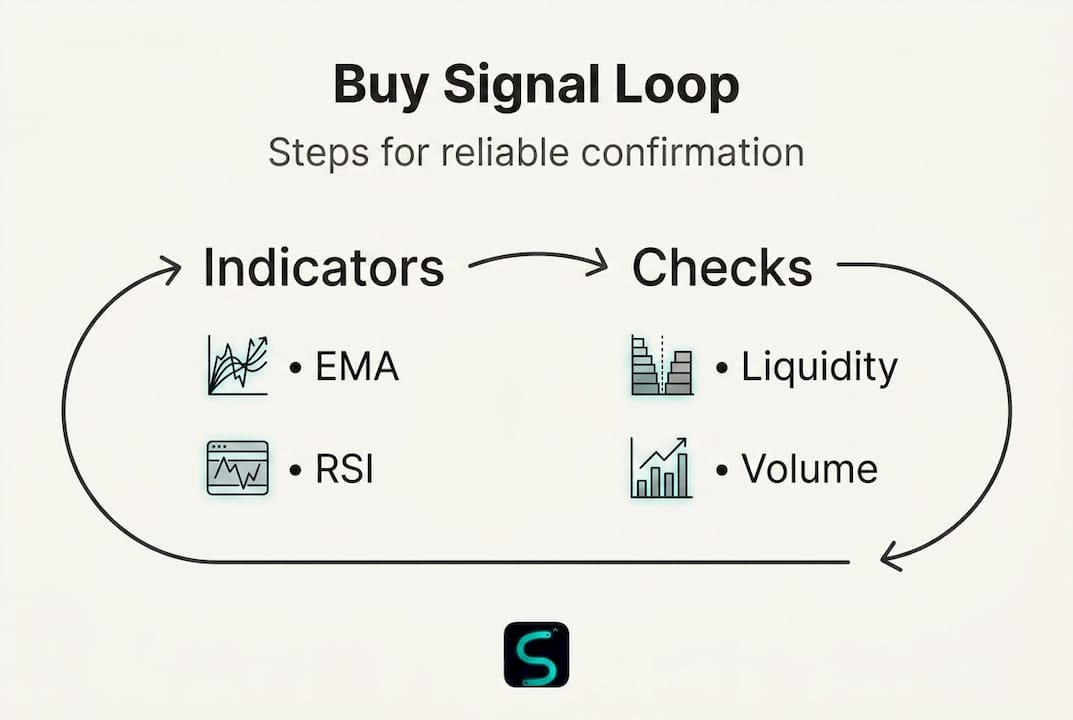
- How to build robust buy signal confirmation loops
- Why discipline—not signals—drives long-term scalping gains
- Scalping smarter: Tools for buy signals and discipline
- Frequently asked questions
Key Takeaways
| Point | Details |
|---|---|
| Buy signals are cues | A buy signal indicates a potential trade entry, not a guaranteed outcome. |
| Combine indicators | The most robust buy signals in scalping come from combining trend, momentum, and volume tools. |
| Watch for false triggers | False buy signals are common in volatile and illiquid markets; confirm before acting. |
| Discipline beats signal chasing | Consistent results come from strict rules and managing trades, not relying on signals alone. |
| Crypto and forex differ | Crypto scalping favors breakouts with higher win rates compared to range-bound forex trades. |
Defining buy signals in technical trading
A buy signal is a condition or event from technical analysis indicating a favorable time to buy an asset, expecting price increase. Notice the word "favorable." It does not say certain. It does not say guaranteed. That one distinction separates traders who use signals correctly from those who blow up chasing them.
In practical terms, a buy signal is a moment when one or more technical indicators cross a threshold that historically precedes upward price movement. For scalpers working on 1-minute to 15-minute charts, these moments occur frequently, sometimes dozens of times per session. The challenge is not finding signals. The challenge is filtering which ones are worth acting on.
The most common indicator categories used to generate buy signals include:
- EMA (Exponential Moving Average): Tracks the direction of trend. When price crosses above the EMA or two EMAs cross bullishly, it signals a potential upward move.
- RSI (Relative Strength Index): A momentum oscillator that flags oversold conditions (typically below 30) as potential buy zones.
- MACD (Moving Average Convergence Divergence): Captures momentum shifts by measuring the relationship between two EMAs. A bullish crossover of the MACD line above the signal line is a classic entry cue.
- VWAP (Volume-Weighted Average Price): Measures the average price weighted by volume. Price bouncing off VWAP in a trending session is a high-probability buy zone used heavily by institutional traders.
Signals from these indicators confirm conditions, they do not predict them. A bullish MACD crossover tells you momentum was shifting in the past few bars. Price action must confirm that momentum is still valid before you pull the trigger. Understanding using buy/sell indicators the right way means learning to use them as filters, not forecasts.
Pro Tip: Never treat a single indicator firing as enough justification to enter. Signals stack. When EMA trend, RSI momentum, and VWAP alignment all point in the same direction, the probability of a successful trade rises meaningfully.
Core indicators: EMA, RSI, MACD, and VWAP explained
With the concept of buy signals understood, let's dive into the leading technical tools traders rely on for signal generation.
Each indicator serves a distinct role, and understanding these roles is what separates a disciplined scalper from a random button-pusher. According to best practices in scalping strategy with indicators, combining trend, momentum, and volume tools creates far more robust signals than relying on any single one.
| Indicator | Type | Best for | Weakness |
|---|---|---|---|
| EMA | Trend | Smooth trending markets | Unreliable in choppy conditions |
| RSI | Momentum | Identifying oversold entries | Can stay oversold in strong trends |
| MACD | Momentum/Trend | Crossover signals | Lags in fast-moving markets |
| VWAP | Volume | Intraday session anchoring | Less useful outside market hours |
EMA is the backbone of trend identification for scalpers. It reacts faster than a simple moving average, making it better suited for lower timeframes. However, when price chops sideways, EMAs tangle and produce misleading crossovers that trigger false entries repeatedly.

RSI and MACD both measure momentum but from slightly different angles. RSI compares average gains to average losses over a set period, while MACD subtracts one EMA from another. Together, they can confirm whether a move has real momentum behind it or is just noise.
VWAP is arguably the most underused tool in retail scalping. Because it factors in volume, it reflects where the majority of trading activity occurred. A price bounce off VWAP in a high-liquidity session is far more meaningful than a random EMA touch in a thin market.
A statistic worth noting: crypto breakouts show a 35.6% win rate compared to range-bound forex strategies, suggesting breakout-oriented signal setups carry a slight edge in digital asset markets. Using the right intraday scalping indicators for each asset class matters more than most traders realize.
Prioritizing high-liquidity sessions when combining trend, momentum, and volume indicators produces the most consistent signal quality for scalpers.
Recognizing false signals and edge cases in scalping
As you start using these indicators, it's vital to recognize when buy signals may actually mislead you.
False signals are not rare. They are a permanent feature of scalping. In choppy, low-volume markets, false signals appear frequently through tangled EMAs, broken structure, liquidity sweeps, and whipsaws that stop you out before the intended move develops. Knowing when NOT to trade is just as valuable as knowing when to enter.
Common conditions that produce false buy signals:
- Low volume periods: Thin markets move erratically. Signals generated during low-volume windows lack institutional backing and fail more often.
- Liquidity sweeps: Price briefly spikes below a key level to trigger stop orders, then reverses. On a 1-minute chart, this looks like a signal forming, only for price to rip back the other way immediately.
- Conflicting indicators: When RSI says oversold but price is still below a bearish EMA, the signals are fighting each other. Acting on one while ignoring the other is a recipe for a bad entry.
- News events: Fundamental catalysts override technical setups. A perfectly formed buy signal means nothing the moment a central bank decision hits the wire.
"Scalping offers no holy grail. Discipline matters more than any single setup or indicator stack you can build." — Seasoned scalper, r/Daytrading
| Scenario | False signal frequency | Recommended defense |
|---|---|---|
| Choppy, low-volume session | Very high | Sit out or widen filters |
| Pre-news market | High | Avoid entries within 5 minutes of releases |
| Trending, high-volume session | Low | Use signals with full confirmation loop |
| Post-breakout pullback | Medium | Confirm structure holds before entry |
The best buy/sell signal guide for scalpers is one that teaches you to recognize the context first, then evaluate the signal. Context always wins.
Pro Tip: Before entering any buy signal, ask yourself: "Is this a trending, liquid session?" If the honest answer is no, skip it. Protecting capital in bad conditions is the most underrated scalping skill.
How to build robust buy signal confirmation loops
Learning to filter out false signals is just the beginning; mastering confirmation loops turns raw signals into actionable trades.
A confirmation loop is a personal ruleset that requires multiple conditions to align before you execute. It removes impulsive decisions and replaces them with structured logic. Here is a practical framework:
- Check trend direction with EMA. Is price above or below your primary EMA? Only take buy signals in the direction of the trend.
- Confirm momentum with RSI or MACD. Is RSI rising from an oversold zone? Is MACD crossing bullishly? One confirmation is good, both is better.
- Validate with VWAP. Is price above VWAP or bouncing from it during a high-liquidity window? This adds a volume dimension to your signal.
- Wait for price action confirmation. Did price actually close above a key level? A bullish engulfing candle or break of structure confirms the signal is live.
- Set your risk parameters before entering. Know your stop and target before the order goes in. Never adjust your stop against you after entry.
For crypto traders, breakout-oriented setups with a 35.6% win rate still become profitable with tight risk-to-reward ratios. For forex scalpers, range-bound conditions demand tighter confirmation before acting on any buy signal.
Additional best practices for your confirmation loop:
- Backtest every rule with realistic spread and commission costs included
- Log every trade outcome to track which confirmations add the most edge
- Avoid adding new indicators mid-session; pick your tools before the session starts
Getting trading alerts and entries delivered in real time through tools like Discord webhooks can speed up execution without sacrificing discipline. Pairing that with a reliable algorithmic signal service reduces the cognitive load of managing every confirmation manually.
Pro Tip: Run your confirmation loop for at least 50 trades in a simulator before going live. If it does not show a positive expectancy with realistic costs included, rebuild it before risking real capital.
Why discipline—not signals—drives long-term scalping gains
Here is the uncomfortable truth most trading content avoids: the signal itself is almost never what separates profitable scalpers from losing ones. After extensive testing and community consensus across scalping forums, the consistent finding is that no holy grail exists, and long-term consistent profits from scalping are eroded by costs and noise without iron discipline.
Chasing signals without a systematic framework leads to a predictable outcome. You win a few trades that feel great, then give back the gains on five impulsive entries that did not meet your own rules. The signal quality itself matters far less than how rigidly you follow the process around it.
What experienced scalpers actually do differently is treat signals as permission to evaluate, not permission to enter. A buy signal says "look here." Discipline decides whether the conditions meet the standard you set in advance. Following a strategy playbook built around rules, not instincts, is what creates repeatable results. Adapt quickly when market conditions shift, but never bend your rules mid-trade.
Scalping smarter: Tools for buy signals and discipline
Ready to reinforce your buy signal process with tools built specifically for scalpers? Putting theory into practice is where most traders stall, and that gap is exactly what Scalping-Algo is designed to close.
The Algo Master suite combines multi-indicator confirmation into a single, streamlined TradingView environment, giving you EMA, RSI, MACD, and VWAP signals with volatility gating and real-time alerts. If you want a tool that reads market regime before firing a signal, the Edge Finder indicator adds regime analysis on top of your core setup. Browse the full range of scalping indicators to find the stack that matches your confirmation loop, your asset class, and your timeframe.
Frequently asked questions
What makes a buy signal reliable for scalping?
A buy signal is most reliable when confirmed by multiple indicators and backed by price action and high liquidity conditions. Combining EMA, RSI, MACD, and VWAP across a liquid session dramatically reduces false triggers.
How do I spot false buy signals in crypto or forex?
False buy signals often appear in low-volume markets, during liquidity sweeps, or when indicators conflict with price action. False signals in choppy markets frequently result from tangled EMAs and absence of structural support.
Should I depend on buy signals alone for short-term trading?
No, signals are cues for potential moves, but consistent scalping success depends more on discipline and trade management. Success demands discipline over signals, as the broader trading community consistently confirms.
Are buy signals different for crypto vs. forex?
Yes, crypto favors breakouts with a 35.6% win rate compared to forex, which tends to produce more range-bound conditions where momentum signals behave differently.
What is the best way to use buy/sell signal indicators?
Combine indicators like EMA, RSI, MACD, and VWAP for confirmation and always backtest with realistic costs before going live to minimize noise and validate your edge.