
Live trading sounds simple on the surface: open a position, wait for profit, repeat. But 80-90% of retail day traders lose money over the long term, and that number doesn't budge much regardless of market conditions. The gap between what traders expect and what actually happens in live markets is enormous. This guide cuts through the noise, explains exactly what live trading is, how short-term strategies work in practice, what the data says about risk management, and what tools give you a real edge.
Table of Contents
- Live trading explained: What it is and how it works
- Short-term live trading strategies: Scalping, day, and swing
- Risk management in live trading: Rules, psychology, and benchmarks
- Tools and platforms for live trading: Indicators, automation, and education
- A hard-earned perspective: Why live trading is more about discipline than prediction
- Advanced tools for live trading: Take your next step
- Frequently asked questions
Key Takeaways
| Point | Details |
|---|---|
| Live trading means real risk | Live trading involves executing real-money orders and exposes you to actual market and psychological risks. |
| Success favors discipline | Traders succeed by following strict rules and managing risk, not by relying on prediction alone. |
| Short-term strategies require tight control | Scalping, day, and swing trading demand precise risk management, small risk per trade, and use of stop-losses. |
| Advanced tools boost edge | Using platforms, specialized indicators, and educational support helps traders compete and refine their strategies. |
| Sample size matters most | Tracking at least 100 trades with defined rules gives insight that single trades or small samples cannot. |
Live trading explained: What it is and how it works
Live trading means executing real-money trades in active financial markets. Every position you open carries actual financial risk. Profits and losses are real. That's the fundamental difference between live trading and demo or paper trading, where you simulate trades with no capital at stake.
Demo trading has genuine value for learning platform mechanics and testing strategies. But it removes the psychological weight that defines live trading. Slippage, emotional pressure, and real drawdown don't exist in demo environments. When you move to live markets, those factors hit immediately and they hit hard.
Retail forex and crypto trading involves speculating on currency pairs or cryptocurrencies via online brokers and platforms like MT4 and MT5, without physical ownership, using leverage, market orders, limit orders, and stop orders. You're not buying Bitcoin outright in most cases. You're trading a contract tied to its price movement, often with leverage that amplifies both gains and losses.
The most common platforms for retail live trading are:
- MetaTrader 4 (MT4): Industry standard for forex, highly customizable, vast indicator library
- MetaTrader 5 (MT5): MT4's successor, supports more asset classes including stocks and futures
- TradingView: Browser-based charting platform with Pine Script indicators, widely used for crypto and forex analysis
Leverage is a core feature of live trading. A 10:1 leverage ratio means a $1,000 account controls $10,000 in market exposure. That magnifies profits but equally magnifies losses. A 1% adverse move on a 10:1 leveraged position wipes 10% of your account. Understanding leverage isn't optional. It's foundational.
Order types matter too. Market orders execute immediately at current price. Limit orders fill only at your specified price or better. Stop orders trigger when price hits a level, often used to cut losses automatically. Knowing when to use each order type is part of executing live trades with precision.
Pro Tip: Before going live, spend at least 30 days on demo trading, but treat every demo trade as if real money is on the line. Track your entries, exits, and emotional state. The data you collect will be far more valuable than any theoretical knowledge. For deeper trading education, the Scalping-Algo blog covers practical live trading mechanics across multiple asset classes.
Short-term live trading strategies: Scalping, day, and swing
With the mechanics laid out, let's break down the main short-term strategies that traders apply in live trading and see how each approach is managed for risk.
Short-term trading methodologies include scalping, day trading, and swing trading, each requiring tight risk management of 0.5-2% per trade, stop-losses, and kill-zone sessions such as the London and New York opens. Here's how each method works in practice:
Scalping targets micro-movements in price, typically on 1-minute to 5-minute charts. Traders open and close positions within seconds to minutes, aiming for small gains that compound over many trades. High frequency is the defining feature. A scalper might execute 20 to 50 trades in a single session. Execution speed and tight spreads are critical. Even a few extra pips in spread can eliminate an entire scalping edge.
Day trading involves opening and closing all positions within the same trading session. No overnight exposure. Day traders typically work on 5-minute to 15-minute charts, targeting larger intraday moves than scalpers. The approach requires focused attention during specific market hours and clear rules for when to stop trading.

Swing trading holds positions for hours to a few days, capturing short-term directional moves. Swing traders use 15-minute to 4-hour charts and tolerate wider stop-losses in exchange for larger potential targets. This style suits traders who can't monitor markets all day.
| Strategy | Timeframe | Trade Duration | Risk Per Trade | Frequency |
|---|---|---|---|---|
| Scalping | 1m to 5m | Seconds to minutes | 0.5-1% | 20 to 50+ per session |
| Day trading | 5m to 15m | Minutes to hours | 1-2% | 3 to 10 per session |
| Swing trading | 15m to 4h | Hours to days | 1-2% | 1 to 5 per week |
Risk controls are non-negotiable across all three methods. Here's a practical framework:
- Set a maximum risk per trade before entering any position (0.5-2% of account)
- Place stop-losses at logical market structure levels, not arbitrary pip distances
- Define your kill zone sessions, London open (3-4 AM EST) and New York open (8-9 AM EST) offer the highest volatility and volume
- Set a daily loss limit, typically 3-5% of account, and stop trading when hit
- Track every trade in a journal with entry reason, result, and emotional state
For traders focused on scalping, intraday scalping indicators can significantly sharpen entry timing on lower timeframes. Pairing those with a structured scalping strategy playbook gives you a repeatable process rather than gut-feel decisions. If you're specifically working the 1-minute chart, a dedicated 1-minute scalping indicator built for TradingView removes a lot of the manual analysis burden.
Pro Tip: Kill zones aren't just about volatility. They're about institutional order flow. The London and New York opens are when banks and hedge funds execute large positions, creating the liquidity and directional moves that retail scalpers can ride. Trade outside those windows and you're often fighting low-volume noise.
Risk management in live trading: Rules, psychology, and benchmarks
Understanding the strategies is just step one. Next, let's look at why most traders fail and what evidence-backed risk management looks like in live trading.
The data is stark. Average retail day traders lose approximately 36% annually after fees, with median win rates for systematic forex and crypto strategies sitting at just 32-38% and profit factors around 1.1-1.2. The top 1% of traders achieve roughly 0.4% daily returns consistently. These aren't motivational statistics. They're benchmarks that define what realistic performance looks like.
"Live trading tests psychology more than strategy. 90% of traders fail due to emotions and over-risking, not because their strategy doesn't work. Success comes from mechanical rules, 0.5-1% risk per trade, and minimum 100-trade sample sizes."
That quote captures the core problem. Most traders abandon a perfectly valid strategy after 10 losing trades because they assume the strategy is broken. In reality, a strategy with a 40% win rate will produce strings of 8 to 10 consecutive losses regularly. That's not failure. That's math.
The psychological traps that kill live trading accounts include:
- Revenge trading: Doubling position size after a loss to "make it back fast"
- Overtrading: Taking low-quality setups out of boredom or FOMO
- Moving stop-losses: Widening stops mid-trade because you don't want to accept a loss
- Skipping stops entirely: Holding losing positions hoping they'll reverse
- Inconsistent sizing: Risking 5% on a "sure thing" and 0.5% on a "risky" trade
The best TradingView scalping indicators help remove some of this subjectivity by giving you objective signal criteria. But the indicator doesn't click the button for you. The discipline to follow the signal and honor the stop-loss is entirely on you.
Actionable risk management rules for live trading:
- Risk no more than 1% of total account per trade
- Use a minimum sample size of 100 trades before evaluating any strategy
- Set a hard daily stop loss of 3% and walk away when hit
- Review your trade journal weekly, not daily, to avoid emotional overreaction to short-term results
- Separate your trading account from personal funds to maintain psychological distance
| Metric | Retail Average | Top 10% Traders |
|---|---|---|
| Annual return (after fees) | -36% | +15 to 30% |
| Win rate | 32-38% | 45-55% |
| Profit factor | 1.0 to 1.1 | 1.3 to 1.8 |
| Risk per trade | 3-10% | 0.5-1% |
| Sample size before strategy review | Under 20 trades | 100+ trades |
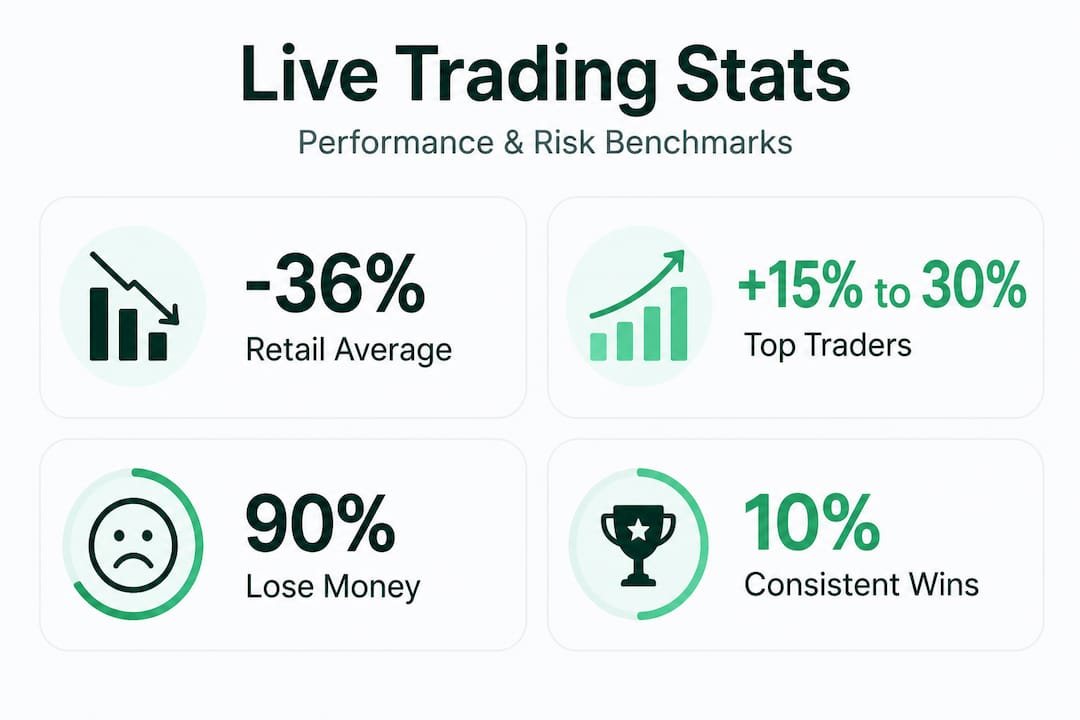
The numbers make it clear. The difference between losing and winning traders isn't exotic strategy. It's discipline applied consistently over a large sample of trades.
Tools and platforms for live trading: Indicators, automation, and education
Concrete risk management depends heavily on the right tools and support. Here's what you need for effective live trading, both technically and educationally.
The platform you trade on shapes your entire experience. MT4 and MT5 remain dominant for retail forex and crypto execution, offering robust order management, custom indicators, and automated trading through Expert Advisors (EAs). TradingView has become the go-to charting environment for crypto traders and those who prefer browser-based analysis with Pine Script indicators.
What separates useful tools from noise? Here's a checklist of what to look for in live trading tools:
- Non-repainting signals: Indicators that don't redraw historical signals after the fact. Repainting indicators look great on backtests but fail in live conditions.
- Volatility gating: Filters that prevent signal generation during low-volume, choppy market conditions where false signals are most common.
- Confluence detection: Tools that combine multiple signals (momentum, volume, structure) to confirm entries rather than relying on a single indicator.
- Divergence detection: Identifies when price and momentum indicators disagree, often preceding reversals.
- Native alert integration: Webhook alerts that push signals directly to Discord or mobile without manual monitoring.
- Open-source code: Transparency in how the indicator calculates signals builds trust and allows customization.
The Edge Finder indicator is a strong example of a confluence-based tool that combines multiple signal layers to filter out weak setups. For traders who want a broader view across timeframes simultaneously, the MTF scalping dashboard on TradingView gives you multi-timeframe alignment at a glance, which is critical for avoiding trades that look good on the 1-minute chart but are running against the 15-minute trend.
Education matters just as much as tools. A community where experienced traders share live sessions, review setups, and provide mentorship accelerates the learning curve significantly. Solo trading without feedback loops is one of the slowest ways to improve.
Pro Tip: Before trusting any indicator in live trading, run it on at least 3 months of historical data manually. Click through bar by bar, not just a visual backtest. This builds intuition for how the tool behaves in different market conditions and prevents over-reliance on automated signals.
A hard-earned perspective: Why live trading is more about discipline than prediction
Here's the uncomfortable truth most trading content avoids. The strategy you use matters far less than how consistently you apply it.
We've seen traders with objectively mediocre strategies outperform traders with sophisticated systems because the former follow their rules without exception. The data confirms this: 90% of traders fail due to emotions and over-risking, not because their entry method is flawed. That's a massive insight that most people read, nod at, and then ignore the moment they're in a losing trade.
The obsession with finding the "perfect" indicator or the "best" strategy is often a form of avoidance. It feels productive to research new tools. It's much harder to sit with a losing trade, honor your stop, and move on to the next setup. But that's exactly what separates the top 10% from everyone else.
Sample size is the secret weapon almost nobody talks about. Evaluating a strategy after 15 trades is statistically meaningless. A strategy with a 45% win rate will produce 10 consecutive losses roughly every 400 trades. If you quit after those 10 losses, you never see the 200 profitable trades that follow. The traders who survive long enough to see their edge play out are the ones who risk small enough to stay in the game through inevitable drawdown periods.
The comparison between different trading approaches often reveals that the difference in raw performance between competing tools is minimal. What matters is whether you can follow the rules of whichever system you choose, without deviation, for hundreds of trades. Process over outcome. Every time.
Advanced tools for live trading: Take your next step
If you're ready to trade with discipline, the right tools and educational support make a measurable difference in execution quality and consistency.
Scalping-Algo provides premium scalping indicators built specifically for retail traders working short-term strategies in crypto and forex. All indicators are built in Pine Script v6, are fully non-repainting, and include volatility gating and confluence filters designed for 1-minute to 15-minute timeframes. The Algo Master Suite integrates signals, alerts, backtesting, and education into a single Command Center dashboard. For traders who want precision entry tools with real-time signal generation, the Edge Finder indicator delivers institutional-grade signal logic accessible to individual retail traders. A live Discord community with mentorship sessions and live trading support rounds out the platform, giving you feedback loops that solo trading simply can't provide.
Frequently asked questions
Is live trading riskier than demo trading?
Yes, live trading exposes you to real financial risk, psychological pressure, slippage, and transaction costs that demo trading doesn't replicate.
What are the main reasons retail traders lose money in live trading?
Most traders lose due to emotional decision-making, poor risk controls, and oversizing positions. Data shows the average retail day trader loses 36% annually after fees, primarily from behavioral failures rather than strategy flaws.
What platforms are best for live crypto and forex trading?
MT4, MT5, and TradingView are the most widely used platforms for live retail trading, offering order execution, charting, and indicator support across forex and crypto markets.
How much should I risk per trade in live trading?
Experts recommend 0.5-2% per trade to avoid catastrophic drawdown and give your strategy enough runway to prove itself over a statistically meaningful sample.
What is a "kill zone" in live trading?
A kill zone is a high-activity window around major market opens, like the London or New York session, where institutional order flow creates the volatility and directional momentum that short-term traders target for their best setups.