
Retail scalpers operate in one of the most punishing environments in finance. The data is jarring: up to 97% of retail traders lose money in short-term markets, yet the myth that isolation breeds focus persists. The truth is that trading alone strips away the feedback loops, accountability structures, and shared intelligence that separate profitable scalpers from the majority who wash out. This article breaks down why community membership is a measurable performance advantage, not just a social bonus, and how to leverage it the right way.
Table of Contents
- Why most solo traders struggle in the scalping market
- How trading communities drive performance and discipline
- Competitive advantages from shared scalping insights
- Risks and how to choose a vetted trading community
- Why short-term wins aren't everything: A nuanced take
- How to maximize your scalping potential with advanced community tools
- Frequently asked questions
Key Takeaways
| Point | Details |
|---|---|
| Community improves discipline | Structured accountability and journaling lead to higher performance in scalping. |
| Mentorship accelerates learning | Live feedback and guidance help scalpers refine strategies and avoid costly mistakes. |
| Shared insights yield edge | Real-time group analysis uncovers fleeting opportunities solo traders often miss. |
| Choose vetted groups | Vetted communities protect against scams and hype, supporting safer trading. |
| Balance short-term vs long-term | Relying solely on rapid wins can hurt sustainable returns; combine group info with careful research. |
Why most solo traders struggle in the scalping market
Scalping is a discipline that punishes hesitation, rewards precision, and exposes every gap in your process within minutes. When you trade alone, those gaps widen fast.
The most underrated problem for solo scalpers is the absence of real-time feedback. You enter a trade, it goes against you, and you have no sounding board to separate a bad setup from a normally volatile market. Without a second opinion, confirmation bias takes over. You convince yourself the trade is still valid. You hold longer than your plan dictates. Before you know it, a small loss compounds into a session-destroying drawdown.
Psychological pressure is the second silent killer. Scalping requires rapid-fire decisions on 1-minute and 5-minute charts, often across multiple instruments. The cognitive load is enormous, and without a community reinforcing your methodology, emotional trading replaces systematic execution. Fear of missing out kicks in. Revenge trading follows a loss. These are patterns almost every solo scalper knows, and they are brutally hard to break without external accountability.
Crypto markets add another layer of danger: organized manipulation. Research on pump-and-dump schemes in crypto shows that retail traders, especially those scalping on low timeframes, are the primary victims of coordinated price manipulation. Solo traders rarely have the signal-to-noise filtering that vetted communities provide, meaning they are more likely to chase pumped assets and absorb the dump.
Here is what tends to go wrong for solo scalpers specifically:
- No peer review of trade setups before execution
- Chasing trades based on social media hype instead of verified signals
- No structured journaling to identify patterns in losses
- Isolation from indicator improvements and evolving market strategies
- Psychological burnout from carrying every bad decision alone
Consider joining spaces that already solve some of these issues, like an options trading Discord or a futures signal Discord, where vetted analysis replaces noise. The difference between consuming random Twitter calls and operating inside a structured group with verified methodologies is massive. One accelerates losses. The other builds real edge.
"The market doesn't care about your conviction. It cares about your positioning. Solo scalpers position based on emotion far more often than they realize."
Active journaling within a peer group changes this dynamic entirely. When you know your trades will be reviewed by other experienced scalpers, you make more deliberate entries. You document your reasoning. You track your mistakes over time. That structured reflection loop, which is rare among solo traders, is one of the most direct paths to measurable improvement.
How trading communities drive performance and discipline
Communities do more than offer company. They create performance infrastructure that individual traders simply cannot replicate on their own.
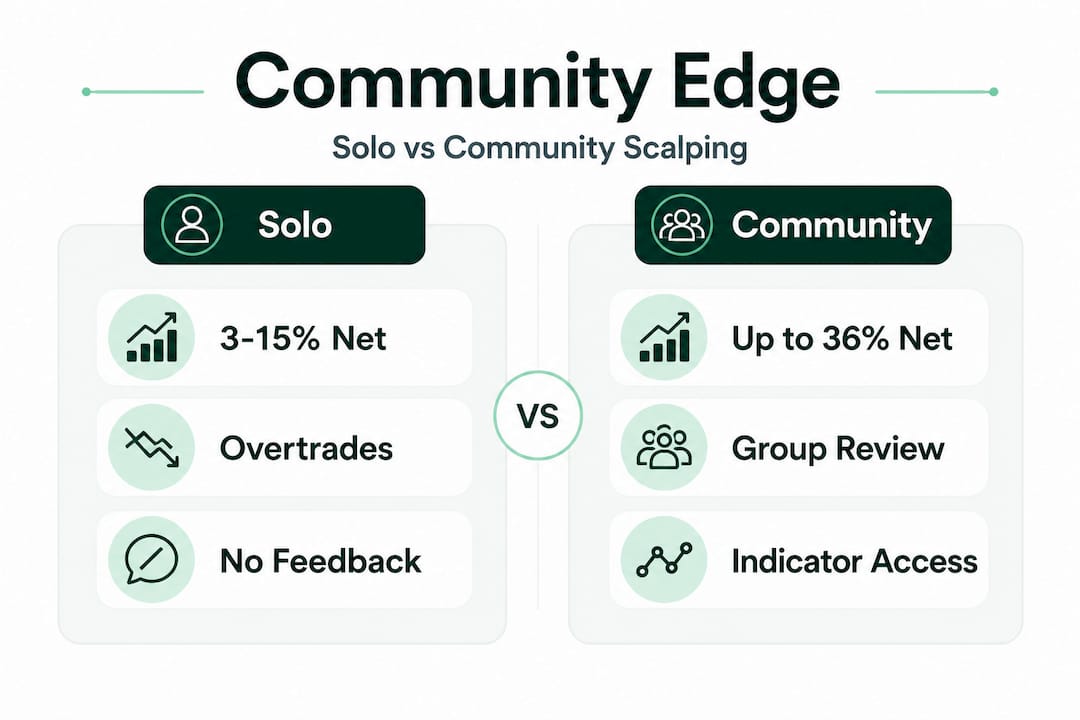
The numbers tell a clear story. Traders who journal actively within communities show 31% net profitability over 90 days or more, compared to 3 to 15% for general day traders operating without structured support. That is not a minor edge. It represents the difference between grinding and growing.
Here is how structured communities generate those results:
- Accountability journaling: Members log entries, exits, rationale, and outcomes daily. Peers review these logs and surface recurring mistakes the trader cannot see themselves.
- Live session mentorship: Real-time screen sharing during active market hours lets experienced traders coach entries in context, not after the fact.
- Shared methodology libraries: Proven playbooks for specific setups, like EUR/USD wick analysis on the 1-minute chart, are accessible to every member, cutting the learning curve sharply.
- Group signal validation: Before acting on a signal, members cross-check it against community consensus, reducing impulsive trades.
- Post-session debriefs: Group reviews of the trading day identify what worked, what failed, and why, across multiple timeframes and instruments.
Mentorship is the most underestimated accelerant. Structured mentorship programs focus on live feedback, specific scalping methodologies, and incremental skill development. A mentor watching you scalp EUR/USD on a 1-minute chart can spot a premature entry within seconds. That real-time correction is worth months of solo trial and error.
Pro Tip: Look for communities where mentors trade live alongside members rather than just presenting recorded content. Active mentorship in real market conditions is significantly more effective than after-the-fact analysis.
Group methodology fosters consistency in a way that solo trading never can. When your community uses a shared indicator suite, defined entry criteria, and agreed risk parameters, you start aligning your execution with a system rather than reacting to every candle. This consistency is what separates scalpers who survive for years from those who blow up within months.
The performance methodology behind indicator-driven communities often includes volatility gating, divergence detection, and confluence scoring. These mechanisms filter low-quality setups before they ever reach your execution window. When you pair those tools with community review, the combination creates a feedback-rich environment where your edge compounds over time.
If you want a closer look at how specific indicators integrate into this kind of workflow, the intraday scalping indicators designed for 1-minute to 15-minute charts are a practical starting point.
| Performance metric | Solo scalper | Community scalper |
|---|---|---|
| Net profitability (90 days) | 3 to 15% | Up to 31% |
| Trade journaling rate | Low | Consistently high |
| Access to vetted signals | Rare | Standard |
| Psychological support | None | Peer-driven |
| Strategy refinement speed | Slow | Accelerated |
Competitive advantages from shared scalping insights
While discipline and mentorship drive performance, the actual intelligence flowing through active communities gives scalpers a measurable market edge in real time.
Scalping is a short-term competitive foraging game. The traders who access superior information faster than others capture the opportunity. In isolation, you are working with one data stream: your own. Inside a community, you tap into dozens of experienced perspectives simultaneously, each filtering a different instrument, timeframe, or session.
This collective intelligence surfaces setups you would never find alone. A member focused on the Asian session spots a liquidity sweep on BTC/USDT that aligns perfectly with a setup another member flagged on a 5-minute chart. You confirm the signal against your own indicators and execute with genuine confidence, not hope. That is a fundamentally different experience from scalping in isolation.
Shared tools amplify the advantage further. Communities built around 1-minute scalping indicators give every member access to the same real-time, non-repainting signals. When everyone uses the same validated indicator suite and cross-checks results openly, the group collectively filters out false signals faster than any individual could.
Mentorship programs also deliver nuanced, practical techniques that rarely appear in textbooks. Think specific entry timing relative to candle closes, exact volume thresholds for confirmation, and session-specific behavior patterns for particular pairs. These micro-details make a genuine difference on a 1-minute chart where every second of delay erodes profit potential.
Key competitive advantages that communities provide:
- Real-time group analysis that uncovers setups across multiple instruments simultaneously
- Tool sharing including open-source indicators with transparent logic and no repainting
- Live expert commentary on breaking market conditions that affect scalping entries
- Cross-validation of signals before execution, reducing false positive trades
- Access to webhook-driven alerts that feed directly into execution workflows
Pro Tip: Prioritize communities that publish verified backtest results and open-source their indicators. Transparency about tool performance is the single strongest signal that a group is legitimate and not just selling hype.
If you want to see what a tool built on transparent, verifiable logic looks like in practice, the edge finder indicator is a good reference point for understanding how institutional-grade signal logic translates into scalping-specific outputs.
Risks and how to choose a vetted trading community
Not every trading community is an asset. Some are traps, and the difference matters enormously for both your capital and your development as a trader.
The risks are real. Research on pump-and-dump schemes in crypto consistently shows that coordinated manipulation often runs through social trading groups, Discord servers, and Telegram channels disguised as signal services. Retail loss rates near 97% are partly driven by traders acting on these manipulated signals without understanding the source or verifying the method.
Watch for these red flags when evaluating a community:
- No verified performance records or backtested data shared publicly
- Heavy promotion of specific coins or assets without technical rationale
- Paid tiers that gatekeep signals without any free trial period or sample results
- Anonymous leadership with no transparent trading history
- Urgency tactics like "act now" alerts that pressure rapid entries without analysis
- Vague methodology with no documentation of entry criteria, risk parameters, or indicator logic
A legitimate community does the opposite. It publishes real results, documents its methodology openly, shows live trades during sessions rather than only retrospective highlights, and builds tools that members can verify themselves.
Pro Tip: Use communities that enforce structured journaling and peer-reviewed trade logs. When accountability is baked into the group culture, hype-driven trades naturally get filtered out because members must justify their reasoning before executing.
Look for communities connected to tools you can verify independently. The best TradingView scalping indicators come with open-source code, clear documentation, and verifiable non-repainting logic. If a community's edge depends entirely on signals you cannot scrutinize, that is a warning sign regardless of how impressive their track record appears. The trading community blog covers additional criteria for evaluating groups before you commit.
Why short-term wins aren't everything: A nuanced take
Here is the perspective most scalping communities will not give you, because it runs counter to their incentive to keep you active and engaged.
Communities are exceptional at creating momentum. Shared energy, rapid-fire signals, and group enthusiasm generate a feeling of edge. And often, the edge is real in the short run. Members catch quick moves, share profitable setups, and build streaks that feel sustainable. But short-term competitive foraging environments, by their nature, can prioritize speed over sustainability. The group optimizes for the next trade rather than the next quarter.
This is where individual discipline must override group excitement. A community that encourages you to increase position size after a winning streak, or to trade through high-impact news events because "the setup looks clean," is subtly pushing you toward short-term thinking at the expense of long-term account health.
The traders we see maintain profitability over years, not just months, share a common pattern. They use community intelligence as input, not as instruction. They filter group signals through their own risk framework. They never bypass their own stop-loss rules because a mentor said the trade looks strong. The community informs. The individual decides.
Sustainable scalping requires balancing the speed of community insights with the patience of long-term risk management. If you are scalping intraday setups on a 5-minute chart, the group's real-time analysis is genuinely valuable. But the decision to size up, take the trade, or skip it entirely must always run through your personal risk parameters first.
Pro Tip: Always combine group insights with your own research before acting. The best community is one that makes you a better independent thinker, not one that replaces your thinking entirely.
How to maximize your scalping potential with advanced community tools
The insights in this article only matter if you act on them with the right resources behind you.
At Scalping-Algo, we built our platform specifically for traders who want community support and institutional-grade tools working together in one place. The Algo Master suite integrates real-time buy and sell signals, volatility gating, divergence detection, and backtesting in a single dashboard, all connected to a live Discord community with mentorship sessions and trade reviews. You can also explore the Edge Finder indicator as a standalone entry point, a tool designed specifically to surface high-probability scalping setups on lower timeframes with full transparency. Every script is open-source and non-repainting. If you are ready to trade smarter alongside a vetted community rather than in isolation, explore all available TradingView scalping indicators and find the setup that fits your style.
Frequently asked questions
How can trading communities help me become profitable as a scalper?
Communities provide mentorship, shared indicators, and enforced accountability through journaling, which is why community scalpers show 31% profitability over 90 days compared to 3 to 15% for solo day traders.
What red flags should I look for when joining a trading community?
Avoid any group that lacks verified performance records, hides its methodology, or promotes specific assets with urgency tactics, since pump-and-dump schemes frequently operate through these channels and target retail scalpers directly.
What is the benefit of active journaling in a trading group?
Journaling within a community creates peer-reviewed accountability, forcing deliberate trade reasoning that directly improves discipline and win rates. Traders who practice it consistently show 31% net profitability compared to those who do not.
How do mentorship programs create value for scalpers?
Structured mentorship programs deliver live feedback during active market hours, helping scalpers correct execution errors in real time rather than learning from losses after the session has already closed.