

Most retail traders enter the market with confidence and exit with losses. The numbers are not subtle: 91% of retail traders in India's F&O market lost money in FY25, with total net losses widening to Rs 105,603 crore. Scalping, the fastest and most demanding form of short-term trading, amplifies every mistake. Without a structured education, traders are not competing, they are guessing. The difference between the small group of consistently profitable scalpers and the overwhelming majority who lose is rarely about intelligence or market access. It is almost always about education, process, and discipline.
Table of Contents
- Facing the harsh reality: Why most retail scalpers lose
- Education as the game-changer: Mechanics, risk, and process
- Tools, technology, and advanced strategies: What education enables
- From learning to live trading: Building a personalized, profitable roadmap
- Why most trading advice misses the mark: What really matters for retail scalpers
- Enhance your scalping journey with professional resources
- Frequently asked questions
Key Takeaways
| Point | Details |
|---|---|
| Education prevents losses | Retail scalpers with proper education avoid the behavioral and technical traps that cause 90% of uneducated traders to fail. |
| Tools amplify skills | Advanced indicators and platforms only make a difference when traders understand how to use them through structured learning. |
| Personalization is key | Each trader must build a strategy and process suited to their psychology, risk tolerance, and market conditions. |
| Practice builds discipline | Simulation, journaling, and ongoing education are practical ways to turn theory into consistent live results. |
| Professional resources accelerate progress | Premium tools and educational support can help traders quickly move past common pitfalls and gain an advantage. |
Facing the harsh reality: Why most retail scalpers lose
Scalping looks deceptively simple from the outside. Fast trades, quick profits, repeat. But the data tells a completely different story. F&O trader loss data from SEBI's FY25 study shows that nine out of ten retail participants in derivatives markets are losing money, and those losses are growing year over year. In Europe, 74-89% of retail CFD traders lose money according to ESMA data, a figure that has remained stubbornly consistent across brokers and market conditions.
The hard truth: High-frequency scalping does not just expose bad trades. It accelerates them. A single behavioral flaw, repeated dozens of times per session, compounds losses faster than almost any other trading style.
Here is a breakdown of retail loss rates across major markets:
| Market / Region | Loss Rate | Source |
|---|---|---|
| India F&O (FY25) | 91% | SEBI Study |
| European CFD Retail | 74-89% | ESMA Data |
| Global Retail Average | ~80%+ | Multiple Studies |
The reasons behind these numbers go beyond bad luck. The most common culprits include:
- Over-leveraging: Using maximum available leverage without understanding position sizing or margin calls
- Emotional trading: Chasing losses, revenge trading, or freezing during volatile moves
- Ignoring market mechanics: Entering trades without understanding bid-ask spreads, slippage, or liquidity conditions
- No structured risk controls: Trading without stop-losses, position limits, or defined risk per trade
- Misreading indicators: Applying tools superficially without understanding their logic or limitations
Scalping magnifies all of these problems. When you are placing ten to thirty trades per session, even a small edge in your favor matters enormously. Without that edge, and without understanding risk management principles, every session becomes a slow drain on your capital. The traders who survive long enough to become profitable are the ones who treat education as non-negotiable, not optional.

Education as the game-changer: Mechanics, risk, and process
Understanding why traders fail is only useful if it points toward a solution. Education is that solution, but not the generic kind. Targeted trading education teaches you the specific mechanics that scalping demands: how markets actually move, how to read order flow, how to apply indicators with precision, and how to manage risk in real time.
Lack of trading education leads directly to misunderstanding options Greeks, superficial indicator use, and emotional decision-making. These are not personality flaws. They are knowledge gaps. Close the gap, and the behavior changes.
Here is how educated and uneducated trading approaches compare in practice:
| Factor | Uneducated Trader | Educated Trader |
|---|---|---|
| Entry decisions | Gut feel or random signals | Confluence-based, rule-driven |
| Risk per trade | Variable, often too high | Fixed percentage of capital |
| Indicator use | Surface-level, reactive | Contextual, with understanding of logic |
| Emotional response | Impulsive after losses | Structured review and reset |
| Strategy adaptation | Abandons strategy quickly | Adjusts based on data and journaling |
The structured learning process that separates profitable scalpers from the rest follows a clear sequence:
- Learn market mechanics first. Understand how price moves, what drives liquidity, and how your specific instrument behaves across different sessions.
- Study your tools deeply. Knowing how to read intraday indicator usage means understanding the math behind the signal, not just the color of the arrow.
- Build a rule-based process. Define your entry criteria, exit rules, and risk limits before you enter any trade.
- Practice with feedback. Review every trade. Identify what worked, what did not, and why.
- Develop psychological discipline. Recognize your behavioral patterns and build systems that protect you from your own impulses.
Pro Tip: Before adding any new indicator to your setup, spend at least one full week studying it on historical data. Understand when it fails, not just when it works. This single habit separates serious traders from casual ones.
Professional trading mindset research shows that profitable traders ask better questions, not just seek better answers. Education is what teaches you which questions matter. Explore edge finder strategies to see how this principle applies directly to scalping setups.
Tools, technology, and advanced strategies: What education enables
Once you understand the process, technology becomes an accelerant rather than a crutch. Educated scalpers use platforms like TradingView, direct market access brokers, and specialized indicator suites in ways that genuinely improve their execution. Uneducated traders use the same tools and lose money faster because of them.
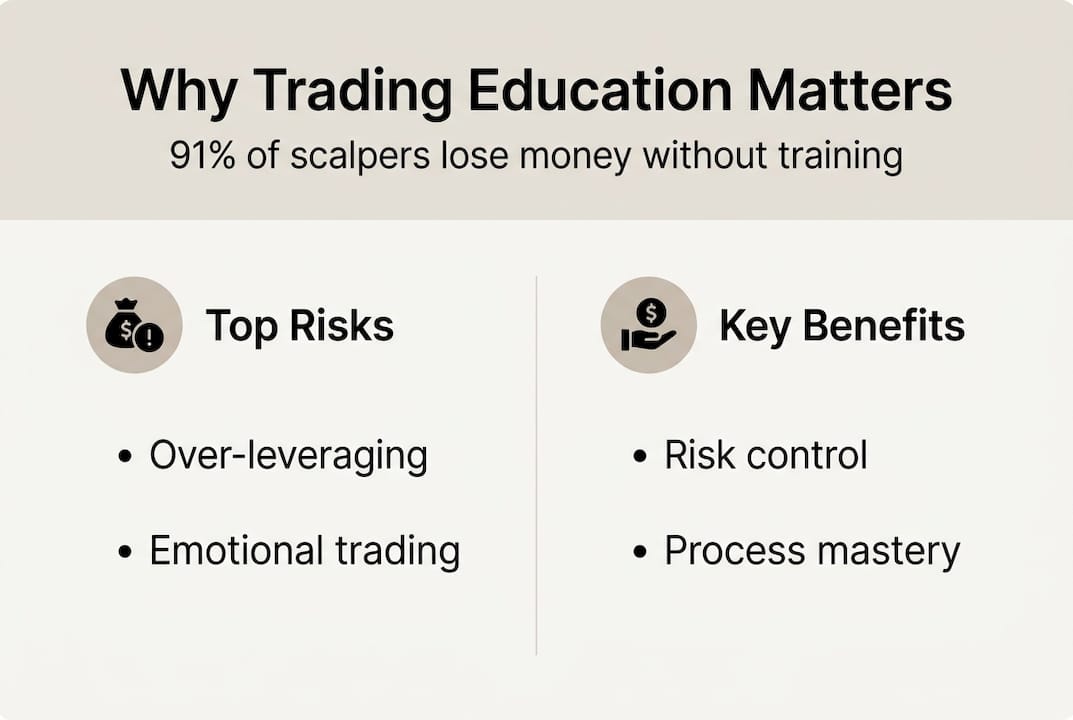
Scalping requires mastery of precise execution, low-latency tools, liquidity analysis, and strict risk-per-trade limits. Novices fail not because the tools are bad, but because the learning curve is steep and emotional overrides destroy discipline before skill can develop.
Here is what educated tool use actually looks like in practice:
| Tool / Feature | Uneducated Use | Educated Use |
|---|---|---|
| Real-time indicators | Follow every signal blindly | Filter signals with confluence and context |
| Hotkeys and execution | Slow, manual, error-prone | Fast, pre-configured, consistent |
| Level 2 / Order book | Ignored or misread | Used to confirm liquidity before entry |
| Alerts and webhooks | Not configured | Automated, tied to specific conditions |
The specific skills that education unlocks for scalpers include:
- Reading market structure: Identifying support, resistance, and momentum shifts in real time on 1-minute to 5-minute charts
- Volatility awareness: Knowing when to trade and when to stay out based on spread conditions and news risk
- Confluence building: Combining multiple signals, such as volume, trend, and momentum, before committing to a position
- Adaptive strategy use: Recognizing when a strategy is working in current conditions and when to pause it
Pro Tip: Set up your best scalping indicators on a paper trading account for at least two weeks before going live. Track your win rate, average gain, and average loss. If the numbers do not make sense in simulation, they will not improve with real money.
The right day trading tools paired with genuine knowledge of how to use them create a compounding advantage. Every session, you get slightly better at reading your setup. Over weeks and months, that compounds into consistency. Without the educational foundation, retail trading education research confirms that even sophisticated tools produce the same losing outcomes.
From learning to live trading: Building a personalized, profitable roadmap
Knowledge without application is just theory. The transition from studying trading to actually trading profitably requires a structured, personal roadmap. This is where most educational programs fall short. They teach concepts but skip the implementation layer.
Education provides edge through risk management, strategy development, emotional control, and consistent processes. For scalping specifically, where you may execute dozens of trades per session, that edge needs to be deeply internalized, not just intellectually understood.
Here is a practical roadmap for moving from learning to live trading:
- Start with a simulator. Use paper trading or a demo account to practice your strategy in real market conditions without financial risk.
- Journal every trade. Record your entry reason, exit reason, emotional state, and outcome. Patterns will emerge within weeks.
- Define your personal edge. Identify the specific setup, time of day, and market condition where your strategy performs best.
- Set non-negotiable rules. Maximum daily loss limit, maximum position size, and required confluence before entry. Write them down.
- Review weekly, not just daily. Daily reviews catch individual mistakes. Weekly reviews reveal systemic patterns in your behavior.
- Seek structured feedback. Communities, mentors, or discord trading alerts with live session reviews accelerate your learning curve dramatically.
Remember: Profitability is not a destination you reach once. It is a process you maintain. Markets evolve, and your education must evolve with them.
Pro Tip: If you are exploring options scalping, study 0DTE trading strategies carefully before going live. Zero-day options move fast and punish underprepared traders with full premium loss in minutes.
How professionals learn is fundamentally different from how beginners learn. Professionals build feedback loops. Beginners chase the next hot strategy. Your roadmap should prioritize the feedback loop above everything else.
Why most trading advice misses the mark: What really matters for retail scalpers
Most trading content focuses on the wrong things. It sells indicators, setups, and signal services while glossing over the two factors that actually determine whether a retail scalper succeeds: psychological architecture and personalized process.
After years of testing scalping strategies, the traders who consistently profit are not the ones with the best indicators. They are the ones with the most disciplined feedback loops and the clearest understanding of their own behavioral tendencies. The minority who succeed do so because they built infrastructure around their psychology, not just their charts.
Surface-level education teaches you what to do. Deep education teaches you why you do not do it even when you know better. That gap, between knowing and executing, is where most retail scalpers lose their edge. No indicator closes that gap. Only honest self-assessment, structured journaling, and consistent review do.
The uncomfortable reality is that personalization matters more than strategy. A mediocre strategy executed with iron discipline outperforms a brilliant strategy executed inconsistently. Most trading advice ignores this because it is harder to sell discipline than it is to sell a signal. Our perspective at Scalping-Algo is that indicator comparison insights are useful, but they are secondary to building the psychological and process infrastructure that makes any strategy work.
Enhance your scalping journey with professional resources
Understanding education's role in trading success is the first step. Taking action on that understanding is what separates traders who improve from those who stay stuck in the same losing patterns.
At Scalping-Algo, we built our platform specifically for retail scalpers who are serious about improving. Our premium scalping indicators are built in Pine Script v6, generate real-time non-repainting signals, and come with full educational support so you understand exactly how and why each tool works. The Algo Master suite integrates alerts, backtesting, and live Discord mentorship sessions into one Command Center, giving you the infrastructure that professional traders rely on, without the institutional price tag.
Frequently asked questions
How does trading education reduce losses for scalpers?
Trading education equips scalpers with risk management frameworks, structured strategy development, and emotional control techniques that directly reduce impulsive, loss-generating decisions. Traders who follow a defined process lose less and recover faster.
What are the most common mistakes retail scalpers make?
Retail scalpers most often fail due to over-leveraging, misreading indicators, and trading emotionally without a defined process. Misunderstanding of mechanics like options Greeks and superficial indicator use are especially costly in high-frequency environments.
How can traders practice and improve outside of live markets?
Simulators, structured journaling, and replay tools let traders build skill and identify behavioral patterns without risking real capital. Structured learning processes with honest self-review accelerate improvement faster than live trading alone.
Are advanced indicators and technology enough to become a profitable scalper?
No. Tools amplify your existing edge, but they cannot create one from scratch. Consistent profitability requires education, disciplined execution, and psychological mastery working together.
What evidence shows trading education is linked to consistent profits?
91% of retail traders in India's F&O market lost money in FY25, while ESMA data shows 74-89% loss rates for European CFD traders. The consistent pattern across markets is that uneducated retail participants lose, while those who build structured, educated processes perform significantly better over time.