

Building a trading strategy is the process of designing a systematic set of rules that govern every buying and selling decision you make in financial markets. Without that written framework, you are not trading. You are guessing. A well-constructed strategy specifies your market, timeframe, setup conditions, entry and exit rules, stop-loss placement, position sizing, and a review process. These are not optional extras. They are the difference between a trader who compounds gains over time and one who blows up after three losing weeks. The frameworks covered here draw on validated methods including backtesting, walk-forward analysis, and structured trade review to give you a repeatable edge.
What are the essential components of a trading strategy?
A repeatable trading strategy must specify market, timeframe, setup definition, entry and exit rules, stop-loss, target, position sizing, and a review process. Each component does a specific job. Remove one and the whole structure weakens.
Start with a single market and a single timeframe. Traders who jump between Bitcoin on the 1-minute chart and EUR/USD on the daily chart rarely master either. Picking one market forces you to learn its behavior: how it reacts to news, how it moves during high-volume sessions, and where it tends to reverse. Once you have that context, every other component becomes easier to define.
Here are the core building blocks every strategy needs:
- Market and timeframe. Choose one asset class (crypto, forex, indices, futures) and one primary timeframe. Scalpers typically work the 1m to 15m range. Swing traders use the 4H or daily.
- Market condition filter. Define whether your setup works in trending markets, ranging markets, or both. A momentum entry in a choppy range will lose money consistently.
- Setup type and entry rules. Write your entry as a three-part structure: conditions (what the chart must show), trigger (the specific price action or indicator signal that fires the trade), and invalidation (what cancels the trade even if conditions look right). Writing setups with explicit invalidation filters reduces impulsive errors that most traders never track.
- Stop-loss and target. Anchor both to market structure, not arbitrary pip counts. A stop below the last swing low and a target at the next resistance level is a structural approach. A 20-pip stop because it "feels right" is not.
- Position sizing and risk per trade. Fix your risk per trade as a percentage of account equity, typically 0.5% to 2%. Risk capacity depends on your financial situation, time horizon, and loss absorbency. What you are willing to lose and what you can actually afford to lose are two different numbers.
- Trade management rules. Decide in advance whether you will trail stops, scale out at partial targets, or hold full size to the target. Discretionary decisions made mid-trade almost always cost money.
Pro Tip: Write your full strategy in a single document before you place one live trade. If you cannot explain every rule in plain language, the strategy is not ready.
How to test and validate your trading strategy effectively
Testing is where most retail traders cut corners, and it is exactly where strategies fall apart in live markets. The goal of validation is not to find a strategy that looks great on historical data. The goal is to find a strategy that holds up when conditions change.
Follow this sequence:
- Run a historical backtest. Apply your rules to past price data manually or with a tool. Effective backtesting frameworks separate signal evaluation from execution assumptions, applying realistic fills, fees, and slippage. A backtest that ignores commissions on a scalping strategy will overstate returns significantly.
- Check your sample size. Fifty trades is a minimum. Two hundred is better. Small samples produce misleading win rates and skewed risk-reward averages.
- Purge data between training and testing windows. When your signals rely on lookback periods, data leakage between training and testing windows produces optimistic results that never appear in live trading.
- Run walk-forward analysis. Walk-forward analysis evaluates sequential out-of-sample performance using rolling optimization and testing windows. It produces realistic equity curves rather than curve-fitted ones. This step separates strategies that genuinely work from those that were simply tuned to fit past data.
- Stress test your parameters. Shift your entry trigger by one bar. Widen your stop by 10%. If performance collapses with minor changes, the strategy is over-optimized and will fail live.
"Walk-forward discipline, more than mathematical optimization, is key to avoiding overfitting and ensuring realistic expectations for live trading." — PineForge
The GrainStorm.ai team applies a similar validation workflow in commodity markets, demonstrating that systematic risk control and out-of-sample testing apply across asset classes, not just equities or crypto.
A strategy that survives walk-forward testing with consistent metrics across multiple windows is one you can trust to deploy with real capital.

How to implement your strategy in live markets
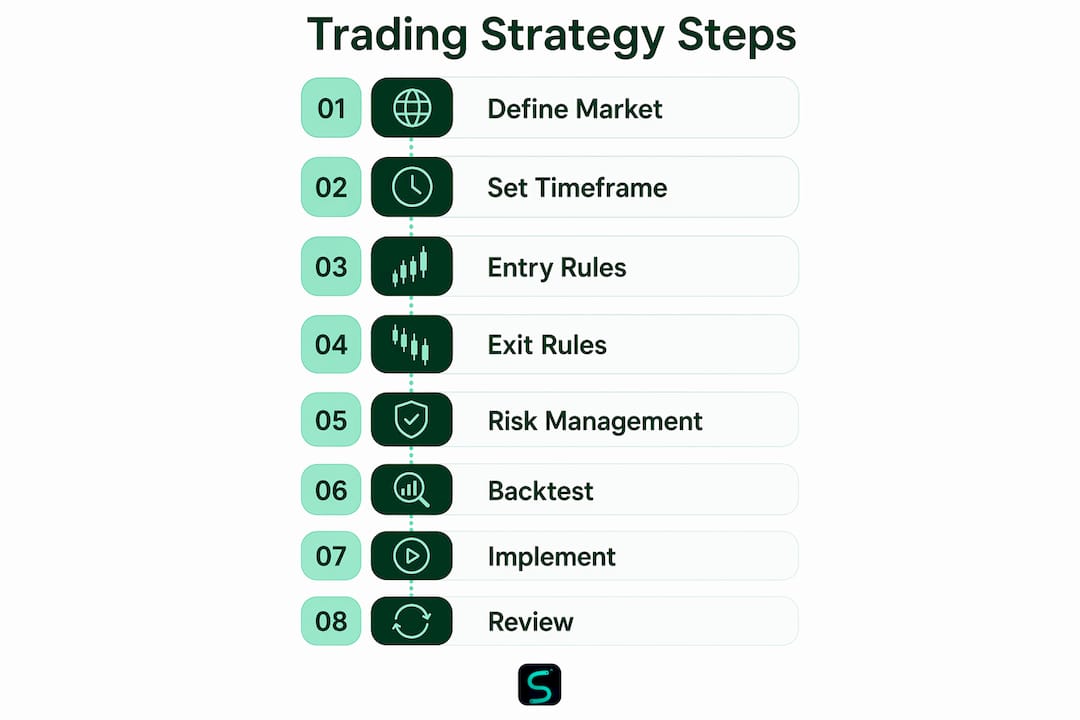
The transition from backtesting to live trading is where discipline either holds or breaks. The rules you wrote during testing must govern every session without exception. Consistency in trading comes from following a defined system with rules for entry, exit, risk limits, and review. Improvisation is the enemy of a systematic approach.
Build a daily workflow around these habits:
- Pre-market preparation. Scan your market against your setup criteria before the session opens. Build a watchlist of levels where your conditions could trigger. This prevents reactive trading when price moves fast.
- Set alerts. Use price alerts for your entry trigger, stop-loss level, and target. Alerts remove the need to stare at screens and reduce emotional interference. Scalping-algo's TradingView indicators include native webhook alerts to Discord, which makes this step automatic.
- Follow your written rules. If the setup does not meet all your criteria, including the invalidation conditions, you do not take the trade. Skipping one rule opens the door to skipping all of them.
- Keep a detailed trading journal. Log every trade with entry price, stop, target, setup type, and outcome. Include a screenshot and a one-line note on why you took the trade.
- Review on a schedule. Weekly reviews of 30 to 60 minutes and monthly deep dives after a meaningful sample of trades reveal patterns, strengths, and rule deviations. This is where real improvement happens.
Pro Tip: Use your day trading checklist as a pre-session ritual. Checking off objective criteria before each trade removes the guesswork that kills consistency.
What are common mistakes when building a trading strategy?
Most retail traders make the same errors. Knowing them in advance saves months of painful losses.
- Starting with indicators instead of logic. Indicators are tools, not strategies. Stacking RSI, MACD, and Bollinger Bands on a chart without a clear market logic behind them produces noise, not signals. Define your market thesis first, then select indicators that measure it.
- Vague entry and exit rules. "Buy when price looks strong" is not a rule. Objective, verifiable entry criteria prevent improvisation during fast sessions. Every condition must be measurable.
- Ignoring risk management. A detailed trading plan with explicit risk per trade and position management rules directly reduces the major causes of investor failure. Traders who skip this step eventually experience a single trade that wipes out weeks of gains.
- Over-optimizing during backtesting. Tweaking parameters until the backtest looks perfect is a trap. The result is a strategy that fits the past perfectly and fails the future completely. Walk-forward testing is the antidote.
- Changing strategy after a losing streak. Three losing trades in a row is not evidence that your strategy is broken. It may be within normal statistical variance. Changing rules impulsively resets your edge to zero every time.
Pro Tip: Review your scalping entry methods periodically against your written rules. If your live entries no longer match your documented criteria, the drift is the problem, not the strategy.
Key takeaways
A trading strategy works only when every component from market selection to review process is written, tested, and followed without exception.
| Point | Details |
|---|---|
| Define all components upfront | Specify market, timeframe, setup, entry, exit, stop, target, and position sizing before trading live. |
| Validate with walk-forward analysis | Rolling out-of-sample testing prevents overfitting and produces realistic performance expectations. |
| Risk sizing drives sustainability | Fix risk per trade as a percentage of equity based on your actual financial capacity, not preference. |
| Journal and review consistently | Weekly and monthly trade reviews reveal rule deviations and improvement opportunities faster than any indicator. |
| Avoid impulsive rule changes | Losing streaks within normal variance are not strategy failures. Stick to your written rules and let sample size decide. |
Why discipline beats a perfect strategy every time
Here is what I have learned after years of working with traders across crypto, forex, and futures: the strategy is rarely the problem. The trader is.
I have seen traders with genuinely solid systems, clear rules, and validated backtests blow up their accounts within two months of going live. The reason is almost always the same. They followed the rules until the first real drawdown, then they started improvising. One skipped stop. One oversized position to "make it back." One strategy swap after a bad week. That is not a strategy problem. That is a discipline problem.
The traders who actually build consistent results treat their written plan like a legal contract. They do not renegotiate mid-session. They review it weekly, update it monthly based on data, and change rules only after a statistically meaningful sample tells them something is structurally wrong. Not after three bad trades. Not after a frustrating Friday.
Simplicity compounds faster than complexity. A two-condition entry rule you follow 95% of the time beats a seven-condition system you follow 60% of the time. Every time. The journal is where the real edge lives, not the chart. Traders who review their trades honestly, including the ones they took outside their rules, improve faster than anyone who just adds more indicators.
Start simple. Follow your rules. Review your data. That is the whole game.
— Tran
Take your strategy further with Scalping-algo
If you have your framework mapped out and want tools that enforce it in real time, Scalping-algo was built for exactly this stage.

Scalping-algo's premium TradingView indicators are built in Pine Script v6 and generate real-time, non-repainting buy and sell signals optimized for the 1m to 15m timeframes across crypto, forex, indices, and futures. Every signal includes volatility gating and confluence filters so you are not chasing noise. The Algo Master suite combines three indicators into a single strategic framework, giving you entry signals, divergence detection, and a Command Center dashboard with backtesting, alerts, and live Discord mentorship. It is the infrastructure layer your written strategy needs to execute consistently.
FAQ
What is a trading strategy in simple terms?
A trading strategy is a written set of rules that defines when to enter a trade, when to exit, how much to risk, and which market conditions apply. Without written rules, decisions become reactive rather than systematic.
How many components does a solid trading strategy need?
A repeatable strategy needs at least eight components: market, timeframe, market condition filter, setup type, entry rules, exit rules, stop-loss, and position sizing. Adding a review process makes it nine and significantly improves long-term performance.
What is walk-forward analysis and why does it matter?
Walk-forward analysis tests a strategy on sequential out-of-sample data windows to verify it performs beyond the period it was optimized on. It is the most reliable method for avoiding overfitting and building realistic performance expectations before going live.
How much should I risk per trade?
Most professional frameworks recommend risking 0.5% to 2% of account equity per trade. Your actual risk capacity depends on your financial situation, time horizon, and ability to absorb losses, not just your comfort level with volatility.
When should I change my trading strategy?
Change a strategy only after a statistically meaningful sample of trades, typically 100 or more, shows a structural breakdown in performance metrics. Losing streaks of three to five trades are normal variance. Impulsive rule changes after short drawdowns reset your edge and prevent you from learning what the strategy actually does.