

Crypto day trading is defined as opening and closing all positions within a single session to capture short-term price moves while avoiding overnight exposure. Unlike swing trading, it demands a repeatable process, not prediction. The 24/7 crypto market creates constant opportunity, but without structure, that opportunity becomes noise. This guide covers the strategies, tools, risk controls, and daily workflows that separate profitable retail traders from the majority who lose capital chasing setups they don't fully understand. Tools like TradingView, Altrady, and order flow platforms are part of the equation. Discipline is the rest.
What crypto day trading strategies work best?
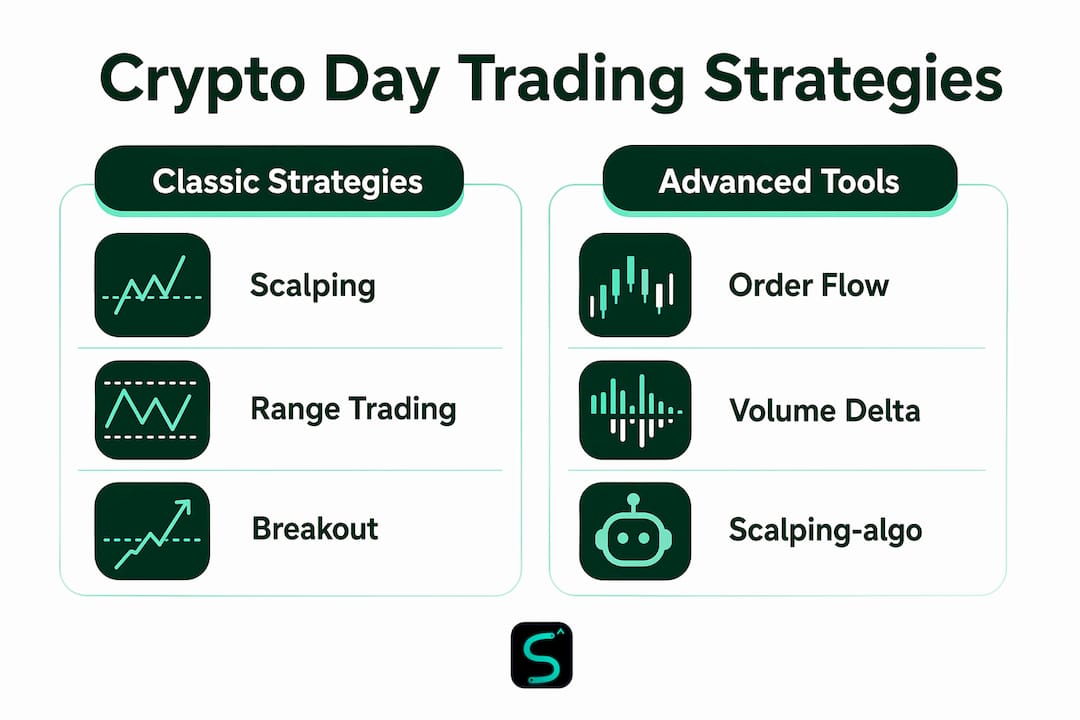
Crypto day trading strategies fall into four core archetypes, and each one performs differently depending on market conditions. Choosing the wrong strategy for the current environment is one of the fastest ways to lose money.
Scalping targets tiny price movements across many trades, typically on 1-minute to 5-minute charts. The goal is accumulating small wins that compound over a session. Scalping requires fast execution, tight spreads, and high-liquidity assets like Bitcoin (BTC) or Ethereum (ETH). Low-liquidity altcoins are a trap here. Wide spreads and slippage on thinly traded assets will erase your edge before you even get started.

Range trading profits from price oscillating between defined support and resistance levels. This strategy fits the reality that crypto markets spend roughly 60% of their time in consolidation or ranging phases. Grid trading is a structured version of this approach, placing buy and sell orders at regular intervals within the range. It works well on stable pairs during low-volatility sessions.
Breakout trading means entering when price moves decisively beyond a key level, typically on expanding volume. The trap most traders fall into is entering on the first touch of resistance. Confirmed breakouts require volume expansion and, ideally, order flow confirmation showing real buying pressure behind the move.
Momentum trading follows strong directional moves, entering after a catalyst like a news event or a large liquidation cascade. It requires speed and discipline. Momentum setups have a short window, and chasing them late is how traders turn winning setups into losing trades.
- Use RSI to spot overbought and oversold conditions as a filter, not a trigger
- Confirm entries with volume and order book depth, not price alone
- Match your strategy to the session. Breakouts work better during high-volume periods like the New York open overlap
Pro Tip: Technical indicators like RSI are lagging by design. Pair them with order flow and cumulative volume delta (CVD) to understand why price is moving, not just that it is.
Which tools give crypto day traders a real edge?
The right platform does more than display charts. It connects to multiple exchanges, executes smart order types, and surfaces order flow data that standard retail interfaces hide entirely.
| Tool | Primary strength | Cost range | Best for |
|---|---|---|---|
| TradingView | Charting, indicators, alerts | Free to $59.95/month | Strategy building, signal visualization |
| Altrady | Multi-exchange terminal, smart orders | $18.66 to $135/month | Execution speed, portfolio management |
| Bookmap | Order flow heatmaps, liquidity visualization | Varies by plan | Reading real-time market microstructure |
| GoCharting | Footprint charts, CVD analysis | Competitive pricing | Order flow analysis on crypto pairs |
| Quantower | Advanced order routing, DOM trading | Free tier available | Futures and derivatives day trading |
Professional retail platforms like Altrady can improve workflow speed by 5 to 10 times compared to standard exchange interfaces. That speed difference matters most during fast-moving breakout setups where a two-second delay changes your fill price significantly.
Order flow and liquidation maps have become non-negotiable tools for serious intraday traders in 2026. They reveal stop-loss clusters and liquidity pockets that standard indicators cannot show. Reading cumulative volume delta alongside price tells you whether buyers or sellers are actually in control, which is information that a moving average simply cannot provide.
Pro Tip: Most platforms offer free trials or demo modes. Test Bookmap or GoCharting for one week before committing to a paid plan. Your ability to read a footprint chart is worth more than any indicator subscription.
For traders building on TradingView, the Scalping-algo indicator suite offers non-repainting buy and sell signals optimized for 1-minute to 15-minute timeframes, with built-in confluence tools that filter low-probability setups automatically.
How to manage risk in crypto day trading
Risk management is the only part of day trading that guarantees long-term survival. Strategy wins you trades. Risk management keeps you in the game long enough to win enough of them.
The core rule is straightforward: risk no more than 1 to 2 percent of your total account on any single trade. On a $5,000 account, that means a maximum loss of $50 to $100 per trade. This feels conservative until you string together five losing trades in a row, which every trader does eventually.
- Calculate position size from your stop distance, not a fixed lot size. Position sizing based on stop-loss distance prevents disproportionate risk across different setups. A tight stop on a volatile asset requires a smaller position than a wide stop on a stable one.
- Target a risk/reward ratio between 1.5 and 2.0. Maintaining a 1.5 to 2.0 risk/reward ratio means you can be wrong on more than half your trades and still grow your account. This is the math that makes day trading sustainable.
- Set a daily loss limit and honor it without exception. Define the maximum dollar amount you will lose in a single session before you start. When you hit it, close the platform. No exceptions.
- Never move your stop loss against your position. Moving a stop to avoid a loss is not risk management. It is emotional decision-making dressed up as strategy. Emotional reactions and impulsive decisions are the most common cause of account blowups in retail crypto trading.
- Avoid revenge trading. After a losing trade, the instinct is to recover the loss immediately. That instinct is wrong. Take a break, review what happened, and return only when you are thinking clearly.
Pro Tip: Track your FOMO-driven entries separately in your journal. Most traders discover that impulsive, unplanned trades account for a disproportionate share of their total losses.
For a deeper breakdown of position sizing and stop placement, Scalping-algo's risk management guide covers the mechanics in practical detail.
How to build a daily crypto day trading workflow
A repeatable daily workflow is what separates a trader from a gambler. Successful day trading requires defined entries, stop losses, take-profit targets, and position sizing before any order is placed. Without that structure, every trade is an impulsive guess.
Pre-session preparation (30 minutes before open):
- Review the prior session's volume profile and identify dominant trend direction
- Mark key support and resistance levels on the 1-hour and 15-minute charts
- Note any scheduled news events or macro catalysts that could spike volatility
- Set your daily loss limit and write it down before you open a single chart
Trade identification and execution:
- Wait for your specific setup to appear. Do not force trades because the market is moving
- Confirm the setup with at least two signals: price action plus volume, or price action plus order flow
- Pre-plan your entry, stop loss, and take-profit level before clicking the buy or sell button
- Size the position correctly based on your stop distance and the 1 to 2 percent risk rule
Post-session review:
- Screenshot every trade, both winners and losers
- Write one sentence explaining why you entered and whether the reason was valid
- Note any emotional decisions: trades taken out of boredom, revenge, or FOMO
- Track your win rate and average risk/reward ratio weekly, not daily
The review process is where most traders improve fastest. Focusing on a few recurring setups rather than chasing every pattern accelerates skill development. Quality of trades beats quantity every time. Reading order book depth and CVD during your review helps you understand whether your entries aligned with actual market pressure or just price patterns.
Key takeaways
Profitable crypto day trading requires disciplined risk management, strategy-to-market-condition matching, and a repeatable daily workflow executed without emotional interference.
| Point | Details |
|---|---|
| Strategy selection matters | Match scalping, range, breakout, or momentum strategies to current market conditions, not personal preference. |
| Tools determine execution quality | Platforms like Altrady and Bookmap provide order flow data and speed that standard exchange interfaces cannot match. |
| Risk 1 to 2 percent per trade | Calculate position size from stop distance and cap daily losses before the session starts. |
| Risk/reward ratio of 1.5 to 2.0 | This ratio allows profitability even with a sub-50% win rate across sessions. |
| Process beats prediction | A structured daily workflow with pre-planned entries and post-trade journaling outperforms any attempt to forecast price. |
What I've learned about trading crypto every day
By Tran
Most retail traders come into crypto day trading looking for the right indicator or the perfect setup. After years of watching traders improve and fail, the pattern is clear: the traders who last are not the ones with the best signals. They are the ones with the most boring, consistent process.
The biggest mistake I see is overcomplication. Traders stack five indicators on a chart, subscribe to three signal services, and then freeze when the signals conflict. The traders who perform consistently pick two or three setups they understand deeply and ignore everything else. That focus is not a limitation. It is the edge.
The second thing I would tell any retail trader is to respect the 24/7 nature of crypto. It creates the illusion that you always need to be in a trade. You do not. The best trade is often no trade. Sitting on your hands when conditions are unclear is a skill, and it takes longer to develop than any technical pattern.
Technology matters, but only when it serves the process. Tools like Scalping-algo's TradingView indicators are genuinely useful because they filter noise and surface high-probability setups on lower timeframes. But a tool cannot replace the judgment to know when the market context makes any setup invalid. Build the judgment first. Then let the tools accelerate it.
— Tran
Take your crypto trading further with Scalping-algo
If you are serious about day trading cryptocurrency, the right indicators can cut your decision time and filter out the low-probability setups that drain accounts. Scalping-algo's premium TradingView indicators are built in Pine Script v6, generate non-repainting signals on 1-minute to 15-minute charts, and include volatility gating so you are not trading into dead markets.
For traders who want a structured, three-indicator framework, the Algo Master suite combines entry signals, confluence confirmation, and divergence detection into one system. It is designed for retail traders who want institutional-grade logic without building it from scratch. The platform also includes a Discord community with live trading sessions and mentorship for traders at every level.
FAQ
What is crypto day trading?
Crypto day trading is the practice of opening and closing all positions within a single trading session to profit from short-term price movements. It avoids overnight exposure and relies on technical analysis, order flow, and disciplined risk management.
How much capital do I need to start day trading crypto?
There is no fixed minimum, but starting with less than $1,000 makes proper position sizing difficult when risking only 1 to 2 percent per trade. Most experienced traders recommend at least $2,000 to $5,000 to trade with meaningful but controlled risk.
What is the best strategy for day trading cryptocurrency?
No single strategy works in all conditions. Range trading suits consolidating markets, which represent roughly 60% of crypto price action. Breakout and momentum strategies perform better during high-volume sessions with clear directional moves.
How do I manage risk when day trading crypto?
Risk no more than 1 to 2 percent of your account per trade, set a daily loss limit before each session, and always pre-plan your stop loss and take-profit levels before entering a position. Never adjust a stop loss to avoid a loss.
Do I need special tools to day trade crypto?
Standard exchange interfaces are not built for fast intraday execution. Platforms like TradingView for charting and Altrady for multi-exchange order management give retail traders the speed and data access needed to compete effectively in intraday crypto markets.