

Reducing slippage in scalping comes down to four levers: use limit and IOC orders instead of market orders, trade only in deep liquidity windows, pick the right account model for your trade frequency, and cut round-trip latency with better routing. Fix your execution path first (order type, broker model, tech stack), then refine strategy. Skip that order and you're optimizing entries on a foundation that leaks money every fill.
TL;DR:
- Using limit and IOC orders instead of market orders, especially during high-liquidity sessions, significantly reduces slippage from market volatility and latency.
- Trading on ECN accounts with tight spreads and low commissions can improve overall cost efficiency when executing dozens of trades daily.
- Minimizing round-trip latency through direct API routing and proximity hosting lowers the window for market movement against your order before fill.
- Incorporating execution filters such as volatility gates, spread thresholds, session timing, and position caps prevents trades during high-risk, low-liquidity conditions.
- Regularly logging and testing order fill prices against request prices helps identify persistent slippage patterns that may require broker changes or infrastructure improvements.
Table of Contents
- Slippage Reduction Scalping: Where To Start
- Order Placement And Sizing Tactics You Can Use Today
- Which Account Type Actually Reduces Slippage?
- What Latency And Infrastructure Actually Move The Needle?
- Building Execution Filters Into Your Scalping Algorithm
- How Do You Measure Your Actual Slippage?
- How Scalping-Algo Applies These Tactics
- What Execution Discipline Actually Buys You
- Put These Tactics On Autopilot With Scalping-Algo
- Sources
- FAQ
Slippage Reduction Scalping: Where To Start
Slippage is the gap between the price you expect and the price you actually get filled at. That's different from the spread, which is the visible gap between bid and ask that your broker quotes before you even click. Slippage is dynamic: it moves with liquidity, volatility, and the exact millisecond your order hits the book, and it can run positive, negative, or flat depending on market conditions at fill time.
For scalpers, this distinction isn't academic. You might trade a broker with a tight 0.1 pip spread and still bleed 1.5 pips per trade in slippage during a news spike. Spread is what you're quoted. Slippage is what you pay.
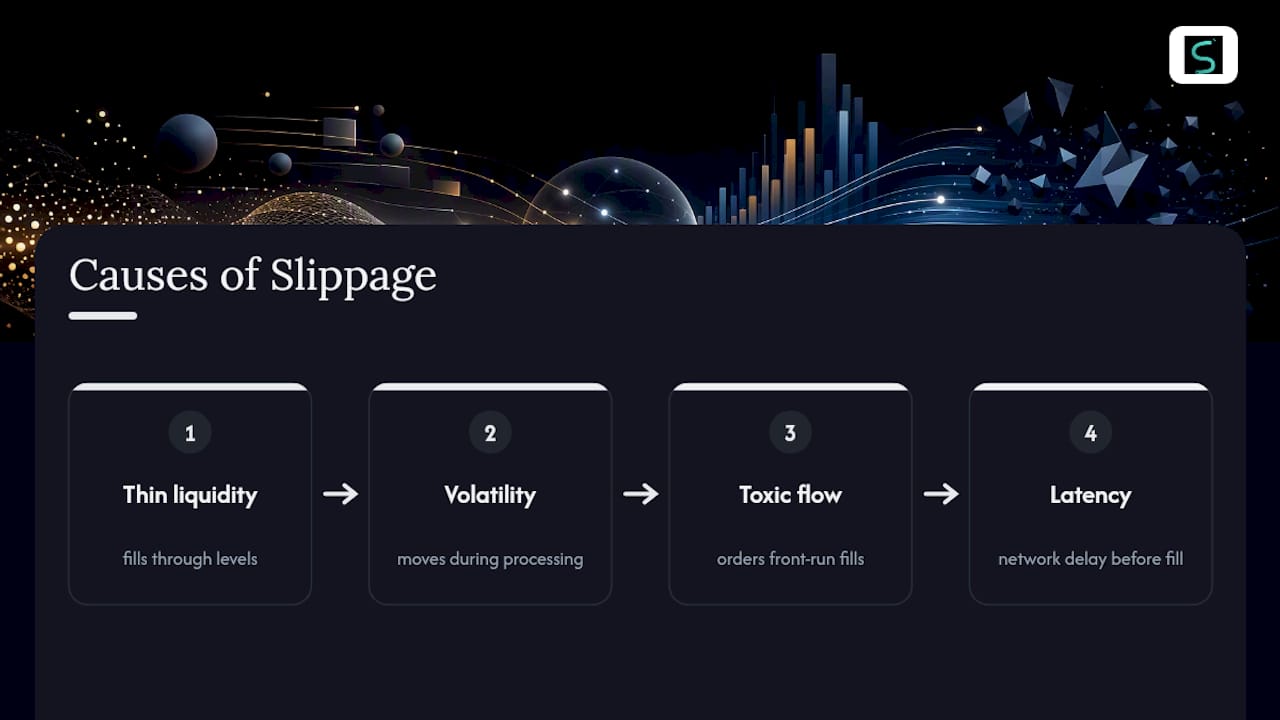
Slippage happens for four overlapping reasons. Thin liquidity means there aren't enough resting orders at your price to fill you cleanly, so your order eats through several price levels. Volatility widens the gap between when you click and when the exchange processes the order. Toxic flow, meaning informed, fast-moving orders arriving right before a price move, can front-run your fill during news releases or liquidity gaps. And latency, the time your order spends traveling from your terminal to the exchange and back, gives the market time to move against you before your order even arrives.
Most scalpers chase strategy tweaks (a new indicator, a tighter stop) when the bigger leak is sitting in their order type, their broker's execution model, or their network path. Fixing those three things typically does more for your bottom line than any signal refinement.
Order Placement And Sizing Tactics You Can Use Today
Market orders guarantee a fill, not a price. For scalpers trading on 1 to 15 minute charts, that's a costly trade-off, because the whole strategy depends on tight entries and exits. Limit orders guarantee a price, not a fill, but for scalpers running high win-rate systems with fast reversals, a missed fill is cheaper than a bad one.
A practical starting point: place limit orders 0.5 to 1.5 pips inside the current quote on liquid forex pairs, or one to two ticks off the bid/ask on futures, then adjust based on your own fill-rate testing. There's no universal number here. Test it against your instrument and session.
- Use IOC (immediate-or-cancel) orders when you want a fast fill attempt without resting exposure. If the market doesn't meet your price instantly, the order cancels rather than sitting exposed.
- Use post-only or maker-preferring flags on exchanges that support them (common on crypto venues) to avoid paying taker fees and reduce your exposure to adverse selection.
- Reserve FOK (fill-or-kill) for larger clips where a partial fill would leave you with an awkward, unhedged position size.
- Split large entries into two or three smaller limit orders across nearby price levels instead of one block order. This reduces the market impact of a single large clip hitting thin depth.
- Build retry logic that waits a few seconds and re-evaluates the spread before resubmitting a canceled order, rather than immediately market-chasing the price.
Session and news timing matter as much as order type. Avoid the first 60 to 90 seconds around high-impact releases (CPI, NFL, FOMC), when spreads widen and liquidity providers pull quotes. Many practitioner scalpers use a tactic sometimes called "ghost entry": placing a resting limit order slightly away from the current price ahead of a session open, letting the market come to you rather than chasing a fast-moving quote. It won't fill every time, but the fills you do get tend to be cleaner.
Pro Tip: *Log every rejected or requoted order for a week.
Which Account Type Actually Reduces Slippage?
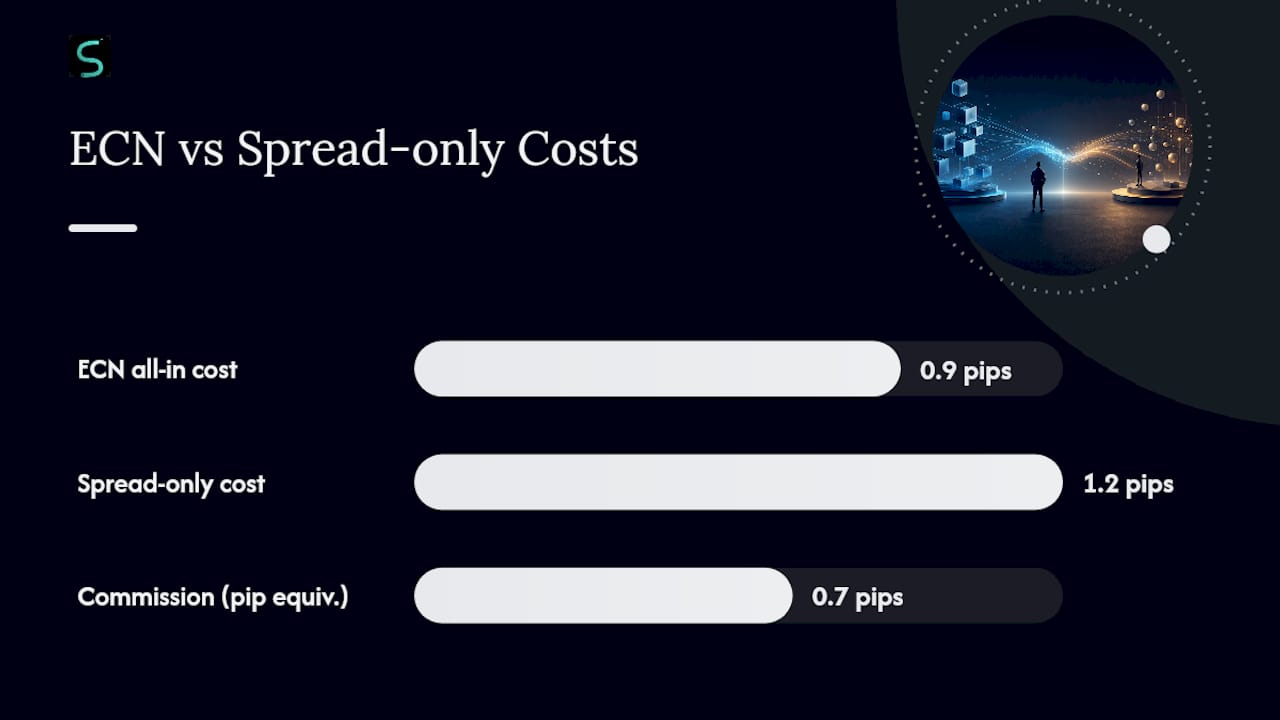
The account model you trade on can matter more than your entry technique. Raw-spread (ECN) accounts charge a per-lot commission but typically offer spreads close to the interbank rate. Spread-only accounts skip the commission but mark up the spread to cover the broker's cost. For scalpers firing dozens of trades a day, the difference compounds fast.
The math is straightforward once you convert commission into pip-equivalents. Say your ECN broker charges $7 per round-turn lot on EUR/USD, and one pip on a standard lot is worth $10. That commission equals roughly 0.7 pips per round trip. If the ECN account's average spread is 0.2 pips, your all-in cost is about 0.9 pips. Compare that to a spread-only account advertising 1.2 pips with no commission. In this case, the raw-spread model wins by roughly 0.3 pips per trade, which adds up quickly across dozens of daily fills. Working through the same conversion with your own broker's numbers is the only way to know which side of that line you sit on.
- ECN tends to win when your trade frequency is high and your average spread markup on a spread-only account exceeds your commission-in-pips.
- Spread-only can still hold up for lower-frequency scalpers or on instruments where the ECN commission structure is disproportionately high relative to trade size.
- Watch for requotes, inconsistent fill prices on identical setups, or a pattern of slippage that only runs against you (never in your favor) — these are signs of poor execution quality, not bad luck.
- Verify broker registration and complaint history through the CFTC before committing meaningful capital, especially with less familiar U.S. brokers.
To test a broker's real fill quality, run 50 to 100 trades of similar size and market condition, log requested price versus executed price for each, and calculate your average slippage in pips. Do this before scaling size, not after.
What Latency And Infrastructure Actually Move The Needle?
Round-trip time, the delay between sending an order and getting confirmation back, is one of the more measurable levers in slippage reduction. Lower RTT reduces the window where price can move against you between click and fill. On certain FX venues, sub-2 millisecond RTT is achievable through direct market access, and while most retail scalpers won't hit institutional colocation numbers, a VPS positioned near your broker's servers can meaningfully close the gap versus running your platform from a home connection three time zones away.
Three infrastructure choices affect this in practice:
- Execution route. A broker API or direct market access route typically shaves meaningful time off a manual GUI click, since the GUI adds rendering and confirmation overhead before the order ever leaves your machine.
- Server location. A VPS hosted in the same data center region as your broker's matching engine cuts network hops, which is the single biggest lever most retail scalpers can control directly.
- Signal delivery. If you're running a trade-copier setup or relaying signals to an execution terminal, batching and server-to-server delivery reduces the delay between signal generation and order placement compared to consumer-grade webhook relays running through a home internet connection.
Whatever your setup, log four timestamps for every trade: quote time, order send time, broker acknowledgment time, and fill time. That data is what turns "I think my broker is slow" into a documented case for switching. Practical engineering guides on trade-copier setups and API routing walk through the specific fixes worth trying first.
Building Execution Filters Into Your Scalping Algorithm
The best slippage control happens before the trade fires, not after. Gating logic that stops your algo from trading during high-risk conditions prevents more damage than any order-type tweak downstream.
- Volatility gating: Use ATR or a comparable volatility measure to pause entries when the reading spikes beyond your normal range, since wide-range candles usually mean thin, fast-moving books.
- Spread gating: Set a maximum spread threshold per instrument. If the live spread exceeds it, skip the trade rather than force a fill into a bad market.
- Session filters: Favor the hours when your instrument's order book is consistently deep. Order-book depth predicts slippage more reliably than volatility alone, which is why the same pair can behave completely differently at 3 AM versus during the London/New York overlap.
- Position and order caps: Limit your maximum number of simultaneously active orders and set hard position caps, so a string of partial fills doesn't leave you overexposed.
- Failover rules: Define what your algo does on a partial fill (cancel the remainder, average in, or hedge) before it happens live, not while you're staring at an open position.
For instruments prone to erratic spot liquidity, some scalpers shift entirely to futures or micro futures contracts, where centralized order books tend to offer more consistent depth than fragmented spot markets.
Pro Tip: Build your volatility and spread gates as hard blockers in the algo itself, not as alerts you're supposed to act on manually. A gate you have to remember to apply is a gate that fails during the exact volatility spike it's meant to catch.
How Do You Measure Your Actual Slippage?
You can't fix what you haven't measured. A reproducible broker-execution test gives you a number instead of a hunch.
- Log five fields per trade: requested price, executed price, spread at time of order, precise timestamp, and order type used.
- Run a paired test. Trade the same strategy simultaneously across two brokers or two account types for a fixed sample, ideally 100 trades or more per side, to control for the fact that market conditions differ minute to minute.
- Calculate average slippage by subtracting requested price from executed price across every trade, then average the result. Calculate standard deviation too. A high average with low deviation means consistent (fixable) markup. A low average with high deviation means occasional bad fills dragging your numbers around.
- Translate slippage into P&L drag by multiplying your average slippage in pips or ticks by your typical position size and trade count per day.
A rough industry benchmark: many scalpers treat average slippage above 1 to 1.5 pips per round trip on major forex pairs as a red flag worth investigating, though the right threshold depends heavily on your instrument and timeframe. If your test shows slippage consistently running against you (never in your favor) across a large sample, that's a pattern, not noise, and it's grounds to renegotiate your account type or move brokers entirely.
How Scalping-Algo Applies These Tactics
Scalping-Algo's suite is built around the exact friction points covered above. Non-repainting signals confirmed on candle close remove the guesswork that causes traders to chase late entries into bad fills. Native webhook alerts push signals straight to Discord or your execution terminal, cutting the manual delay between "I see a signal" and "I placed the order," which is where a lot of retail slippage quietly accumulates. The integrated backtesting dashboard inside the Command Center lets you validate entry timing across historical volatility regimes before risking live capital, and the same dashboard structure supports the kind of fill-quality logging described in the measurement section above.
- Non-repainting, close-confirmed signals reduce late-entry chasing
- Sub-second webhook delivery shortens signal-to-order lag
- Backtesting dashboard supports regime and timing validation
- Command Center centralizes alerts, signals, and education in one place
What Execution Discipline Actually Buys You
Trade frequency and execution quality pull against each other. Every strategy that promises more setups per session is quietly asking you to accept looser fills, and most scalpers only notice the trade-off once they've logged a few hundred trades. Expect measurable improvement in weeks, not days, and expect the gates that block your favorite session to feel wrong before the numbers prove they're right.
— Tran
Put These Tactics On Autopilot With Scalping-Algo
Reading about limit offsets and RTT targets is one thing. Running them consistently, trade after trade, without missing a signal or fat-fingering an entry during a volatility spike, is another. Scalping-Algo is built to close that gap between the tactics above and what actually happens on your chart at 2 AM.
If entry discipline is your weak point, Smart Scalping Signals delivers non-repainting entries with native webhook alerts, so the signal-to-order lag described in the latency section shrinks to whatever your execution route allows. If you're building the volatility and spread gates from the strategy controls section, Edge Finder handles regime detection so your algo knows when liquidity conditions favor a trade. And if you want to see the timing math for yourself before committing, the Momentum Oscillator is built to work alongside both inside the same Command Center dashboard.
None of this replaces the broker-execution test outlined earlier. Run that paired test against your own account before scaling size, regardless of which tools sit on your chart. Then explore the full plan lineup — Monthly at $79, Yearly at $799, or Lifetime access at $1,999, all with full indicator suite and Discord alert access included.
Sources
FAQ
What is the most successful scalping strategy?
There's no single "most successful" scalping strategy, since results depend heavily on instrument, timeframe, and execution quality. What separates consistently profitable scalpers is less the entry signal and more the execution discipline: limit-based entries, liquid trading hours, and a broker model matched to trade frequency.
How do you reduce slippage in trading?
The biggest levers are using limit or IOC orders instead of market orders, trading during high-liquidity sessions, and cutting latency through a VPS or direct API route instead of a manual GUI. Slippage itself is defined as the gap between expected and executed price, and each of these tactics narrows that gap at a different point in the trade lifecycle.
What is the 3-5-7 rule in trading?
Definitions vary depending on the source, and it's not a standardized industry term with a single agreed meaning. Some traders use it as a risk-management shorthand for capping risk per trade, per day, and per week, but treat any specific version with caution rather than as an established rule.
What counts as a good slippage percentage?
Many active scalpers treat average slippage above 1 to 1.5 pips per round trip on major forex pairs as worth investigating, though the acceptable threshold depends on your instrument, timeframe, and typical spread. The only reliable way to know your own number is to log requested versus executed price across a real sample of trades, as outlined in the measurement section above.
Does Scalping-Algo help reduce slippage directly?
Scalping-Algo doesn't control your broker's execution engine, but its non-repainting signals and native webhook alerts cut the manual delay between signal and order placement, which is one of the contributors to slippage. Current plan pricing and full indicator access are listed on the Scalping-Algo site.