

Trade entry timing is defined as the exact moment a trader executes an order relative to a confirmed market signal, and it directly controls the risk-to-reward ratio of every trade you take. Most retail traders obsess over direction. They spend hours identifying the right setup, the right trend, the right asset. Then they enter late, and the trade fails. Not because the direction was wrong. Because the timing destroyed the math. The importance of trade entry timing goes far beyond picking the right moment. It determines whether a mathematically positive setup actually pays out. Institutional models like Almgren-Chriss and the Implementation Shortfall framework prove this. Every second of delay increases adverse price exposure and shrinks your potential reward before you even hold a position.
Why does delayed entry destroy your risk-to-reward ratio?
A 15-point entry delay on NQ futures increases risk by 30% and decreases potential reward by 9%, combining to a 40% degradation in risk-to-reward ratio. That number is not abstract. It means a setup that should pay 3:1 now pays less than 2:1, and your stop is wider, so your dollar risk per trade is also larger.
The mechanics are straightforward. When you enter late, price has already moved away from the ideal level. Your stop must sit below a structure point that is now farther from your entry. Your target has not moved. So reward shrinks and risk expands simultaneously. This is stop expansion and reward shrinkage working against you at the same time.

| Entry Scenario | Stop Distance | Reward Potential | Risk-to-Reward |
|---|---|---|---|
| On-time entry (at signal) | Tight, near structure | Full move available | 3:1 or better |
| 1 candle late | Slightly wider | Partial move remaining | ~2:1 |
| 3+ candles late | Wide, past structure | Tail end of move only | Below 1:1 |
The confirmation tax is what traders pay when they wait for candle closes before acting. Waiting for a candle to close feels safe. It is not. It adds implementation shortfall and price slippage, turning positive expectancy setups into negative expectancy before you even click the button.
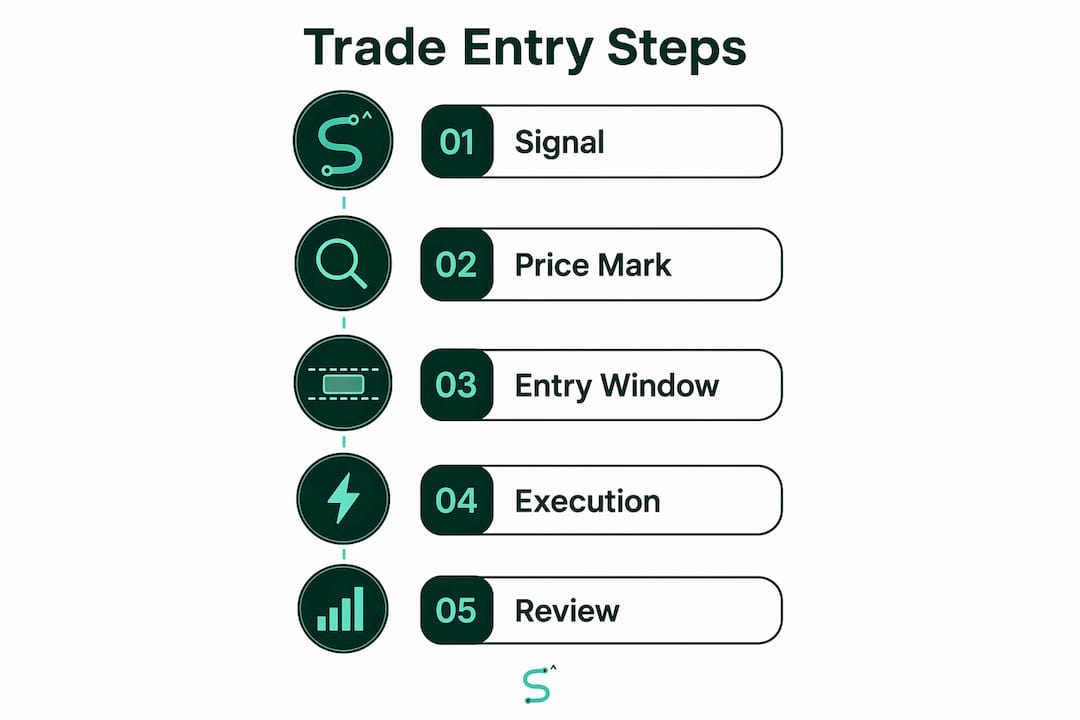
The 1–3 candle rule addresses this directly. If your signal fires, you have a window of one to three candles to execute. After that, the setup's original math no longer applies. You are trading a different setup with worse numbers.
Pro Tip: Pre-mark your entry price before the signal fires. When the level activates, execute immediately. Do not wait for the candle to close.
What is the Optimal Trade Entry (OTE) zone?
The Optimal Trade Entry zone, a concept from Smart Money Concepts, defines the 62%–79% Fibonacci retracement range as the institutional entry sweet spot. This is where institutional traders tend to enter after a displacement move, and where retail traders can align their entries for the best possible risk-to-reward balance.
The midpoint of this zone sits at 70.5% retracement. That level acts as a mean threshold. Entering at 70.5% gives you a stop below the swing low with a tight distance, while the full projected move remains available as your target. Entries above 62% or below 79% still fall within the zone, but 70.5% offers the tightest stop relative to reward.
Smart Money Concepts also explains why retail traders consistently get stopped out. They enter at breakouts, which are often liquidity grabs by institutional players. Institutions sell into retail buying at highs, then reverse. The OTE zone is where institutions actually build positions after sweeping liquidity. Aligning your entries with these levels puts you on the same side of the trade as the money that moves markets.
For practical application, resources covering institutional entry models provide useful context on how Fibonacci retracement zones interact with market structure. The key takeaway is that the OTE zone is not a prediction tool. It is a probability filter. Entries inside the zone have a higher probability of a tight stop and a full reward move.
Pro Tip: Mark the 62%, 70.5%, and 79% retracement levels on every setup before the session opens. Wait for price to enter the zone before executing.
How does timing differ across scalping, day trading, and swing trading?
Trade execution timing matters most for scalpers and day traders. For swing traders, the impact is measurably smaller. Research shows that delays of up to 40 trading days reduce average 12-month swing trading returns by less than 3 percentage points. That is a meaningful but not catastrophic difference. For a scalper, a 3-candle delay can be catastrophic.
The reason comes down to timeframe math. A scalper targeting 10 points on NQ with a 5-point stop has no margin for error. A swing trader targeting a 20% move over three months can absorb a slightly worse entry because the reward is large enough to cover the slippage. This does not mean swing traders should ignore timing. It means the consequences of poor timing are compressed into a smaller impact on the overall return.
Here is how timing applies across each style:
- Scalpers (1m–5m charts): Timing is the primary edge. Every candle counts. Entries must occur within the 1–3 candle window after signal confirmation. Liquidity bursts and session opens are the highest probability windows.
- Day traders (5m–15m charts): Timing is critical but slightly more forgiving. The ICT Macro Time strategy identifies 20–30 minute windows of institutional algo activity at session opens and key liquidity sweeps. Aligning entries with these windows improves execution quality significantly.
- Swing traders (daily–weekly charts): Timing matters for entry quality but not for trade survival. Swing traders benefit more from cycle-based entry frameworks that align entries with intermediate market rhythms and structural crossovers. Rigid time-based exits, like closing a position at a fixed clock time, consistently underperform exits based on price structure.
The critical mistake traders make is applying scalping timing rules to swing trades, or applying swing trade patience to scalping setups. Each style requires a calibrated approach to when you pull the trigger.
How do you improve trade entry timing in live markets?
Timing trades effectively in live markets requires preparation before the session, not reaction during it. Institutional execution algorithms like Almgren-Chriss front-load entries to minimize implementation shortfall. Retail traders can apply the same principle by deciding entry levels in advance and executing mechanically when price arrives.
-
Pre-mark key levels before the session opens. Identify the OTE zone, prior day highs and lows, and any open fair value gaps. These are your activation levels. When price reaches them, you execute. You do not deliberate.
-
Target macro liquidity windows. The ICT Macro windows last 20–30 minutes and occur at predictable times around session opens and major news releases. Institutional algos become hyperactive during these windows. Entries taken inside these windows benefit from higher order flow and tighter spreads.
-
Use multi-timeframe confirmation, not multi-timeframe delay. Check the higher timeframe for trend direction and structure. Execute on the lower timeframe when price enters your pre-marked zone. Do not wait for the higher timeframe candle to close. That is a confirmation delay disguised as discipline.
-
Apply the 1–3 candle rule strictly. After your signal fires, you have three candles to enter. If you miss that window, mark the trade as a missed opportunity and wait for the next setup. Chasing a setup after three candles is not trading. It is gambling with worse odds.
-
Separate entry timing from exit timing. Time-based exit rules that force you to close at a fixed clock time destroy edge. Exit based on price structure, not the clock. Entry timing is about speed and precision. Exit timing is about patience and structure.
-
Build a pre-session checklist. A structured day trading checklist forces you to mark levels, identify macro windows, and set alerts before the market opens. Traders who prepare this way execute faster and with less hesitation when the moment arrives.
Trade entry timing also improves when you recognize that institutional liquidity activation and momentum convergence create the highest probability windows. When liquidity, momentum, and your pre-marked level all align, execution becomes mechanical. Emotion drops out of the equation.
Pro Tip: Set price alerts at your OTE zone levels before the session. When the alert fires, you execute. No second-guessing. The decision was already made.
For traders who want to go deeper on advanced scalping entry methods, combining OTE zones with liquidity sweep confirmation produces the tightest entries and the best risk-to-reward ratios on lower timeframes.
Key Takeaways
Trade entry timing controls risk-to-reward math directly, and a delay of even one candle can convert a winning setup into a losing trade before you hold a position.
| Point | Details |
|---|---|
| Delayed entry degrades R:R | A 15-point NQ delay increases risk by 30% and cuts reward by 9%, a combined 40% R:R loss. |
| OTE zone targets 62%–79% retracement | The 70.5% Fibonacci midpoint offers the tightest stop with the full reward move still available. |
| Timing impact varies by style | Scalpers and day traders lose edge fast with late entries; swing traders absorb delays better. |
| Pre-session preparation drives speed | Marking levels and setting alerts before the open removes hesitation and enables fast execution. |
| Macro windows improve execution quality | ICT Macro windows of 20–30 minutes concentrate institutional order flow for higher probability entries. |
The uncomfortable truth about timing I had to learn the hard way
Most traders I have worked with believe their edge lives in their analysis. They think if they read the chart correctly, the trade will work. I believed that too, for longer than I want to admit. The uncomfortable truth is that correct analysis with a late entry often performs worse than a slightly imperfect analysis with a well-timed entry.
The moment that changed my thinking was tracking my own trades over a three-month period. I had a high directional accuracy rate. My win rate on direction was strong. But my profit factor was mediocre. When I audited the losing trades, the pattern was clear. I was entering one to three candles late on nearly every setup. The direction was right. The timing was wrong. The math was broken before I even held the position.
The mindset shift required here is not about being faster. It is about deciding earlier. Preparation before the session is what creates speed during the session. When you have already decided that you will enter at the 70.5% retracement level if price gets there, execution becomes a reflex. You are not making a decision in real time. You are executing a plan you already made.
Patience and decisiveness are not opposites in trading. Patience means waiting for price to reach your pre-marked level. Decisiveness means executing the instant it does. Traders who confuse patience with hesitation miss entries. Traders who confuse decisiveness with impulsiveness chase entries. The discipline is in the preparation, not the click.
— Tran
Scalping-algo tools built for precise trade entries
Knowing the theory behind trade entry timing is one thing. Executing it in real time on a live chart is another. Scalping-algo builds premium TradingView indicators specifically for retail scalpers and day traders who need fast, non-repainting signals on 1m–15m timeframes.
The Scalping-algo indicator suite generates real-time buy and sell signals with built-in confluence tools, volatility gating, and divergence detection. These tools align directly with the principles covered here: front-loaded execution, liquidity activation signals, and tight entry zones. The Algo Master system combines three indicators designed to identify OTE-aligned entries and alert you the moment a high-probability window opens. For retail traders who want institutional-grade execution without building their own algorithms, this is the practical next step.
FAQ
What is trade entry timing in day trading?
Trade entry timing is the practice of executing a trade order at the exact moment a market signal activates, relative to price structure and liquidity. Timing directly controls stop distance and reward potential, making it a core component of risk management.
How much does a late entry affect profitability?
A 15-point delay on NQ futures degrades risk-to-reward by approximately 40%, combining a 30% increase in risk with a 9% reduction in potential reward. Even a one-candle delay can convert a positive expectancy setup into a negative one.
What is the OTE zone and how does it improve entry timing?
The Optimal Trade Entry zone is the 62%–79% Fibonacci retracement range where institutional traders tend to build positions after a displacement move. Entering at the 70.5% midpoint gives retail traders the tightest stop with the full projected reward move still available.
Does entry timing matter for swing traders?
Swing trading is less sensitive to entry timing than scalping or day trading. Research shows that delays of up to 40 trading days reduce average 12-month returns by less than 3 percentage points, making trend quality and cycle structure more important than split-second execution for swing traders.
What is the 1–3 candle rule for trade entries?
The 1–3 candle rule states that a trader must execute within one to three candles after a signal fires. Entries taken after this window catch the tail end of the move, not the optimal liquidity point, and carry significantly worse risk-to-reward ratios.