

An effective exit strategy in trading is a predefined plan to close positions that maximizes gains and limits losses. Most traders obsess over entries, but trade exits determine roughly 70% of a trade's outcome versus only 30% from the entry. That single fact rewrites how you should allocate your preparation time. This guide to exit strategies trading covers the core techniques, from stop-loss placement and reward-to-risk ratios to trailing stops and partial exits, so you can build a trading exit plan grounded in math, not emotion.
What are the essential components of a trading exit strategy?
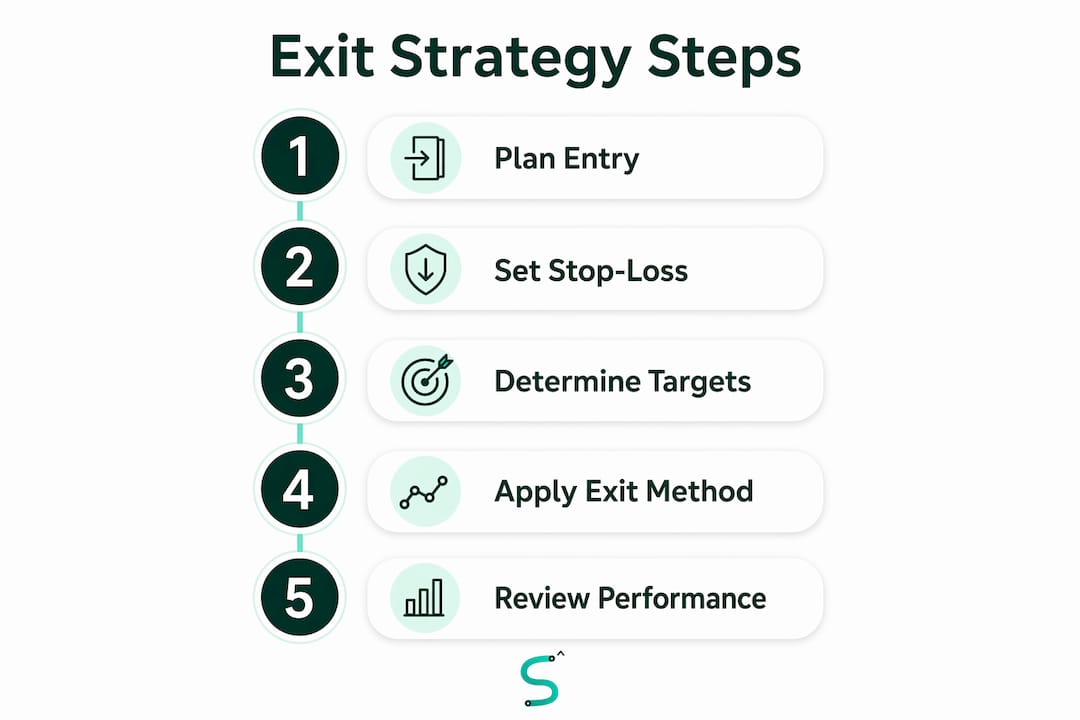
Every exit plan starts with two conditional orders placed before you enter the trade: a stop-loss and a take-profit. Setting them after entry is one of the most expensive habits in trading. The market does not wait for you to decide.
The industry standard for position sizing ties directly to your stop-loss placement. Risk only 1–2% of total account capital per trade. That threshold exists because volatile markets can string together losing streaks that wipe out undisciplined traders fast. Keeping losses small per trade gives your edge time to play out across hundreds of trades.

Your take-profit level should reflect a minimum reward-to-risk ratio of 1:1.5. For every dollar you risk, target at least $1.50 in return. Below that threshold, your win rate needs to be unrealistically high to stay profitable over time. Most traders underestimate how much this ratio shapes long-term expectancy.
The three non-negotiable components of any exit plan are:
- Stop-loss order: Set as a conditional order before entry. Never adjust it wider after the trade opens.
- Take-profit target: Based on technical levels and a minimum 1:1.5 reward-to-risk ratio, not gut feel.
- Position size: Calculated so that hitting the stop-loss costs no more than 1–2% of your account.
Pro Tip: Use bracket orders to place your stop-loss and take-profit simultaneously at entry. This removes the temptation to second-guess your plan mid-trade and automates exit execution so emotion never gets a vote.
Check your risk management checklist before every session to confirm these three elements are in place for each position you plan to take.
How do different exit methods work and when to apply them?
Three primary exit methods exist: full exit, partial (scale-out) exit, and trailing stop. Each one fits a different trading style and return profile. Picking the wrong method for your strategy is one of the most overlooked reasons traders underperform.
Full exit at a fixed target
A full exit closes 100% of the position when price hits your predetermined target. This method works best in high win-rate strategies and mean-reversion setups where price tends to snap back to a level and then stall. It produces consistent, predictable results and keeps your expectancy calculation clean.
Partial staggered exit (scale out)
A partial exit closes a portion of the position at the first target and lets the remainder run. A common split is closing 30% at the first target and letting 70% continue toward a larger objective. This approach locks in some profit early while keeping exposure to a bigger move. It suits swing traders and scalpers who see setups with two distinct price objectives.
Trailing stop
A trailing stop moves your exit level in the direction of the trade as price advances. Trailing stops set at 1.5–2× ATR distance filter out normal price noise and keep you in the trade during trend extensions. This method suits trend-following strategies where the final target is unknown but the direction is clear.
| Exit method | Best strategy fit | Key advantage | Main risk |
|---|---|---|---|
| Full exit | Mean-reversion, high win-rate | Predictable expectancy | Misses large trend moves |
| Partial scale-out | Swing, hybrid setups | Locks gains, captures extensions | Reduces average win size |
| Trailing stop | Trend-following | Lets winners run | Whipsaw in choppy markets |
Matching your exit method to your strategy type can improve profitability by 20–40%. That gap is not a minor optimization. It is the difference between a strategy that works and one that bleeds slowly.
For scalping setups specifically, understanding staggered partial exits in the context of lower timeframe structures helps you apply these methods with precision.
How do you determine optimal exit points using market structure?
Exit placement is not guesswork. It requires reading the market's own structure and measuring volatility to set levels that make technical sense.
Support and resistance levels are the most reliable anchors for fixed take-profit targets. Price tends to react at these zones because large numbers of orders cluster there. Setting your target just before a major resistance level, rather than at it, increases the probability of a full fill before price reverses.
Exiting at round numbers or arbitrary price points is one of the most common errors in retail trading. Round numbers attract attention, which means they attract stop hunts and liquidity grabs. Professional exits sit at structurally significant levels, not psychologically convenient ones.
ATR (Average True Range) is the standard tool for calibrating stop-loss and trailing stop distances to actual market volatility. Read more about applying ATR in the volatility indicators guide to understand how to size your exits to the instrument you are trading.
Time-based exit rules add a third dimension to your plan. Closing a trade after a set period if price has not moved favorably frees up capital and reduces exposure to stagnant setups. A trade that goes nowhere for two hours is not a safe trade. It is dead capital.
Pro Tip: Before placing a trade, mark the nearest support and resistance zones on your chart. Set your take-profit target just inside the nearest opposing zone, not at it. This one habit alone will improve your fill rate on exits.
Key rules for structurally sound exit placement:
- Anchor take-profit targets to support/resistance zones, not round numbers.
- Use ATR multiples (1.5–2×) to set stop-loss and trailing stop distances.
- Apply time-based rules: exit or re-evaluate if price stagnates beyond your expected window.
- Avoid placing exits at obvious psychological levels where stop hunts are common.
What are the most common exit strategy mistakes to avoid?
Most traders lose money not because their entries are wrong, but because their exits are undisciplined. The mistakes below are the most damaging and the most preventable.
-
Moving the stop-loss wider after entry. This is the single most destructive habit in trading. Widening a stop-loss after opening a position converts a controlled risk into an open-ended emotional loss. The original stop was placed for a reason. Removing it removes your protection.
-
Exiting early due to impatience. Price rarely moves in a straight line to your target. Normal pullbacks and consolidation phases trigger premature exits in traders who have not defined their tolerance for noise. Set your stop-loss to absorb normal volatility and then let the trade work.
-
Using partial exits for comfort, not math. Retail traders overuse scale-outs because taking some profit feels safer than holding. But if your strategy has a high win rate and a fixed target, partial exits reduce your average win without improving your win rate. The math does not support comfort-based exits.
-
Ignoring time-based exit rules. A trade that sits flat for hours is consuming margin and attention. Time rules force you to re-evaluate and redeploy capital where the setup is still valid.
"Psychological discipline to predefine and stick to exit plans is more important than entry quality for sustained trading success. Superior exits can recover from poor entries. Poor exits squander good entries."
Reviewing your common trading mistakes regularly keeps these patterns visible before they become expensive habits.
Key Takeaways
Effective exit strategies, built on predefined stop-loss orders, a minimum 1:1.5 reward-to-risk ratio, and method-to-strategy alignment, determine the majority of your trading results.
| Point | Details |
|---|---|
| Exits drive outcomes | Trade exits account for roughly 70% of a trade's result, making exit planning your top priority. |
| Risk 1–2% per trade | Set stop-loss as a conditional order before entry and never risk more than 2% of account capital. |
| Match method to strategy | Full exits suit mean-reversion; trailing stops suit trends; partial exits suit hybrid setups. |
| Use market structure | Anchor exits to support/resistance zones and ATR multiples, not round numbers. |
| Automate your exits | Bracket orders remove emotional decision-making and enforce your plan at execution. |
Why exit management is the skill most traders ignore
I have reviewed hundreds of trade journals over the years, and the pattern is always the same. Traders spend 80% of their prep time on entries and almost none on exits. Then they wonder why a solid setup turned into a losing trade.
The uncomfortable truth is that your entry is almost irrelevant compared to what you do after. A mediocre entry with a disciplined exit plan will outperform a perfect entry managed emotionally. I have seen traders with genuinely good signal quality blow accounts simply because they moved stops, exited early, or held losers past their defined limit.
The fix is not a better indicator. The fix is a written exit plan for every trade before you place it. That plan should specify your stop-loss level, your take-profit target, your exit method, and your time rule. When the trade is live, your only job is to follow the plan. Reviewing your exits in a journal after each session, noting where you deviated and why, is how you actually improve over time.
Automated exits, through bracket orders or alert-based systems, remove the moment of hesitation that costs traders the most. When the system handles execution, you are not deciding under pressure. You are just observing. That shift alone changes how you trade.
— Tran
How Scalping-algo supports your exit execution
Timing exits on lower timeframes is where most traders struggle most. The 1-minute to 15-minute charts move fast, and manual decisions under pressure lead to the exact mistakes covered above.

Scalping-algo's premium TradingView indicators generate real-time, non-repainting buy and sell signals with built-in volatility gating and divergence detection, giving you objective exit signals rather than gut-feel decisions. The platform's Smart Scalping Signals indicator delivers automated alerts directly to Discord via native webhooks, so your exit triggers fire without hesitation. Combined with the Command Center dashboard for backtesting and the active Discord community for live mentorship, Scalping-algo gives you the infrastructure to execute your exit plan consistently, trade after trade.
FAQ
What is a trading exit strategy?
A trading exit strategy is a predefined plan that specifies when and how to close a position. It includes a stop-loss order, a take-profit target, and rules for adjusting or exiting based on time or market conditions.
What reward-to-risk ratio should I target for exits?
The minimum recommended reward-to-risk ratio is 1:1.5, meaning you target at least $1.50 in profit for every $1.00 risked. Ratios below this require an unrealistically high win rate to stay profitable.
When should I use a trailing stop instead of a fixed target?
Use a trailing stop in trend-following strategies where price direction is clear but the final target is uncertain. Set the trail at 1.5–2× ATR to filter noise and let winning trades run further.
How do I avoid moving my stop-loss wider during a trade?
Place your stop-loss as a conditional order at entry and do not touch it after the trade opens. Using bracket orders automates this discipline and removes the option to widen the stop under emotional pressure.
How does a partial exit differ from a full exit?
A partial exit closes a portion of the position at the first target and holds the rest for a larger move. A full exit closes everything at one target. Partial exits suit hybrid setups; full exits suit high win-rate, mean-reversion strategies.