

A trader risk management checklist is a multi-layered, repeatable system that verifies position sizing, loss limits, correlation exposure, and psychological readiness before and during every trading session. Without one, even technically skilled traders blow accounts. The difference between traders who survive long-term and those who don't almost always comes down to whether they follow a structured risk management system before entering any position. This guide breaks down every layer of that system so you can build and use one starting today.
1. What does a trader risk management checklist cover?
A complete trading risk assessment checklist operates across four distinct layers: position sizing, stop-loss placement, daily and weekly loss limits, and account drawdown protocols. Risk management is a 4-layer system where all layers must work together. Skipping any single layer eventually destroys an account.
Each layer serves a specific function. Position sizing limits how much you lose on any one trade. Stop-loss placement defines your exit before you enter. Daily limits act as circuit breakers. Drawdown protocols force you to pause or reduce size when your account takes a serious hit.

Pro Tip: Print your checklist and fill it out by hand before each session. Physical checklists engage your analytical thinking and reduce impulsive decisions.
2. Per-trade risk limits and position sizing
Professional traders limit risk per trade to between 0.5% and 2% of total account equity. That number is not arbitrary. Losing 1% of your account requires only a 1.01% gain to recover. Losing 20% requires a 25% gain just to break even. The math compounds fast in the wrong direction.
Position sizing is the calculation that enforces this limit. You divide your dollar risk per trade by the distance between your entry and stop-loss to get your share or contract size. This turns your risk limit from a vague intention into a hard number before you place the order.
Your checklist item here is simple: calculate position size mathematically before every trade, not after. Guessing size is not a strategy. It is a liability.
3. Daily loss limits as circuit breakers
Hard daily loss limits of 2% to 5% reduce maximum drawdowns by 34% compared to traders who trade without them. The recommended daily limit is often set at three times your per-trade risk amount. If you risk 1% per trade, your daily limit is 3%.
When you hit that limit, you stop trading for the day. No exceptions. Uncontrolled trading after hitting a daily limit is the primary cause of account blow-ups. The emotional state after a string of losses is the worst possible condition for making trading decisions.
Your checklist item: write your daily loss limit in dollar terms before the session opens. When you reach it, close your platform.
4. How to build a pre-trade checklist that actually works
Pre-trade checklists verify 7 to 10 criteria before order submission. The minimum recommended risk-reward ratio is 1:2 for long-term profitability. Every item on the list must pass before you take the trade. If one fails, you skip the trade entirely.
A practical pre-trade checklist for active traders includes these steps:
- Setup validation. Does the price action match your defined entry pattern?
- Higher timeframe alignment. Is the trade direction consistent with the trend on the next timeframe up?
- Risk-reward ratio. Is the ratio at least 1:1.5, ideally 1:2 or better?
- Position size calculated. Have you done the math using your entry, stop, and account size?
- News check. Are there any earnings releases, Fed announcements, or major economic events within the next 30 minutes?
- Emotional state check. Are you trading from a calm, focused state, or are you chasing a loss?
- Stop-loss placed. Is your stop defined and entered before the trade goes live?
Trading risk management checklists enforce deliberate thinking to prevent emotional and impulsive entries. The checklist is not bureaucracy. It is the process that separates execution from gambling.
Pro Tip: Review your day trading checklist before every session, not just when you feel uncertain. Discipline applied consistently beats discipline applied selectively.
5. Monitoring and adjusting risk over time
Ongoing tracking turns your checklist from a static document into a living system. Weekly portfolio audits comparing planned versus actual trades help you identify where your risk management slips. You find the gaps only when you look for them.
The table below shows a practical drawdown management protocol every trader should follow:
| Drawdown Level | Action Required |
|---|---|
| 5% from peak | Reduce position size to 75% of normal |
| 10% from peak | Cut position size to 50% of normal |
| 20% from peak | Stop trading entirely, review system |
| Daily limit hit | Close platform, no more trades that day |
Account drawdown protocols call for size reductions at 5%–10% and a full stop at 20%. These thresholds are not suggestions. They are the rules that keep a bad week from becoming a blown account.
Log every trade and tag it as rule-followed or rule-broken. Post-trade audits tagging trades this way allow you to refine your edge over time. Traders who skip this step repeat the same mistakes across hundreds of trades without ever knowing why their results stay flat.
6. How layered risk rules prevent catastrophic losses
The three-tiered system of per-trade limits, daily caps, and drawdown protocols creates nested safety nets. Each layer catches what the previous one misses. Position sizing limits the damage from any single bad trade. Daily limits stop a bad morning from becoming a bad month. Drawdown protocols prevent a bad month from ending your trading career.
| Risk Layer | What it controls | What happens without it |
|---|---|---|
| Position sizing | Loss per trade | One trade wipes a large portion of equity |
| Daily loss limit | Loss per session | Emotional revenge trading destroys the account |
| Drawdown protocol | Loss per month | No recovery point, account blown |
| Correlation control | Simultaneous losses | Related positions amplify a single market move |
Correlation risk requires treating positions above 0.7 correlation as one larger trade for risk budgeting. If you hold two positions in assets that move together, you are not diversified. You are doubling your exposure while thinking you are spreading it.
Most traders fail because they ignore multi-layer risk management. The failure is not usually one catastrophic decision. It is the slow erosion that happens when one or two layers are missing and the market eventually finds that gap.
7. Psychological readiness as a checklist item
Psychological readiness is not a soft concept. It is a hard checklist criterion. Before every session, rate your emotional state on a simple 1 to 5 scale. If you score below 3, reduce your position size or sit out entirely.
Common psychological red flags to check before trading include: trading after a major personal stressor, trading to recover yesterday's losses, feeling overconfident after a strong winning streak, and trading while fatigued or distracted. Any one of these conditions degrades decision quality. The checklist forces you to confront them before they cost you money.
Psychological discipline and numeric limits work together. The numbers tell you how much to risk. Your mental state determines whether you will actually follow those numbers when the market moves against you.
Key takeaways
A complete trader risk management checklist combines position sizing, daily loss limits, drawdown protocols, and psychological readiness checks into one repeatable system that protects capital at every level.
| Point | Details |
|---|---|
| Per-trade risk limit | Risk no more than 0.5%–2% of account equity on any single trade. |
| Daily loss limit | Set a hard daily cap at 2%–5% and stop trading the moment you hit it. |
| Drawdown protocol | Cut size at 5% and 10% drawdown; stop trading entirely at 20%. |
| Pre-trade checklist | Verify setup, trend, risk-reward, news, and emotional state before every entry. |
| Weekly audit | Compare planned versus actual risk each week to catch slippage early. |
What I've learned from using a checklist every single day
The first time I printed a physical checklist and committed to filling it out before every session, I felt like I was slowing myself down. That feeling passed within a week. What replaced it was clarity. I stopped second-guessing entries because the checklist had already done the work.
The hardest item on any checklist is the emotional state check. Traders skip it because it feels subjective. But I have watched more accounts take serious damage from a bad psychological state than from a bad setup. The math of risk management is straightforward. The psychology is where most traders quietly break their own rules.
My advice: never treat the checklist as optional on good days. The days you feel most confident are often the days you take on too much size or skip the news check. Discipline applied only when you feel uncertain is not discipline. It is a habit that only shows up when it is already too late.
Adapt your checklist to your style and timeframe. A scalper on the 1-minute chart needs faster checks than a swing trader. But never remove a layer entirely. The layers exist because each one protects against a specific failure mode. Remove one, and that failure mode is now undefended.
— Tran
How Scalping-algo supports your risk management practice
Scalping-algo builds tools specifically for traders who take checklist discipline seriously. The platform's TradingView indicators generate real-time, non-repainting signals on timeframes from 1m to 15m, giving you objective setup validation as a checklist input rather than a gut call. Volatility gating and confluence filters mean the system only signals when conditions meet defined criteria.
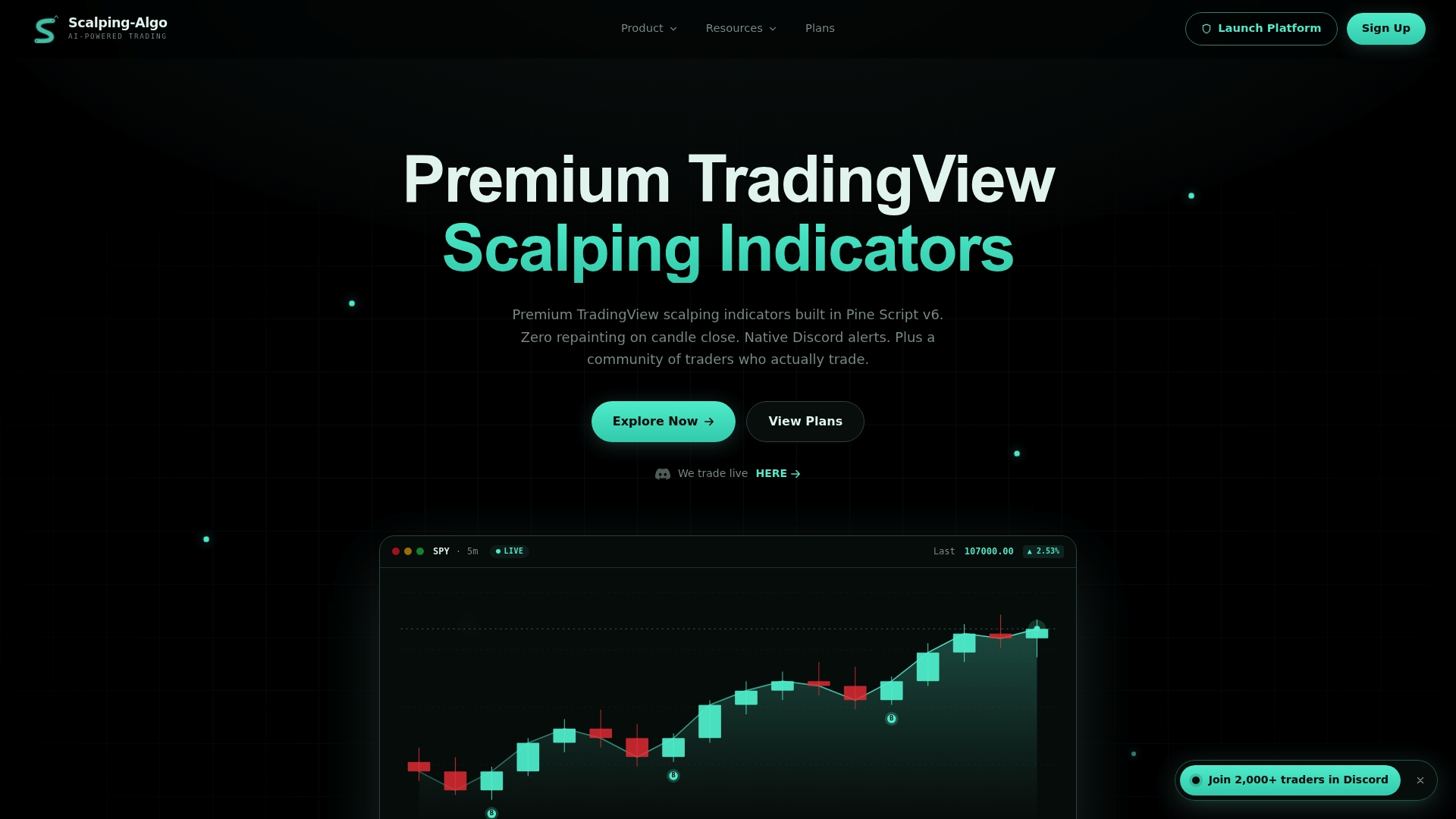
The Algo Master indicator suite integrates directly with your pre-trade process, flagging entries that align with trend, momentum, and risk-reward thresholds. Native webhook alerts push signals to Discord so you never miss a setup that fits your rules. Explore the full suite of professional scalping indicators and see how they fit into your checklist workflow.
FAQ
What is a trader risk management checklist?
A trader risk management checklist is a structured set of criteria verified before and during each trading session, covering position sizing, loss limits, stop-loss placement, and psychological readiness. Its purpose is to enforce consistent, rule-based decisions and prevent impulsive trades.
How much should I risk per trade?
Professional traders risk between 0.5% and 2% of total account equity per trade. Keeping risk at 1% means a losing trade requires only a 1.01% gain to recover.
What is a good daily loss limit for traders?
A daily loss limit of 2%–5% of account equity is the standard range. Setting it at three times your per-trade risk amount is a practical rule that gives you enough room to trade while capping session damage.
When should I stop trading due to drawdown?
Reduce position size to 75% at a 5% drawdown, cut to 50% at 10%, and stop trading entirely at 20%. These thresholds prevent a losing streak from compounding into an unrecoverable account loss.
Why does psychological readiness belong on a risk checklist?
Emotional states like loss-chasing, overconfidence, and fatigue directly degrade decision quality. Checking your mental state before each session is a concrete risk control, not a soft suggestion.