

Most traders blow accounts not from bad entries but from bad risk controls. You can have a 60% win rate and still end up in the red if your losses dwarf your winners. This guide to risk management in trading covers everything from the foundational one-percent rule to volatility-adjusted stops, layered loss limits, and the daily routines that separate disciplined traders from the ones who keep starting over. Whether you trade crypto, forex, futures, or indices, these techniques apply directly to your setup right now.
Table of Contents
- Key Takeaways
- The guide to risk management in trading fundamentals
- Building a layered risk management system
- Advanced risk controls: volatility, margin, and market regimes
- Building your daily risk management routine
- My take on what most traders get wrong
- Put your risk plan into action with Scalping-Algo
- FAQ
Key Takeaways
| Point | Details |
|---|---|
| Use the one-percent rule | Never risk more than 1% of your account on a single trade to protect capital through losing streaks. |
| Build a layered defense | Stack position sizing, stop losses, daily limits, and drawdown tiers to cover every risk dimension. |
| Adjust stops for volatility | Widen stop distances during high-volatility sessions to avoid premature exits on normal noise. |
| Journal every trade | Track planned vs. actual risk on each trade to catch execution errors before they compound. |
| Know when to stop trading | Hitting your daily or weekly loss cap is a signal to pause, not push harder. |
The guide to risk management in trading fundamentals
Risk management starts with one non-negotiable principle: protect the capital first. The one-percent rule means on a $10,000 account, your maximum loss per trade is $100. Some traders stretch this to 2% during high-conviction setups, but 1% is the standard that keeps you in the game through losing streaks.
Position sizing flows directly from that number. The formula is straightforward:
- Decide your dollar risk per trade (1% of account).
- Identify your stop-loss level based on where the trade is technically invalidated.
- Calculate position size: dollar risk divided by stop distance in points or pips.
- Place both your stop loss and take-profit before entering.
That fourth step matters more than most traders realize. Pre-defining your exit points removes the temptation to make emotional decisions mid-trade. A stop loss placed at a technical invalidation point reflects where your trade thesis is genuinely wrong, not just where it feels uncomfortable.
Here is a quick example. You trade ETH/USD with a $20,000 account. Your 1% risk limit is $200. Your technical stop sits $40 below your entry. Your position size is $200 divided by $40, which equals 5 contracts or units. Simple, repeatable, and unemotional.
Pro Tip: Set your stop loss at the same time as your entry order. If you enter without a stop, you are already violating your risk plan before the trade even develops.
Building a layered risk management system
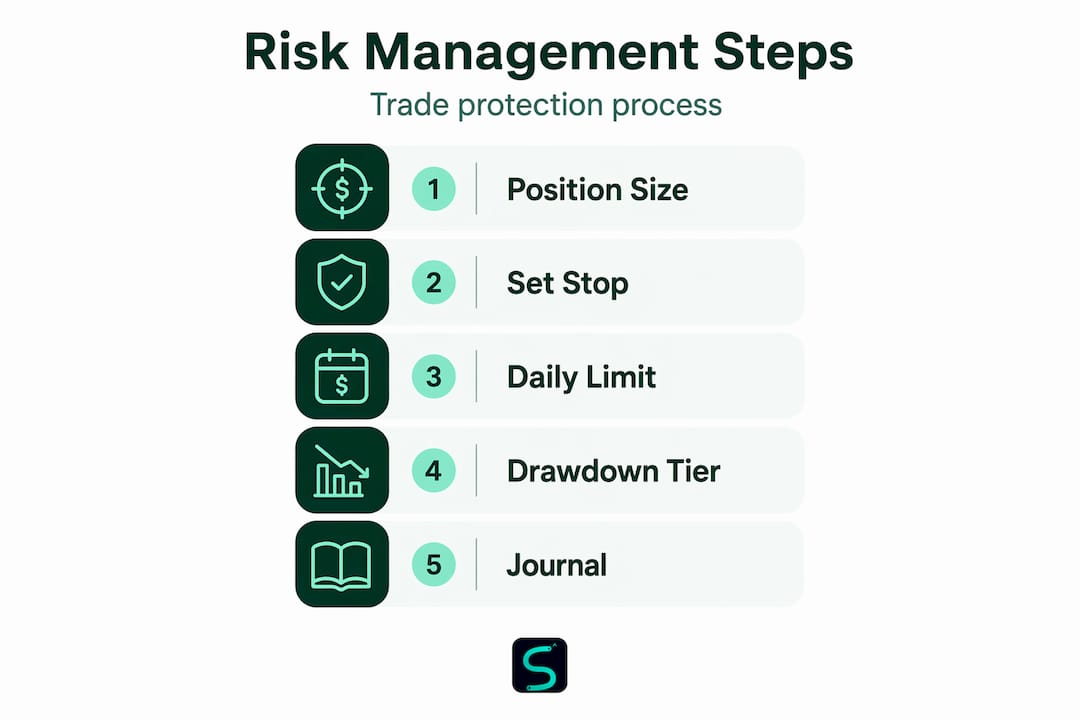
One stop loss per trade is not enough. A layered system stacks four levels of protection so that no single failure collapses your account.
| Layer | What it controls | Example |
|---|---|---|
| Position sizing | Risk per single trade | Max 1% per trade |
| Stop loss | Per-trade loss cap | Stop at technical invalidation |
| Daily loss limit | Total loss per day | 3% of account |
| Weekly/drawdown cap | Extended losing runs | 5-6% weekly, tiered drawdown rules |
Daily and weekly limits are where most retail traders fall short. A 3% daily loss limit on a $50,000 account means you stop trading at $1,500 in losses for that session. Weekly, the cap sits around $2,500 to $3,000. When you hit those numbers, you close the platform. No exceptions.
Drawdown management adds another tier. Think of it in three stages. Normal variance sits below 5% drawdown and requires no changes. A 5-10% drawdown signals you to cut position size in half and review your setups. Anything beyond 10% means you stop trading entirely, review your journal, and only return after identifying what broke down.

The most common failure point here is not the system itself. It is execution. Moving stops wider after entry, skipping the daily limit because "this trade feels different," and sizing up to recover losses are the behaviors that turn a manageable drawdown into an account-ending one. Auditing your trades weekly against your planned risk levels catches these patterns early.
Pro Tip: Use a simple spreadsheet or a trading journal app to log your planned risk versus actual risk on every single trade. The gap between those two numbers tells you everything about your real discipline level.
Advanced risk controls: volatility, margin, and market regimes
Once your base system is solid, you need to adapt it to changing market conditions. Fixed stop distances fail in volatile markets. Stop distances and position sizes must expand and contract with market noise. A stop that works perfectly during a quiet London session will get triggered constantly during a high-impact news event.
A practical rule: your stop should never sit closer than 1.5 times the average true range (ATR) for that instrument on your timeframe. During high-volatility sessions, you have two options. Widen the stop and reduce position size proportionally to keep dollar risk constant, or skip the trade entirely if the reward-to-risk ratio collapses.
Here is what advanced risk control looks like in practice:
- Volatility gating. Before entering, check whether the current ATR is abnormally high. If it is more than 50% above the 20-period average, consider halving your position size.
- Slippage budgeting. In crypto and futures, spreads widen and order books thin out fast. Build slippage into your risk calculation, especially on market orders during fast-moving sessions. Treat widening spreads as a direct risk signal and reduce size accordingly.
- Margin awareness. Under FINRA's 2026 intraday margin rules, broker-dealers now monitor margin adequacy in real time throughout the trading day rather than relying on the old $25,000 pattern day trader threshold. Intraday margin deficits can now get your trades blocked automatically, so knowing your exact margin usage at all times is no longer optional.
- Portfolio-level stress testing. Professional institutions use Value-at-Risk (VaR) metrics to define maximum acceptable loss thresholds at a portfolio level. As a retail trader, a simplified version of this means asking: if every open position hit its stop simultaneously, what percentage of my account is at risk?
Volatility-adjusted risk sizing is not a complication. It is what separates traders who survive volatile regimes from those who get wiped during them.
The role of volatility in your sizing decisions is one of the most underrated edges you can develop as a short-term trader.
Building your daily risk management routine
Knowing the theory is step one. Embedding it into a daily process is what makes it real. Here is a practical routine that covers pre-trade planning, execution, and review:
- Pre-session planning. Before placing a single trade, define your maximum loss for the day, identify the key levels where your setups would be invalidated, and check the economic calendar for high-impact events that may require wider stops or no trading at all.
- Trade execution checklist. For every entry, confirm your position size matches your 1% rule, your stop is at a technical level (not a round number), and your reward-to-risk ratio is at least 2:1. Skipping any of these three steps disqualifies the trade.
- Intraday monitoring. Track your running daily P&L against your loss limit. When you hit 50% of your daily cap, slow down. When you hit the full cap, stop.
- Post-session journal review. Log every trade with planned risk, actual risk, stop placement, and outcome. Ask yourself: did the trade close where my stop said it would, or did I move it?
The journaling step is where most execution failures surface. Revenge trading, moving stops, and oversizing all leave a clear fingerprint in your journal data if you are honest about recording it. Review weekly. Adjust monthly.
Pro Tip: Ask three questions after every losing trade: Was my stop in the right place? Did I follow my position sizing rule? Did I exit at my planned stop or somewhere else? If the answer to any of these is no, that is your real lesson, not the loss itself.
Knowing when to pause is as important as knowing when to trade. Hitting a 10% drawdown tier without a clear review process is one of the fastest paths to account destruction. A structured pause with a checklist review, not just a day off, is what keeps you on the right side of compounding over time. You can also use a day trading checklist to standardize your pre-session and post-session reviews.
My take on what most traders get wrong
I have seen traders with solid setups blow their accounts repeatedly. Not because their entries were bad, but because they treated risk management as a single tool rather than a system.
The biggest misconception I keep running into: traders think a stop loss is a risk management plan. It is one layer. What actually protects an account is the combination of stop placement, position sizing, daily caps, and drawdown tiers working together. Remove any one of those layers and the system has a gap.
The second thing I have learned: managing heat, which is the normal adverse movement a trade experiences before resolving, is a skill almost nobody teaches. Traders who understand how much heat their setups typically take before moving in their favor stop getting shaken out of good trades. That reduces unnecessary re-entries and keeps transaction costs from eating into edge.
Volatility-aware sizing is the technique I credit most for long-term survival. Fixed-percentage stops work in textbook conditions. In real markets, you need to adapt sizing to volatility or the market will calibrate your stops for you in the worst way possible.
Treat risk management as a skill you refine over months of journaling and review. It is not set-and-forget. It is the one area where getting better directly improves your results, regardless of which market you trade.
— Tran
Put your risk plan into action with Scalping-Algo
Understanding risk management theory is one thing. Executing it precisely under live market conditions is another challenge entirely.
At Scalping-Algo, we have built tools specifically for traders who want to apply disciplined risk controls at speed. The Algo Master indicator suite integrates volatility gating, confluence filtering, and real-time signal alerts directly into your TradingView charts, so you are not making sizing decisions on the fly. The Smart Scalping Signals indicator layers risk filters into every entry signal, giving you non-repainting buy and sell signals optimized for the 1m to 15m timeframes where execution risk is highest. Explore the full suite at Scalping-Algo and start trading with a risk structure that actually holds.
FAQ
What is the one-percent rule in trading?
The one-percent rule means you never risk more than 1% of your total account balance on a single trade. For a $10,000 account, that caps your maximum loss per trade at $100.
How do daily loss limits protect traders?
Daily loss limits, typically set at around 3% of account value, stop you from compounding losses during bad sessions. Once you hit the limit, you stop trading for the day regardless of how you feel about the next setup.
How should stops be adjusted for volatility?
Stop distances should expand when market volatility rises, and your position size should decrease proportionally to keep your dollar risk constant. A useful baseline is placing stops no closer than 1.5 times the current ATR.
What is the biggest risk management mistake traders make?
Moving stop losses wider after entering a trade is the most common execution failure. It converts a defined, manageable loss into an undefined one and is the clearest sign that emotion is overriding the trading plan.
Do the 2026 FINRA margin rules affect my risk management?
Yes. Under the new 2026 intraday margin rules, brokers monitor margin adequacy throughout the trading day in real time. This replaces the old pattern day trader minimum and means your trades can be blocked automatically if you create an intraday margin deficit, making real-time margin tracking a required part of your risk routine.