

Scalp trading attracts skilled, fast-moving traders precisely because it offers high-frequency opportunities across crypto and forex markets. But here's the reality most traders face: you can build a setup that looks brilliant on paper and still lose money live. Fees, slippage, and execution delays are silent killers of small profit targets. The margin between a winning scalp and a breakeven trade is razor-thin, and without a structured approach to managing costs, verifying your edge, and optimizing your workflow, even solid setups collapse under real-world friction. This guide walks you through the full process, from mechanics to testing to technology.
Table of Contents
- What makes scalp trading unique?
- Step-by-step: Setting up your scalp trading system
- Execution and technology: The tools that deliver speed
- Testing, verification, and realistic edge evaluation
- A hard-won perspective: Why most scalp trading edges fail after fees
- Next steps: Enhance your edge with specialized scalping tools
- Frequently asked questions
Key Takeaways
| Point | Details |
|---|---|
| Discipline drives profit | Strict entry and exit rules plus risk controls protect your edge in scalp trading. |
| Costs can erase your gains | Always factor spread, slippage, and fees into your strategy, or small wins will turn into losses. |
| Workflows and tools matter | Rapid execution platforms and well-designed playbooks are essential for consistent scalp trading. |
| Backtest for realistic edge | Only backtesting with real-world costs shows if your scalp trading system holds up. |
| Continuous edge re-testing | True expert scalpers record and analyze cost-effects session by session, adapting setups to changing conditions. |
What makes scalp trading unique?
Scalp trading is built around speed and volume. You're targeting small price movements, entering and exiting positions within seconds to minutes, and repeating that process dozens of times per session. The goal is to stack small wins consistently rather than waiting for large directional moves.
Scalping targets small price movements with frequent trades and tight risk controls. One of the biggest discipline challenges is exit timing. Small profits per trade disappear fast if you hold a losing trade too long hoping it reverses. Every minute you hold a loser, you're eroding the gains from your last two or three winners.
The microstructure of a market matters enormously here. A practical scalping edge depends heavily on transaction costs and market microstructure. High liquidity and tight bid-ask spreads reduce the chance that spreads and slippage consume your entire target move. This is why scalping in crypto and forex demands a different approach depending on the asset class and exchange you're trading.

Here's a direct comparison of the two most popular scalping environments:
| Factor | Forex scalping | Crypto scalping |
|---|---|---|
| Spread consistency | Tight and predictable in majors | Can widen sharply during volatility |
| Liquidity depth | Very deep in major pairs | Varies heavily by exchange and asset |
| Session sensitivity | Highly time-dependent (London/NY) | 24/7 but volume clusters exist |
| Execution risk | Lower slippage on major pairs | Higher slippage on altcoins |
| Regulatory clarity | Clear and established | Still evolving |
Key behavioral demands unique to scalping:
- Exit discipline is non-negotiable. A scalper who holds losers longer than winners will eventually blow the account.
- Consistency beats occasional big wins. You're building edge through repetition, not home runs.
- Attention management matters. Fatigue after 50 trades degrades decision quality sharply.
- Costs compound against you. Five trades per session at $2 commission each adds $10 daily drag before you profit a cent.
"Exit discipline in scalping is everything. One bad hold can erase the gains from ten successful scalps." This is why structured rules, not intuition, govern the best scalp traders.
Understanding the algorithmic trading benefits for scalpers becomes clear once you realize how much execution consistency matters at this pace.
Step-by-step: Setting up your scalp trading system
Mechanics understood, now it's time to build the actual system. A structured playbook is what separates professionals from discretionary guessers.
A structured scalping playbook should include a repeatable setup, explicit entry trigger and confirmation versus pattern, session and time-of-day awareness, and integrated execution cost assumptions covering spread and slippage. Without these elements defined in advance, you're improvising under pressure. That's a losing habit.
Retail scalping tools should help with risk budgeting and execution speed. Maintaining small per-trade risk and limiting overtrading through daily max loss thresholds are two of the most practical controls you can implement immediately.
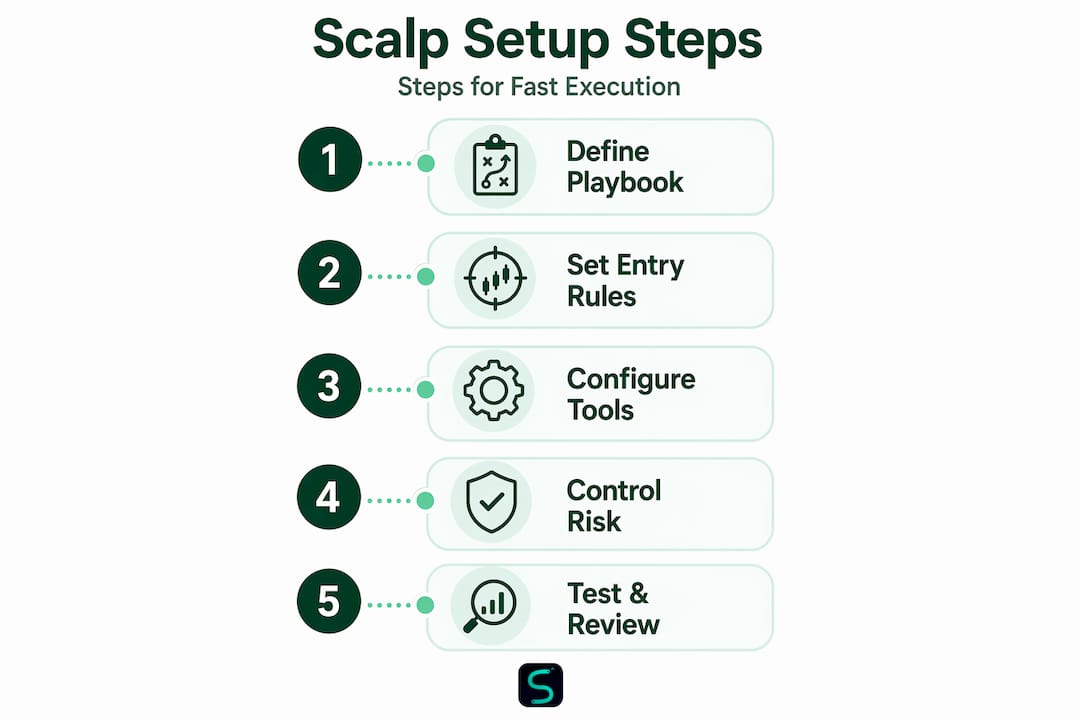
Here's the workflow table for a robust scalping plan:
| Component | Requirement | Why it matters |
|---|---|---|
| Platform | Low latency, custom layout, hotkeys | Faster entry and exit reduces slippage |
| Risk per trade | 0.5-1% of account maximum | Protects capital over high trade frequency |
| Daily loss limit | 2-3% max drawdown before stopping | Prevents revenge trading after setbacks |
| Session timing | Trade highest liquidity windows | Tighter spreads, more predictable fills |
| Entry trigger | Indicator-confirmed, not pattern alone | Reduces false signal entries |
| Target and stop | Pre-defined before entry | Removes emotion from exit decisions |
Follow this repeatable process for every scalp:
- Identify the session window. Only trade during periods with proven liquidity for your asset. London open, New York open, and the overlap window are the most reliable for forex. For crypto, look at volume clusters around major exchange opens.
- Confirm your setup is valid. Does price align with your structure? Is the indicator signal present? Don't force trades outside your criteria.
- Check spread and execution conditions. If spread is unusually wide, skip the trade. Slippage on a tight target is account-damaging.
- Define stop and target before entry. Write them down or set them immediately. No adjusting mid-trade unless your system explicitly allows it.
- Enter with precision. Use limit orders when conditions allow. Market orders in illiquid moments lead to bad fills.
- Exit according to plan. No holding past your target hoping for more. No widening your stop because price is close.
- Log the trade immediately. Record entry, exit, spread paid, slippage experienced, and outcome. This data drives improvements.
Pro Tip: Set a daily loss limit that automatically ends your session when hit. Two or three consecutive losers affect judgment more than most traders admit. A hard stop protects your capital and your mental state.
The resources for scalping traders available today make it far easier to structure this playbook with pre-built templates and indicator-driven signals. An indicator-based playbook gives you objective criteria that remove the ambiguity from setup identification.
Execution and technology: The tools that deliver speed
Strategy without execution infrastructure is theory. In scalping, a 200ms delay on your order can be the difference between filling at your target price or paying a full spread against you.
Execution tooling is a core part of scalping practice. Traders benefit from platforms that support rapid order execution through custom layouts, hotkeys, and instant entry. Charting and monitoring at very short horizons (1 minute and 3 minute timeframes) is equally important. If your charting platform lags your broker's feed, you're already behind.
Slippage deserves a direct explanation. It's not the same as spread. Slippage reflects real order-book conditions, latency and network effects, liquidity depth, and timing. Spread is the cost of the transaction at the moment of quote. Slippage is what happens when your order arrives and the market has moved. During news events, even major forex pairs experience slippage because liquidity providers pull bids and offers temporarily.
Must-have features for your scalping software and workflow:
- One-click or hotkey order entry. Clicking through multiple confirmation dialogs costs time and money.
- Bracket order functionality. Pre-set stop and target at the same time as entry. No manual management required.
- Real-time Level II or order book depth. Seeing where liquidity sits helps you choose limit vs. market entry.
- Custom alerts tied to your indicators. You can't watch 5 charts simultaneously without getting overwhelmed. Alerts do the monitoring for you.
- Trade journaling integration or export. Automatic logging removes manual errors and speeds up review.
- Webhook alert support. Sends signals directly to Discord or execution platforms without manual intervention.
Pro Tip: Before your session starts, pre-configure your chart layouts, order templates, and hotkeys. When a setup appears in real-time, your only job is executing. Searching for buttons while price moves costs you edge.
Real-time market data is another layer of your technology stack that deserves serious attention. Delayed data on a 1-minute chart is essentially useless for scalping. And for traders who want to operate at institutional speed, institutional tools for scalpers are no longer out of reach. Modern TradingView-based indicator suites bring institutional-grade signal logic to retail execution.
Testing, verification, and realistic edge evaluation
Execution is built. Strategy is structured. Now you need to verify whether your edge actually exists after costs, or whether it's just a visual pattern that looks good in hindsight.
Backtest with realistic fees, slippage, and execution delays. Otherwise the edge often disappears after costs. This is the most common and painful mistake retail scalpers make. They see a strategy produce 200 profitable trades on a chart and assume it's a winner. But without modeling a 0.03% fee, 1-tick slippage, and 100ms latency on each trade, the backtest is fiction.
For crypto scalping on 1-minute charts, realistic-cost backtests show the economics can be unforgiving. Only carefully structured limit-order and VWAP-style approaches remained positive after realistic fees, slippage, and latency assumptions were applied. Market-order strategies on illiquid altcoins rarely survive proper scrutiny.
Here's how crypto and forex compare when realistic costs are factored in:
| Metric | Forex scalping | Crypto scalping |
|---|---|---|
| Median win rate | Higher (established research) | Lower but variable |
| Profit factor when profitable | Moderate | Higher median in profitable strategies |
| Edge survival after costs | More consistent in majors | Asset and exchange dependent |
| Latency sensitivity | High during news events | High around exchange-specific catalysts |
Common backtesting mistakes that destroy the validity of your results:
- Ignoring spread costs entirely. Especially damaging on assets with variable spreads.
- Using market-order fills. Real entries are often worse than the close of the signal candle.
- Optimizing on a single asset or time period. Curve-fitting produces results that won't hold forward.
- Not accounting for overnight gaps or weekend gaps in crypto. These appear in data and distort statistics.
- Treating all wins as equal. A win during peak liquidity is not equivalent to a win during a low-volume session.
Follow this verification process to confirm your edge is real:
- Define the strategy rules completely. Every condition must be explicit. No discretionary overrides during the test.
- Apply realistic cost models. Add spread, estimate slippage (at minimum 0.5x spread), and include commission per trade.
- Segment results by session and asset. An edge that only works during the London open needs to be documented as such.
- Run the test on out-of-sample data. The period you optimized on is not evidence. Test on data you haven't touched.
- Calculate profit factor, win rate, and max drawdown. A profitable equity curve with a profit factor below 1.3 is fragile.
- Record every result in a structured log. Compare live trading results to backtest expectations over time.
"The edge you see in a visual backtest is often the edge you wish existed. The edge that survives realistic modeling is the one worth trading."
Verify your futures scalping win rates using the same cost-inclusive approach. Every asset class has its own friction profile. Use our scalping checklist to make sure you haven't missed a verification step before going live.
A hard-won perspective: Why most scalp trading edges fail after fees
Here's the uncomfortable reality we see consistently: most retail scalpers don't lose because their setup is wrong. They lose because they never properly measured whether the setup generates enough gross profit to survive realistic costs. A system generating 0.3% per trade looks great until you factor in 0.05% commission, 0.02% average slippage, and 0.03% spread. You've just consumed two-thirds of your gross profit before you count the losing trades.
The classic myth is that a visually profitable backtest on a clean chart equals a tradeable system. It doesn't. Markets reprice liquidity constantly. Spreads widen during news, volatility events, and session transitions. An entry that looks clean at the close of a candle in historical data may have filled 3 ticks worse in live conditions.
What experienced scalpers do differently is simple but disciplined. They treat cost modeling as a first-class part of system design, not an afterthought. They build strategies around algorithmic speed for scalping to minimize execution lag. They re-test their edge monthly, not annually. Markets change. A forex edge that worked during a low-volatility regime may break down when central bank policy shifts the interest rate environment.
The traders who last long in scalping also track execution quality as a separate metric from profitability. If your average slippage is creeping up, that's a warning sign that your broker's execution quality is degrading or your session timing is off. Catching that early prevents months of slow capital erosion.
Pro Tip: After every session, log not just profit and loss but also average spread paid, slippage per trade, and number of trades outside your system rules. These secondary metrics reveal problems before they show up in your equity curve.
Next steps: Enhance your edge with specialized scalping tools
The framework in this guide covers the full arc from setup to verification. But implementing it effectively requires tools built specifically for the pace and precision scalping demands.
Scalping-Algo's Algo Master scalping indicators are designed from the ground up for 1-minute to 15-minute timeframes across crypto, forex, indices, and futures. Non-repainting buy and sell signals, volatility gating, confluence confirmation, and native webhook alerts to Discord give you the execution infrastructure that retail traders rarely access. Everything is built in Pine Script v6, open-source, and backed by a live Discord community with mentorship sessions and real-time trade reviews. Explore the full suite of TradingView scalping indicators and see how a properly integrated toolset accelerates both your edge verification and your live execution quality.
Frequently asked questions
What is the most important factor for profitable scalp trading?
Liquidity and tight spreads are crucial since transaction costs quickly erode small scalp profits. Always target highly liquid assets and actively minimize all friction points before executing.
How do you minimize slippage as a scalper?
Use fast execution platforms with hotkeys and custom layouts, choose sessions with peak liquidity, and remember that slippage reflects order-book conditions beyond just broker quality. Limit orders reduce slippage risk significantly in most conditions.
What's the best way to verify your scalp trading edge?
Backtest with all fees, slippage, and execution delays applied, then test on out-of-sample data. If the edge survives realistic cost modeling, it's worth trading live at small size to confirm.
Is scalp trading more predictable in forex or crypto?
Forex has a higher median win rate across systematic strategies, but crypto shows higher profit factor and success frequency when profitable strategies are found. The best choice depends on your cost structure and execution infrastructure.