

Most retail scalpers spend hours refining their charts, stacking indicators, and hunting the perfect setup. Yet performance stays flat. The reason isn't the chart. Institutional tools are less about having a chart and more about the execution lifecycle: pre-trade checks, order routing and slicing, and post-trade measurement to improve realized execution versus decision prices. That gap, the space between your trade idea and your actual fill, is where institutional traders consistently win. This article breaks down exactly what institutional tools are, what each component does, and how scalpers operating in crypto, forex, and futures can start closing that gap today.
Table of Contents
- What are institutional trading tools?
- Core components: From order management to analytics
- Why speed and execution quality matter for scalpers
- Accessing institutional tools as a retail trader
- The real institutional edge: What most scalpers overlook
- Take your scalping to the next level with pro-grade tools
- Frequently asked questions
Key Takeaways
| Point | Details |
|---|---|
| Institutional tools defined | These platforms unify order management, execution, risk, and analytics for a lifecycle-driven trading approach. |
| Execution quality is key | Small differences in routing, fill speed, and order types make a major impact for scalpers. |
| Retail access is growing | Brokers and educative labs offer APIs, workflow tutorials, and pro-grade features to advanced retail traders. |
| Unified beats patchwork | Multi-asset, integrated systems offer more consistent performance and measurement than mixing many separate apps. |
| Mindset and measurement | True edge comes from optimizing your workflow and analytics, not just from new software tools. |
What are institutional trading tools?
Institutional trading tools are not just "better charting software." That's the first misconception to clear up. These platforms exist to manage the entire order lifecycle, from the moment you decide to trade through final settlement and performance review.
The core components you'll hear about are:
- OMS (Order Management System): Tracks, manages, and processes orders across multiple venues. It handles compliance, position limits, and allocations.
- EMS (Execution Management System): Handles the live act of trading. Smart order routing, order type selection, and venue selection all live here.
- Algo engines: Automated execution logic that slices large orders, times entries, and manages fills without manual intervention.
- Post-trade analytics: TCA (Transaction Cost Analysis) and reporting tools that audit what actually happened versus what you intended.
The contrast with most retail tools is significant. Retail platforms focus heavily on the user interface, indicator stacks, and basic order entry. They put 90% of development into the visual layer. Institutional setups flip that priority: the interface is almost secondary to what's happening underneath with connectivity, routing, and risk management.
"Institutional trading stacks are increasingly unified multi-asset platforms that consolidate OMS/EMS/algos/connectivity and post-trade processes, rather than assembling many standalone systems."
This shift toward unified platforms matters for scalpers. A patchwork of standalone tools introduces latency, data inconsistency, and workflow friction. Understanding how trading dashboards connect those layers gives you a clearer picture of what to build toward. When all components talk to each other natively, your workflow becomes faster, more reliable, and auditable.
Retail traders who access institutional trading conditions typically notice the difference immediately: lower effective spreads, tighter fills, and far more control over how and where orders are sent.
Pro Tip: The next time you evaluate a trading platform, stop asking "does it have good charts?" and start asking "how does it route my orders and what post-trade data does it give me?" That's the institutional mindset.
Core components: From order management to analytics
With a grasp on the broader concept, let's break down the specific parts of institutional trading environments and what each does for a real-world scalper operating on 1-minute to 15-minute timeframes.
Each module in the institutional stack has a distinct role. Here's how they map to real trading outcomes:
| Component | Primary Function | Scalping Benefit |
|---|---|---|
| OMS | Order tracking and allocation | Prevents duplicate fills, manages position limits |
| EMS | Smart routing and venue selection | Tighter fills, lower slippage |
| Algo Engine | Automated order slicing and timing | Consistent execution without emotion |
| Connectivity Layer | FIX/REST/WebSocket APIs | Speed, automation, reduced manual errors |
| Liquidity Aggregation | Multi-venue price consolidation | Better bid/ask, deeper book access |
| Risk Module | Real-time exposure monitoring | Stops runaway losses during volatile moves |
| Post-Trade Analytics | TCA and execution review | Feedback loop for continuous improvement |
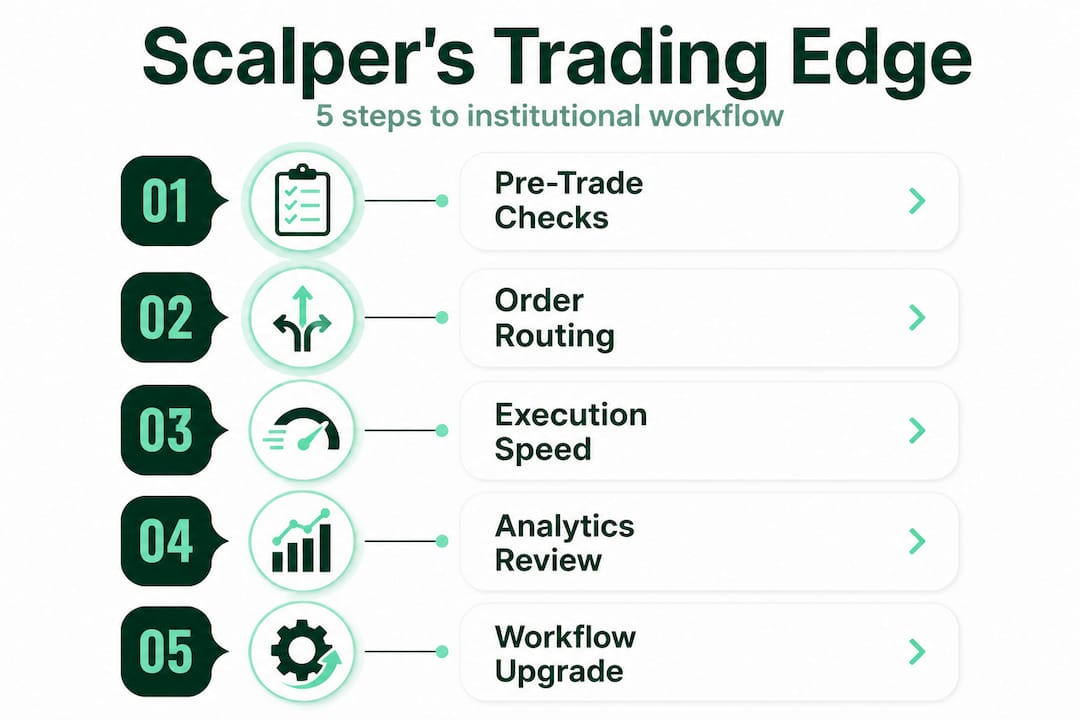
The advanced scalping tools that serious traders rely on touch most of these layers in some form, even at the retail level. Here's the key workflow to understand, step by step:
- Pre-trade: The OMS checks position limits, available capital, and compliance rules before the order leaves your system.
- Order submission: The EMS selects the best venue, applies the correct order type (limit, IOC, FOK), and routes the order with minimal latency.
- Execution: The algo engine monitors fills in real time, adjusting routing or slicing if needed.
- Post-trade: The analytics layer records fill price, time, slippage, and venue performance for review.
Scalping speed in crypto and forex depends on every step of this chain working efficiently. One weak link, whether it's a slow API or a manual confirmation step, costs you at the fill.

Some institutional-grade vendors now offer crypto and FX stacks as modular connectivity + liquidity aggregation plus risk and settlement workflows, with API options including FIX, REST, and WebSocket. That modularity is powerful because it lets you configure a workflow optimized specifically for short-term strategies rather than long-duration portfolio trades.
For futures scalping strategies, the connectivity layer is especially critical. Futures markets have microsecond-level competition at certain hours, and even a 50-millisecond latency advantage can separate a profitable fill from a bad one.
Pro Tip: If you're evaluating a broker or platform for serious scalping, request their average order execution latency stats and ask specifically whether they support direct market access (DMA). Those two data points will tell you more than any marketing page.
Setting up a clean professional trading workflow that mirrors these institutional steps, even in a simplified retail context, creates discipline and repeatability that most traders never develop.
Why speed and execution quality matter for scalpers
Now that you know what institutional modules are, see how their speed and quality advantages actually change results for short-term scalpers working in fast markets.
Slippage is your hidden tax. On a 5-point scalp in ES futures, even 1.5 points of slippage cuts your realized profit by 30%. Multiply that across 20 to 50 daily trades and poor execution quality becomes the dominant driver of underperformance. This isn't theoretical. It's arithmetic.
Here's how retail and institutional execution compare on the metrics that matter most for scalpers:
| Factor | Retail Execution | Institutional Execution |
|---|---|---|
| Order routing | Single venue, often PFOF | Multi-venue, smart routing |
| Latency | 100ms to 500ms typical | Sub-10ms with DMA |
| Order types | Basic (market, limit, stop) | IOC, FOK, pegged, iceberg, and more |
| Fill transparency | Limited reporting | Full TCA with venue breakdown |
| Pre-trade risk checks | Manual or none | Automated, rule-based |
| Liquidity access | One book | Aggregated across venues |
For scalping and other short-term strategies, the main practical distinction is execution and venue control: routing, low-latency access, order-type behavior, and measurement and auditing. Small differences in latency, fill quality, and routing can dominate outcomes over a large sample of trades.
The algorithmic trading benefits most relevant to scalpers are all execution-side: automated order placement, consistent order type application, and removal of hesitation lag. When your algo fires on signal, it doesn't second-guess. It routes, fills, and records.
Real-time market data feeds into this directly. Stale data means your signal is already late by the time your order goes out. Institutional-grade data connections reduce that gap to near zero.
Key execution factors that scalpers need to control actively:
- Order type selection: IOC (Immediate or Cancel) avoids partial fills sitting in the book. FOK (Fill or Kill) ensures all-or-nothing execution. These are non-negotiable for tight scalping setups.
- Venue selection: Some venues offer better liquidity at certain times of day. Smart routing adapts to that dynamically.
- Post-trade TCA: Review your average slippage per session, per instrument, and per time window. Patterns reveal where your workflow is leaking edge.
The path from retail to institutional trading is not about one big technology upgrade. It's about progressively improving each link in the execution chain, measuring the impact, and iterating.
Accessing institutional tools as a retail trader
Even if you aren't in a prop shop or hedge fund, there are concrete ways to leverage institutional concepts and tools starting right now.
The gap between retail and institutional access has narrowed significantly over the past few years. Here's where the real opportunities sit:
- Broker APIs: Interactive Brokers, Tradovate, and several crypto-focused brokers offer REST and WebSocket APIs that support programmatic order entry. This is a direct bridge to EMS-style control.
- DMA access: Some brokers offer direct market access for futures and forex, bypassing market maker routing. This alone materially improves fill quality for active scalpers.
- Sandbox environments: Many platforms offer paper trading or sandbox modes where you can test full execution workflows without real capital. Use these to simulate your institutional workflow before going live.
- Broker training programs: Resources like the IBKR Student Trading Lab provide structured education on professional workflow concepts and give access to institutional-grade tooling in a learning environment.
- Programmable alert systems: Webhook-based alerts that connect your indicator signals directly to order entry remove the manual confirmation step entirely.
"For educational and retail-accessible learning, some broker and education hubs frame institutional workflow concepts and provide professional-grade tooling access and tutorials, which are useful for building short-term strategy execution skills."
Building this skill set takes structured effort. A solid scalping checklist helps you standardize your pre-trade, in-trade, and post-trade process so nothing gets skipped during live sessions. Discipline in the small steps is what separates consistently profitable scalpers from sporadic ones.
Knowing how to set trading alerts precisely is another layer of execution control. Alerts that fire on genuine signal conditions, rather than manual chart watching, bring your workflow closer to the automated, rule-based environment that institutional traders operate in.
Finally, using precision scalping indicators built specifically for lower timeframes gives your signal generation a more reliable foundation. When the signal layer is clean, the downstream execution workflow has better material to work with.
Pro Tip: Start with one area of improvement, either better order types or post-trade review, and master it before adding the next. Layering too many changes at once makes it impossible to identify what's actually moving your numbers.
The real institutional edge: What most scalpers overlook
Here's the uncomfortable truth we've seen consistently: traders chase tools when they should be chasing workflows.
Most retail scalpers who "go institutional" buy better software, subscribe to better data, and maybe even get API access. Then performance stays about the same. The missing piece is a measurement culture. Institutional desks don't just use sophisticated tools; they review every fill, audit every session, and iterate based on hard data. The tool is just the mechanism for capturing that data.
The execution lifecycle concept covers it precisely: pre-trade checks and policies, order routing and slicing during the trade, and post-trade TCA to measure realized execution versus your decision price. That feedback loop, from decision to fill to analysis back to decision, is the actual institutional edge. Not the Bloomberg terminal. Not the co-located server.
For a scalper running 30 trades a day, even a basic post-trade review habit, reviewing slippage, fill percentage, and session timing, creates compounding improvement over weeks. We've seen traders cut average slippage by 40% simply by identifying that their worst fills consistently happen in the first 15 minutes after a major news event. That insight doesn't require a hedge fund budget. It requires consistent measurement.
The traders who bridge the institutional gap fastest are the ones who prioritize the algorithmic trading edge through discipline and feedback loops, not just by acquiring the most advanced software stack. Execution, mistake minimization, and iterative improvement are the core of what institutional trading actually means.
Take your scalping to the next level with pro-grade tools
Institutional-grade thinking deserves institutional-grade signal tools to work with. That's exactly what we've built at Scalping-Algo.
Our Smart Scalping Signals indicator delivers real-time, non-repainting buy and sell signals optimized for 1-minute to 15-minute timeframes across crypto, forex, and futures. Pair that with the Edge Finder indicator, which layers confluence detection and volatility gating directly onto your chart, and you have a signal layer that's built for precise, fast execution. Both tools are built in Pine Script v6, fully open-source, and designed to integrate cleanly with webhook-based alert workflows. For actionable strategies, setups, and execution shortcuts, browse the full trading tricks and tips library.
Frequently asked questions
What is the main difference between retail and institutional trading tools?
Institutional tools focus on execution quality, order routing, and workflow integration, while retail tools tend to emphasize charts and basic order entry. As unified multi-asset platforms show, institutions consolidate OMS, EMS, algos, and post-trade processes into one connected system.
Can retail scalpers use institutional-grade tools?
Yes, many brokers and platforms now offer APIs, advanced routing, and educational resources that bridge the gap. The IBKR Student Trading Lab is one example of a professional-grade learning environment accessible to individual traders.
Which features matter most for scalping strategies?
Low-latency execution, customizable order types, and post-trade analytics are the most critical. Execution and venue control, including routing, order-type behavior, and measurement, directly determine fill quality on short-term trades.
How can I learn institutional workflows without a hedge fund background?
Educational platforms, broker training labs, and sandbox testing environments offer structured, practical learning. Programs like the IBKR Student Trading Lab provide hands-on exposure to institutional concepts without requiring professional employment.
Are unified platforms better than using many different tools?
For most scalpers, yes. Unified multi-asset platforms reduce workflow friction by connecting trading, risk, and analytics across the full trade lifecycle, removing the data gaps and latency that patchwork setups introduce.