
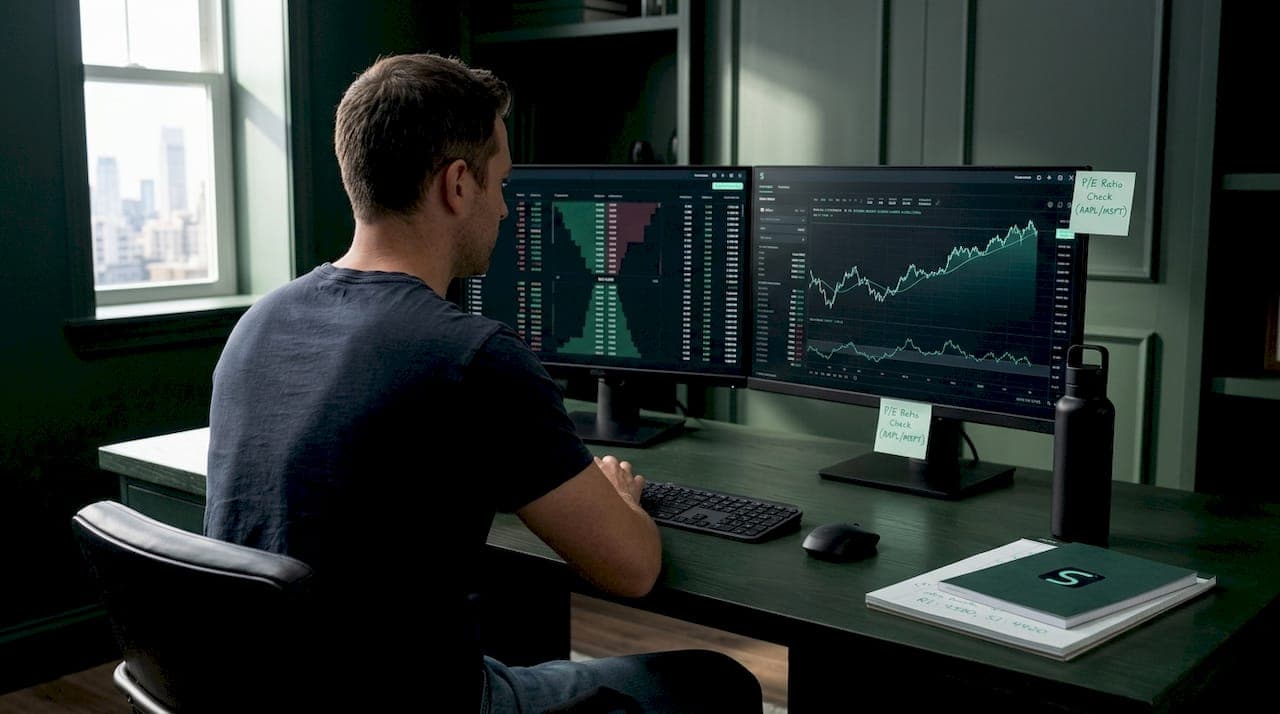
Most retail scalpers blame bad luck when trades consistently close against them by a few ticks. The real culprit is almost always data lag. When your price feed is even a few seconds behind, every entry looks perfect in hindsight and terrible in execution. Real-time market data is not a luxury for scalpers in crypto, forex, and commodities. It is the foundation of every decision you make on the 1m, 3m, and 5m charts. This guide breaks down exactly what real-time data is, compares tools, and shows you how to build a genuine execution edge.
Table of Contents
- What is real-time market data?
- Types of real-time data feeds and how they affect execution
- Key platforms and data tools for scalpers
- Precision, pitfalls, and getting the real edge
- Why most traders overrate speed and miss the real edge
- Take your scalping to the next level with professional tools
- Frequently asked questions
Key Takeaways
| Point | Details |
|---|---|
| Core definition | Real-time market data delivers streaming price and order book updates essential for scalping strategies. |
| Level 1 vs. Level 2 | Level 1 is sufficient for most retail needs, while Level 2 offers deeper market visibility. |
| Tool selection | Platforms like TradingView, Dukascopy, and Alpaca offer robust real-time data for scalpers. |
| Limits of speed | Ultra-low latency primarily benefits institutions; retail traders profit more from disciplined setups. |
| Practical edge | Edge comes from using real-time data with structured indicators and repeatable tactics. |
What is real-time market data?
Real-time market data means price and volume information delivered with zero intentional delay from the exchange or liquidity provider to your screen. Compare this to delayed data, which many free platforms still serve, typically 15 to 20 minutes behind the live market. For a swing trader, that gap barely matters. For a scalper targeting 5 to 15 tick moves, it renders every signal useless.
The most granular form of real-time data is tick-by-tick data. Every single transaction executed on the exchange generates a tick. Tick data shows you price, volume, and timestamp for each trade as it happens. This is the rawest possible feed, and it forms the backbone of serious scalping.
Here are the core components you need to understand:
- Price (bid/ask/last): The bid is what buyers will pay, the ask is what sellers want, and the last price is where the most recent trade occurred.
- Volume: How many units traded at each price level and in each time interval.
- Time and sales (the tape): A real-time log of every executed transaction, showing price, size, and time.
- Order book data: The full list of pending buy and sell orders at every price level.
There is also a key distinction between Level 1 data and Level 2 data. Level 1 shows only the best bid and ask prices currently available, which is the National Best Bid and Offer (NBBO). Level 2 shows the full order book depth, revealing every pending order at every price level. For most retail scalpers, Level 1 is sufficient. Level 2 becomes valuable when you want to read order book imbalances and anticipate short-term price pressure. Understanding the MTF Scalping Dashboard overview shows how pulling multiple data layers together amplifies your signal quality.
"The fastest data feed in the world does not help if you have no actionable framework to interpret it. Tools and structure matter more than raw speed."
Pro Tip: Before upgrading your data feed, audit your current setup for feed latency. Open your broker's platform next to TradingView with the same instrument. If prices consistently differ by more than a second or two, your execution is compromised.
Types of real-time data feeds and how they affect execution
Understanding the data type directly shapes your execution speed and accuracy. Not all real-time feeds are equal. The delivery mechanism matters just as much as the speed label on the tin.

Level 1 data includes the best bid, best ask, and last trade price. For the majority of retail scalpers on 1m to 15m timeframes, this is genuinely all you need. You are not trying to front-run institutional orders. You are identifying momentum, structure, and signal confluence. Level 2 gives you market depth and is most useful for reading order flow imbalances in liquid markets like major forex pairs, Bitcoin, and front-month futures contracts.
Here is a direct comparison:
| Feature | Level 1 | Level 2 |
|---|---|---|
| Best bid/ask | Yes | Yes |
| Last trade price | Yes | Yes |
| Full order book | No | Yes |
| Market depth | No | Yes |
| Latency requirement | Standard | Low to very low |
| Best for | Most retail scalpers | Advanced order flow traders |
| Typical cost | Free to low cost | Paid subscription or broker plan |
| Platforms | TradingView, MT4/5, Alpaca | Bookmap, Sierra Chart, cTrader |
Feed types also vary in delivery method:
- Streaming APIs: Continuous data push over WebSocket or similar protocols. Common with TradingView, Alpaca, and most modern broker platforms.
- FIX protocol/socket feeds: Institutional standard. Used by Dukascopy and prime brokers. Sub-millisecond delivery, designed for algorithmic execution.
- Broker-proprietary feeds: Each broker massages and routes data internally. Some introduce small but meaningful delays.
Choosing the best TradingView indicators for scalping only makes sense when the underlying data powering those indicators is genuinely live. An indicator calculating momentum on stale prices will output stale signals. Simple logic with real consequences.
Key platforms and data tools for scalpers
Choosing the right platform comes down to speed, reliability, and the markets you trade. Here is a practical overview of the top options for retail scalpers:
| Platform | Data type | Markets | Key strength | Weakness |
|---|---|---|---|---|
| TradingView | Level 1, live charts | Crypto, forex, indices, commodities | UI, indicators, alerts | Basic plan has delayed data |
| Dukascopy | Tick-by-tick FIX API | Forex, CFDs | Institutional speed, free tick data | Steeper learning curve |
| Alpaca | Streaming WebSocket | US equities, crypto | Free API, developer-friendly | Limited asset classes |
| cTrader | Level 1 and 2 | Forex, CFDs | Order book tools, speed | Broker-dependent quality |
For forex, crypto, and commodities scalping, the platforms most used by serious retail traders are TradingView for chart-based analysis and signal tools, Dukascopy FIX API for tick-by-tick execution, and Alpaca for programmable crypto and equity streams. Each solves a different part of the problem.
Key things to look for when evaluating any real-time data tool:
- Latency disclosure: Does the platform publish its average feed latency? If not, test it manually.
- Uptime and reliability: During high-volatility events like NFP releases or crypto flash moves, does the feed stay live?
- Market access: Can you access the exact instruments you trade, including perpetual futures and spot crypto pairs?
- Integration with execution: Can you trigger orders directly from alerts, or do you need to manually act on signals?
Explore how day trading indicators for TradingView work in tandem with live feeds to automate decision points without needing to watch every tick manually. Tools like the Smart Scalping Signals indicator process real-time data and output non-repainting signals, cutting the gap between data and decision. And if you want to optimize for lower timeframes specifically, the intraday indicator for scalping guide walks through how feed quality directly impacts indicator output.
Pro Tip: Connect your TradingView alerts to a Discord webhook. When a real-time signal fires, you get an instant push notification with price, ticker, and direction. No screen watching required.
Precision, pitfalls, and getting the real edge
Here is where most scalpers lose the thread. They obsess over getting faster data without understanding where the actual edge lives. Real-time order book data does reveal market depth imbalances that generate actionable signals. When the bid stack is significantly heavier than the ask stack, price tends to move upward in the short term. These imbalances are the micro-edge that serious scalpers chase.
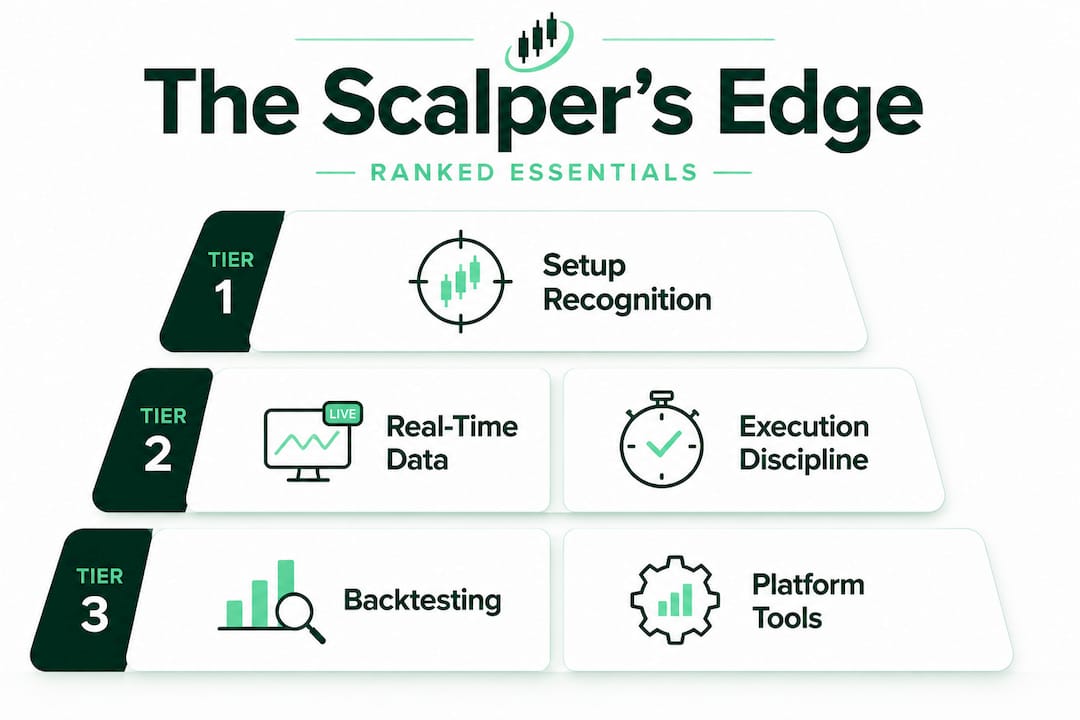
But here is the critical caveat. High-frequency trading firms operate in environments with latency below 10 microseconds. Retail traders, even on premium feeds, are operating at milliseconds. In heavily algorithmic markets, HFTs detect and react to order book imbalances before any retail trader can act. Chasing that specific edge in ultra-liquid, heavily algo-traded instruments like S&P 500 futures during peak hours is not productive.
The smarter play for retail scalpers:
- Identify your instrument's algo density. Bitcoin spot markets, mid-cap crypto pairs, and minor forex crosses are less dominated by HFTs than ES or NQ futures during US open.
- Focus on structural imbalances over tick imbalances. A 15-bar consolidation with compressed volatility is more actionable than a fleeting order book spike.
- Use real-time data to confirm, not discover. Your setup should come from structure and indicator signals. Real-time data confirms the entry timing.
- Set hard latency checks. If your feed regularly shows price several ticks behind your broker's execution platform, fix the feed before trading live.
- Automate alerts, not reactions. Use webhook-powered alerts to capture real-time signal events and review them with discipline rather than chasing every ping.
The scalping algo indicators framework addresses this exact hierarchy: structure first, signal second, data confirmation third.
"Retail edge in scalping is not about reaction speed. It is about setup discipline and consistent signal execution. Real-time data supports that process. It does not replace it."
Pro Tip: Backtest your setups using historical tick data from Dukascopy or Alpaca before going live. If the setup is not consistently profitable on clean historical data, adding a faster feed will not fix it.
Why most traders overrate speed and miss the real edge
Here is a perspective that runs counter to how most data vendors market their products. Faster data is not the primary driver of scalping profitability for retail traders. We have seen this play out repeatedly. A trader pays for premium co-location data, shaves 50ms off their feed, and still loses. Why? Because the edge was never in the milliseconds.
Institutional players will always win the pure latency race. Always. They have purpose-built fiber, co-located servers, and FPGA hardware doing order routing in nanoseconds. Trying to compete on that dimension as a retail trader is a losing bet before you place a single trade.
What actually moves the needle is repeatable setup recognition. The scalpers who consistently extract profit are the ones who have defined two or three specific price structures that they trade exclusively, with clear rules for entry, stop, and target. They use real-time data not to find trades but to time entries into known setups with precision.
The 1-minute scalping setups approach is a practical example. The trader already knows the setup before price arrives at the trigger zone. Real-time data just tells them when the moment is live. That is a fundamentally different relationship with data than trying to read the tape and react in real time.
Most traders also underestimate the psychological drag of watching live ticks. Real-time data at the tick level creates noise that disrupts decision-making. Impulsive entries, premature exits, revenge trades. Structure-based scalping with real-time confirmation removes much of that noise while still keeping you sharp on timing.
The bottom line: upgrade your tools, yes. But spend equal time building your setup library and execution discipline. That combination outperforms raw speed every time.
Take your scalping to the next level with professional tools
Now that you understand how real-time data feeds into precise scalping execution, the next step is matching that knowledge with tools built for exactly this environment.
Scalping-Algo offers a full suite of Pine Script v6 TradingView indicators that process live, non-repainting signals on 1m to 15m charts. Every tool is built to integrate with real-time data from TradingView's live feed, with native webhook alert support for instant Discord notifications. The Algo Master suite combines regime filters, volatility gating, and order-block detection into a single platform. The Edge Finder tool identifies high-probability confluences so you are trading structure and momentum together. Explore the full indicator library and find the tools that match your style and markets. Real-time data is already flowing. Now give it the framework to generate consistent signals.
Frequently asked questions
What is the difference between Level 1 and Level 2 market data?
Level 1 shows only the best bid and ask prices, while Level 2 reveals the full market order book depth, including every pending order at every visible price level.
Why is ultra-low latency important for institutional scalping?
Institutions use ultra-low latency to act on order book imbalances within microseconds, well below the threshold where retail traders can compete on speed alone.
Are free real-time market data tools reliable for scalping?
Free tools can work for structure-based scalping, but many lack the depth, feed stability, or tick accuracy that serious scalping on volatile instruments demands.
How can I check if my data feed is truly real-time?
Compare your platform's price against a direct exchange or broker feed on the same instrument. Any consistent offset of more than one to two seconds means your feed introduces lag that affects execution.