

Most traders assume the real edge in scalping comes from finding the perfect entry signal. That belief is costly. Automation wins tend to come from robust execution and risk controls, not simply from improving the signal. In commodities scalping specifically, where crude oil, gold, and agricultural futures can gap violently in seconds, what happens after the signal fires is what separates consistent traders from blown accounts. This guide covers exactly that: the mechanics of commodities scalping, the automation layer most traders ignore, and the tools that enforce the edge you're chasing.
Table of Contents
- What is commodities scalping?
- The real edge in commodities scalping: Execution and risk control
- Automated tools and frameworks for scalpers
- Common pitfalls in automated commodities scalping
- Perspective: Why most traders get execution wrong in commodities scalping
- Level up your commodities scalping with premium automation
- Frequently asked questions
Key Takeaways
| Point | Details |
|---|---|
| Execution is the real edge | Consistent commodities scalping success comes from robust execution and risk control, not just signal quality. |
| Use advanced automation | Modern tools with system-level safeguards can greatly improve both safety and consistency in scalping. |
| Avoid common mistakes | Skipping risk controls or neglecting automation flaws leads to most losses in automated scalping. |
| Prioritize risk management | Always test new systems in simulation to catch execution errors before risking real capital. |
What is commodities scalping?
Commodities scalping is the practice of entering and exiting positions in markets like crude oil futures (CL), gold (GC), natural gas (NG), and agricultural contracts (corn, wheat, soybeans) within very short timeframes, typically seconds to a few minutes. The goal is simple: capture small price movements repeatedly, accumulate gains, and exit before risk builds.
It's a fundamentally different style from swing trading or position trading. Here's what makes it distinct:
- Tiny position durations. Most scalp trades close within 1 to 5 minutes, sometimes faster.
- High trade frequency. A serious scalper can take 20 to 80 setups in a single session.
- Liquidity dependence. Scalping only works where bid/ask spreads are tight and volume is high. Illiquid contracts destroy edge instantly.
- Extreme cost sensitivity. Commissions, slippage, and exchange fees matter enormously at this horizon. A strategy that "works" on paper can fail live because of 1 tick of slippage per trade.
- Tight risk parameters. Stops are measured in ticks, not points.
Retail traders are drawn to commodities scalping for practical reasons. Capital requirements are lower than longer-term strategies. Overnight risk is mostly eliminated since positions close intraday. And the sheer number of setups means more frequent opportunities to practice and improve. Checking out futures scalping strategies can help you understand how win rates and trade structures look across different commodity contracts.
The key distinction between scalpers who grow accounts and those who grind them down often has nothing to do with signal quality. Execution and risk controls like order type selection, smart routing and splitting, retries, and system-level risk controls are dominant differentiators for automated scalping tools. That's the part most traders skip.
Pro Tip: Many novice scalpers spend months hunting the perfect entry indicator while ignoring exit logic and risk layering entirely. Flip that ratio. A mediocre entry with solid execution and tight risk will outperform a great entry with sloppy exit handling.
The real edge in commodities scalping: Execution and risk control
With the mechanics of scalping clear, let's break down what actually drives a consistent edge, because most traders underestimate the automation and risk side completely.
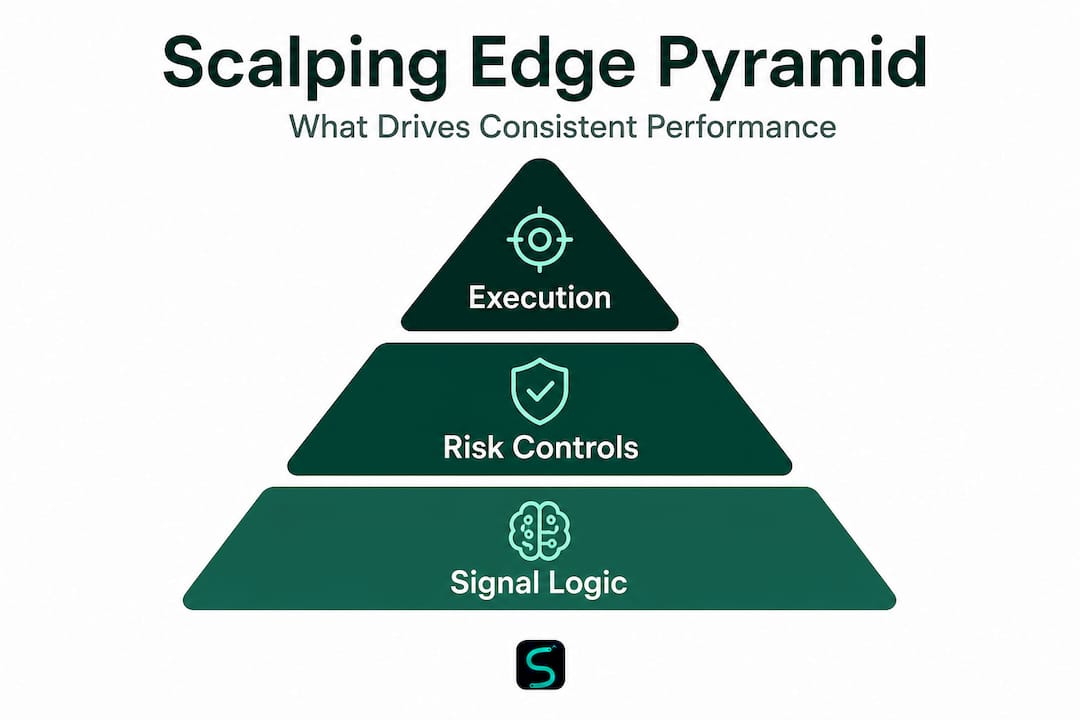
Think of a scalping system in three distinct layers:
- Signal logic. The indicators, pattern recognition, or model logic that generates a potential entry or exit. This is the layer most traders obsess over.
- Execution layer. How the order actually gets placed, managed, and confirmed. Order type selection (market vs limit), timing, smart routing, retry logic on failed fills.
- Risk control layer. System-level safeguards: slippage thresholds, latency monitoring, max exposure caps, daily drawdown halt triggers, API health checks.
Here's the uncomfortable truth: layers two and three drive results far more than layer one at scalping timeframes. A strong signal fired with market orders during a liquidity gap, with no slippage check, into a position that's already at daily risk limit, is a losing trade regardless of signal quality. Order type selection, smart order routing, retry logic, and execution-level controls like slippage monitoring and latency tracking are fundamental to any serious setup.
Look at how these approaches differ in practice:
| Execution approach | Order management | Risk controls | Typical slippage cost |
|---|---|---|---|
| Manual trading | Market orders, manual entry | None or ad hoc | High (2 to 5 ticks avg) |
| Basic script/bot | Limit orders, no retries | Manual position size | Moderate (1 to 3 ticks) |
| Advanced automation | Smart routing, retries, fill confirmation | Circuit breakers, drawdown halts, latency checks | Low (0 to 1 tick) |

The numbers in that table compound quickly across 40 trades per session. Two ticks of extra slippage per trade, across a session with 40 trades in crude oil (where 1 tick = $10), adds up to $800 of unnecessary drag. That's the difference between a profitable day and a red one.
There are also serious algorithmic trading benefits that come from separating these layers clearly. It's easier to debug. It's easier to stress test. And it lets you maximize speed with automation without exposing yourself to runaway losses when market conditions shift.
Pro Tip: Build circuit breakers into your system before you go live. A daily drawdown halt that stops all trading after a 1.5% account loss is not a weakness in your strategy. It's the feature that keeps you in the game tomorrow.
Automated tools and frameworks for scalpers
The edge in execution is clear. But many traders still don't know which tools actually implement this layer effectively. Here's a breakdown of the main categories and what to look for.
Alert-based automation. Tools like TradingView webhooks fire alerts to execution endpoints (Discord, third-party bridges) when signal conditions are met. These are fast, visual, and easy to audit. The risk is latency between alert and order placement. Always measure round-trip time on your setup.
Broker API bots. Programmatic connections directly to your broker's order management system. These offer the most control, including custom order logic, retries, and fill confirmation. Higher technical barrier to entry, but the execution precision is unmatched.
Platform-specific bots. Proprietary systems built for specific exchanges or brokers. Often plug-and-play but limited in customization. Good starting point for traders newer to automation.
Risk overlays. Separate systems or modules that sit on top of your signal and execution layers, enforcing max exposure, position sizing, drawdown limits, and kill switches. These are non-negotiable for serious scalping. The research is clear: dominant differentiators of automated scalping tools are found in the execution and risk layer, not the signal logic.
| Tool category | Key features | Risk controls offered |
|---|---|---|
| Alert-based automation | Real-time webhooks, visual signals | Basic, depends on bridge configuration |
| Broker API bots | Full order management, retry logic | Advanced, custom circuit breakers |
| Platform-specific bots | Plug-and-play, exchange-native | Moderate, usually capped at platform defaults |
| Risk overlays | Standalone risk enforcement | Full: drawdown halts, exposure caps, kill switch |
When evaluating any tool, ask specifically: does it handle failed fills? Does it track latency? Does it have a kill switch? Can it enforce a max daily loss threshold? These are not optional features. They are the features that determine survivability. Explore top advanced scalping tools that check these boxes.
For TradingView users specifically, the quality of the underlying indicator matters too. Exploring intraday scalping indicators and understanding what makes best TradingView indicators reliable will help you evaluate which signal logic is worth automating in the first place.
Key features every serious scalping tool should have:
- Non-repainting signals (historical accuracy must reflect live performance)
- Native webhook alert support for fast, reliable execution triggers
- Volatility gating (avoid trading in conditions your system wasn't designed for)
- Clear confluence filtering to reduce false signal frequency
- Open source or auditable code so you understand exactly what fires and when
Common pitfalls in automated commodities scalping
Sophisticated tools bring real power. But they also introduce failure points most traders never anticipate until it's too late.
The 5 biggest mistakes scalpers make with automation:
- Ignoring latency entirely. A 300ms delay on a 1-minute chart is catastrophic. Always benchmark your full execution loop: signal fire, webhook delivery, order placement, and fill confirmation.
- Poor API error handling. What happens when your broker API returns an error? If your bot silently fails and retries forever, you may end up in multiple unintended positions.
- No circuit breakers. Trading without a daily drawdown halt is like driving without brakes. One bad session with no kill switch can erase weeks of gains.
- Over-optimization. Curve-fitting parameters to historical data produces systems that work perfectly in backtesting and fail immediately live. System-level risk controls, including slippage monitoring, latency tracking, and drawdown breakers, are key to disciplined and survivable scalping over real market conditions.
- Neglecting system maintenance. APIs change. Broker infrastructure updates. Market structure shifts. A bot you set up six months ago may behave differently today if you haven't reviewed it.
Psychological pitfalls are equally real, even with automation. Revenge trading after a bad automated session (manually overriding the system to "win back" losses) is one of the fastest ways to blow an account. Trusting a system you don't fully understand is another. If you can't explain exactly what your automation does in a failure scenario, you're exposed.
Quick robustness checklist for your automation setup:
- Latency benchmarked and within acceptable bounds for your timeframe
- API error handling tested (including timeout and rejection scenarios)
- Daily drawdown halt confirmed and tested in paper environment
- Position sizing logic verified independently from signal logic
- Kill switch accessible and tested before going live
Use real-time market data for scalping to validate your latency benchmarks. Reference a solid scalping day trading checklist before each session. And don't overlook the value of setup trading alerts correctly from the start.
Pro Tip: Always run new automation setups on paper or simulation accounts for a minimum of two weeks before going live. Hidden execution errors, such as duplicate orders, incorrect sizing, or missed fills, show up reliably in sim. They're far more expensive to discover in a live account.
Perspective: Why most traders get execution wrong in commodities scalping
Here's the honest take most guides won't give you. The scalping education market is flooded with content about entry signals: RSI divergence, VWAP bounces, order block setups. That content gets clicks because traders want to believe the edge lives in finding the right moment to enter. It feels more controllable. More learnable.
But the data doesn't support that belief. Automation wins come from robust execution and risk controls, not just better signal logic. We've seen this pattern repeatedly. Traders with genuinely good signal frameworks still blow up because they treat execution as an afterthought.
The "holy grail" trap is real. Traders spend months switching indicators, back-testing endlessly, convinced the next signal model will be the one that makes everything work. Meanwhile, they're running on broker defaults with no latency monitoring, no drawdown circuit breaker, and no systematic position sizing. The problem was never the signal.
Here's the mindset shift that separates traders who last: stop thinking of execution and risk management as "extra steps." They are the strategy. The signal tells you where to trade. Execution and risk controls determine whether you actually capture that trade efficiently, survive the bad days, and compound over time.
We'd also argue that until you've invested serious time in why algorithmic trading matters from an execution standpoint, not just a signal standpoint, automation is more liability than advantage. You're adding complexity and potential failure points without the safeguards that make those tools actually work.
The traders who consistently outperform in commodities scalping are not the ones with the flashiest entry setups. They're the ones who built boring, systematic, well-monitored execution frameworks and stuck to them.
Level up your commodities scalping with premium automation
The gap between knowing these principles and actually implementing them is where most traders stall. That's exactly why we built what we built.
Our premium scalping indicators are built in Pine Script v6 with non-repainting signals, native webhook alert support, volatility gating, and confluence filtering designed for commodities and futures scalping on 1m to 15m timeframes. The Algo Master suite integrates signal logic, execution alerts, and risk parameters in one dashboard, so you're not cobbling together three different tools. For traders who want focused, high-precision signals optimized for short-term execution, Smart Scalping Signals delivers exactly that. Every tool is open-source and auditable, built for traders who want real transparency, not just flashy screenshots.
Frequently asked questions
Is commodities scalping possible for beginners or only advanced traders?
Commodities scalping is accessible to beginners, but system-level risk controls are essential before increasing trade size. Start small, use simulation accounts, and prioritize learning execution mechanics before scaling up capital.
What distinguishes a professional scalping system from a basic bot?
The main difference is advanced execution controls: smart routing, slippage checks, retry logic, and daily drawdown circuit breakers. Basic bots generate orders; professional systems manage, confirm, and protect those orders at every step.
Why do automated scalping systems sometimes lose money even with good signals?
Without robust execution and risk management, even strong entry signals can be ruined by slippage, latency, or missed fills. Execution and risk controls, not just signals, determine real-world trading outcomes.
What risk controls should every scalping automation include?
Essential controls include slippage and latency monitoring, API health checks, max exposure caps, and daily drawdown circuit breakers. These are non-negotiable for any scalping setup that needs to survive and grow over time.