

Most scalpers enter the market convinced that more volatility automatically means more profit. That assumption gets accounts blown. The role of volatility in scalping is genuinely more nuanced: volatility is the necessary fuel for short-term price swings, but the wrong kind, at the wrong time, with the wrong execution conditions, turns that fuel into a fire you cannot control. This article breaks down how volatility creates opportunity, how it raises execution risk, which indicators you need, and exactly how to filter for conditions where your edge actually holds.
Table of Contents
- How volatility creates scalpable opportunities in crypto and forex markets
- Volatility's impact on execution risks: spreads, slippage, and liquidity challenges
- Volatility-based indicators: tools for timing and managing scalp trades
- Advanced volatility concepts: gamma scalping and volatility regime management
- Practical strategies for retail scalpers to leverage volatility effectively
- Rethinking volatility in scalping: beyond "more is better"
- Explore premium scalping tools optimized for volatility trading
- Frequently asked questions
Key Takeaways
| Point | Details |
|---|---|
| Volatility drives scalpable moves | Scalping depends on short-lived price swings created by sufficient market volatility. |
| Execution matters as much as volatility | High volatility with poor liquidity or wide spreads can harm trade fills and profitability. |
| Use volatility indicators | Tools like Bollinger Bands and ATR help identify suitable entry points and risk conditions. |
| Advanced volatility strategies require nuance | Gamma scalping and volatility regime management rely on understanding realized vs implied volatility and current market state. |
| Apply disciplined filters | Retail scalpers should combine volatility, execution, and event filters to protect their edge and manage risk effectively. |
How volatility creates scalpable opportunities in crypto and forex markets
Scalping lives or dies on price movement. Without it, there is nothing to trade. Volatility drives the frequent, short-lived price swings that give scalpers their entry and exit windows. When volatility collapses, price action stagnates. Setups disappear. You end up forcing trades in dead markets, which is worse than sitting on your hands.
Two tools dominate volatility reading on short timeframes:
- Bollinger Bands: When bands expand, volatility is rising. When they contract into a tight squeeze, a breakout is often imminent. On the 1-minute and 5-minute charts, band expansions signal the kind of rapid directional moves that scalpers can ride quickly.
- Average True Range (ATR): ATR measures how much a pair moves on average over a given period. A rising ATR means conditions are heating up. A falling ATR is your cue to step back and wait.
Session timing matters just as much as the indicators themselves. The London-New York overlap, roughly 8:00 to 12:00 EST, is the single best window for forex scalping. Volume is high, spreads are tighter, and directional moves have follow-through. In crypto, volatility clusters around macro news releases and major U.S. equity market opens.
Understanding this rhythm is part of your day trading checklist. Stop-loss placement also ties directly to volatility. A 1x ATR stop in a high-volatility environment gives your trade room to breathe without getting clipped by noise. The same stop in a low-volatility environment will be oversized relative to the actual move.
Volatility's impact on execution risks: spreads, slippage, and liquidity challenges
Here is where most retail scalpers get blindsided. They see the volatility spike, they see the setup, and they fire the order. What they do not see coming is the execution degradation that follows.

High volatility with poor liquidity causes fills to deteriorate sharply. During thin liquidity periods, retail ECN spreads can widen to the point where your theoretical edge is already gone before the trade opens. Slippage on stop-loss exits during volatility spikes is a documented problem, with fills reported 200 to 500 pips off intended levels in extreme cases.
How do you build a defense against this? Use a rule-based filter approach:
- Check current spread before entry. Set a hard ceiling. If EUR/USD spread is above 1.5 pips, skip the trade.
- Monitor ATR range. If ATR is running more than two standard deviations above its 20-period average, execution quality is likely degraded.
- Track session hours. Avoid the 30-minute window before and after major news releases. Liquidity withdraws fast.
- Use limit orders where possible. Market orders in volatile conditions are an open invitation to slippage. Limit orders let you define the price you are willing to accept.
- Review fills after every session. If average slippage is creeping up, the execution environment has changed and your approach needs to adapt.
The GBP/USD flash crash in October 2016 dropped over 600 pips in minutes during low-liquidity Asian trading hours. Scalpers who held positions through that event faced stop-loss fills at completely unintended levels. It is an extreme example, but the principle applies every day at a smaller scale.
The connection between algorithmic trading for scalpers and execution quality is real. Automated systems can monitor spread conditions in real time and hold orders back when conditions are unfavorable, something a manual trader almost never does consistently.
Pro Tip: Build spread and slippage thresholds into your trading rules and treat them as hard stops, not suggestions. Skipping a trade because execution conditions are bad is a win, not a miss.
Volatility-based indicators: tools for timing and managing scalp trades
Getting the volatility read right requires tools calibrated for the timeframes you are actually trading on. Volatility analysis in scalping means using indicators that react quickly and do not lag behind the price action you are trying to catch.
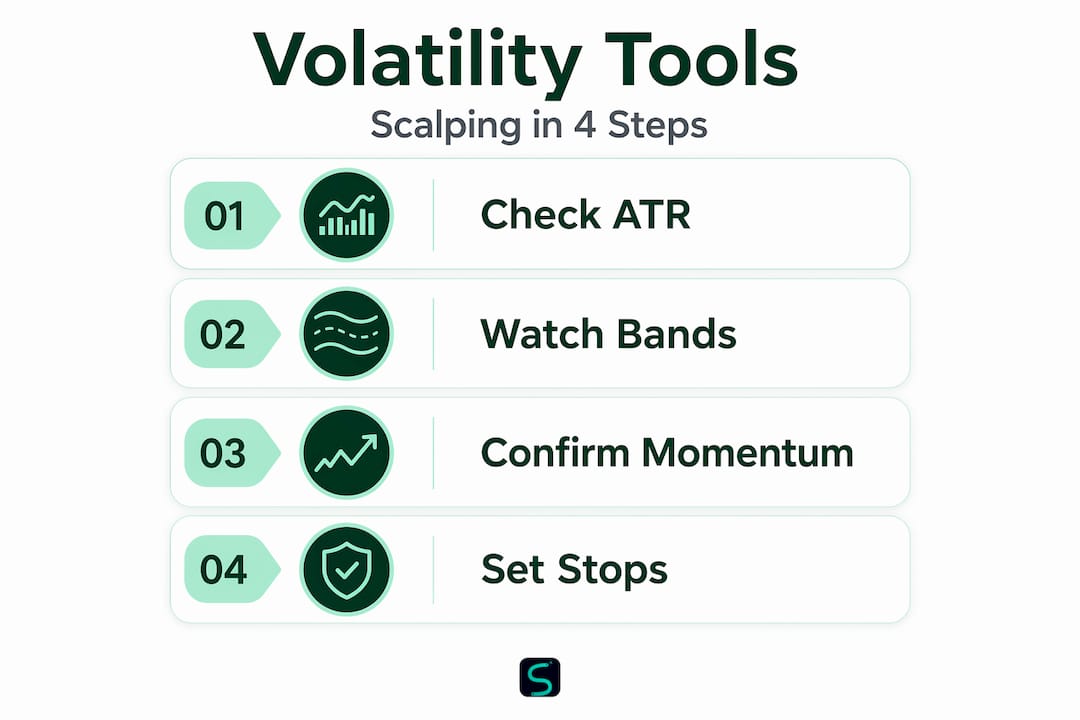
Here is a comparison of the three most-used volatility and momentum indicators for short-term scalping:
| Indicator | Primary use | Best timeframe | Key signal |
|---|---|---|---|
| Bollinger Bands | Volatility range and reversals | 1m, 3m, 5m | Band squeeze followed by expansion |
| ATR | Range measurement and stop sizing | 5m, 15m | Rising ATR signals favorable conditions |
| RSI (short period) | Momentum confirmation | 1m, 2m, 3m | Overbought/oversold in trending volatility |
Bollinger Bands and ATR measures help scalpers detect when volatility is rising or contracting enough to justify an entry and how to size the position accordingly. The practical edge comes from combining them. Bands tell you the environment; ATR tells you the actual range in pips.
A few execution tips for each:
- Bollinger Bands on 1-minute charts: Wait for a band squeeze, then watch for the first candle that breaks outside the band with above-average volume. That is your signal the move has momentum.
- ATR for stop placement: Multiply the current ATR reading by 1.5. That is your minimum stop-loss distance to avoid being shaken out by random noise.
- RSI at period 7 or 9: Shorter period RSI responds faster to price shifts, giving you earlier momentum signals. A cross above 50 while price is inside an expanding Bollinger Band is a high-quality entry signal.
The best TradingView scalping indicators incorporate these readings in real time, and pairing them with a momentum oscillator indicator adds a reliable filter that cuts out a significant percentage of false entries.
Pro Tip: Never trade a volatility expansion signal in isolation. Confirm it with a momentum reading. A band breakout with a flat RSI is often a fakeout. A band breakout with RSI surging above 60 is far more reliable.
Advanced volatility concepts: gamma scalping and volatility regime management
Once you have the core indicators dialed in, the next level is understanding how volatility regimes and advanced strategies like gamma scalping change the game entirely.
Gamma scalping is an options-based approach where a trader holds a delta-neutral, gamma-positive position and profits by re-hedging as the underlying price moves. Gamma scalping profits when realized volatility exceeds implied volatility, because the frequent underlying moves generate re-hedging gains large enough to offset theta decay. If realized volatility falls below implied, the strategy loses. It is not a simple direction bet. It is a bet on volatility itself.
For retail scalpers trading spot crypto or forex, the takeaway is structural: your entries should be calibrated to current volatility, not historical averages. Key points to internalize:
- A setup that worked in a high-volatility regime will perform differently in a low-volatility regime. The same pattern, different result.
- Volatility regimes do not announce themselves. They shift gradually, then suddenly.
- Multi-timeframe volatility monitoring catches regime changes earlier. Check ATR on the 15-minute chart while trading the 1-minute chart.
- After a volatility spike, there is typically a cooldown period. Fading that cooldown is dangerous.
Volatility regime transitions can flip scalping profitability without warning. Tools that track when markets move from expansion to contraction states allow you to pause the strategy before it gives back gains.
The algorithmic trading benefits for managing regime changes are significant. An automated system can detect ATR compression across multiple timeframes simultaneously and suspend trade signals until conditions normalize, something a manual trader can easily miss mid-session.
Practical strategies for retail scalpers to leverage volatility effectively
Knowing the theory is one thing. Building it into a repeatable process is another. Here is how to apply volatility analysis in scalping as a structured, rule-based framework.
- Define your volatility entry window. Use ATR(14) on the 5-minute chart. Set a floor (not too low, no scalpable moves) and a ceiling (not too high, execution degrades). Trade only when ATR falls inside that range.
- Set a spread ceiling. For major forex pairs, a ceiling of 1.5 to 2 pips is reasonable. For crypto, adjust based on the exchange and asset. Breach the ceiling, skip the trade.
- Avoid the news zone. Rule-based volatility filters protect scalpers from the liquidity vacuum that forms 15 to 30 minutes before and after high-impact releases. Mark those times on your chart and go flat.
- Size stops using ATR. Do not use fixed-pip stops. A 1.5x ATR stop adjusts automatically to current market conditions, keeping you out of the noise without giving up more than necessary.
- Log slippage on every trade. Weekly review of average slippage is one of the most underused edges in retail scalping. If it is rising, your broker, session timing, or pair selection needs to change.
Use your scalping checklist to confirm each condition is met before entering. Discipline around these filters is what separates consistent scalpers from traders who win for two weeks and then hand it all back.
Pro Tip: Build these filters into automated alerts on your platform. When ATR is outside your target range, or spread exceeds your ceiling, a real-time alert stops you from overriding your own rules in the heat of the moment.
Rethinking volatility in scalping: beyond "more is better"
The conventional view is simple: volatile market equals more setups, more trades, more profit. We disagree with that framing and have seen it cause real damage to trader accounts.
High volatility without reliable execution reduces or inverts edge even when the entry logic is correct. The setup triggers. The signal is valid. But if the spread just widened by three pips and the fill slips another two, a five-pip target trade is already underwater before price even moves. That is not a strategy problem. That is an execution problem wearing a strategy costume.
The smarter framing is this: volatility is a prerequisite for scalping, but execution quality is the actual bottleneck. Most retail traders optimize entries obsessively while ignoring the friction that eats their edge. Before chasing volatile markets, get your execution stack right.
Crypto and forex behave very differently here. Crypto markets run 24 hours, with volatility that can spike without session structure. Spreads on major centralized exchanges are generally tighter, but liquidity gaps in derivatives and perpetual futures can be severe. Forex has more predictable volatility windows but is heavily influenced by broker infrastructure and ECN conditions. What works as a filter in one market may be irrelevant in the other.
Our recommendation: start with quantitative volatility regime filters before anything else. Know what ATR range corresponds to your edge. Know your spread tolerance. Monitor those numbers with automated tools, not manual checking. The algorithmic trading tools built for scalpers exist precisely to handle this monitoring layer so you can focus on execution decisions rather than environmental scanning.
Volatility will always be there. The question is whether you are trading it or being traded by it.
Explore premium scalping tools optimized for volatility trading
Understanding the role of volatility in scalping is valuable. Having tools that apply that understanding automatically is where real consistency starts.
At Scalping-Algo, we build TradingView indicators in Pine Script v6 designed specifically for short-timeframe volatility conditions. Our Algo Master indicator suite includes built-in volatility gating, spread monitoring, and real-time non-repainting signals calibrated for 1-minute to 15-minute charts across crypto and forex. If you want signals filtered by ATR range, momentum confirmation, and execution quality metrics in one view, take a look at our smart scalping signals indicator. You can explore the full toolkit at the Scalping-Algo platform and find the right layer of automation for your trading style.
Pro Tip: Use our indicators alongside your own volatility analysis. Automated filters catch what manual review misses, especially during fast-moving markets when decisions need to happen in seconds.
Frequently asked questions
Why is volatility important for scalping trading strategies?
Volatility creates the short-term price swings scalpers need for frequent entry and exit opportunities. Without it, price action becomes too static for short-duration trades to generate meaningful returns.
Can high volatility negatively affect forex scalping?
Yes. High volatility with poor liquidity worsens fills and causes slippage that can push stop-loss executions far beyond intended levels, reducing or reversing a scalper's edge regardless of entry quality.
What volatility indicators are most useful for scalpers?
Bollinger Bands and ATR help detect when volatility is expanding or contracting, giving scalpers timing signals and a basis for sizing stops relative to actual market conditions.
How does gamma scalping depend on volatility?
Gamma scalping profits when realized volatility exceeds implied volatility, as the underlying price moves generate re-hedging gains large enough to outpace option time decay losses.
How can retail scalpers manage risks during volatile markets?
ATR-based filters, spread ceilings, and avoiding entry around high-impact news releases give scalpers a rule-based framework that protects against degraded execution conditions without requiring real-time manual monitoring.