

Safety in trading is the practice of applying rigorous risk controls and security measures to preserve capital and reduce losses across every market condition. Without it, even a profitable strategy collapses under a single bad streak. The importance of safety in trading goes beyond avoiding losses. It determines whether you survive long enough to profit at all. Traders who treat risk management as optional discover the hard way that a disciplined safety culture is the single most reliable operational advantage in the markets.
Why safety matters in trading: the core case
Risk management is the cornerstone of trading safety, and it matters more than win rate, strategy edge, or market selection. Top profitable traders survive by managing risk strictly, not by winning more often. That distinction is the foundation of every durable trading career.

The math behind risk per trade
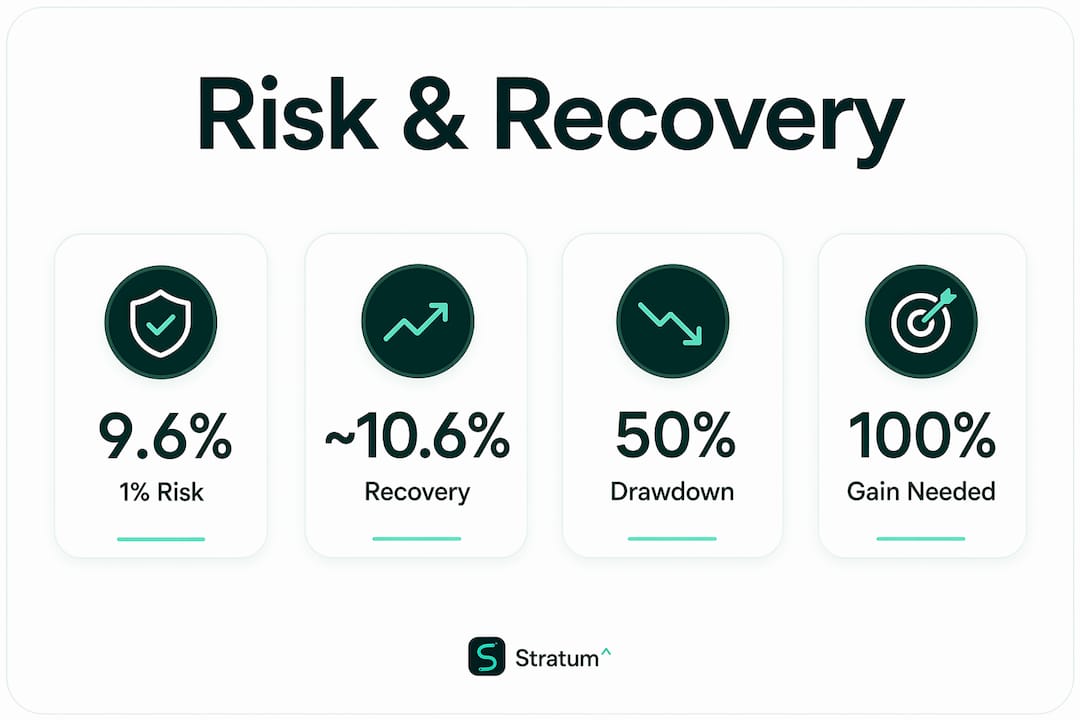
The numbers here are not abstract. At 1% risk per trade, ten consecutive losses cost you only 9.6% of your account. At 5% risk per trade, ten consecutive losses cost 40.1%, requiring a 67% gain just to break even. That asymmetry is why professional traders cap single-trade risk at 1 to 2% of total capital, not because it feels conservative, but because the math demands it.
Drawdown recovery compounds the problem exponentially. A 50% drawdown requires a 100% gain to recover. A 70% drawdown requires a 233% gain. These are not edge cases. They are the predictable outcome of ignoring position sizing, and they explain why most retail accounts blow up within the first year.
Correlation risk: the invisible multiplier
Most traders track individual position size but miss correlation risk entirely. Positions with a correlation above 0.7 should be treated as partial exposure in your total risk calculation, not as separate trades. Running three correlated crypto longs simultaneously is not three separate 1% risks. It is closer to a single 3% risk, and that distinction can be the difference between a manageable drawdown and an account-ending loss.
Traders with explicit daily loss limits carry 34% lower maximum drawdowns than those without them. That single rule, a hard daily stop, does more for long-term account survival than any indicator or signal system.
Pro Tip: Set your daily loss limit at 3 to 5% of total account value. Once hit, close the platform. No exceptions. Revenge trading after a loss limit breach is the fastest path to a blown account.
| Risk level | 10-loss drawdown | Recovery needed |
|---|---|---|
| 1% per trade | 9.6% | ~10.6% |
| 2% per trade | 18.3% | ~22.4% |
| 5% per trade | 40.1% | ~67% |
| 10% per trade | 65.1% | ~186% |
How do safety measures in automated trading protect your investments?
Automated and AI-driven trading systems introduce a new category of risk that manual traders rarely consider: technical failure. A strategy can be profitable on paper and still lose money in live conditions because of bugs, security breaches, or execution errors. Understanding why safety in trading scripts matters is non-negotiable for anyone running bots or algorithmic systems.
Security threats targeting trading bots
AI trading bots face supply chain attacks and prompt injection as primary security threats in 2026. These attacks target the libraries, APIs, and data feeds your bot depends on, not the bot itself. A compromised dependency can silently alter order logic or leak API credentials without triggering any obvious error. Experts recommend rotating API keys every 90 days and applying IP whitelisting as a minimum baseline. For context on why AI bots frequently fail, security gaps and missing safety layers are among the top causes.
Technical safety layers every automated system needs
Independent risk monitors must run outside the main trading engine to remain effective if that engine crashes. This is not optional architecture. It is the only design that guarantees an emergency exit function works when the system that needs stopping has already failed. Pre-trade checks, position limits, and kill switches all belong in a separate process, not inside the strategy logic itself.
Execution bugs are a separate and equally serious threat. Concurrency issues and silent order failures cause real losses even when the underlying strategy is sound. A mutual exclusion lock prevents double orders from firing simultaneously. A verification loop with a 2-second delay after order placement confirms the order is live on the exchange, not just submitted. Skipping these checks is how a profitable system generates unexpected losses in live trading.
Pro Tip: After every order placement in your automated system, build in a 2-second verification loop to confirm the order is active on the exchange. Silent failures are invisible until they cost you real money.
| Safety layer | Function | Failure without it |
|---|---|---|
| API key rotation | Prevents credential theft | Account takeover |
| IP whitelisting | Blocks unauthorized access | Unauthorized trades |
| Mutual exclusion locks | Prevents duplicate orders | Double position entries |
| Independent risk monitor | Kills positions if engine fails | Uncontrolled losses |
| Order verification loop | Confirms live order status | Silent stop loss failures |
For traders using webhook trading alerts, these same safety principles apply to the alert delivery pipeline, not just the execution layer.
What practical trading safety tips can traders apply right now?
The risks of unsafe trading are not theoretical. They show up as blown accounts, missed recovery opportunities, and psychological damage that follows traders for years. The good news is that the most effective safety practices are simple, repeatable, and available to traders at every experience level.
Here are the seven trading safety tips that deliver the most protection per unit of effort:
- Set a hard daily loss limit. Define it before the session starts. When you hit it, stop trading for the day, no exceptions.
- Reduce position size during drawdowns. If your account drops 10%, cut risk per trade by 50% until you recover. This protects against compounding losses.
- Treat correlated positions as one trade. If you hold multiple assets moving together, calculate total exposure, not individual trade risk.
- Use a pre-trade checklist. Write down your entry criteria, stop level, and target before placing any order. This eliminates impulsive entries.
- Journal every trade. Record entry, exit, reason, and outcome. Patterns in your losses reveal systemic errors faster than any indicator.
- Test automated systems for silent failures. Run concurrency tests and simulate API outages before going live. Testing for silent failure modes only surfaces in live conditions if you skip this step.
- Build psychological guardrails. Revenge trading after a loss is the most common account-destroying behavior. Trading psychology discipline is a safety measure, not a soft skill.
How to ensure safety in trading comes down to systems, not willpower. Rules written down and enforced mechanically outperform intentions every time.
How does risk management drive long-term trading profitability?
Risk management is a layered defense system, and prioritizing it over strategy ensures survival long enough to realize any edge. This is the insight most traders miss. A strategy with a 55% win rate and poor risk management loses money. A strategy with a 45% win rate and strict risk controls can be highly profitable over time. The math of expectancy rewards discipline, not aggression.
Why survival time is the real edge
Every trader's primary goal should be staying in the game long enough for their edge to play out. A single catastrophic loss can eliminate months of gains and the psychological capital needed to keep trading. Adjusting risk parameters dynamically during drawdowns is one of the most underused safety techniques available to retail traders.
The compounding effect of avoided losses is more powerful than the compounding effect of gains. Protecting a $10,000 account from a 50% drawdown saves you from needing a 100% return just to get back to flat. That same capital, kept intact, can compound forward. This is why building a trading strategy without embedding risk controls from the start is structurally flawed.
Pro Tip: Before evaluating any strategy by its win rate or return, check its maximum drawdown first. A strategy that never exceeds a 15% drawdown is worth far more than one with higher returns and a 40% drawdown history.
Traders who apply layered safety rules consistently outperform those chasing returns in three measurable ways:
- Lower maximum drawdowns mean faster recovery after losing streaks.
- Smaller position sizes during volatile periods reduce exposure when prediction is hardest.
- Psychological stability from controlled losses allows clearer decision-making on the next trade.
Safety code and failure handling make up more of a well-built automated trading system's codebase than the core strategy itself. That ratio reflects a professional truth: protecting what you have is harder and more important than generating new gains.
Key takeaways
Safety in trading is not a feature you add later. It is the structural foundation that determines whether any strategy survives long enough to be profitable.
| Point | Details |
|---|---|
| Risk per trade limit | Keep single-trade risk at 1 to 2% to survive losing streaks without catastrophic drawdowns. |
| Daily loss limits work | Traders with hard daily stops carry 34% lower maximum drawdowns than those without them. |
| Automated safety layers | Independent risk monitors, kill switches, and order verification loops are non-negotiable for bot traders. |
| Correlation risk is hidden | Positions correlated above 0.7 must be treated as combined exposure, not separate trades. |
| Survival beats strategy | A disciplined safety culture outlasts any edge. Staying in the game is the prerequisite for profiting from it. |
Safety first: what I've learned after years at the trading desk
The most common mistake I see traders make is treating safety as something to add once they have a working strategy. That logic is backwards. Safety is what makes a strategy workable in the first place. I have watched traders with genuinely good setups blow accounts because they skipped position sizing rules during a hot streak, then got hit by a single outsized loss that wiped out weeks of gains.
The automation era has made this more urgent, not less. AI-driven bots and Pine Script systems can execute faster than any human, but they also fail faster and more silently. A bug in an automated system does not pause to ask if you are sure. It fires orders until something stops it. That is why the safety code around a strategy matters as much as the strategy itself.
My honest view: most retail traders underinvest in safety by a wide margin. They spend hours optimizing entries and almost no time on daily loss limits, drawdown protocols, or system health checks. The traders I have seen build consistent accounts over years all share one habit. They treat risk management as the primary job and treat signal generation as secondary. That mindset shift is the single most valuable thing any trader can adopt in 2026.
— Tran
Trade smarter and safer with Scalping-Algo's premium tools
Scalping-Algo builds safety directly into its indicator suite. The platform's premium TradingView indicators are built in Pine Script v6 with non-repainting signals, volatility gating, and confluence filters that reduce low-quality entries before they happen. These tools do not just generate signals. They enforce the kind of signal discipline that keeps risk per trade in check across crypto, forex, indices, and futures. The Algo Master indicator suite integrates backtesting, alerts, and a Command Center dashboard so traders can monitor system health and execution quality in one place. If you are serious about applying the safety principles covered in this article, Scalping-Algo gives you the infrastructure to do it.
FAQ
Why does risk management matter more than win rate?
A high win rate with poor position sizing still produces account-destroying drawdowns. Traders with strict risk controls survive losing streaks that eliminate undisciplined traders with better win rates.
What is the safest risk per trade percentage?
Keeping risk at 1 to 2% per trade means ten consecutive losses cost less than 10% of your account, keeping recovery realistic. At 5% risk, the same streak costs over 40%, requiring a 67% gain to break even.
How do you ensure safety in automated trading systems?
Run an independent risk monitor outside the main trading engine, use mutual exclusion locks to prevent duplicate orders, and build a post-placement verification loop to confirm orders are live on the exchange.
What are the biggest risks of unsafe trading?
The primary risks are catastrophic drawdowns from oversized positions, account blowouts from correlated trades, and silent execution failures in automated systems that go undetected until significant capital is lost.
How often should API keys be rotated for trading bots?
Security experts recommend rotating API keys every 90 days at minimum, combined with IP whitelisting, to protect automated trading accounts from credential theft and unauthorized access.