

Opening-range breakouts and M15 EMA pullbacks are the two setups worth testing first. Both work, but only when spreads stay tight relative to the average move and stops are sized off ATR or structure rather than a fixed pip count. Skip the demo phase and you're gambling with the market's cost drag, not trading it. Backtest first, forward-test on demo second, and only then risk real capital.
TL;DR:
- Trading opening-range breakouts requires strict cost management, trend filtering, and ATR-based stops to remain profitable after fees.
- Combining EMA, MACD, RSI, and ATR indicators with disciplined session timing improves the reliability and success rate of M15 scalps.
- Proper risk management involves risking no more than 1% per trade, limiting concurrent positions, and closing trades that stall within four candles.
- Tests with realistic spreads and slippage have shown many breakout setups are unprofitable in live conditions despite promising backtest results.
- Using automation tools and pre-marked levels enhances discipline and efficiency, but consistent execution and proper timing are critical for long-term profitability.
Table of Contents
- What Are the Best 15-Minute Scalping Setups?
- How Do You Execute a 15-Minute Scalp Step by Step?
- Risk and Trade Management Rules for M15 Scalping
- Which Indicator Combos Actually Work on M15?
- When Is the Best Time to Scalp a 15-Minute Chart?
- Does Backtesting Actually Predict Live M15 Results?
- How Do You Stay Disciplined Trading 15-Minute Charts?
- What Mistakes Wreck Most 15-Minute Scalping Accounts?
- How Do You Pick a Broker for 15-Minute Scalping?
- What Tools Make 15-Minute Scalping More Efficient?
- Author's Perspective: What I Trade, What I Avoid
- Test M15 Setups With Scalping-Algo's Signal Suite
- Sources
- FAQ
What Are the Best 15-Minute Scalping Setups?
Not every M15 pattern deserves your screen time. Some setups have a real statistical edge once you account for spread and slippage. Others look clean on a chart and lose money in practice. Here's the ranked list worth building a rotation around.
-
Opening-range breakout (ORB). Mark the high and low of the first 15 or 30 minutes after a session opens. Wait for a full M15 candle to close beyond that range on volume, then enter on the retest or the next candle's open. Stop goes just inside the range; target is typically 1.5x to 2x the range width. Add a time stop: if price hasn't moved in your favor within three to four M15 candles, close it. This setup is popular for a reason, but it's also the one that gets abused. A broad test of 1,087 naive breakout trades found the pooled result turned negative once real trading costs were applied across seven markets. The lesson isn't "don't trade ORB." It's "don't trade ORB without a trend filter and strict cost math."
-
M15 EMA pullback. Use a 20 and 50 EMA. When both slope the same direction and price pulls back to the 20 EMA without closing below the 50, that's your entry zone. Invalidation is a clean close through the 50 EMA. This setup performs best in the trending windows described below and struggles in chop.
-
Session reversal window. The first 15 minutes after London or New York opens frequently print a fakeout, a liquidity grab that traps early breakout traders before reversing. The fix is patience: ignore the first candle for entries, wait for a clear rejection wick or engulfing close back inside the range. Then enter with a stop beyond that first candle's high or low.
-
VWAP bounce / mean reversion. In range-bound conditions, price tends to snap back toward the session VWAP after an overextension. Enter on the bounce with a tight stop beyond the extreme, targeting a return to VWAP or the opposite range edge. This is a counter-trend tool, so only run it when the EMA pullback setup is flat or conflicting.
-
Confluence cluster scalp. Pre-mark your session levels, VWAP, and a key EMA before the candle even closes. When two or three of those levels stack within a tight price band, the resulting trade has a noticeably higher hit rate than any single signal alone, because you're stacking independent confirmations instead of trading on one.
-
Indicator-based momentum scalp. EMA trend filter, MACD histogram for momentum, RSI(14) as an overextension check, ATR(14) for stop and target sizing. This combo shows up repeatedly in community M15 scripts because each layer filters a different failure mode rather than duplicating the same signal three times.
How Do You Execute a 15-Minute Scalp Step by Step?
Your chart template decides half the battle before you ever click "buy." Run M15 as your primary structure timeframe, M5 for entry confirmation, and, if you're comfortable with faster execution, M1 for micro-timing the fill. Pairing M15 with a faster confirmation chart is a standard workflow among traders who scalp for a living, not a shortcut for beginners.
Here's the sequence to follow on every trade:
- Pre-mark your levels before the session opens: opening range, VWAP, prior session high/low, and any scheduled news.
- Wait for the M15 candle to close past your trigger level. Never enter on a candle that's still forming.
- Confirm on M5 or M1. Look for a matching directional candle or a retest that holds your level.
- Calculate your ATR-based stop before you place the order, not after.
- Enter with a limit order on the retest, or a market order if price is running and you accept the extra slippage.
- Set your stop-loss and take-profit immediately on order placement. Never leave a scalp unprotected while you "watch it a bit."
- Apply your time stop. If the trade hasn't moved in your favor within three to four M15 candles, exit regardless of P&L.
Run through this checklist before every entry: session window active, spread within your pre-set tolerance, no red-folder news in the next 15 minutes, higher-timeframe trend aligned or neutral, and ATR stop calculated in actual pips or points.
Pro Tip: Write your entry checklist as a TradingView chart note or sticky text box. If you have to recall it from memory during a fast M15 close, you'll skip a step under pressure.
A quick walkthrough: EUR/USD prints a bullish M15 candle closing above the London opening range at 8:45 AM local. You confirm on M5, a green candle holds above the breakout level. ATR(14) on M15 reads 8 pips, so your stop goes 8 pips below entry, target set at 14 pips (1.75x ATR). Three M15 candles later, price has stalled a pip above entry. Time stop closes it flat. No loss, no story, just a clean process followed correctly.
Risk and Trade Management Rules for M15 Scalping
Risk sizing is where most scalping accounts actually die, not in the entries. Risk 0.25% to 1% of account equity per trade, scaled down as your concurrent open positions increase. Cap yourself at two to three concurrent trades so a correlated move across pairs doesn't multiply your drawdown.
- Stop sizing: use 1x to 1.5x ATR(14) for liquid FX majors during active sessions, and 1.5x to 3x ATR for volatile crypto pairs, where wicks run wider even on the 15-minute chart.
- Target and trail logic: take partial profit at 1x your risk, trail the remainder using structure (prior swing) rather than a fixed pip target once price moves in your favor.
- Time stops: close any trade that hasn't reached 0.5x its target within four M15 candles. Dead trades tie up risk capital you could redeploy.
- Daily loss limit: stop trading for the day after two consecutive losses or a loss of 2% of equity, whichever comes first. No revenge trades, no exceptions.
Spread matters more on M15 scalps than most traders admit. If your target is 12 pips and the spread eats 3 of them before the trade even breathes, you need a 25% larger move just to break even. Testing on naive breakout rules found round-trip costs of roughly 2 basis points on forex and 12 basis points on crypto were enough to flip a marginally profitable rule into a loser. Check your spread-to-target ratio before every trade, not after a losing week forces you to.
Which Indicator Combos Actually Work on M15?
Fewer, sturdier signals beat a chart cluttered with eight overlapping indicators saying the same thing five different ways. The most tested M15 combo pairs a trend filter with a momentum check and a volatility-based exit:
- EMA 20/50 for trend direction. Price above both, sloping up, means long bias; below both means short bias.
- MACD histogram to confirm momentum is actually building in the direction the EMAs suggest, not just drifting.
- RSI(14) as an overextension filter. Above 70 or below 30 on M15 often means wait for a pullback rather than chase.
- ATR(14) to size your stop-loss and take-profit dynamically instead of guessing a round pip number.
This exact structure shows up in popular open-source TradingView scripts built specifically for M15 scalping, and for good reason: each layer catches a different kind of false signal.
Parameter defaults differ by instrument. FX majors during London or New York hours tolerate tighter EMA settings (20/50) since moves are more orderly. Volatile crypto pairs often need wider ATR multipliers and a slower EMA pair (30/60) to avoid getting shaken out by noise that isn't a real trend change.
Price structure should override your indicators when the two disagree. If RSI says overbought but price just broke a clean structural high with volume, the breakout usually wins. Indicators lag; structure doesn't. Treat your indicator stack as confirmation, not a standalone signal generator, and resist the urge to add a fifth or sixth filter every time one trade goes wrong. A tool like Edge Finder exists specifically to filter regime conditions instead of stacking more lagging indicators on top of each other.
When Is the Best Time to Scalp a 15-Minute Chart?
Timing decides more of your win rate than most traders want to admit. The London open and the New York open produce the bulk of tradable 15-minute volatility because that's when institutional order flow actually shows up. Structured post-news windows also deliver clean directional moves, provided you wait for the initial spike to settle before entering.
- Trade the first two hours after London opens and the first two hours after New York opens; these overlap windows carry the tightest spreads and highest volume.
- Avoid the hour before and immediately after high-impact news releases unless you're specifically running a post-news continuation setup with a wider stop.
- Skip the Asian session on most FX majors unless you're trading a pair with genuine Asian-session liquidity, like USD/JPY or AUD/USD.
- For crypto, weekday US afternoon and evening hours (UTC) tend to carry higher volume than weekend sessions, where spreads widen unpredictably.
Pick two or three instruments and master their personality rather than scanning twenty charts for any setup that fires. A trader who knows exactly how EUR/USD behaves at the London open will out-execute someone jumping between ten unfamiliar pairs every single time.
Does Backtesting Actually Predict Live M15 Results?
Only when the backtest models real friction. A robust M15 backtest needs a large enough sample (hundreds of trades minimum), realistic spread and commission assumptions, slippage on market orders, and an out-of-sample period you didn't touch while building the rules. Skip any of those and your equity curve is fiction.
The evidence for skepticism is concrete: a sweep of 1,087 breakout trades across seven markets came back negative after realistic costs were applied, even though the raw pattern looked plausible before fees. That's the gap between a chart pattern and a tradable edge.
- Build your backtest with a trend or regime filter, not the raw candle pattern alone, using tools like TP Scanner - Analyse tes trades avec l'IA for automated trade scan and take-profit analysis.
- Test at least 100 to 200 trades in the same market condition before trusting a win rate.
- Forward-test on demo for two to four weeks minimum, tracking win rate, average R multiple, and expectancy per trade.
Scalping-Algo's TradingView indicator suite ships fully open-source, so you can audit the exact logic generating a signal instead of trusting a black box. The platform's backtesting dashboard and Discord webhook alerts let you run the same signal set on demo before committing real capital, which is the entire point of a forward-test protocol.
Pro Tip: Track expectancy, not just win rate. A 40% win rate with a 2.5R average winner beats a 65% win rate with a 0.8R average winner every time.
How Do You Stay Disciplined Trading 15-Minute Charts?
Speed is the enemy of discipline on M15. A setup that takes four candles to play out gives you exactly one hour to second-guess yourself, and most traders use that hour poorly.
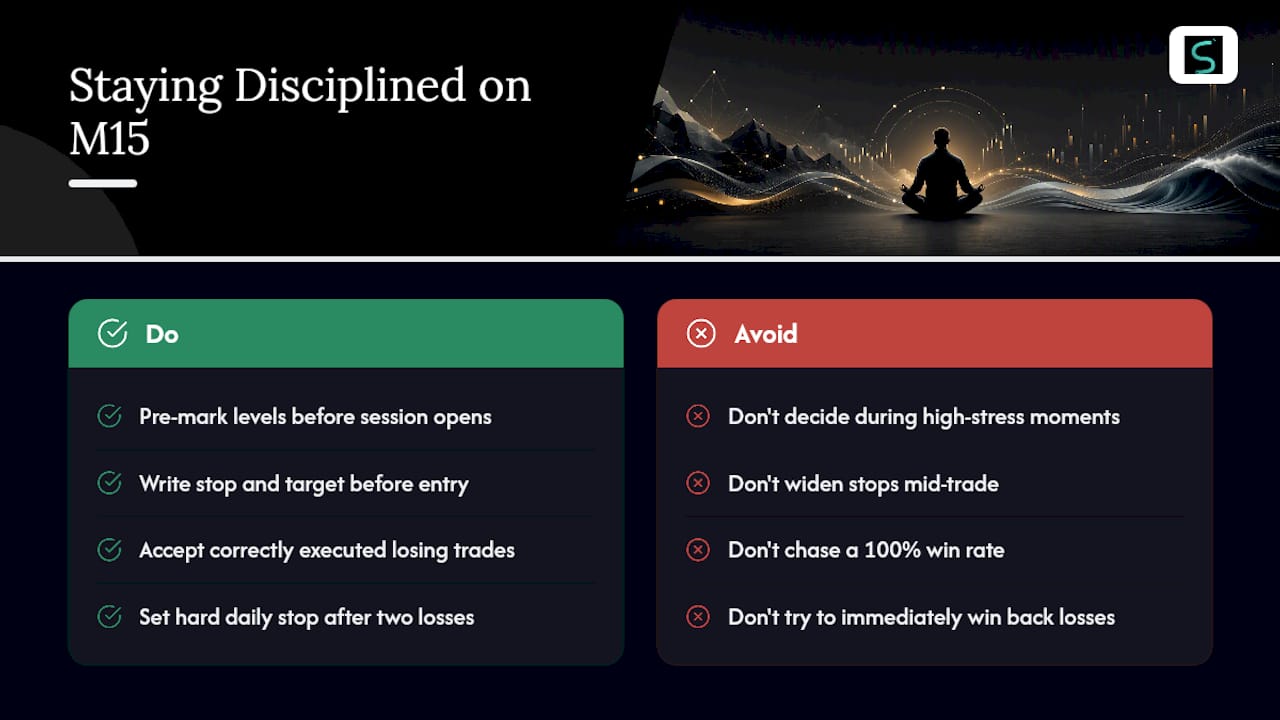
The fix isn't willpower. It's removing decisions from the moment of maximum stress. Pre-mark your levels before the session opens, so you're reacting to a plan instead of inventing one while your heart rate climbs. Write your stop and target before you enter, not after you see how the trade opens.
Accept that a losing trade executed correctly is a good trade. Scalping runs on a string of small, controlled losses punctuated by winners that cover them and then some. Traders who chase a 100% win rate end up widening stops mid-trade, which is how a manageable loss becomes an account-damaging one.
Set a hard stop on your trading day, not just your trades. Two consecutive losses or a defined percentage drawdown means you're done for the session, no matter how "obvious" the next setup looks. The urge to immediately win back a loss is exactly when judgment erodes fastest, and 15-minute charts move too fast to recover from a revenge trade gone wrong.
Boredom is also a risk. Waiting for your setup instead of forcing a marginal one is a skill, not a limitation.
What Mistakes Wreck Most 15-Minute Scalping Accounts?
Overtrading tops the list. The 15-minute chart prints a new candle every quarter hour, and that constant flow tempts traders into forcing entries during dead sessions just to stay busy. Most of those forced trades lose.
Ignoring spread relative to target is the second killer. A setup with an 8-pip target and a 3-pip spread needs the market to move nearly twice as far in your favor just to hit breakeven plus profit. Traders who never check this ratio wonder why their "working" strategy bleeds slowly.
Trading against the higher-timeframe trend without a strong reason is another common trap. An M15 pullback setup against an H1 or H4 downtrend needs extra confirmation, not less, yet plenty of traders skip that check because the M15 pattern alone looks tidy.
Skipping the time stop does the same thing more slowly, tying up capital in a trade that's clearly not working.
Finally, testing a new setup live instead of on demo is how traders pay full tuition for a lesson a backtest could have taught for free.
How Do You Pick a Broker for 15-Minute Scalping?
Execution quality matters more for scalping than for any other trading style, because a few pips of slippage on a 10-pip target is a meaningfully worse trade. Look for a broker offering raw or ECN-style spreads rather than a wide fixed spread baked into a "commission-free" account; the marketing framing often hides a worse execution cost.
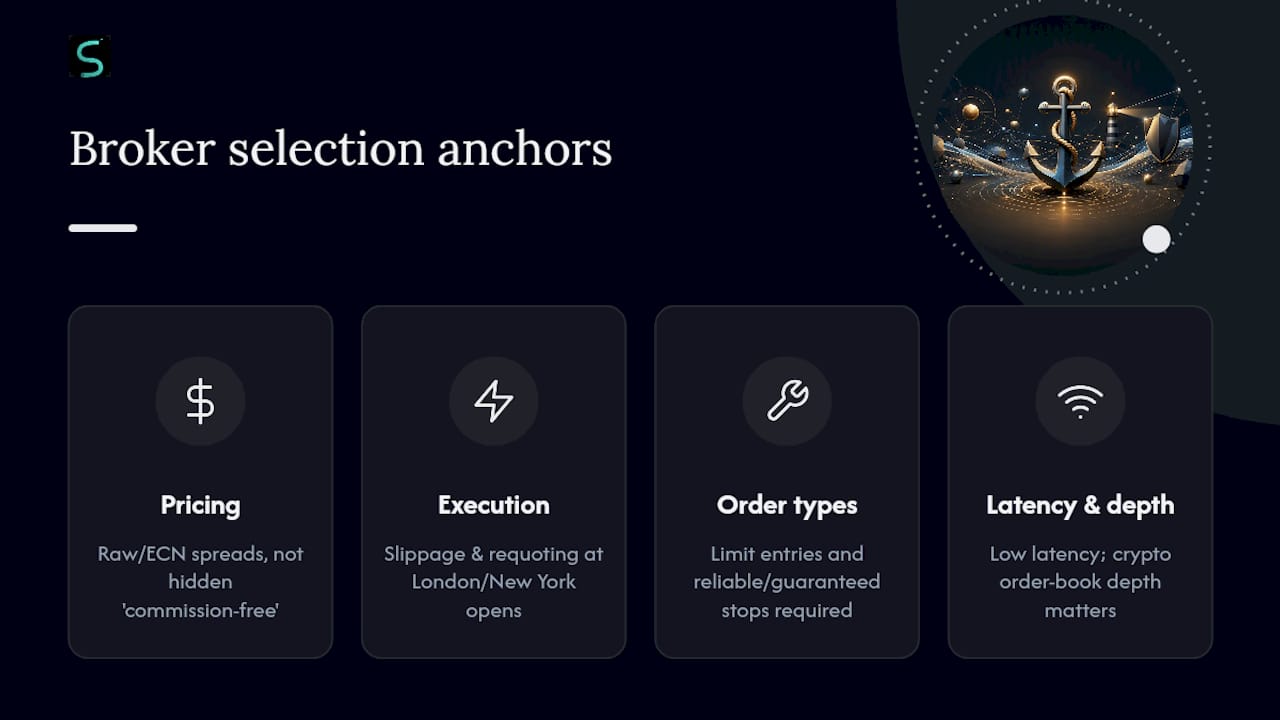
Check the broker's average execution speed and requoting policy specifically during high-volume windows like the London and New York opens, since that's exactly when you'll be placing most of your M15 trades. A broker that performs fine in quiet Asian-session hours can slip badly the moment real volume hits.
Confirm the platform supports the order types your strategy needs: limit orders for retest entries, and guaranteed or reliable stop-loss execution so your ATR-based stop doesn't slip through in a fast move. Low latency between your charting platform and the broker's execution server also matters if you're running M1 confirmation entries on top of M15 structure.
For crypto scalping, check the exchange's order book depth on your chosen pair during your trading window. Thin order books widen effective spreads exactly when you need tight execution most.
What Tools Make 15-Minute Scalping More Efficient?
TradingView remains the standard charting environment for M15 scalping, largely because its Pine Script ecosystem lets traders build and share custom indicators rather than relying on whatever ships with a broker's default platform. Community scripts combining EMA, MACD, RSI, and ATR logic are widely available and give you a transparent starting point to study.
Alert automation is where most retail traders lose time they don't need to lose. Manually watching six charts for a setup to trigger is a losing game against a well-configured webhook alert that pings your phone or Discord the moment a condition is met. A tool like Smart Scalping Signals is built specifically to generate that kind of real-time, non-repainting alert on lower timeframes.
A dedicated backtesting environment matters more than a spreadsheet. You need to test hundreds of historical trades with realistic spread and slippage assumptions before ever risking live capital, and doing that by hand is where most traders quietly give up and skip the step entirely.
Trade journaling software, even a simple spreadsheet tracking entry, exit, R multiple, and setup type, turns a vague sense of "I'm doing okay" into an actual expectancy number you can trust or fix.
Author's Perspective: What I Trade, What I Avoid
I lean on EMA pullbacks and session reversal setups more than breakouts. Raw breakouts get chased by too many traders at once, and that crowding is exactly what widens slippage against you. Live execution has taught me spreads spike right when you need them tight, at the open. The habit that changed my results most: pre-marking every session level the night before and refusing to move a stop once it's set. Everything else is secondary to that one rule.
— Tran
Test M15 Setups With Scalping-Algo's Signal Suite
Building and backtesting every one of these setups by hand, EMA pullbacks, ORB filters, ATR stop math, eats hours you could spend actually trading. Scalping-Algo's open-source TradingView indicator suite generates real-time, non-repainting buy and sell signals built for lower timeframes, with confluence tools and volatility gating designed to cut down false entries on M15 charts specifically.
The Command Center dashboard bundles alerts, backtesting, and signals in one place, so you can forward-test a setup on demo before ever risking live capital, backed by a Discord mentorship community for traders working through the same session-timing and stop-sizing questions covered above. If you want a plug-and-play starting point, Smart Scalping Signals is built for exactly this kind of execution.
Membership runs $79 per month, $799 per year, or $1,999 as a one-time lifetime payment for full access to the indicator suite, alerts, and community. Start by running a demo backtest against your top setup this week and compare the results against your manual notes.
Sources
- Does the 15-Minute Candle Breakout Scalper Work? | What Doesn't Work
- Chartsnipe
- Scalping 15min: EMA + MACD + RSI + ATR-based SL/TP — TradingView
FAQ
Is a 15-Minute Timeframe Good for Scalping?
Yes, M15 works for scalping when paired with a lower-timeframe confirmation chart like M5 or M1 and strict ATR-based stops. It's slower than M1 scalping, which reduces noise but also reduces trade frequency, so it suits traders who want fewer, higher-quality setups over a session.
Can You Make $1,000 a Day With Day Trading?
It's possible on a large enough account with strong risk management, but it isn't a realistic baseline expectation for most retail traders. Daily targets that force trades regardless of setup quality are one of the fastest ways to blow through a daily loss limit and erode an account instead of growing it.
What Is the Best Timeframe for Scalping?
There's no single best timeframe; it depends on your reaction speed and available screen time. M15 offers a workable balance between signal reliability and trade frequency, while M1 and M5 demand faster execution and tighter spread tolerance.
What Is the Most Successful Scalping Strategy?
No single strategy wins consistently across every market condition, but setups combining a trend filter (like EMA 20/50) with momentum confirmation and ATR-scaled stops tend to outperform single-signal approaches after costs. Session-timed setups around London and New York opens also carry a real, testable edge over trading random hours.
How Much Does Scalping-Algo Cost?
Scalping-Algo offers Monthly access at $79 per month, Yearly at $799, or a one-time Lifetime plan at $1,999, all covering the full indicator suite, alerts, and Discord community.