

Squeeze breakout scalping works when you trade the release, not the squeeze itself: confirm a Bollinger Band expansion outside the Keltner Channel, wait for two bars of momentum agreement plus a volume push, enter on the bar close, and place your stop at the opposite side of the locked range with ATR padding. Scale out in R-multiples instead of guessing a target. The indicators doing the heavy lifting are Bollinger Bands, the Keltner Channel (the TTM Squeeze concept lives here), a momentum histogram, volume, ADX, and VWAP.
TL;DR:
- Squeeze breakouts are most reliable when confirmed by two bars of momentum and volume exceeding 1.5 times the average, with entry on bar close.
- Avoid trading within strong trending environments by checking that ADX is below 25 to 30 before the breakout and that higher timeframe bias aligns with the move.
- Place stops at the opposite bubble boundary of the locked range, adding ATR padding, and scale out in predefined ratios to manage risk and protect profits.
- Successful scalping requires strict confirmation and session timing filters, especially on 1-minute charts, to reduce false signals and improve entry certainty.
- Use automated tools to detect, confirm, and alert on squeeze triggers, then backtest at least 100 signals before risking live capital.
Table of Contents
- How Do You Set Up a Valid Squeeze for Scalping?
- What's the Exact Entry Trigger and Grading Checklist?
- How Do You Set Stops, Size Positions, and Plan Exits?
- What's the Pre-Trade and In-Trade Checklist for 1 to 5 Minute Charts?
- Why Do Squeeze Breakouts Fail, and How Do You Filter Them Out?
- Tran and Scalping-Algo: Turning Rules Into a Working Chart
- Tran's View: When This Strategy Fits Your Process
- Try the Squeeze Breakout Rules on a Live Chart with Scalping-Algo
- Sources
- FAQ
How Do You Set Up a Valid Squeeze for Scalping?
A squeeze exists when Bollinger Bands tuck inside the Keltner Channel, or when BandWidth drops into the lower percentile range for that instrument's recent history. This overlap signals volatility compression tight enough that a release is coming, though the ChartSchool definition is clear that the setup only works if you wait for confirmation instead of jumping in the moment the dots vanish.
On 1 to 5 minute charts, defaults matter more than most scalpers admit. A few starting points:
- Bollinger Bands: 20-period, 2.0 standard deviations
- Keltner Channel: 20-period, 1.5x ATR multiplier
- Momentum histogram: 12/26/9 style oscillator watching for zero-line crosses and slope changes
- ADX filter: 14-period, avoid entries when it's already above a moderate threshold (more on that later)
- VWAP: session-anchored, used as a directional bias line, not an entry trigger
If you trade forex pairs with no real volume feed, lean harder on ADX and VWAP alignment instead. Session timing matters too. A squeeze that fires during the New York lunch lull behaves differently than one that fires at the London open, so filter for active sessions before you filter for anything else.
What's the Exact Entry Trigger and Grading Checklist?
The trigger is simple to state and easy to trade badly. Here's the sequence that keeps it disciplined:
- Lock the range. Mark the high and low of the squeeze while BB stays inside KC.
- Wait for bar-close confirmation. Price must close beyond the locked range, not just wick through it.
- Check momentum for two bars. The histogram needs to stay aligned in the breakout direction for two consecutive bars, since a single bar is frequently noise rather than signal.
- Confirm volume. Look for a push at or above 1.5 times the recent average, per the breakout confirmation research on this pattern.
- Check higher-timeframe bias. Align the breakout direction with the 15 minute or 4 hour trend before you size in.
Grade the setup honestly. Grade A means every box above is checked, full size. Grade B means one condition is soft (such as weaker volume or borderline HTF alignment), size down accordingly. Grade C means multiple conditions fail. Skip it. Waiting for the close costs you a few ticks of entry price compared to entering on the wick, but it saves you from far more false releases than it costs.
How Do You Set Stops, Size Positions, and Plan Exits?
The squeeze range gives you a built-in stop location, and that's what makes this setup attractive for scalping risk. Place your structural stop at the opposite boundary of the locked range, adding a buffer based on ATR to avoid noise stops.
Size to your risk, not your gut:
- Decide your dollar risk per trade (commonly 0.5% to 1% of account equity)
- Divide that dollar figure by the distance from entry to stop to get position size
- If the range plus padding puts your stop 8 points away and you're risking $80, you're sized at 10 units, full stop
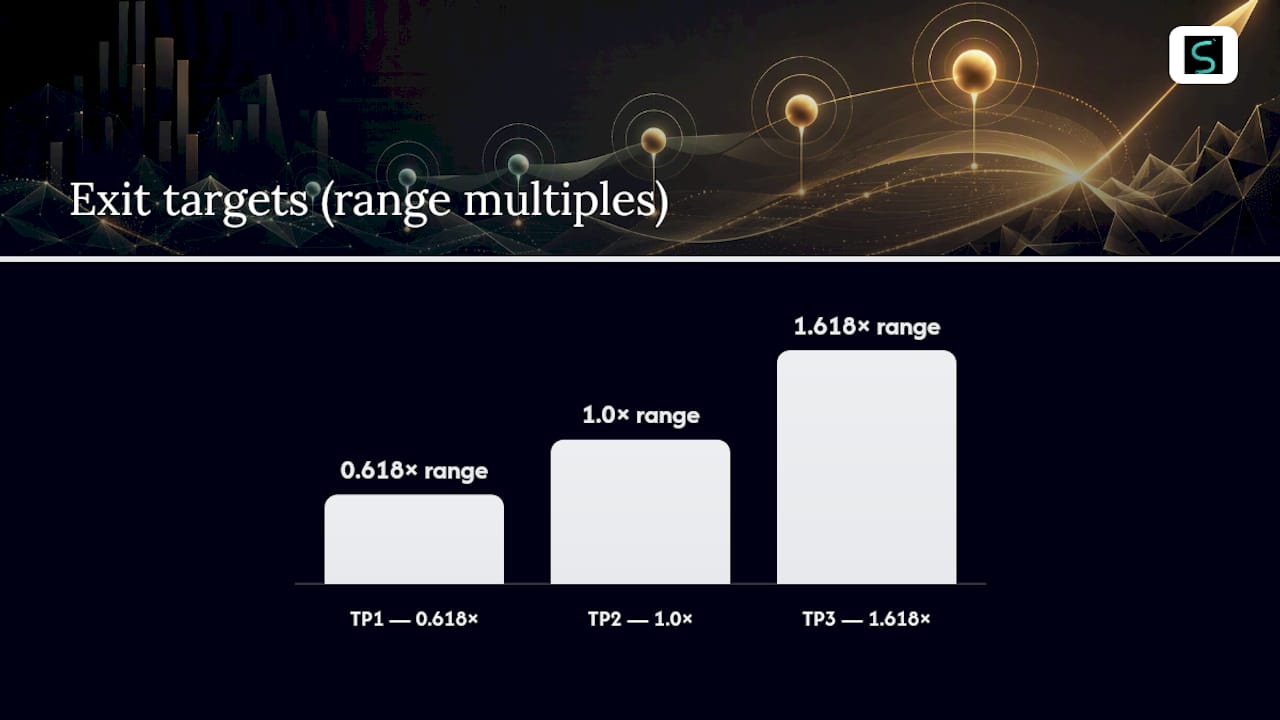
Exits work best in tiers tied to the range itself, an approach the DayTradingToolkit breakout research backs with practical scale-out rules:
- TP1 at 0.618x the range, move stop to breakeven once hit
- TP2 at 1.0x the range, trail the remainder
- TP3 at 1.618x the range for the runner, using a trailing stop or moving average
Pro Tip: Move your stop to breakeven the instant TP1 fills. It turns a losing scalp back into a scratch trade more often than you'd expect, and it's the single easiest habit to enforce. Review your stop-loss framework if you're still eyeballing padding instead of calculating it.
What's the Pre-Trade and In-Trade Checklist for 1 to 5 Minute Charts?
Scalping timeframes punish hesitation, so the workflow needs to run in seconds, not minutes.
- Confirm the squeeze is locked. BB inside KC, or BandWidth in its low percentile range.
- Check ADX. Below your trending threshold, ideally under 25 to 30.
- Check higher-timeframe bias. 15 minute or 4 hour trend agrees with your expected breakout direction.
- Check liquidity and session. Avoid thin pre-market or post-close windows.
- Calculate position size before price moves, not after.
- On breakout: confirm bar-close plus two-bar momentum plus volume, enter, set your stop and tiered targets immediately, and enable alerts.
The 1-minute ORB research makes a fair point about timeframe tradeoffs: 1 minute entries get you in earlier with a tighter stop, but they also generate more false signals than 5 minute confirmation. If you're forex trading without a volume feed, weight ADX and VWAP more heavily. Webhook alerts routed to a phone or Discord channel cut the latency between confirmation and execution, which matters more on 1 minute charts than almost anywhere else in trading.
Why Do Squeeze Breakouts Fail, and How Do You Filter Them Out?
Most losing streaks on this setup trace back to two habits: trading the first bar instead of waiting for confirmation beyond the initial breakout, and trading squeezes that occur within strong trends without caution.
- Skip entries when ADX sits above a moderate threshold before the release even happens. The regime-dependence research is direct about this: squeezes inside strong trends behave unreliably, and you're often better off switching to trend-following execution entirely.
- Watch for overlapping squeeze clusters across correlated instruments. That's usually a sign of a broader volatility event, not a clean setup.
- Stop trading the pattern around major news releases or in the last thin hour of a session, where volume confirmation becomes meaningless.
Tran and Scalping-Algo: Turning Rules Into a Working Chart
Every rule above maps to something you can build or buy. Scalping-Algo's suite handles range locking, ADX gating, and non-repainting signal confirmation directly on the chart, which removes the manual work of tracking squeeze boundaries bar by bar.
- Range detection and lock flags the squeeze boundary automatically instead of you eyeballing it.
- ADX and regime gating filters signals before they print, matching the trending-market avoidance rule above.
- Hit-rate dashboard counts TP1/TP2 outcomes across visible chart history, which is calibration, not prediction. Treat past hit rates the way any serious backtest should be treated: informative, never a guarantee.
- Webhook alerts can push confirmed signals to Discord the instant a bar closes.
Before sizing live, test the setup against 100 confirmed signals on your instrument and timeframe, then adjust your ADX and volume thresholds until the frequency and quality match what your account can handle. Our risk gating breakdown walks through how to structure that sizing discipline.
Tran's View: When This Strategy Fits Your Process
This setup rewards traders who respect the confirmation delay and punish those who don't. If you're latency-aware and willing to gate every signal through ADX and volume, squeeze breakout scalping earns its place in your rotation. If you don't have a written stop and exit plan before you enter, skip it. I'd rather see a trader paper-test 100 signals and reject the setup than force size into a Grade C release out of boredom.
— Tran
Try the Squeeze Breakout Rules on a Live Chart with Scalping-Algo
Reading the rules is one thing. Watching them fire in real time on your own chart, without redrawing the squeeze boundary by hand every session, is another. Scalping-Algo builds the exact mechanics covered above (non-repainting signal confirmation, automatic range locking, ADX and volume gating, and tiered TP/SL projection) directly into a TradingView indicator suite, so you're executing the checklist instead of reconstructing it bar by bar.
Start on paper or in a demo account, run the visible hit-rate dashboard against your own instrument and timeframe, and only move to live sizing once the sample size gives you confidence in the numbers you're seeing. Support runs through an active Discord community where webhook alerts land the moment a signal confirms. If you want the full three-indicator system built around this exact playbook, the Algo Master suite is the place to start, or head to the main indicator suite to see current plans and trial options.
Sources
- Bollinger Squeeze - ChartSchool - StockCharts.com
- Bollinger Squeeze: Trading the Breakout After the Quiet | DayTradingToolkit
- Squeeze Breakout Trading — Entering After Volatility Compression | darwintIQ
FAQ
What Is the Most Profitable Scalping Strategy?
There's no single strategy that outperforms all others across every instrument, but squeeze breakout scalping ranks highly because the compression range gives you a built-in structural stop, which keeps your risk-to-reward ratio favorable when you confirm entries properly.
Does the TTM Squeeze Work?
The TTM Squeeze concept works as a volatility compression signal, but its edge comes from the confirmation rules around it (momentum for two bars, volume, HTF bias) rather than the dot pattern alone.
What Is the 3-5-7 Rule in Trading?
The 3-5-7 rule is a general risk management guideline suggesting you risk no more than 3% on a single trade, 5% across correlated positions, and a limited total portfolio exposure; it's not specific to squeeze breakout scalping but pairs well with its R-based sizing.
Is 1 Minute Scalping Profitable?
1 minute scalping can be profitable, but it demands tighter execution and stricter filters since false signals appear more often on 1 minute charts than on 5 minute confirmation, according to ORB timeframe research.
How Do I Avoid False Squeeze Breakouts?
Require bar-close confirmation, two bars of aligned momentum, and a volume push above 1.5 times average before entering, and skip any squeeze that fires while ADX already sits above a moderate threshold around 25 to 30.