

Risk gating is a mandatory, pre-signal checkpoint that blocks a trade entry when predefined conditions are not met. The rule is simple: if the setup fails the gate, there is no trade. Full stop.
Three anchors make this framework credible and practical: ISO 31000 (the international risk management standard that formalizes identify-analyze-evaluate-treat-monitor cycles), ATR (the volatility metric that drives dynamic gate thresholds), and Scalping-algo (the TradingView indicator suite that enforces these gates in Pine Script v6 before any signal fires).
The core discipline: Score your gates before the signal, not after. A gate evaluated after you already want the trade is not a gate. It is a rationalization.
- Risk gating filters out low-quality setups at the entry level, not after a loss.
- Gates use objective metrics (ATR, spread %, volume) so emotion has no role.
- Pre-signal scoring is the single habit that separates repeatable scalping from guesswork.
Table of Contents
- Breaking down risk gating: components every scalper needs
- Why you must score gates before the signal fires
- What quantitative gates look like on 1–15 minute charts
- How qualitative signals work alongside quantitative gates
- How to implement risk gates in TradingView with Pine Script v6
- How to test your gates before risking capital
Breaking down risk gating: components every scalper needs
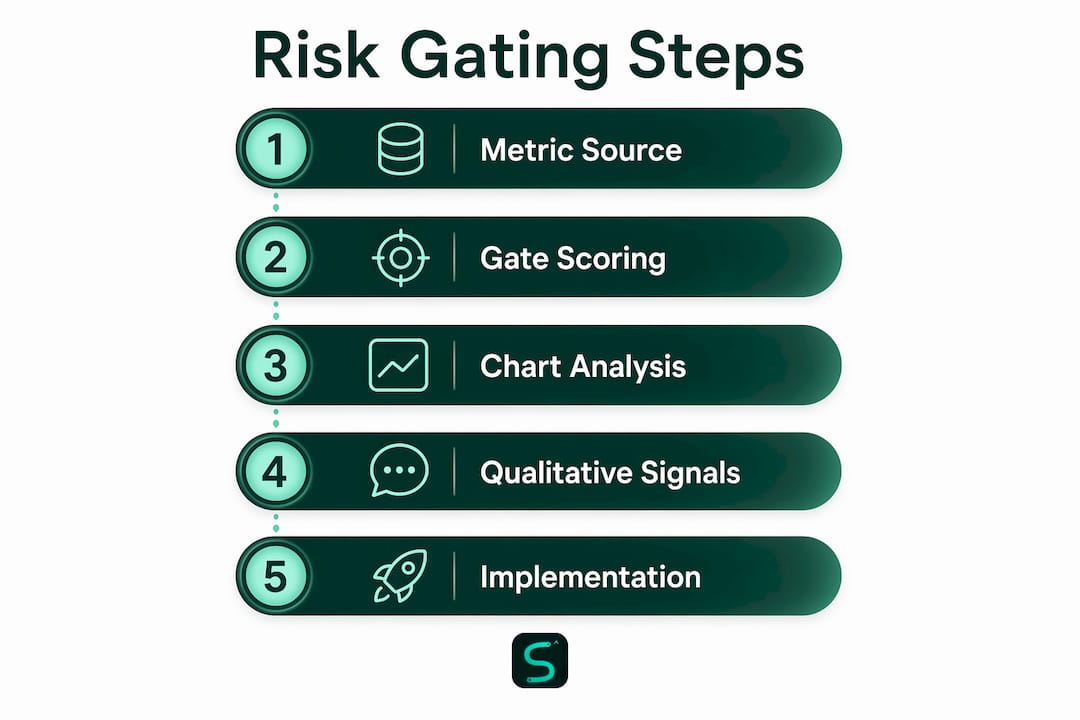
A risk gate has five reusable parts. Understanding each one lets you build gates directly into TradingView inputs or Pine Script v6 logic.
- Metric source: The raw data feeding the gate. Price action, ATR(14), bid/ask spread, volume, or order flow.
- Threshold band: The numeric boundary that separates pass from fail. Example: ATR(14) must be above 0.0008 on a 5m forex chart.
- Must-meet criteria: Hard pass/fail. Fail any one of these and the trade is killed automatically. Per phase-gate design principles, must-meet failures should always force a no-go.
- Should-meet criteria: Scored conditions that improve confidence but do not kill the trade alone. RSI divergence or order block alignment are typical examples.
- Gate log / ownership: Every gate state gets recorded per signal. This closes the loop for continuous monitoring and reassessment.
| Component | Example metric | Why it matters for scalping |
|---|---|---|
| Metric source | ATR(14), spread %, volume | Feeds objective, real-time gate inputs |
| Threshold band | ATR floor, max spread % | Defines the exact pass/fail boundary |
| Must-meet (hard) | Min ATR, max spread | Kills the trade before sizing is computed |
| Should-meet (soft) | RSI divergence, order block | Adds confidence scoring without hard veto |
| Gate log | Timestamp, gate state, signal | Enables audit, tuning, and ownership |
Why you must score gates before the signal fires
Scoring risk after a signal invites emotional bias and FOMO-driven overrides. Once you see a signal you want, every gate evaluation tilts toward justifying the entry. That is not analysis. It is confirmation bias with extra steps.
Three concrete consequences follow when gates are not predefined:
- Selection bias: You unconsciously approve gates on winning trades and reject them on losers, making your backtest look better than reality.
- Inconsistent position sizing: Without a gate enforcing a risk cap, position size floats with confidence level rather than account rules.
- Overtrading: No gate means no filter. Signal frequency rises, but edge per trade falls.
From phase-gate theory: Gates are go/kill decisions and a gate that always advances is ineffective. The same logic applies to every scalping entry: if your gate never rejects a trade, it is not functioning as a gate.
The benefits of algorithmic trading for scalpers come precisely from this: codifying rules removes the emotional override that kills consistency.
What quantitative gates look like on 1–15 minute charts
Quantitative gates are numeric, objective, and coded. Here are the core types with example parameter ranges for scalping timeframes.
- ATR volatility floor: Minimum ATR(14) value required before entry. Prevents trading in dead, choppy markets.
- ATR expansion cap: Maximum ATR multiple allowed. Prevents entries during news spikes where spread and slippage explode.
- Spread cap: Maximum bid/ask spread as a percentage of ATR or in ticks. Protects execution cost.
- Minimum volume: Rolling volume must exceed a session baseline. Confirms liquidity.
- Position-size cap: Risk per trade expressed as a fixed account percentage. Computed only after hard gates pass.
- Time-of-day filter: Block entries during low-liquidity windows (pre-market open, lunch lull, last 5 minutes before close).
| Timeframe | ATR(14) floor multiplier | Max spread (% of ATR) | Min volume (vs. session avg) | Max risk per trade |
|---|---|---|---|---|
| 1m | Around session avg ATR | Moderate max spread | Slightly above session avg volume | Limited risk per trade |
| 3m | Around session avg ATR | Moderate max spread | Slightly above session avg volume | Limited risk per trade |
| 5m | Around session avg ATR | Moderate max spread | At least session avg volume | Limited risk per trade |
| 15m | Around session avg ATR | Moderate max spread | Slightly below session avg volume | Limited risk per trade |
For position sizing, the formula is straightforward: Position size = (Account × Risk %) / (ATR × multiplier). Run this calculation only after all must-meet gates pass.
Pro Tip: Scale your ATR gate dynamically. During the New York open or major economic releases, widen the ATR floor and tighten the spread cap. During the midday lull, do the opposite. Static gates either block good trades in quiet markets or allow outsized losses in breakouts — dynamic scaling solves both problems at once.
The role of volatility in scalping covers ATR usage in depth if you want to go further on threshold calibration.
How qualitative signals work alongside quantitative gates
Hybrid gating pairs qualitative direction with quantitative feasibility and produces more resilient short-term systems than either approach alone. The split is clean: qualitative signals tell you which way, quantitative gates tell you whether to go.
Typical qualitative signals scalpers use:
- Momentum divergence: RSI or MACD diverging from price action signals a potential reversal or continuation.
- Order blocks: Institutional supply/demand zones identified on higher timeframes.
- Time-and-sales spikes: Sudden volume bursts at a price level confirm real participation.
A practical hybrid rule set looks like this:
- Must-meet (quantitative): ATR floor passed + spread cap passed + volume minimum passed.
- Should-meet (qualitative): Divergence present OR order block confluence present.
- Entry fires only when: All must-meet gates pass AND at least one should-meet condition is true.
In a trending market, the order block alignment often satisfies the should-meet gate cleanly. In a range, divergence at the boundary does the same job. The quantitative gates stay fixed regardless of condition. This is why the hybrid approach holds up across regimes where a purely qualitative system breaks down.
For more on pairing qualitative setups with gate logic, the scalping entry methods guide covers advanced entry structures that map directly to this framework.
How to implement risk gates in TradingView with Pine Script v6
Implement gates as pre-signal boolean checks in Pine Script v6 and expose every threshold as a user input for fast tuning.
- ATR gate:
atr_val = ta.atr(14)thengate_atr = atr_val >= input.float(0.0008, "ATR Floor"). - Spread gate: Approximate spread using
high - lowon a tick basis or pass it as an input from broker data.gate_spread = spread_pct <= input.float(0.10, "Max Spread %"). - Must-meet boolean:
gate_pass = gate_atr and gate_spread and gate_volume. Signal fires only whengate_pass == true. - Should-meet score: Compute divergence and order block booleans separately. Use them to filter or color-code signals, not to kill them outright.
- Non-repainting: Always evaluate gates on
bar_state.isconfirmedor use[1]indexing to reference the previous closed bar. Never compute on the live bar and plot as historical.
For webhook alerts, the alert condition should check gate_pass and signal_long (or short). The webhook payload should include: symbol, direction, position size (computed from the gate-approved risk %), ATR value at trigger, and gate state (pass/true). This gives your execution layer full context on every alert.
Pro Tip: Add a gate-state label to your chart using label.new() in Pine v6. Color it green when all must-meet gates pass, red when any fail. You will spot regime shifts and misconfigured thresholds in seconds instead of digging through logs.

Real-time trading signals and webhook architecture pair directly with this gate-boolean approach.
How to test your gates before risking capital
Test gates across three stages: historical backtest, paper-forward test, and a short live rollout. Measure gate-specific metrics at each stage.
Metrics to track:
- Win rate and average win/loss ratio
- Expectancy (average win × win rate minus average loss × loss rate)
- Maximum drawdown during the test window
- Trade frequency and percent of signals rejected by gates
- Realized slippage and transaction costs per trade
Sample test schedule:
- Historical backtest: minimum 200 trades per timeframe, across at least two distinct market regimes (trending and ranging).
- Paper-forward test: 3–4 weeks of live-market paper trading. Track gate rejection rate daily.
- Live rollout: 2 weeks at minimum position size. Compare live metrics to paper results.
[CISA's risk assessment guidance](https://www.cisa.gov/resources