

A forex scalping strategy is a rule-based plan to capture 5–10 pips per trade on 1–15 minute charts, repeating the process multiple times per session. You're not hunting home runs. You're stacking small, consistent wins with tight stops and fast exits. Here are three setups you can load on demo today:
- 1-minute EMA crossover: Enter long when the 9 EMA crosses above the 20 EMA with RSI above 50; stop 3–4 pips below the cross candle's low; exit at 5–7 pips or when EMA re-crosses.
- 5-minute Bollinger Bands + RSI pullback: Enter long when price pulls back to the middle Bollinger Band and RSI bounces from 40–50; stop below the band; target the upper band.
- Volatility-gated London open breakout: Mark the high/low of the 7:00–8:00 AM ET range; enter on a confirmed break with ATR above its 14-period average; stop inside the range; target 1.5× the range width.
Three execution musts before any trade: confirm spread is under 1 pip on EUR/USD, verify no high-impact news within 15 minutes, and have your stop defined before you click.
Pro Tip: Set your stop before you enter. Traders who define the exit after entry consistently widen stops under pressure, which is the single fastest way to turn a scalping account into a drawdown account.
Key Takeaways
A forex scalping strategy only works when execution quality, cost control, and behavioral discipline are treated as non-negotiable structural requirements, not afterthoughts.
| Point | Details |
|---|---|
| Target 5–10 pips per trade | Use liquid pairs like EUR/USD during the London–NY overlap for the tightest spreads and best fills. |
| Role-based indicator stack | Assign each indicator one job: trend, momentum, volatility, location, or exit. Never stack two tools answering the same question. |
| Risk 0.5–1% per trade | Calculate lot size from your stop distance before entry; set a 2–3% daily max loss and stop when you hit it. |
| Test before going live | Run 90–120 demo trades tracking expectancy, win rate, and max drawdown before committing real capital. |
| Scalping-algo for signal precision | Non-repainting signals with volatility gating and webhook alerts reduce human latency and improve execution consistency. |
Table of Contents
- What is a forex scalping strategy, and is it right for you?
- Core principles that make scalping repeatable
- How to choose timeframes, pairs, and session windows
- What should you check before choosing a broker for scalping?
- Proven indicator setups with step-by-step entry and exit rules
- Trade management and risk rules specific to scalping
- How to build, backtest, and forward-test a scalping system
- Common scalping mistakes and how to avoid them
- A complete 1-minute scalping example from pre-trade to post-trade
- How TradingView, MetaTrader, and premium indicators speed up execution
- What experienced scalpers know that beginners often miss
- Scalping-algo gives you institutional-grade signals on retail timeframes
- Sources
What is a forex scalping strategy, and is it right for you?
Scalping is the practice of placing multiple short-duration trades, each lasting seconds to a few minutes, to capture a handful of pips per entry. Common tools include Bollinger Bands, moving averages, RSI, and Stochastic. The edge comes from repetition and consistency, not from any single large move.
Typical targets run 5–10 pips per trade. A scalper might take 10–20 trades in a single London session, closing each position before any meaningful retracement can develop. Timeframes stay between 1 and 15 minutes. Anything higher starts to look more like day trading.
Who benefits from scalping:
- Disciplined traders who follow rules without improvising mid-trade
- Traders with access to ECN or raw-spread accounts (sub-1-pip EUR/USD)
- Those who can dedicate 2–4 focused hours to a single session
- Traders comfortable with fast decision-making under real-time pressure
Who should avoid it:
- Traders with high-latency setups or retail market-maker brokers with wide spreads
- Anyone prone to revenge trading after a loss
- Traders with limited starting capital who cannot absorb a string of small losses
- Those who cannot monitor charts actively during peak liquidity windows
Scalping can be profitable, but success depends more on execution quality, spread control, and strict risk rules than on any single indicator. The high trade frequency magnifies both costs and mistakes, so the margin for error is genuinely thin.
Quick pros and cons:
- Pro: Exposure time per trade is short, limiting overnight and news risk
- Pro: Liquid pairs offer tight spreads and fast fills during peak sessions
- Con: Costs (spread + commission) eat into small pip targets fast
- Con: Requires intense focus; fatigue degrades execution quality quickly
Core principles that make scalping repeatable
No scalping plan survives contact with the market without a few non-negotiable rules underneath it. These aren't preferences. They're structural.
The five core principles:
- Defined entry and exit before every trade. If you don't know your stop and target before you click, you're speculating, not scalping.
- Role-based indicator usage. There is no single best indicator for scalping; each tool must answer a different question: trend direction, momentum timing, volatility state, price location, or exit signal. Stacking three trend indicators gives you three confirmations of the same thing.
- Spread-aware setups. A 5-pip target with a 1.2-pip spread means you need a 2.4-pip move just to break even. Every setup must account for the full round-trip cost.
- Small, fixed stops. Scalping stops typically run 3–8 pips depending on the pair and timeframe. Wider stops change the risk/reward math and turn a scalp into a swing trade.
- Fixed daily loss limit. Decide the maximum you'll lose in a session before you open the platform. When you hit it, you close the platform. No exceptions.
Organize your indicators by role, not by quantity. One trend filter (EMA), one momentum trigger (RSI), one volatility gate (ATR or Bollinger Bands), and one location reference (support/resistance level or order block) is a complete stack. Adding a fifth indicator rarely adds edge; it usually adds hesitation.
Pro Tip: The single rule that separates working scalpers from struggling ones: a hard daily stop combined with a zero-revenge-trading policy. One bad session should never be allowed to compound into a blown week.
How to choose timeframes, pairs, and session windows
Timeframe selection
The 1-minute chart gives the most signals but the most noise. Stops are tight (3–5 pips), targets are small (5–7 pips), and execution speed matters most here. The 5-minute chart filters out some noise, allows slightly wider stops (5–10 pips), and suits traders who want a few high-quality setups per session rather than a high-frequency flow. The 15-minute chart sits at the edge of scalping; it's better suited to traders transitioning toward day trading.

A practical rule: if you're new to scalping, start on the 5-minute chart. The signal-to-noise ratio is better, and you have more time to confirm before entering.
Pair selection
Stick to the most liquid pairs. Scalpers target 5–10 pips per trade and prefer pairs where spreads tighten during peak sessions. EUR/USD is the default choice: deepest liquidity, tightest spreads, and the most consistent behavior around technical levels. USD/JPY and GBP/USD are solid secondaries. Minor pairs (EUR/GBP, AUD/NZD) often carry wider spreads and thinner liquidity, which erodes small pip targets fast.
The 5-3-1 rule is a useful framework here: limit yourself to five currency pairs, master three strategies, and trade one consistent session per day. It keeps your focus narrow and your edge repeatable.
Session windows
The London–New York overlap (roughly 8:00 AM–12:00 PM ET) is the primary window for most scalpers. Spreads tighten, volume spikes, and price moves with purpose. The London open alone (3:00–5:00 AM ET) is a secondary window worth watching for breakout setups. Avoid the Asian session for EUR/USD scalping unless you're specifically running a range-bound strategy; spreads widen and price tends to drift.
| Timeframe | Typical Stop | Typical Target | Best For |
|---|---|---|---|
| 1-minute | 3–5 pips | 5–7 pips | High-frequency, fast execution |
| 5-minute | 5–10 pips | 8–15 pips | Balanced signal quality |
| 15-minute | 8–15 pips | 15–25 pips | Transition to day trading |
| London–NY overlap | Tightest spreads | Best liquidity | All scalping styles |
What should you check before choosing a broker for scalping?
Broker selection is not a minor detail for scalpers. It's a structural cost decision that affects every trade you take.
Critical broker metrics to verify:
- Raw spread on EUR/USD: Target under 0.5 pips on an ECN/raw account. Market-maker spreads of 1.5–2 pips on a 5-pip target are account-draining.
- Execution latency: Top scalpers look for execution times under 50 milliseconds. Anything higher introduces meaningful slippage on fast-moving 1-minute setups.
- Commission structure: ECN brokers charge a per-lot commission (typically $3–7 per round turn per standard lot) in exchange for raw spreads. Calculate your total cost per trade before going live.
- Slippage behavior: Test during peak hours. A broker that fills cleanly in demo but slips 2–3 pips in live trading destroys scalping math.
- Order types supported: Confirm the platform supports limit orders, stop-loss orders, and OCO (one-cancels-other) pairs for TP/SL management.
Fee calculation example: On EUR/USD with a 0.3-pip raw spread and a $5 round-turn commission on a 0.1-lot position, your total cost per trade is roughly 0.3 pips + 0.5 pips (commission equivalent) = 0.8 pips.
| Broker Metric | Minimum Acceptable | Preferred |
|---|---|---|
| EUR/USD raw spread | Under 1.0 pip | Under 0.5 pip |
| Execution time | Under 100ms | Under 50ms |
| Commission (per round turn) | Under $7/lot | Under $5/lot |
| Slippage (peak hours) | Under 1 pip | Under 0.3 pip |
| Scalping policy | Permitted | Explicitly permitted |
Pre-live broker checklist:
- Open a demo account and place 20 market orders during London–NY overlap. Record fill prices versus quoted prices.
- Check the broker's terms of service for scalping restrictions (some brokers ban sub-60-second trades).
- Confirm OCO order functionality works as expected on your platform.
- Run the same test during a news event to observe slippage behavior.
Pro Tip: Never test a broker's execution quality in a demo environment alone. Demo fills are almost always cleaner than live. Run at least one week of micro-lot live trading before committing real size.
Proven indicator setups with step-by-step entry and exit rules
Common scalping indicator settings favor shorter periods to increase responsiveness on 1–5 minute charts: EMA 5/9/20, RSI shortened to 2–7 periods, Bollinger Bands with a 7–10 SMA and 1.5–2 standard deviations. Here are three complete setups.
Setup 1: 1-minute EMA crossover
Indicators: 9 EMA, 20 EMA, RSI (7-period)
Entry trigger (long):
- 9 EMA crosses above 20 EMA on the 1-minute chart.
- RSI is above 50 at the moment of the cross.
- Price is not within 5 pips of a major daily support/resistance level (avoid fading strong structure).
- Spread is under 1 pip.
Stop placement: 3–4 pips below the low of the crossover candle.
Take-profit: 5–7 pips from entry, or exit when the 9 EMA crosses back below the 20 EMA, whichever comes first.
No-trade conditions: Major news within 15 minutes, spread above 1.2 pips, RSI above 75 at entry (overbought entry).
Position sizing: Risk 0.5–1% of account per trade. Calculate lot size as: (Account × Risk%) ÷ (Stop pips × pip value).
Setup 2: 5-minute Bollinger Bands + RSI pullback
Indicators: Bollinger Bands (10 SMA, 2 SD), RSI (7-period)
Entry trigger (long):
- Price has touched or crossed the lower Bollinger Band.
- RSI drops below 35, then turns back above 35 on the next candle.
- The next candle closes back inside the bands (mean-reversion confirmation).
- Enter at the open of the candle following confirmation.
Stop placement: 2–3 pips below the lower band at entry.
Take-profit: Middle band (10 SMA) for a conservative target; upper band for an extended target.
No-trade conditions: Strong trending market where price walks the lower band for multiple candles; spread above 1.5 pips.
Setup 3: Volatility-gated London open breakout
Indicators: ATR (14-period), horizontal range lines
Entry trigger:
- Mark the high and low of the 7:00–8:00 AM ET consolidation range on the 5-minute chart.
- Wait for ATR to be above its 20-period average (confirms volatility is expanding).
- Enter on a candle close above the range high (long) or below the range low (short).
- Confirm the breakout candle has above-average volume or a strong close (no wicks that consume more than 30% of the candle body).
Stop placement: Inside the range, 2–3 pips from the broken level.
Take-profit: 1.5× the range width from the entry point.
No-trade conditions: ATR below its 20-period average; breakout occurs within 5 minutes of a high-impact news release.
Pro Tip: *For indicator reliability on short timeframes, always confirm your signal on the next candle close instead of acting mid-candle.
Trade management and risk rules specific to scalping
Position sizing is where most scalpers lose discipline. The math is simple; the execution is not.
Worked example: Account size $5,000. Risk per trade: 1% = $50. Stop distance: 5 pips on EUR/USD. Pip value on a standard lot: $10. Lot size = $50 ÷ (5 × $10) = 1 mini lot (0.1 standard lot). That's the number. No guessing, no rounding up because "the setup looks great."
Core risk rules:
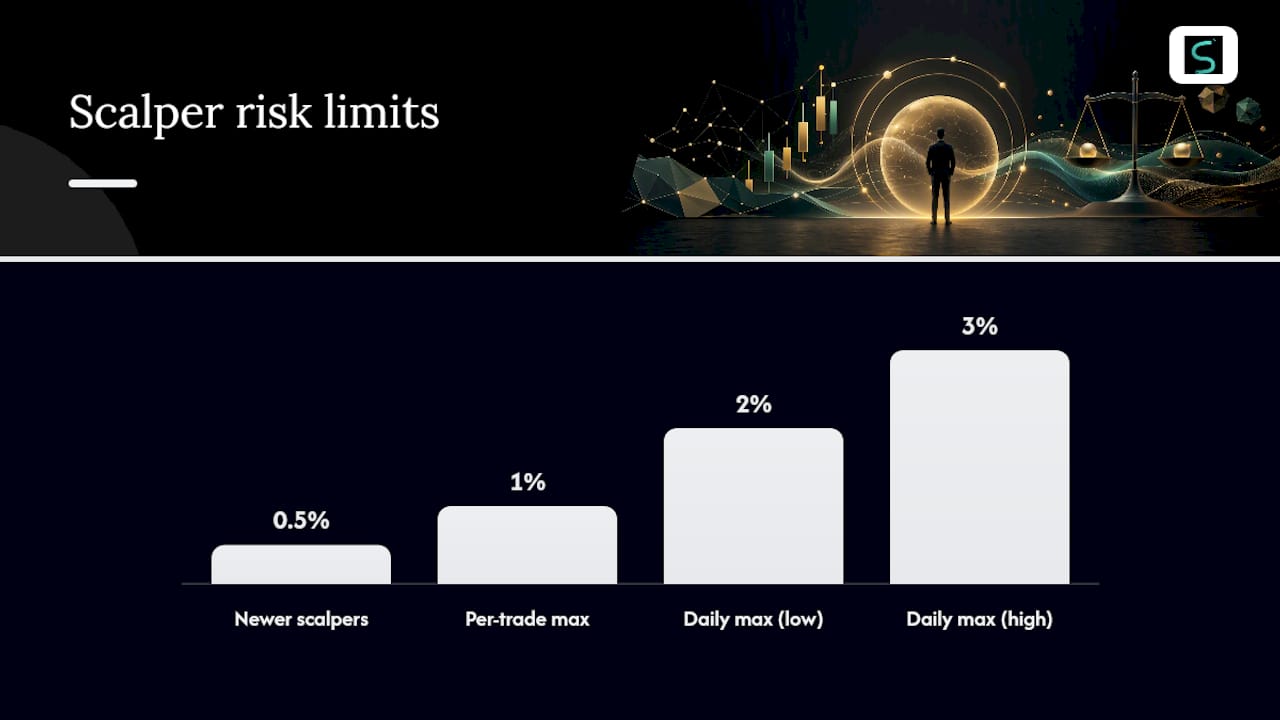
- Max 1% risk per trade. For newer scalpers, 0.5% is a better starting point. The goal is to survive long enough to build a track record.
- Daily max loss: 2–3% of account. When you hit it, you stop. A 3% daily loss on a $5,000 account is $150. That's recoverable. A 10% loss because you kept trading after a bad run is not.
- Max trades per session: Set a hard cap (10–15 trades on a 1-minute chart is a reasonable ceiling). More trades usually means lower quality setups.
- No stop adjustments after entry. Moving a stop wider because price is "almost there" is the most common way scalpers turn small losses into large ones.
Time-based exits: If a trade hasn't hit your target or stop within a defined window (5–10 minutes on a 1-minute setup, 15–20 minutes on a 5-minute setup), close it at market. Dead trades tie up margin and attention.
Scaling out: On a 5-minute setup with a 12-pip target, closing half the position at 6 pips and moving the stop to breakeven on the remainder is a practical way to lock in gains while letting a portion run. Don't apply this to 1-minute setups; the targets are too small for partial exits to add value.
Pro Tip: Protect a run of small wins by treating them as a daily buffer, not as license to take bigger risks. A trader who books 8 pips across three trades and then loses 15 on an oversized fourth trade has a net losing session. Forex risk management means the fourth trade follows the same rules as the first.
How to build, backtest, and forward-test a scalping system
Testing is what separates a strategy from a hypothesis. Here's a repeatable plan.
Backtest checklist
- Choose one setup and one pair. Don't test three setups simultaneously.
- Set your chart to the correct timeframe and apply indicator settings exactly as defined.
- Include realistic costs: add your broker's spread plus commission to every simulated trade.
- Apply a slippage assumption of 0.5–1 pip per trade for market orders.
- Work through at least 200 historical setups. Fewer than 100 gives you statistically unreliable results.
- Filter by session: only count trades that would have occurred during your target window.
- Record every trade: entry, exit, stop, target, outcome, and whether the setup met all entry conditions.
Forward-test (demo) plan
Run a minimum of 90–120 trades on a demo account before considering live capital. Track these metrics:
- Win rate: Aim for 55%+ on a 1:1 risk/reward setup; lower win rates require higher R:R to stay positive.
- Average win vs. average loss: Your average win should be at least equal to your average loss. If it's not, the setup needs adjustment.
- Expectancy: (Win rate × avg win) minus (loss rate × avg loss). Positive expectancy is the minimum bar for going live.
- Max drawdown: The largest peak-to-trough loss in your sample. If it exceeds your daily stop rule, your position sizing is too aggressive.
Journal fields to capture per trade
- Setup type (EMA crossover, BB pullback, breakout)
- Entry time, price, and lot size
- Stop and target at entry
- Actual exit price and reason (TP hit, stop hit, time exit, manual)
- Spread at entry
- Execution issues (slippage, partial fill)
- Post-trade note: did the setup meet all conditions?
Iteration warning: Adjusting indicator parameters to fit historical data is overfitting. If your backtest only works with a 9/21 EMA but not a 9/20 or 10/21, the edge is likely curve-fitted. A robust setup performs reasonably well across a small range of parameter variations.
Useful reference: The 1-minute scalping strategies guide from FXOpen outlines a practical backtest approach with realistic cost assumptions worth reviewing before you start.
Common scalping mistakes and how to avoid them
Most scalping accounts don't fail because of bad indicators. They fail because of repeatable behavioral errors.
The most common mistakes:
- Trading through news events. A 5-pip stop on EUR/USD during a Non-Farm Payrolls release is not a stop; it's a suggestion. Block out the 15 minutes before and after any high-impact release on your economic calendar.
- Ignoring spread at entry. Checking spread once at the start of a session isn't enough. Spreads widen during low-liquidity windows and around news. Check spread before every single entry.
- Overtrading after losses. The instinct to "make it back" is the most expensive instinct in scalping. Your daily stop rule exists precisely for this moment.
- Skipping low-liquidity setups. A technically perfect EMA crossover at 2:00 AM ET on EUR/USD is still a bad trade. Thin markets mean wide spreads and erratic fills.
- Using too many indicators. Three well-chosen indicators with defined roles outperform six overlapping ones every time.
Psychological rules:
- Start each session with a written checklist. Check off each condition before entering any trade.
- After two consecutive losses, take a 10-minute break. Fatigue and frustration compound errors.
- Set a daily win target as well as a daily loss limit. When you hit your win target, consider stopping. Protecting gains is as important as limiting losses.
- Review your journal after every session, not just after losing ones.
Screen setup and pacing: One monitor for your chart, one for your economic calendar. Limit yourself to one pair at a time until you're consistently profitable. Micro-breaks every 45–60 minutes reduce decision fatigue on high-frequency sessions.
A complete 1-minute scalping example from pre-trade to post-trade
This is a full walkthrough of the 1-minute EMA crossover setup on EUR/USD during the London–New York overlap.
Pre-trade checklist
- Confirm the session: it's between 8:00 AM and 12:00 PM ET.
- Check the economic calendar: no high-impact news in the next 15 minutes.
- Verify EUR/USD spread: under 1 pip on your broker's platform.
- Confirm your daily loss limit has not been hit.
- Apply indicators: 9 EMA, 20 EMA, RSI (7-period) on the 1-minute chart.
Indicator settings and visual trigger
The 9 EMA (faster) should be visibly above the 20 EMA (slower) on the current candle. RSI must be above 50. The crossover candle should have a clean body with no excessive upper wick (a long upper wick suggests rejection, not momentum).
Order placement
- Wait for the crossover candle to close. Do not enter mid-candle.
- Place a market order at the open of the next candle.
- Immediately set a stop-loss 3–4 pips below the low of the crossover candle.
- Set a take-profit 6 pips above entry.
- If the broker supports OCO orders, use them so both TP and SL are live simultaneously.
On partial fills or slippage: If your fill is 0.5 pips worse than expected, recalculate your stop distance to maintain the same dollar risk. Don't widen the stop to compensate for a bad fill.
Sample trade outcome
Entry: EUR/USD at 1.08520. Stop: 1.08485 (3.5 pips). Target: 1.08580 (6 pips). The trade reaches 1.08570 within 4 minutes, then the 9 EMA crosses back below the 20 EMA. Exit at market: 1.08568. Net result: +4.8 pips after spread.
Post-trade review questions
- Did the setup meet all five pre-trade checklist conditions?
- Was the entry on a candle close, or did you jump in early?
- Did slippage affect the outcome? By how much?
- Would you take this setup again under the same conditions?
Pro Tip: Log every trade immediately after closing it, not at the end of the session. Memory of execution details degrades fast, and the entry method details that matter most (spread at entry, exact fill price, whether all conditions were met) are the first things you forget.
How TradingView, MetaTrader, and premium indicators speed up execution
Platform choice affects how fast you can act on a signal, and in scalping, latency is a real cost.
TradingView is the preferred charting environment for most retail scalpers. Pine Script v6 allows custom indicator development, the alert system supports webhook delivery, and the interface handles multi-timeframe analysis cleanly. The best TradingView indicators for scalping on 1m and 5m setups include EMA ribbon overlays, ATR-based volatility filters, and RSI with custom overbought/oversold levels. TradingView does not execute orders natively for most brokers, so it works best as a signal source paired with a separate execution platform.
MetaTrader 4 and MetaTrader 5 remain the standard execution platforms for forex scalpers. MT4 handles most EMA and Bollinger Band setups cleanly, supports Expert Advisors (EAs) for semi-automated execution, and connects directly to most ECN brokers. MT5 adds more order types, a built-in economic calendar, and faster backtesting. For pure execution speed, MT5's architecture is marginally better than MT4's on modern brokers.
Webhook alerts and non-repainting signals close the gap between signal generation and order placement. A TradingView alert fires a webhook to a Discord channel or directly to a broker API, reducing the human reaction step from several seconds to near-zero. The key requirement: the signal must be non-repainting. A signal that changes after the candle closes is useless for live execution because the entry price it suggested no longer exists.
Features to prioritize in a premium indicator suite:
- Non-repainting buy/sell signals confirmed on candle close
- Volatility gating (no signals during low-ATR periods)
- Confluence scoring across multiple timeframes
- Projected TP/SL levels based on ATR or order block distance
- Native webhook alerts to Discord or broker API
- Divergence detection for early reversal warnings
- Order block and support/resistance detection for location context
For traders who want to connect TradingView signals to automated forex trading execution paths, webhook-based pipelines allow semi-automated or fully automated order placement without manual intervention on every signal.
Algorithmic scalping reduces human latency further by automating the entry/exit logic entirely, though it requires robust backtesting and careful risk controls before deploying live capital.
What experienced scalpers know that beginners often miss
Most traders approach scalping as an indicator problem. Find the right combination, they think, and the profits follow. That framing is wrong, and it's expensive.
The real constraint in scalping is behavioral consistency under repetition. You can have a statistically positive setup and still lose money if you skip the pre-trade checklist on trade 7 of 10, widen your stop on trade 9 because "it looks like it's turning," or add size on trade 10 because you're down on the session. The setup didn't fail. The execution did.
There's also a common misunderstanding about what "high win rate" means in scalping. A 65% win rate with a 1:1 risk/reward sounds good. But if your average loss is 1.3× your average win because you occasionally hold losers longer than winners, your expectancy is negative. The math matters more than the win rate headline.
One thing worth stating plainly: scalping is not a shortcut to faster profits. It's a higher-frequency version of the same discipline problem every trading style has. The difference is that mistakes compound faster. A swing trader who makes a discipline error once a week has time to recover. A scalper who makes the same error on trade 5 of 15 has compounded it before the session ends.
The traders who make scalping work long-term treat it like a process job, not a performance sport. They follow the checklist, they take the stop, they close the platform when the daily limit hits, and they review the journal before the next session. The edge is real. The question is whether you can execute it consistently enough to realize it.
Scalping-algo gives you institutional-grade signals on retail timeframes
Most retail scalpers spend more time second-guessing their indicators than executing their setups. Scalping-algo solves that directly.
The Scalping-algo premium TradingView indicator suite delivers real-time, non-repainting buy and sell signals built for 1–15 minute charts, with volatility gating that filters out low-quality setups automatically. You get projected TP/SL levels, order block detection, multi-timeframe confluence, and native Discord webhook alerts so signals reach you the moment they fire. No repainting. No ambiguity. The Command Center dashboard integrates backtesting, alerts, and educational resources in one place, and the mentorship Discord gives you live session access alongside a community of active traders.
Whether you're running the 1-minute EMA crossover or the London open breakout, Scalping-algo's three-indicator system gives you the signal infrastructure to execute with precision. Start your subscription and put the setups in this guide to work on a tested, institutional-grade toolkit.
Sources
- Forex Scalping Strategy: Best Indicators and Techniques for Beginners | IG International
- Forex Scalping Indicators: Best Roles & Combinations | FXGlory
- Scalping Indicators in Forex and CFD Trading | Market Pulse
- Forex Scalping Strategy: 1-Minute Chart Analysis Tips | BabyPips
- Is Scalping a Viable Forex Trading Strategy? - Investopedia
- Forex
This article is general information, not a substitute for advice from a qualified financial advisor. Consult a qualified financial professional about your own circumstances before acting on anything here.