

Forex risk management tips are practical, rule-based strategies designed to protect your trading capital, limit losses, and size positions correctly in retail forex trading. Professional traders cap risk per trade at 1–2% of total account equity. That single rule is the foundation of every effective forex strategy, because survival through losing streaks matters more than any single winning trade. Regulatory bodies like ESMA have set leverage caps at 1:30 for major pairs and 1:20 for non-majors, signaling that even regulators recognize overexposure as the primary threat to retail traders. The tips below build a complete, rule-based framework for managing trading risks in 2026.
1. How do you apply the 1–2% risk-per-trade rule?
The 1–2% rule is the single most important principle in forex risk management. Capping risk per trade at 1–2% of total account equity prevents any single loss from threatening your account. On a $10,000 account, that means risking $100–$200 per trade, not per day.
The math works like this. Decide your risk amount first. Then measure the distance in pips from your entry to your stop-loss. Divide your risk amount by the pip value times the stop distance to get your lot size. This method, called fixed fractional position sizing, keeps your risk consistent regardless of how wide or tight your stop is.

Here is a simple example. You have a $10,000 account and risk 1% per trade, so $100. Your stop is 20 pips away. On EUR/USD with a standard lot pip value of $10, your position size is $100 divided by (20 pips × $10) = 0.5 lots. That calculation protects you whether your stop is 10 pips or 50 pips wide.
The survival math is compelling. At 1% risk per trade, you can lose 10 consecutive trades and still have 90% of your account intact. At 5% risk per trade, 10 straight losses wipe out 40% of your capital. Drawdowns are asymmetrical: a 50% loss requires a 100% gain just to break even.
Pro Tip: Never guess your lot size. Calculate it fresh for every trade using your current account balance, your exact stop distance, and your fixed risk percentage. A spreadsheet or position size calculator takes under 30 seconds.
2. What are the best practices for stop-loss placement?
Stop-loss placement determines whether your risk calculation actually holds. Stops placed at round numbers or too close to entry get hunted by liquidity algorithms. Professional placement uses market structure instead.
Use these placement rules:
- Swing highs and lows: Place stops just beyond the most recent swing high (for shorts) or swing low (for longs), with a 5–10 pip buffer beyond the level.
- Support and resistance zones: Stops go outside the zone, not at the edge of it. Price often wicks through levels before reversing.
- ATR-based stops: The Average True Range indicator measures recent volatility. A stop set at 1.5x ATR gives price room to breathe without giving back too much on a winner.
- Moving averages: On higher timeframes, a stop below a key moving average (like the 50 EMA) combines structure with dynamic support.
- Never move stops against you: Once a stop is set, moving it further away to avoid a loss is the fastest way to turn a small loss into a large one.
The minimum risk-to-reward ratio you should accept is 1:2. At 1:2 risk-to-reward, you can be wrong on more than half your trades and still profit over time. A 40% win rate with 1:2 RRR produces a positive expected value. That math is why professional traders refuse trades that do not offer at least twice the reward for the risk taken.
Pro Tip: Before entering any trade, write down your entry, stop, and target. Calculate the RRR. If it is below 1:2, skip the trade. This one filter removes most low-quality setups from your week.
For detailed guidance on stop placement for short-term trades, the stop-loss scalping guide covers exact methods for lower timeframes.
3. How should you manage leverage and position sizing?
Leverage amplifies both gains and losses. The distinction between leverage offered by a broker and the effective leverage you actually use is critical. A broker may offer 1:500, but retail traders should rarely exceed 10:1 effective leverage to avoid rapid account wipeout.
ESMA caps leverage at 1:30 for major currency pairs and 1:20 for non-majors for retail clients in regulated markets. Those caps exist because data shows retail traders lose money at higher leverage rates. Staying well below those caps, at 10:1 or less, is the safest practice regardless of your broker's maximum offering.
A multi-layer circuit breaker system adds another layer of protection. As drawdown grows, reduce position size progressively:
| Drawdown Level | Position Size Adjustment |
|---|---|
| 0–5% drawdown | Full position size (100%) |
| 5% drawdown | Reduce to 75% of normal size |
| 10% drawdown | Reduce to 50% of normal size |
| 20% drawdown | Stop trading entirely |
This system forces you to trade smaller when your account is under stress. Smaller size means smaller losses, which preserves the capital needed to recover. Emotional stress from large drawdowns also impairs decision-making, making the circuit breaker a behavioral tool as much as a financial one.
For a broader look at protecting your account from major losses, the capital protection guide covers the professional mindset behind forex trading safety tips.
4. Why are daily and weekly loss limits vital?
Daily and weekly loss limits are hard stops on your trading day, not suggestions. Setting a daily max loss of 2–3% and a weekly limit of 5–6% prevents a bad session from becoming a catastrophic drawdown. When you hit the limit, you stop trading for the rest of that day or week, no exceptions.
The behavioral benefit is just as important as the financial one. Traders with daily loss limits show 34% lower maximum drawdowns than those without. That difference comes from cutting off revenge trading before it starts. Revenge trading, where you increase size after a loss to "win it back," is the most common way retail traders blow accounts.
Here is how to implement daily and weekly limits in practice:
- Set your daily limit as a dollar amount, not just a percentage. On a $10,000 account, a 2% daily limit is $200. Write it down before the session starts.
- Use a trading journal or spreadsheet to track your running P&L in real time during the session.
- When you hit the daily limit, close all open positions and log off your trading platform. No "one more trade."
- Review weekly limits every Sunday. If you are within 1% of your weekly limit by Thursday, reduce position size for Friday.
- Daily loss limits reduce emotional trading and revenge sizing, which are the two behaviors most likely to cause catastrophic account declines.
5. How do you manage correlated risk across currency pairs?
Correlation risk is one of the most overlooked dangers in retail forex trading. Two positions in highly correlated pairs do not give you twice the diversification. They give you roughly the same directional bet, placed twice.
EUR/USD and GBP/USD, for example, move together most of the time. If you are long both at 1% risk each, your effective exposure is not 2% but closer to 1.7–1.8% because the pairs often move in the same direction simultaneously. When the dollar strengthens sharply, both positions lose at the same time.
Practical rules for managing correlation:
- Cap total correlated risk at 3–5% of your account across all related pairs.
- Check correlation coefficients daily using a currency correlation tool or matrix. Pairs above 0.7 correlation are effectively the same trade.
- For true diversification, trade pairs from different currency groups: a EUR/USD trade and a USD/JPY trade have lower correlation than EUR/USD and GBP/USD.
- Consider adding uncorrelated asset classes (gold, indices) if your platform supports them, to spread directional risk.
For additional context on managing volatility exposure across correlated positions, external research supports capping combined exposure before entering multiple trades in the same session.
6. What role does broker selection play in risk management?
Broker selection is a risk management decision, not just a convenience choice. Unregulated brokers can cause total capital loss through platform manipulation, withdrawal refusals, or outright fraud. Your risk rules mean nothing if your broker can override them.
When evaluating a broker, prioritize these criteria. Look for regulation from FCA, ASIC, or CySEC. Confirm that client funds are held in segregated accounts, separate from the broker's operating capital. Verify that negative balance protection is offered, so a gap move cannot push your account below zero. Check execution quality: slippage on stop-loss orders during news events is a real cost that erodes your risk calculations.
A regulated broker with segregated funds and negative balance protection is not optional. It is the baseline for any serious retail trader. The trader risk management checklist includes broker vetting as a core step before placing any live trade.
Key Takeaways
Effective forex risk management requires capping risk per trade at 1–2%, placing stops on market structure, controlling effective leverage below 10:1, and enforcing daily loss limits to prevent emotional decision-making from destroying your account.
| Point | Details |
|---|---|
| Risk per trade | Cap each trade at 1–2% of account equity to survive losing streaks. |
| Stop-loss placement | Use swing highs/lows with a 5–10 pip buffer, never round numbers. |
| Leverage control | Stay below 10:1 effective leverage regardless of broker maximums. |
| Daily loss limits | Set a 2–3% daily max loss and stop trading the moment you hit it. |
| Correlation risk | Cap total correlated pair exposure at 3–5% of your account. |
The discipline gap: what most traders get wrong
Risk management is not a set of rules you follow when things are going well. It is the framework you enforce hardest when things are going badly. That is where most retail traders fail.
I have watched traders with solid systems blow their accounts not because their strategy stopped working, but because they renegotiated their rules under pressure. They moved a stop "just this once." They doubled size after three losses to recover faster. They skipped the daily limit because the setup "looked perfect." Every one of those decisions felt rational in the moment. None of them were.
The uncomfortable truth is that your risk rules need to be mechanical, not discretionary. Write them down before the trading week starts. Treat hitting your daily loss limit the same way you treat a fire alarm: you stop what you are doing and you leave. No debate, no exceptions. The traders who build sustainable accounts are not the ones with the best entries. They are the ones who never let a bad day become a bad month.
Journaling accelerates this discipline. Logging every trade with your planned risk, actual risk, and emotional state at entry creates a feedback loop that shows you exactly where your discipline breaks down. Most traders are surprised to find that their worst losses cluster around specific conditions: Friday afternoons, post-news volatility, or after a big winning streak. The journal reveals the pattern. The rules fix it.
— Tran
Scalping-algo tools that reinforce your risk rules
Knowing the rules is one thing. Having tools that enforce them at the point of execution is another.
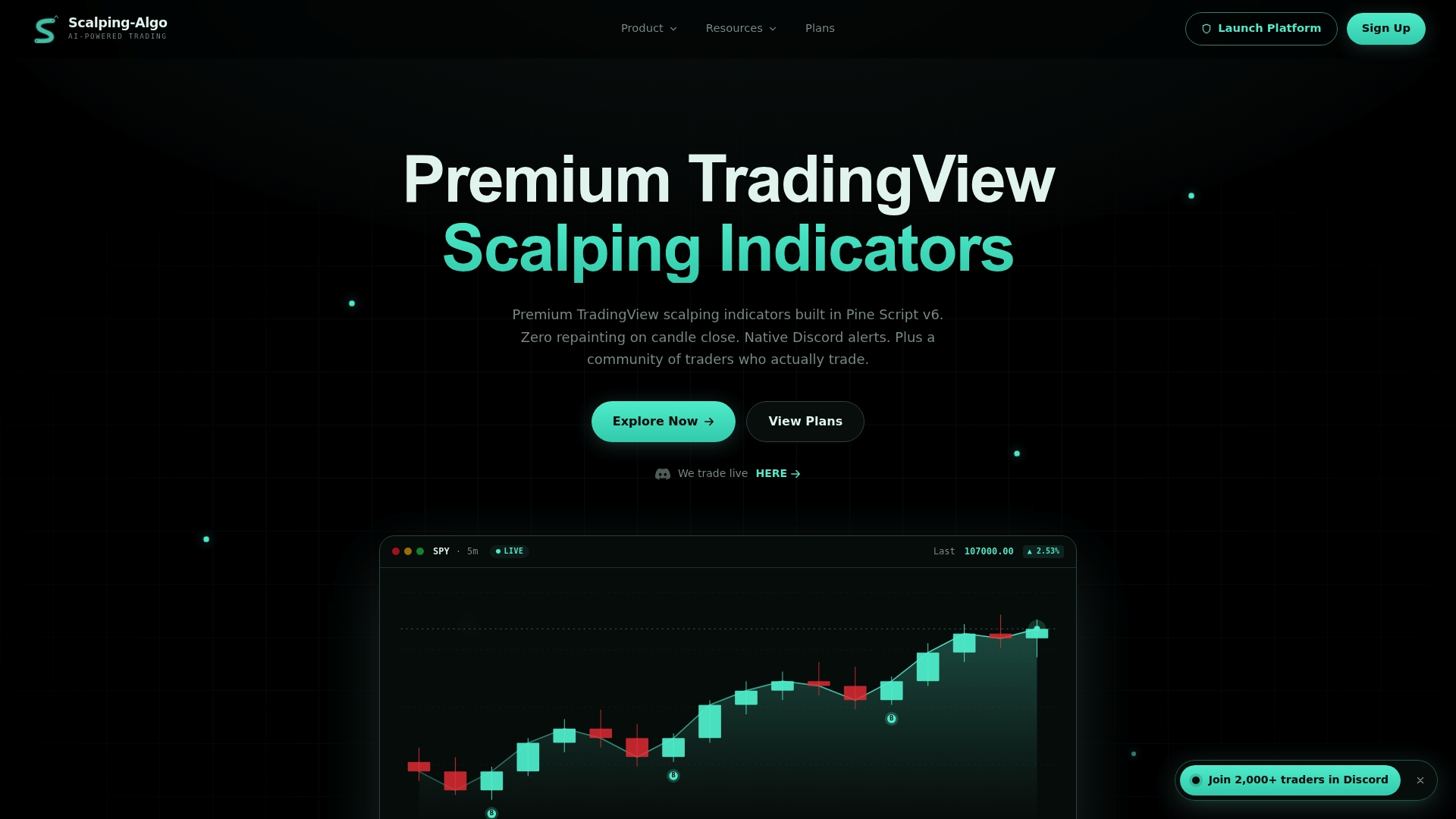
Scalping-algo's premium TradingView indicators are built specifically for retail traders who want institutional-grade entry and exit signals without guessing. The platform's 3-indicator Algo Master system generates real-time, non-repainting buy and sell signals on 1m–15m timeframes, with built-in volatility gating that filters out low-quality setups before they appear on your chart. That filtering directly supports your risk rules by reducing the number of marginal trades you are tempted to take. The Command Center dashboard integrates backtesting, alerts, and a live Discord community where position sizing and daily limits are discussed in real trading sessions.
FAQ
What is the 1–2% rule in forex trading?
The 1–2% rule caps the amount you risk on any single trade at 1–2% of your total account equity. On a $10,000 account, that means risking no more than $100–$200 per trade.
How do I calculate position size using my stop-loss distance?
Divide your risk amount in dollars by the product of your stop distance in pips and the pip value per lot. This gives you the correct lot size to keep risk fixed regardless of stop width.
What leverage should retail forex traders use?
Retail traders should stay below 10:1 effective leverage even if their broker offers more. ESMA caps leverage at 1:30 for major pairs and 1:20 for non-majors for regulated retail accounts.
Why do daily loss limits reduce drawdowns?
Traders with daily loss limits show 34% lower maximum drawdowns than those without. The limits cut off revenge trading and emotional position sizing before they compound into account-threatening losses.
What is correlation risk in forex trading?
Correlation risk occurs when two currency pairs move in the same direction simultaneously, making two separate positions behave like one larger position. Cap total correlated exposure at 3–5% of your account to avoid hidden overexposure.