

Crypto trading is defined as buying and selling digital assets to profit from price movements across spot, derivatives, and decentralized markets. The best crypto trading tips 2026 center on three pillars: matching your strategy to the current market regime, controlling execution risk at the order level, and applying strict position sizing rules before every trade. Retail traders who skip any one of these pillars consistently underperform. This guide covers the strategies, tools, and regulatory checkpoints that separate profitable traders from the majority who blow up their accounts within the first year.
1. Which crypto trading strategies deliver consistent results in 2026?
Four durable crypto strategies stand out in 2026: dollar-cost averaging (DCA), trend following with defined stops, basis (cash-and-carry) trades, and grid trading on narrow ranges. Each has a specific market condition where it works best. Using the wrong one in the wrong environment is the single most common cause of retail losses.
Dollar-cost averaging suits passive accumulation. You buy fixed dollar amounts of BTC, ETH, or SOL at regular intervals regardless of price. This removes timing pressure and works well in long-term uptrends.

Trend following requires a defined entry signal and a hard stop below a recent swing low or ATR band. You hold until the trend breaks. No guessing, no moving stops.
Basis trades exploit the spread between spot and futures prices when funding rates persist above neutral. This is a market-neutral approach that generates yield without directional exposure.
Grid trading places buy and sell orders at fixed intervals above and below a price range. It profits from chop but loses badly in strong trending markets. Know when to turn it off.
| Strategy | Risk level | Time horizon | Complexity |
|---|---|---|---|
| Dollar-cost averaging | Low | Weeks to months | Low |
| Trend following | Medium | Days to weeks | Medium |
| Basis (cash-and-carry) | Low to medium | Days to weeks | High |
| Grid trading | Medium | Hours to days | Medium |
| Day trading / scalping | High | Minutes to hours | High |
Day trading and scalping require continuous monitoring and tight risk control. Many retail traders attempt scalping without the capital base or discipline it demands. Volity's 2026 guide notes that day trading requires roughly $5,000 or more in capital for cost efficiency, while spot trades can start at $20.
Pro Tip: Match your strategy to the regime first. Use CoinMarketCap's market timing API to classify whether the market is trending or ranging before selecting your approach. Applying a grid strategy in a strong uptrend will cost you.
2. How to manage execution risks and order types in 2026
Market orders execute immediately at the best available price. Limit orders wait for your specified price. Coin Bureau recommends learning order mechanics with small sizes before adding complexity. This is not optional advice for beginners. It is the foundation of execution quality.
On decentralized exchanges (DEXes), execution risk scales with your order size relative to available liquidity. CoinMarketCap launched the On-chain Liquidity-to-Market Cap (L/MCap) ratio in April 2026 to address this directly. The ratio compares DEX liquidity to a token's circulating market cap. A low ratio signals high slippage risk before you place the trade.
Key execution rules to follow:
- Use limit orders on DEXes whenever possible to control fill price
- Check the L/MCap ratio before trading low-cap tokens on any DEX
- Split large orders into smaller tranches to avoid moving the market against yourself
- Route orders through aggregators like 1inch or Paraswap to access deeper liquidity pools
- On centralized exchanges (CEXes), use post-only limit orders during low-volume periods to capture maker rebates
Pro Tip: For any DEX trade above 0.5% of a token's on-chain liquidity, split the order into at least three tranches and space them across blocks. This alone can reduce price impact by 30–50% on mid-cap tokens.
3. What risk management rules are critical for 2026 crypto traders?
Risk 1–2% of capital per trade only works when your stop-loss sits at a technically valid level, such as a support zone or an ATR band, not an arbitrary percentage below entry. BitFinance's risk management framework is clear: set your stop before entry and calculate position size from it. Never reverse the process.
Retail traders who survive volatile markets commit to voluntary trading halts after 10–20% portfolio drawdowns. This is not weakness. It is the rule that separates accounts that recover from accounts that go to zero. Cutting exposure at a defined drawdown threshold forces you to reassess rather than revenge trade.
Common pitfalls and how to avoid them:
- Overleverage: Cap leverage at 3x until you have 6 months of positive trade history
- Moving stops mid-trade: Set your stop before entry and do not touch it
- Ignoring regime filters: A winning strategy in a bull trend will lose in a ranging market. Separate regime identification from strategy execution
- Skipping drawdown limits: Define your maximum portfolio drawdown (10–20%) and pause trading when you hit it
- Sizing by conviction: Position size is determined by stop distance and risk percentage, not by how confident you feel
Separating strategy selection from market regime filtering reduces losses by ensuring you apply the right tool to the right conditions. CoinMarketCap's market timing API classifies regimes using momentum, breadth, and macro data. This is the kind of systematic discipline that keeps retail traders in the game long-term.
Pro Tip: Keep a trade journal with every stop placement and the reason for it. After 30 trades, review whether your stops were technically placed or emotionally placed. The pattern will tell you exactly where your discipline breaks down.
4. Which exchanges and regulatory factors matter for retail traders?
Platform selection is a risk management decision, not just a convenience choice. Prioritize exchanges with transparent fee structures, proof-of-reserves disclosures, and strong two-factor authentication (2FA) enforcement. Security hygiene on your end matters equally. Use hardware wallets for any holdings you are not actively trading.
The regulatory environment tightened significantly in 2026. The FCA cracked down on illegal peer-to-peer crypto trading in the UK, targeting eight premises and confirming that no P2P crypto businesses are currently FCA-registered. Trading through unregistered platforms exposes you to financial crime risk and zero consumer protection.
The FCA's 2026 crypto promotion framework also introduced mandatory risk warnings and a 24-hour cooling-off period for first-time investors. New rules ban urgent promotions and refer-a-friend bonuses. If a platform is pushing you to act fast or offering signup bonuses that seem too good, that is a compliance red flag.
Exchange safety checklist:
- Verify registration status using the FCA's Firm Checker or your local regulator's equivalent
- Enable 2FA on every account, preferably with an authenticator app rather than SMS
- Never store large balances on an exchange you cannot verify
- Read the fee schedule before trading, including withdrawal fees and spread markups
- Check whether the platform is licensed in your jurisdiction before depositing
Pro Tip: Before depositing on any new platform, search the exchange name plus "withdrawal issues" or "hack" on Reddit and Twitter. Community reports surface problems faster than any regulator.
5. How to use technology and data tools effectively in 2026
Algorithmic and on-chain data tools give retail traders access to the same execution intelligence that institutional desks have used for years. The L/MCap ratio from CoinMarketCap is the clearest example. New data metrics like L/MCap give retail traders an execution edge that was previously unavailable. That edge is only useful if you build it into your pre-trade checklist.
TradingView remains the standard charting platform for retail traders in 2026. Pine Script v6 indicators, backtesting tools, and webhook alerts make it the most practical environment for building and testing strategies without institutional infrastructure. Pair TradingView with on-chain data from platforms like Glassnode or Nansen for a more complete picture of market structure.
Automation is powerful but dangerous without risk controls baked in. An automated strategy without a hard drawdown limit will run until the account is empty. Before automating any strategy, verify that it includes a maximum loss per session, a daily stop, and a regime filter.
Tools worth integrating into your 2026 workflow:
- CoinMarketCap L/MCap ratio for DEX position sizing and slippage assessment
- TradingView with Pine Script v6 for charting, backtesting, and signal generation
- Glassnode or Nansen for on-chain flow data and wallet behavior analysis
- 1inch or Paraswap for DEX order routing and liquidity aggregation
For beginners, the right sequence is: learn execution mechanics first, then paper trade your strategy, then automate only after you understand every rule the system follows. Skipping steps here is expensive.
Pro Tip: Start with a single TradingView indicator and master its signals on one asset before adding more tools. Stacking five indicators on a chart without understanding each one produces noise, not edge.
Key takeaways
Profitable crypto trading in 2026 requires matching your strategy to the market regime, sizing positions from valid stops, and verifying every platform before depositing capital.
| Point | Details |
|---|---|
| Match strategy to regime | Use trend following in uptrends, grid trading in ranges, and DCA for passive accumulation. |
| Use the L/MCap ratio | Check CoinMarketCap's liquidity-to-market cap ratio before every DEX trade to assess slippage risk. |
| Risk 1–2% per trade | Set stops at technical levels and calculate position size from the stop, not from conviction. |
| Pause at 10–20% drawdown | Stop trading when portfolio drawdown hits your limit. Reassess before re-entering. |
| Verify platform registration | Use the FCA Firm Checker or local equivalent before depositing on any exchange. |
Why most retail traders lose before they learn
I have watched traders blow accounts not because they lacked a strategy, but because they applied the right strategy in the wrong market condition. Grid trading in a trending market is not a strategy problem. It is a regime identification problem. That distinction matters more than any indicator setting.
The traders I see survive long-term share one habit: they treat drawdown limits as hard rules, not suggestions. When the account drops 15%, they stop. They review. They come back with a smaller size. The ones who override that rule to "make it back" rarely do.
The L/MCap ratio is the most underused tool available to retail traders right now. Institutional desks have always modeled liquidity before sizing into positions. Now you can do the same thing with a free metric on CoinMarketCap. There is no excuse for taking a large position in a low-liquidity token and being surprised by the slippage.
Regulation is not your enemy. The FCA's 2026 crackdown on illegal P2P trading removed platforms that were actively stealing from retail users. A tighter regulatory environment means the platforms that survive are more likely to honor withdrawals and protect your funds. Use that filter.
If you are new to scalping strategies in 2026, start with the smallest possible position size and focus entirely on execution quality. Getting filled at the right price consistently is a skill. Build it before you scale.
— Tran
Take your 2026 crypto trading further with Scalping-algo
Scalping-algo builds premium TradingView indicators in Pine Script v6, designed specifically for traders who want real-time, non-repainting signals on 1m–15m timeframes. The platform's 3-indicator trading system combines confluence tools, volatility gating, and divergence detection so you enter and exit with precision rather than guesswork.
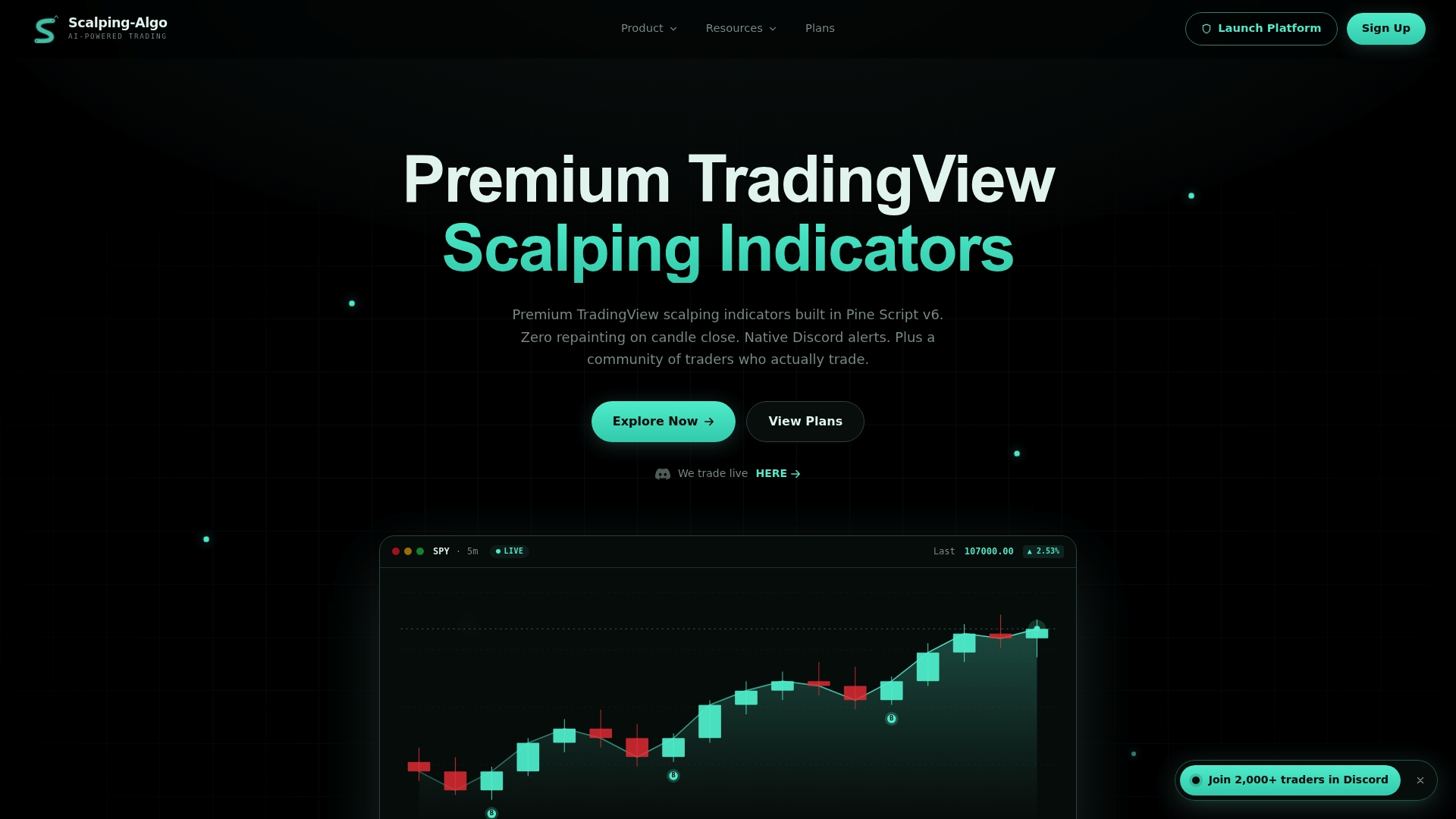
Every script is open-source and includes native webhook alerts to Discord for fast execution. Whether you are learning the mechanics of scalping or looking to automate a proven edge, Scalping-algo's Command Center dashboard and live Discord community give you the infrastructure to trade with discipline. Explore the full suite of premium scalping indicators and see how institutional-grade tools work for individual traders.
FAQ
What are the best crypto trading strategies for 2026?
The four most consistent strategies are DCA, trend following with hard stops, basis (cash-and-carry) trades, and grid trading on ranging markets. Match the strategy to the current market regime before entering any trade.
What is the L/MCap ratio and why does it matter?
The L/MCap ratio, launched by CoinMarketCap in April 2026, compares a token's DEX liquidity to its circulating market cap. A low ratio signals high slippage risk, making it a critical pre-trade check for any DEX swap.
How much capital do I need to start crypto day trading?
Day trading requires roughly $5,000 or more for cost efficiency, according to Volity's 2026 guide. Spot trading and DCA can start with as little as $20, making them better entry points for new retail traders.
How do I trade cryptocurrencies safely in 2026?
Use only FCA-registered or locally licensed exchanges, enable 2FA on every account, and never store large balances on platforms you cannot verify. Risk no more than 1–2% of your capital per trade with stops set at technical levels.
What is the biggest mistake crypto traders make in 2026?
The most common mistake is applying a strategy without a regime filter, such as running a grid strategy in a strong trend. The second most common is overriding drawdown limits and revenge trading after losses.