

The forex market is the largest financial market in the world, with daily turnover reaching $9.6 trillion. That scale means you can enter and exit positions almost instantly, at any hour, five days a week. For individual traders evaluating where to put their capital in 2026, the reasons to trade forex go beyond size alone. Divergent central bank policies, geopolitical tension, and the democratization of institutional tools have created a market environment that rewards prepared, disciplined traders more than any prior cycle.
Why trade forex in 2026: the structural case
The forex market's core advantages are structural, not cyclical. They exist regardless of whether the dollar is rising or falling.
Liquidity and execution speed are the first reasons professionals choose forex over most other markets. A daily volume of $7.5 trillion to $9.6 trillion means spreads stay tight and orders fill fast. You rarely face the slippage problems common in small-cap equities or thinly traded commodities.
Market hours give forex a structural edge over stock exchanges. The market runs 24 hours a day, five days a week, cycling through the Sydney, Tokyo, London, and New York sessions. A trader in Chicago can act on a Bank of Japan rate decision at 2 a.m. without waiting for a market open.

Low capital requirements remove the barrier that keeps many traders out of futures or options. Retail traders can start with as little as $100 to $500 and still access major currency pairs with competitive spreads. That accessibility is rare across asset classes.
Two-way trading is the fourth structural advantage. Forex lets you go short as easily as long. When the euro weakens against the dollar, that is a trade, not a problem. Equity investors often have to wait out bear markets. Forex traders can profit from them.
Pro Tip: Focus your early trading on the London/New York overlap session (roughly 8 a.m. to noon Eastern Time). Liquidity peaks during this window, spreads narrow, and price movements are most consistent.
| Feature | Forex market | Typical stock market |
|---|---|---|
| Daily volume | Up to $9.6 trillion | Under $300 billion (U.S. equities) |
| Trading hours | 24 hours, 5 days a week | 6.5 hours per exchange day |
| Minimum capital | $100–$500 | Varies; pattern day trader rule requires $25,000 |
| Short selling | Freely available | Requires margin account approval |
How do 2026 market conditions create trading opportunities?
Volatility is the raw material of trading profit. The 2026 forex market has more of it than any period in recent memory, and the causes are structural rather than temporary.
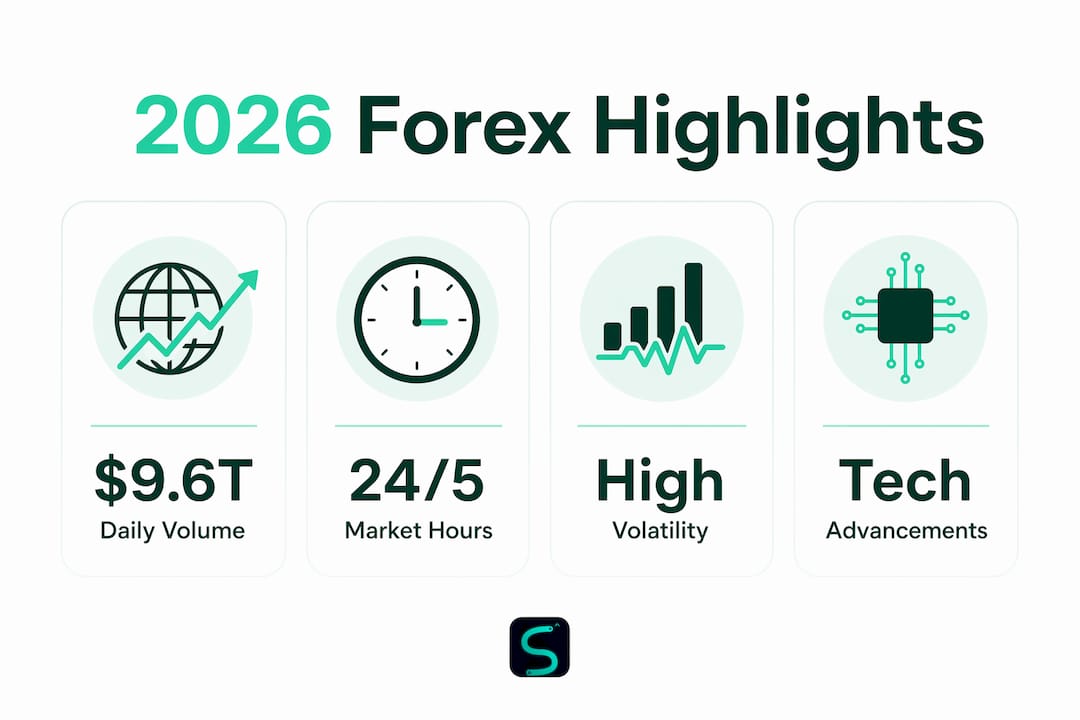
Central bank policy divergence is the primary driver. The Federal Reserve has maintained a high-for-longer interest rate stance anchored by real yields, while other major central banks have moved in different directions. That divergence creates persistent directional trends in pairs like USD/JPY and EUR/USD. Trend-following strategies perform well in this environment.
Geopolitical tensions add a second layer of volatility. Increased price swings driven by central bank divergence and geopolitical events create active trading opportunities that simply did not exist during the low-volatility years of 2019 to 2021. Traders who understand how geopolitical events move currency markets can position ahead of predictable risk-off flows into safe-haven currencies like the USD, JPY, and CHF.
Event-driven volatility is the third factor. FOMC meetings and Non-Farm Payroll reports produce sharp, fast price movements. Experienced traders treat these events as decision points. You either have a clear setup with defined risk, or you stand aside. There is no middle ground when spreads widen and price moves 50 pips in 30 seconds.
Understanding currency vulnerability factors in 2026 helps traders separate noise from tradable setups. Emerging market currencies face particular pressure from USD strength and carry trade unwinds. That pressure creates repeatable patterns for traders who track yield differentials and capital flow data.
What technological advancements empower retail forex traders?
Technology has closed the gap between retail and institutional traders faster than most people realize. The tools available to an individual trader in 2026 were reserved for bank trading desks five years ago.
Professional-grade execution speeds and advanced analytics are now accessible through standard retail platforms. Direct market access, one-click execution, and real-time depth-of-market data are standard features, not premium upgrades. That shift changes what is possible for a trader working from a home office.
Algorithmic and automated trading tools represent the biggest leap. Platforms like TradingView now support Pine Script v6, which lets traders build and backtest fully automated strategies without a programming degree. Scalping-algo's suite of TradingView indicators, built in Pine Script v6, generates real-time, non-repainting buy and sell signals on timeframes as short as 1 minute. That kind of precision was institutional territory until recently. The benefits of algorithmic trading for scalpers include faster reaction times, removal of emotional bias, and consistent application of entry rules across hundreds of setups.
Free resources have also multiplied. Economic calendars, sentiment indicators, and multi-timeframe charting are available at no cost through multiple platforms. The information edge that institutions once held has largely disappeared.
Pro Tip: Technology speeds up execution but does not replace judgment. Use automated signals to identify setups, then apply your own risk rules before entering. Never let an algorithm override a position size you are not comfortable holding.
The critical caveat is this: technology reduces friction but does not eliminate risk. Retail traders still need disciplined risk management to succeed. A faster entry into a bad trade is still a bad trade.
What are the realistic risks of trading forex in 2026?
Forex trading carries real financial risk. Anyone who tells you otherwise is selling something.
Approximately 70–80% of retail forex traders lose money over the long term. The cause is rarely a lack of signals or market access. It is almost always poor risk management, emotional decision-making, and unrealistic expectations about how fast profits arrive. That statistic should not discourage you. It should tell you exactly where to focus your preparation.
The traders who survive and grow follow a clear set of practices:
- Position sizing first. Risk no more than 1–2% of your account on any single trade. This rule alone separates traders who last from those who blow up in the first three months.
- Set stop losses before entry. Define your exit point before you enter. Changing a stop loss mid-trade because price is moving against you is how small losses become account-ending losses.
- Keep a trading journal. Strategy journaling leads to sustainable trading success because it forces you to review what worked, what failed, and why. Most traders skip this step. Most traders lose money.
- Start with a demo account. Learn the mechanics of order entry, margin, and platform tools without real capital at risk. Then move to a small live account and treat early losses as tuition. Live accounts are essential for managing real emotional responses that demo trading cannot replicate.
- Know when to stay out. Event calendar awareness is a core skill. Trading through a high-impact news release without a clear edge is gambling, not trading. Sitting out is a valid position.
Market regime-focused strategies built around support and resistance zones consistently outperform generic signal-following approaches. Understanding whether the market is trending or ranging changes which setups have positive expectancy. Read the role of volatility in scalping to understand how to calibrate your approach to current conditions.
Key Takeaways
The forex market in 2026 rewards traders who combine structural knowledge, disciplined risk controls, and technology-driven execution over those who chase signals without a plan.
| Point | Details |
|---|---|
| Record liquidity | Daily volume up to $9.6 trillion keeps spreads tight and execution fast for retail traders. |
| 24/5 market access | Trading across Sydney, Tokyo, London, and New York sessions gives flexibility no stock exchange matches. |
| Volatility creates opportunity | Central bank divergence and geopolitical tension in 2026 produce consistent, tradable price movements. |
| Technology levels the field | Algorithmic tools and real-time analytics once reserved for institutions are now accessible to individual traders. |
| Risk management decides outcomes | 70–80% of retail traders lose money. Position sizing, stop losses, and journaling are the differentiators. |
The 2026 forex market rewards preparation, not prediction
I have watched traders enter the forex market with two different mindsets. The first group treats it like a lottery. They chase signals, ignore position sizing, and blow up within six months. The second group treats it like a craft. They study market structure, define their risk before every trade, and review their journal weekly. The second group is a small minority. They are also the ones still trading three years later.
What makes 2026 genuinely different is the combination of high volatility and accessible technology. The macro environment, driven by USD strength from real yields and persistent central bank divergence, creates directional trends that last days and weeks, not just hours. That is a scalper's and swing trader's market simultaneously. The tools to trade both timeframes professionally are now within reach of anyone with a laptop and a few hundred dollars.
The uncomfortable truth is that most traders will not use those tools correctly. They will over-leverage, ignore their stop losses, and blame the market when they lose. The traders who treat technology as a discipline aid rather than a shortcut will have a genuine edge in 2026. That edge is not about predicting the next FOMC decision. It is about executing your plan consistently when the market moves against you.
My advice: spend more time on your scalping strategy for 2026 than on finding the perfect indicator. The indicator is the last 10% of the equation. The first 90% is knowing your risk per trade, your session focus, and your rules for sitting out.
— Tran
Scalping-algo's tools for the 2026 forex market
Forex in 2026 demands fast, disciplined execution. Scalping-algo builds exactly the tools individual traders need to compete in this environment.
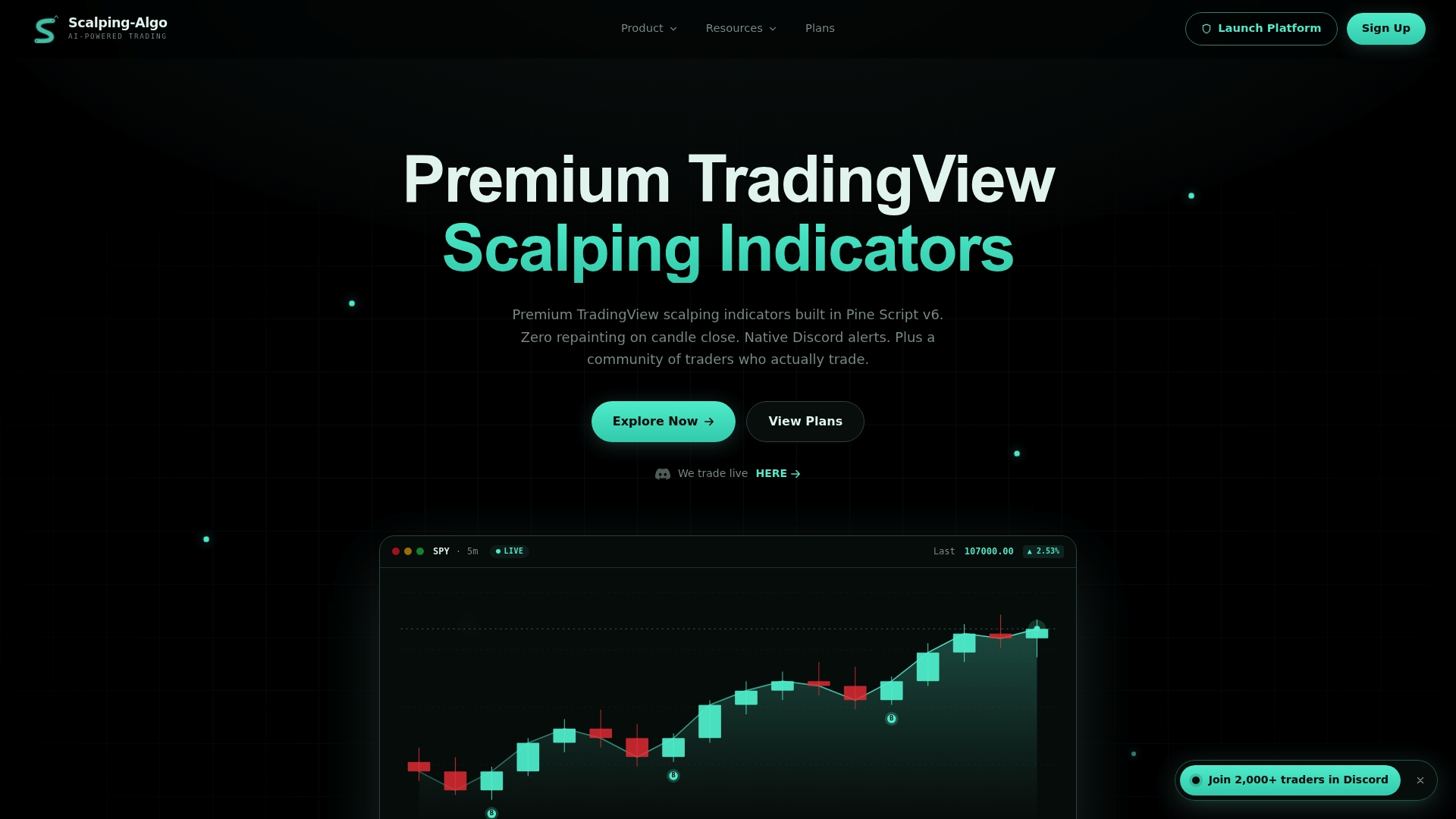
Scalping-algo's premium TradingView indicators are built in Pine Script v6 and generate real-time, non-repainting buy and sell signals on timeframes from 1 minute to 15 minutes. The platform includes volatility gating, divergence detection, and confluence tools that filter low-quality setups before they cost you money. The Algo Master 3-indicator system gives traders a structured, algorithm-driven approach to forex entries and exits. A built-in Command Center dashboard, backtesting tools, and a live Discord community round out the package. For traders serious about the 2026 forex market, this is where preparation meets execution.
FAQ
What makes the forex market unique compared to stocks?
The forex market trades up to $9.6 trillion daily, operates 24 hours a day five days a week, and allows two-way trading with capital as low as $100. Stock markets have fixed hours, higher capital requirements for active trading, and less liquidity in most individual securities.
How much money do I need to start trading forex in 2026?
Retail traders can open a live forex account with as little as $100 to $500. Starting small is advisable. Treat your first live account as a learning experience rather than an immediate income source.
Why do most retail forex traders lose money?
Approximately 70–80% of retail traders lose money due to poor risk management, over-leveraging, and emotional decision-making. Consistent position sizing, defined stop losses, and a trading journal are the practices that separate profitable traders from the majority.
Is 2026 a good time to start trading forex?
Yes, for prepared traders. Central bank policy divergence and geopolitical volatility create clear directional trends and active price movements. The risk is higher than in low-volatility periods, which makes disciplined risk management more critical, not less.
What role does technology play in forex trading success?
Technology provides institutional-grade execution speeds, automated signal generation, and real-time analytics to retail traders. Success still depends on disciplined risk controls. Faster tools amplify both good and bad decision-making equally.