

Democratizing trading technology is defined as making institutional-grade trading tools, platforms, and market access available to individual retail traders, not just hedge funds and banks. For decades, tools like direct market access, algorithmic execution, and real-time data feeds were locked behind six-figure infrastructure costs and regulatory gatekeeping. That gap is closing fast. Regulators like SEBI are proposing direct market access for retail traders, cloud APIs have replaced expensive desktop software, and AI tools now assist individual traders with strategy development that once required a full quant team. The question is not whether to democratize trading technology. The question is how to do it responsibly.
Why democratize trading technology now?
The shift is happening because the technical barriers have collapsed. Brokerages now provide open-source code and backtesting environments that let retail traders build and run automated bots overnight. What previously required a Bloomberg terminal and a dedicated server now runs on a laptop connected to a cloud API.
Three forces are driving this change in 2026:
- Regulatory pressure. SEBI's proposal to expand direct market access removes broker-dealer intermediaries from the order flow, cutting costs and latency for retail participants.
- Cloud infrastructure. The transition from COM/OCX desktop methods to REST API environments means traders can run automated strategies 24/7 without maintaining physical hardware.
- AI accessibility. Purpose-built AI agents focused on narrow trading tasks now outperform generic LLM usage, giving retail traders targeted automation without requiring a data science background.
The combined effect is a market where individual traders can access execution speeds, strategy testing tools, and data feeds that were previously reserved for institutions.
Pro Tip: Before building an automated strategy, test it in a backtesting environment with at least six months of historical data. Most platforms, including those using Pine Script, offer this natively.
What are the key benefits of democratizing trading technology?
Wider access to trading technology produces concrete, measurable benefits for individual traders and for markets as a whole. These are not theoretical gains. They show up in execution quality, portfolio diversity, and market efficiency.
-
Faster order execution. Direct Access Trading platforms reduce order execution latency to milliseconds. For scalpers and active traders, that speed difference directly affects profitability on small price movements.
-
Consolidated multi-asset access. Modern platforms offer access to crypto, forex, indices, commodities, and futures through a single account. Retail traders no longer need separate brokers for each asset class.
-
Lower capital requirements. Cloud-based tools and aggregated API models mask the complexity of fragmented liquidity pools. Traders focus on strategy, not infrastructure costs.
-
More strategy testing opportunities. Open-source backtesting environments let traders validate ideas before risking real capital. This reduces the cost of learning and accelerates skill development.
-
Greater information symmetry. Real-time data feeds and AI-assisted analysis give retail traders access to market signals that institutions have used for years. The information gap narrows with each platform update.
The cumulative impact is a more competitive, more liquid market. When more participants can trade efficiently, price discovery improves and spreads tighten. That benefits everyone in the market, including institutions.
What risks come with broader access to advanced trading tools?
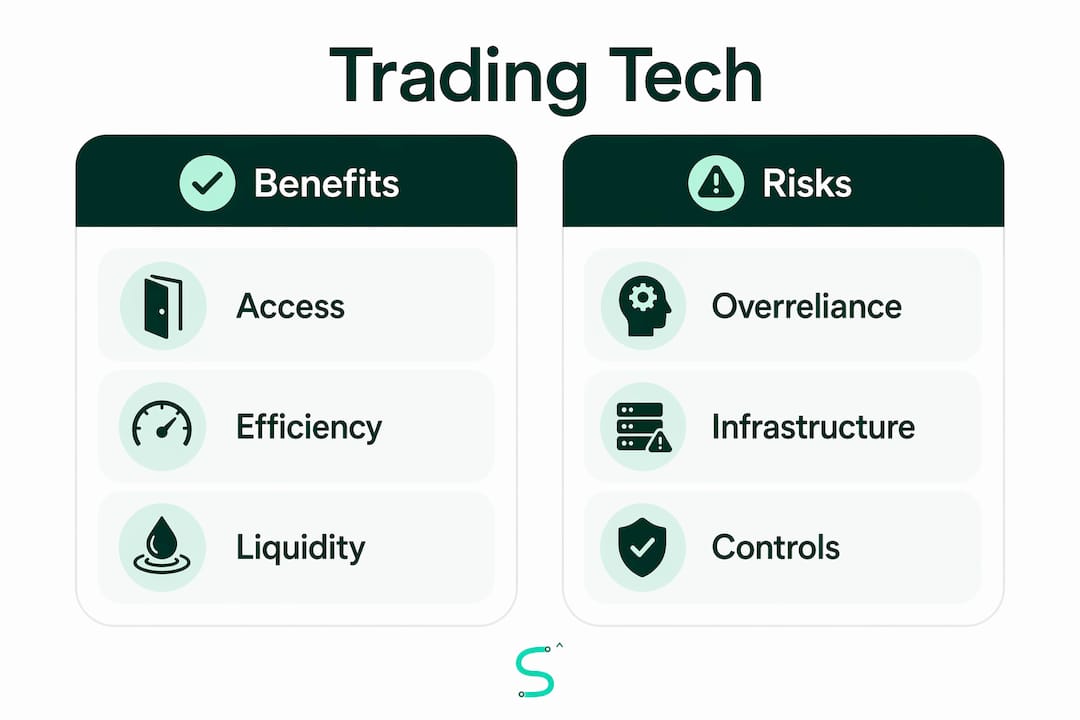
Access without education is dangerous. The same tools that help experienced traders execute faster can cause significant losses for traders who do not understand what they are running.
The core risks break down clearly:
- Misuse of complex tools. Retail traders who deploy algorithmic strategies without understanding the underlying logic often discover the risks only after a drawdown. Automation does not eliminate bad strategy design.
- Over-reliance on AI. Effective AI use requires treating AI tools as interactive assistants that encourage reflection, not as black-box signal generators. Traders who follow AI outputs blindly skip the human judgment that catches edge cases.
- Infrastructure failures. Many retail traders fail not because of poor strategies but because of inadequate bot management and infrastructure upkeep. Reliable cloud uptime and error handling are non-negotiable for systematic trading.
- Inadequate risk controls. Platforms that do not embed stop-loss orders and negative balance protection directly into the UI expose less-experienced traders to losses that exceed their account balance.
- Digital accessibility gaps. Platforms with poor navigation design and no tutorial prompts create friction that pushes out newer traders before they develop competence.
Pro Tip: Always verify that your trading platform includes built-in risk management features like stop-losses and negative balance protection before depositing capital. These are structural safety features, not optional add-ons.
Platforms have a responsibility here. Embedding risk controls into the platform UI is becoming an industry norm, not a differentiator. Traders should treat the absence of these features as a red flag.
How can traders use democratized trading technologies effectively?
Knowing the tools exist is not enough. Using them well requires a specific approach. The traders who benefit most from accessible technology are the ones who treat it as a system, not a shortcut.

| Practice | Tool or Method | Why It Works |
|---|---|---|
| Automate with oversight | Cloud-based bots with continuous monitoring | Prevents infrastructure failures that kill profitable strategies |
| Use AI as an assistant | Purpose-built AI agents for narrow tasks | Focused agents outperform generic LLMs for specific trading workflows |
| Test before deploying | Backtesting environments in Pine Script or similar | Validates strategy logic before real capital is at risk |
| Access multiple markets | Direct market access platforms | Single-account access to crypto, forex, and futures reduces friction |
| Build risk controls first | Stop-loss, position sizing, negative balance protection | Protects capital during learning curve and drawdown periods |
Automated trading systems work best when traders understand what the system is doing at each step. Blind automation is the fastest way to lose capital systematically. The goal is to use technology to execute a tested strategy faster and more consistently than manual trading allows.
Open-source trading scripts give retail traders a significant advantage here. When the code is visible, traders can audit the logic, modify parameters, and understand exactly what conditions trigger a signal. Transparency in code is a form of risk management.
AI agents designed for specific fintech workflows are also worth integrating carefully. The key word is carefully. A narrow AI agent that monitors one specific market condition and flags anomalies adds real value. A generic chatbot that generates trade ideas without context adds noise.
For scalpers specifically, real-time market data is the foundation of every decision. Latency in data feeds translates directly to missed entries and late exits. Platforms that prioritize data speed and accuracy give scalpers a structural edge that no indicator can compensate for if it is absent.
Inclusive platform design also matters more than most traders realize. Platforms built with intuitive navigation and tutorial prompts reduce the friction that causes new traders to make costly mistakes early. Better design produces better trading behavior across the board.
Key Takeaways
Democratizing trading technology expands market access for retail traders, but responsible use requires embedded risk controls, tested strategies, and AI tools treated as assistants rather than autonomous decision-makers.
| Point | Details |
|---|---|
| Access is expanding fast | REST APIs, cloud platforms, and regulatory changes like SEBI's DMA proposal are removing institutional barriers for retail traders. |
| Execution speed matters | Direct Access Trading reduces latency to milliseconds, giving retail traders competitive execution previously reserved for institutions. |
| AI requires human oversight | Purpose-built AI agents outperform generic LLMs, but traders must apply judgment to every signal the system generates. |
| Risk controls are non-negotiable | Stop-loss orders and negative balance protection must be embedded in the platform UI before any automated strategy goes live. |
| Open-source code builds trust | Transparent, auditable scripts let traders verify signal logic and modify parameters, reducing blind reliance on black-box tools. |
The uncomfortable truth about democratized trading tech
I have watched traders get access to institutional-grade tools and immediately treat them like a guaranteed edge. That is the wrong frame entirely. The technology lowers the barrier to entry. It does not lower the barrier to competence.
What I have seen work consistently is a specific mindset: use the technology to execute a strategy you already understand, not to discover a strategy you hope exists. Traders who deploy AI agents or automated bots without first building a manual understanding of the market they are trading tend to hit the same walls, just faster and with more capital at risk.
The regulatory changes happening in 2026, particularly around direct market access, are genuinely significant. They will bring more participants into markets that were previously closed to them. That is good for market efficiency and good for individual traders who are prepared. But preparation is the operative word.
My honest read on where this goes: the platforms that win long-term will be the ones that combine powerful tools with embedded education and risk controls. Access without guardrails is not democratization. It is exposure. The traders who thrive will be the ones who treat every new tool as something to learn before they deploy, not something to trust before they understand.
— Tran
Advanced scalping tools built for retail traders
Scalping-algo was built on the premise that professional-grade trading tools should not require a hedge fund budget or a quant team to use effectively.
The platform offers premium TradingView indicators built in Pine Script v6, with real-time, non-repainting buy and sell signals optimized for timeframes from 1 minute to 15 minutes. Every script is open-source and auditable. The Command Center dashboard integrates alerts, backtesting, and education in one place. For traders who want a structured system, the Algo Master suite combines three indicators designed to work together for cleaner entries and exits across crypto, forex, indices, and futures.
FAQ
What does it mean to democratize trading technology?
Democratizing trading technology means making advanced trading tools, platforms, and market access available to individual retail traders, not just institutional investors. This includes REST APIs, AI-assisted strategy tools, and direct market access platforms.
How does direct market access benefit retail traders?
Direct market access reduces order execution latency to milliseconds and removes broker-dealer intermediaries from the order flow. Retail traders get faster execution and lower transaction costs as a result.
What is the biggest risk of using AI trading tools?
Over-reliance on AI without human judgment is the primary risk. Effective AI use treats AI as an assistant that frames decisions probabilistically, not as an autonomous signal generator that replaces trader analysis.
Why do automated trading bots fail for retail traders?
Most automated bot failures trace back to infrastructure problems, not strategy flaws. Inadequate bot management and unreliable cloud uptime are the leading causes of systematic trading failure at the retail level.
What features should a democratized trading platform include?
A well-built platform embeds stop-loss controls, negative balance protection, intuitive navigation, and tutorial prompts directly into the UI. These features protect less-experienced traders and reduce friction that causes early mistakes.