

Most traders assume the tool they're using is showing them the full picture. That assumption is often wrong. The importance of transparency in trading tools goes far beyond knowing a buy or sell signal fired. It covers where your order went, why the signal triggered, what it cost you to execute, and whether the data behind it was complete. Price transparency directly affects how accurately you can determine true asset value. Without it, you are trading with a blindfold on, making decisions based on partial information in a market that penalizes exactly that.
Table of Contents
- Key Takeaways
- The importance of transparency in trading tools: what it actually covers
- How transparency builds trust and improves your decisions
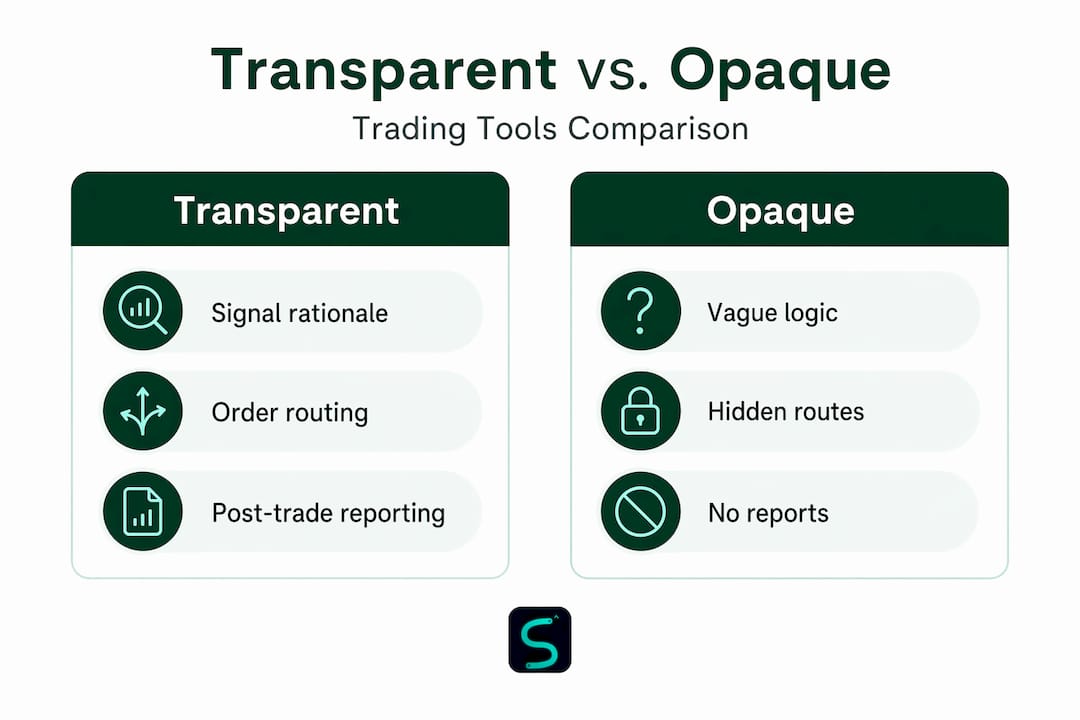
- Transparent vs. opaque tools: what the difference costs you
- How new regulations are reshaping the transparency baseline
- How to evaluate a trading tool's transparency before you commit
- My take on transparency: the uncomfortable truth
- Why Scalping-Algo prioritizes open, transparent tools
- FAQ
Key Takeaways
| Point | Details |
|---|---|
| Transparency covers three stages | Pre-trade, execution, and post-trade transparency each reveal distinct and critical information about your trades. |
| Opaque tools carry hidden costs | Black-box systems obscure fees, execution logic, and order routing, which erodes performance over time. |
| Regulations are raising the bar | EU MiFID II and FINRA reforms now mandate near real-time reporting, making baseline transparency expectations higher than ever. |
| Explainability must be calibrated | Vague rationale statements in AI tools create false confidence. Meaningful transparency includes uncertainty and failure mode communication. |
| Evaluate tools before you commit | Use a structured checklist covering pre-trade rationale, order routing visibility, and post-trade data completeness before choosing any trading tool. |
The importance of transparency in trading tools: what it actually covers
Transparency is not a single feature. It operates across three distinct phases of every trade, and gaps in any one of them can cost you money or distort your judgment.
Pre-trade transparency is what you see before placing an order. This includes quote visibility, the reasoning behind a signal, and whether you understand the conditions that triggered a recommendation. If a tool tells you to buy without explaining what confluence of factors justified that signal, you cannot evaluate whether those conditions fit your strategy or risk tolerance.
Trade execution transparency goes deeper. It tells you where your order was routed, which venue filled it, and whether execution quality met reasonable standards. Order routing visibility is a regulatory expectation, not just a nice feature. Without it, you have no way to detect whether a platform is routing orders to venues that benefit the broker rather than you.
Post-trade transparency is the most overlooked dimension. This includes transaction reporting, reconciliation data, and timing. EU regulation 2025/1246 requires post-trade data published within one minute for transactions on and outside trading venues. That standard exists because delayed data compromises your ability to verify execution costs and assess price priority.
Here is what full transparency should include:
- Pre-trade: Signal rationale, entry conditions, and risk parameters
- Execution: Order routing logic, venue selection, fill quality metrics
- Post-trade: Transaction timestamps, actual cost vs. estimated cost, reconciliation data
Pro Tip: When testing any new trading tool, request a sample post-trade report before committing. If they cannot produce one or it is incomplete, that tells you everything.
How transparency builds trust and improves your decisions
Transparency does more than satisfy regulators. It changes how you think and act as a trader.

Research shows that low explainability in AI tools increases blind trust and over-reliance on system outputs. That might sound like a feature until the model breaks down in a volatile session and you have no framework for recognizing it. Blind trust is not confidence. It is deferred accountability.
The opposite problem is also real. Tools that overload you with raw data, without context or prioritization, create cognitive overload. You end up paralyzed or defaulting to gut instinct, which defeats the purpose of using a tool at all. The goal is calibrated reliance: knowing when to follow the tool, when to question it, and why.
Effective transparency supports that calibration through a few specific mechanisms:
- Uncertainty communication: The tool should tell you when confidence in a signal is lower, not just fire identical-looking alerts regardless of setup quality.
- Scenario comparisons: In high-risk setups, showing alternative outcomes or failure modes gives you grounding. High-risk scenarios benefit from explicit confidence indicators rather than binary signals.
- Audit trails: Being able to review past signals against actual outcomes builds your own judgment over time.
Pro Tip: If your trading tool generates signals with zero differentiation in confidence or setup quality, treat every alert with higher skepticism. Real transparency surfaces the strength of each setup.
Hybrid advisory systems that combine AI analysis with human explainability consistently outperform pure black-box outputs in high-stakes decisions. The reason is simple. You need both the analytical precision and the contextual reasoning to trust the recommendation enough to act decisively.
Transparent vs. opaque tools: what the difference costs you
The distinction between a transparent trading tool and an opaque one is not just philosophical. It shows up in your P&L.
Opaque tools share common warning signs. Watch for these:
- No disclosure of order routing logic or execution venue
- Hidden markups on spreads or commissions not visible at order entry
- Signal rationale described only in vague terms like "proprietary algorithm"
- No post-trade reporting or transaction cost analysis
- No historical performance data you can independently verify
| Feature | Transparent tools | Opaque tools |
|---|---|---|
| Signal rationale | Clearly explained with entry conditions | Proprietary, no detail provided |
| Order routing | Venue and routing logic disclosed | Hidden or unspecified |
| Post-trade data | Full transaction and cost reports | Absent or heavily summarized |
| Performance verification | Independent backtesting supported | Relies on vendor-provided stats only |
| Regulatory alignment | Meets MiFID II or FINRA standards | Compliance status unclear |
| Hidden fees | None or fully disclosed | Frequent undisclosed markups |
Transparency in digital asset trading requires detailed disclosure on liquidity aggregation and execution quality without hidden markups. That standard applies just as clearly to traditional instruments. When a platform obscures execution logic, you cannot benchmark whether your fills were competitive. You are trusting a black box to give you fair outcomes with no way to verify it.
The market-level consequences are equally significant. Insufficient access to bidding and trading data leads to market inefficiencies and pricing distortions. Individual traders absorb those inefficiencies through worse fills and wider effective spreads. Opaque tools do not just hide information. They transfer cost from the platform to you.
Pro Tip: Always cross-reference vendor-reported performance stats against your own tracked fills. If the gap is consistent and unexplained, the tool's execution quality disclosure is likely incomplete.
How new regulations are reshaping the transparency baseline
The regulatory environment is moving in one clear direction: more disclosure, faster, with stricter auditability requirements. This matters for you as a trader because these changes raise the floor for what any credible trading tool should provide.
EU MiFID II transparency reforms shift the focus from information volume to standardized, traceable, and auditable reporting. Regulation 2025/1246 key provisions apply from March 2, 2026, mandating near real-time public disclosure to preserve market integrity. This is not bureaucratic box-checking. It is a structural change in what data must be available to market participants.
On the U.S. side, FINRA's 2026 trade-reporting enhancements extend coverage to OTC markets and fractional shares, providing a consolidated view that was previously unavailable. With more than 50% of trading occurring OTC, excluding that data meant price transparency was fundamentally incomplete. Now, tools that do not incorporate OTC data are operating with a structural blind spot.
| Regulatory update | Scope | Key transparency requirement |
|---|---|---|
| EU Regulation 2025/1246 | All EU trading venues and OTC | Post-trade data published within 1 minute |
| FINRA 2026 enhancements | U.S. OTC markets and fractional shares | Validated, real-time consolidated trade reporting |
| Consolidated Audit Trail (CAT) | U.S. equity and options markets | Full order lifecycle data linked by unique identifiers |
The Consolidated Audit Trail links all order events using unique identifiers, giving regulators comprehensive visibility across markets and venues. From a trader's perspective, CAT means the audit infrastructure now exists to trace the full lifecycle of any order. Tools that fall short of this standard are increasingly out of step with market expectations.
The SEC has also made clear that AI-powered trading tools must provide meaningful disclosure to avoid black-box opacity that obscures conflicts of interest. Compliance is not optional. It is becoming a baseline expectation.
How to evaluate a trading tool's transparency before you commit
You do not have to wait for a regulatory body to vet a tool for you. Use this checklist when assessing any platform or indicator system.
- Pre-trade rationale: Does the tool explain exactly what conditions triggered a signal? Vague references to "pattern recognition" are not sufficient.
- Order routing visibility: Can you see where your order is routed and which venue fills it? This applies to both brokers and integrated execution tools.
- Post-trade reporting: Does the platform provide timestamped transaction data, actual vs. estimated cost comparisons, and reconciliation reports?
- Performance verification: Is historical performance data independently auditable, or does it rely entirely on vendor-provided results?
- Regulatory alignment: Does the tool meet applicable standards such as MiFID II, FINRA trade reporting, or equivalent frameworks for your market?
- Uncertainty disclosure: For AI-powered tools, does the system communicate signal confidence levels and known failure modes?
Post-trade reporting is critical for transaction cost analysis and risk management. If a tool cannot show you what execution actually cost relative to what was estimated, you cannot measure whether it is performing as claimed.
Pro Tip: Ask every vendor one direct question: "Can you show me your post-trade reporting format with real data?" Their response will tell you more than any marketing page.
Watch out for the difference between superficial explainability and genuine transparency. A tool that displays a rationale label next to a signal is not automatically transparent. Superficial explainability can create false confidence and reduce your ability to detect model errors. Meaningful transparency includes what the tool does not know, not just what it claims to know. For digital asset risk specifically, resources like monitoring digital asset market risk offer practical frameworks for assessing execution quality gaps in crypto markets.
My take on transparency: the uncomfortable truth
I have watched traders at all experience levels make the same mistake. They confuse a polished interface with actual transparency. A clean dashboard that shows green and red arrows is not a transparent tool. It is a design choice.
What I have noticed consistently is that over-reliance on opaque tools does not hurt you in normal market conditions. It hurts you in abnormal ones, when execution is stressed, liquidity is thin, or a signal fires based on conditions that no longer hold. That is precisely when you need to understand what the tool is doing and why. If you cannot, you are stuck either following it blindly or ignoring it entirely.
The other thing I have seen is how transparency quality correlates with longevity. Traders who demand clear rationale, verify execution data, and push their providers for post-trade reports consistently make better adjustments over time. They catch issues early. They calibrate their trust based on evidence. That compounds. Traders using black-box tools often discover the problems late, after the losses have accumulated.
My honest recommendation: treat transparency as a non-negotiable criterion, not a bonus feature. If a provider cannot show you where your orders went and why a signal triggered, that is not a preference gap. It is a risk. Demand better disclosure. The tools that provide it are out there, and they are worth finding.
— Tran
Why Scalping-Algo prioritizes open, transparent tools
If the case for transparency has you rethinking your current toolkit, Scalping-Algo was built with exactly this standard in mind. Every indicator in the suite is open-source, written in Pine Script v6, and fully auditable. You can see the logic. No black boxes. No undisclosed parameters.
The premium scalping indicators generate real-time, non-repainting signals with clear entry conditions, volatility gating, and divergence detection baked in. You always know what triggered the signal and why. The Algo Master suite goes further, providing full execution rationale across the three-indicator system, with backtesting support so you can verify performance independently. For traders who need point-and-click clarity at the signal level, the Smart Scalping Signals indicator delivers exactly that. Transparency is not a marketing claim here. It is built into the code.
FAQ
What does transparency in trading tools actually mean?
Transparency in trading tools means full visibility across pre-trade signal rationale, order routing and execution logic, and post-trade transaction reporting. It allows traders to verify execution quality, understand signal conditions, and measure actual costs against expected costs.
Why is transparency important in trading for everyday traders?
Transparency reduces blind trust and gives you the information needed to calibrate your reliance on any tool. Without it, you cannot detect when a system is underperforming, misrouting orders, or generating signals based on conditions that no longer apply.
What are the signs of an opaque trading tool?
Common signs include vague signal rationale, undisclosed order routing, absent post-trade reporting, unverifiable performance claims, and hidden fees or spread markups not visible at order entry.
How do regulations like MiFID II affect trading tool transparency?
EU Regulation 2025/1246 requires post-trade data published within one minute, and FINRA's 2026 enhancements extend consolidated reporting to OTC markets and fractional shares. These rules set a minimum transparency standard that credible tools should meet or exceed.
How can I tell if a tool's explainability is genuine or superficial?
Genuine transparency communicates uncertainty, failure modes, and signal confidence levels. Superficial explainability gives you a rationale label without disclosing what conditions could cause the model to be wrong. If a tool never tells you when its confidence is low, that is a red flag.