

An automated trading system is computer software that generates buy and sell orders based on predefined rules and submits them to exchanges automatically, without any manual input. The definition of automated trading systems centers on one key distinction: the computer handles both the decision and the order submission. You set the rules. The system executes. This separates automated trading from simple alert tools, which only notify you but leave the order placement to you. Platforms like MetaTrader 4, Interactive Brokers, and TradingView all support some form of this automation, from basic conditional orders to fully programmed algorithmic strategies.
What is the definition of automated trading systems?
Automated trading systems are software programs that create buy and sell orders based on predefined rules and automatically submit them to market centers or exchanges. The industry also calls this algorithmic trading, algo trading, or black-box trading. All three terms describe the same core concept: a computer program replaces the human hand at the order entry layer.
The definition of algorithmic trading overlaps heavily here. Both terms describe rule-based, computer-driven order execution. The practical difference is scope. Algorithmic trading often refers to the strategy logic itself, while automated trading systems include the full pipeline: signal generation, order routing, and execution confirmation.
The automation applies specifically at the order-entry layer. A system that only sends you a signal is not fully automated. A system that reads that signal and places the trade without your click is. That distinction matters when you are evaluating tools or building a setup.
Named frameworks like FIX Protocol (Financial Information eXchange) and platforms like NinjaTrader or TradeStation are built around this exact model. They connect strategy logic to live order routing, making the definition concrete and operational.
How do automated trading systems work technically?
The workflow of a trading system has three core layers: data input, signal generation, and order execution. Understanding each layer helps you see where automation adds value and where it can break down.

Data input is the foundation. The system pulls live market data from exchanges or data providers. Price feeds, volume data, and technical indicators all flow into the signal engine continuously.
Signal generation is where the strategy logic lives. The system evaluates incoming data against programmed trading rules. When conditions are met, such as a moving average crossover or a price breaking a key level, the system flags a trade opportunity.
Order execution is the automated layer most people underestimate. Once a signal fires, the system formats an order and sends it to a broker or exchange via an API. The exchange receives it, matches it, and confirms the fill. No human clicks a button.
Automation levels vary across setups:
- Signal-only systems generate alerts but require manual order placement. These are semi-automated.
- Fully automated systems handle signal generation and order management without human intervention, connecting directly to execution infrastructure.
- Post-trade automation handles reporting, reconciliation, and position tracking after fills.
Each level carries different control implications. Full automation is faster and more consistent, but it also means errors propagate without a human checkpoint.
Pro Tip: The integration between your signal engine and your execution API is the most failure-prone part of any automated setup. Test this connection with paper trading for at least two weeks before going live. Timing mismatches and order format errors are common and costly.
Webhook alerts, like those Scalping-algo uses natively, are one practical way to bridge signal generation and execution. A webhook trading alert fires the moment a condition is met and can trigger an order on a connected broker platform automatically.
What types of automated trading systems exist?
Automation in trading ranges from simple conditional orders to fully opaque black-box systems. The type you use determines how much control you retain and how much you rely on the system's logic.
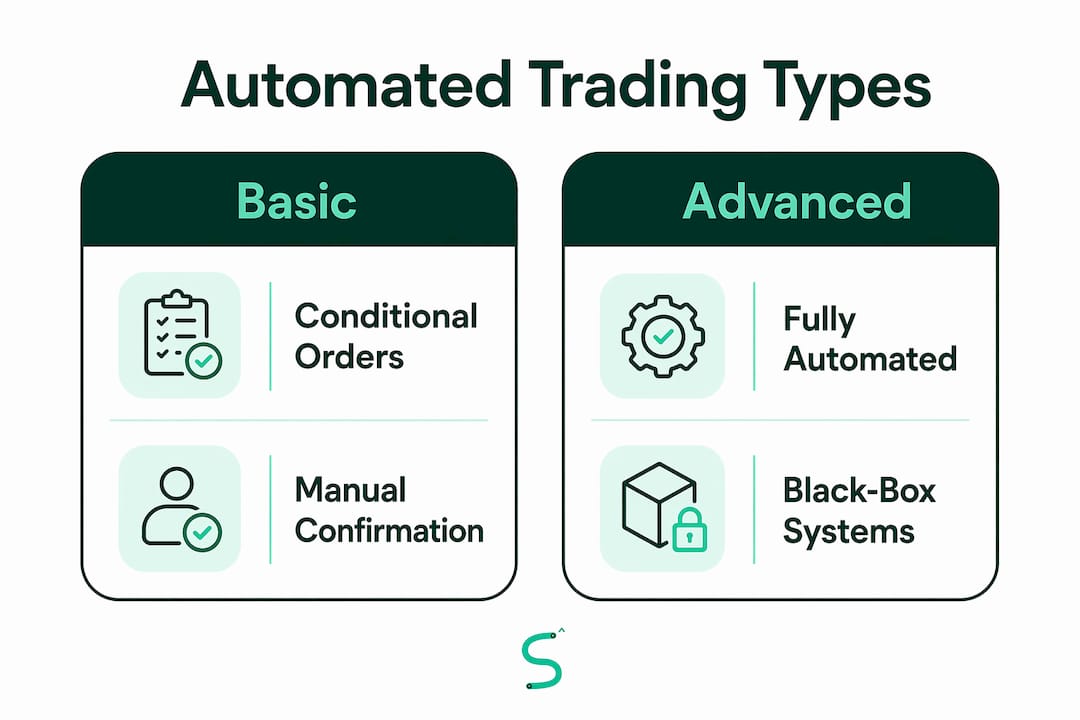
| Type | Description | Control Level | Typical Use Case |
|---|---|---|---|
| Conditional orders | Stop-loss, take-profit, limit orders | High | Risk management for all traders |
| Rule-based systems | Predefined entry/exit logic, manual confirmation | Medium | Discretionary traders using signals |
| Fully automated systems | Signal generation and order execution without input | Low | Algorithmic and quantitative traders |
| Black-box systems | Opaque logic, no user visibility into rules | Very low | Institutional or proprietary trading |
| Semi-automated systems | Signals generated automatically, orders placed manually | Medium-high | Retail traders learning automation |
Simple stop-loss and take-profit orders are the most common entry point. Every retail broker supports them. They automate one specific decision: exit the trade when price hits a level.
Fully automated systems go further. They generate signals and execute orders without any human step in between. These require robust infrastructure, reliable data feeds, and tested strategy logic.
Black-box systems are the most controversial type. The user sees the outputs but not the rules driving them. This lack of transparency creates real risk. If the market regime changes and the system's hidden logic no longer applies, you have no way to diagnose the problem quickly.
For most retail traders, a rule-based system with manual confirmation is the practical starting point. It builds familiarity with how the logic works before you hand full control to the machine.
What are the benefits and drawbacks of automated trading?
The advantages of automated trading are real and well-documented. Speed, consistency, and emotional discipline are the three most cited.
Key benefits:
- Speed: Computers execute orders in milliseconds. Human reaction time cannot compete in fast markets.
- Emotion removal: Automation removes emotional bias by executing strictly on predefined rules. Fear and greed do not override the system.
- Consistency: The system applies the same logic every time. No skipped signals, no second-guessing.
- Multitasking: One system can monitor multiple instruments and timeframes simultaneously.
- Backtesting: You can test strategy logic against historical data before risking capital. This is a major advantage over discretionary trading.
Key drawbacks:
- Programming dependency: A flawed rule set produces flawed trades at machine speed. Errors scale fast.
- Operational risk: Technical failures, connectivity drops, and API errors can cause missed orders or unintended positions.
- Overfitting risk: A strategy that performs well in backtesting may fail in live markets if it was tuned too tightly to historical data.
- Runaway algorithms: Without proper controls, a malfunctioning system can submit thousands of erroneous orders in seconds.
The algorithmic trading benefits for scalpers are particularly strong on short timeframes, where human reaction speed is the binding constraint. But those same timeframes amplify the drawbacks if the system misbehaves.
Pro Tip: Never run a fully automated system without a defined maximum daily loss limit. Set it at the broker level, not just in your strategy code. If the strategy code fails, the broker-level limit is your last line of defense. Read more about protecting your capital before going live.
How do automated trading systems fit into financial market infrastructure?
Automated trading systems do not operate in isolation. They plug into a regulated ecosystem of exchanges, brokers, and risk controls. Understanding this infrastructure helps you see why certain safeguards exist and what happens when they fail.
| Market Component | Role in ATS Operations |
|---|---|
| Market data providers | Supply real-time price and volume feeds to the signal engine |
| Broker-dealer APIs | Route orders from the ATS to exchanges or liquidity pools |
| Electronic exchanges | Match and confirm orders submitted by the ATS |
| Pre-trade risk controls | Screen orders for size, price, and credit limits before submission |
| Kill switches | Halt all trading activity when safety thresholds are breached |
| Regulatory bodies (SEC, FINRA) | Set rules governing ATS operation and broker obligations |
The SEC's Market Access Rule is the key regulatory framework in the United States. It mandates pre-trade risk controls for any broker-dealer providing direct market access. These controls screen every order before it reaches an exchange. If an order exceeds credit limits, position limits, or price bands, it gets blocked automatically.
Kill switches are the most critical safety layer. They halt trading strategies and cancel open orders when safety thresholds are breached. These thresholds include loss limits, abnormal order rates, and connectivity failures. Kill switches became mandatory after the Knight Capital incident in 2012, when a software error caused the firm to lose $440 million in 45 minutes.
A common misconception is that automation removes human oversight entirely. It does not. Regulatory risk controls and kill switches maintain oversight at both the firm level and the exchange level. The human role shifts from manual execution to system design, monitoring, and rule-setting.
Broker-dealer APIs like those from Interactive Brokers or Alpaca connect your strategy directly to exchange order books. Electronic Communication Networks (ECNs) like NASDAQ's matching engine receive those orders and execute them. Every step in this chain has latency, and that latency matters when your strategy depends on precise timing.
Key Takeaways
Automated trading systems execute trades reliably at machine speed, but their real value comes from disciplined rule design, proper API integration, and mandatory safety controls like kill switches.
| Point | Details |
|---|---|
| Core definition | An ATS is software that generates and submits orders automatically based on predefined rules. |
| Automation levels | Systems range from simple stop-loss orders to fully automated black-box execution with no human input. |
| Top benefit | Emotion removal and execution speed are the strongest advantages over manual trading. |
| Biggest risk | Flawed logic or technical failures scale at machine speed without proper safeguards in place. |
| Regulatory safety | The SEC Market Access Rule requires pre-trade risk controls and kill switches for all ATS operations. |
Why the execution layer is where most traders underestimate the complexity
I have seen traders spend months perfecting a signal strategy and then wire it to a live account in an afternoon. That gap between signal quality and execution reliability is where real money gets lost.
The hardest engineering problem in automated trading is not the strategy. It is connecting the signal engine to the execution venue reliably. Timing mismatches, API rate limits, and order format errors are all invisible until they cause a problem. By then, you may have a string of bad fills or a position you did not intend to hold.
Latency matters more than most retail traders realize. A system that fires an order 200 milliseconds late on a 1-minute chart is not the same system you backtested. Latency and message handling must be engineered into the system design from the start, not patched in afterward.
My strongest advice for anyone building or buying an automated system: treat the kill switch as non-negotiable. Threshold-based failsafes like loss limits and order-rate anomaly detection are not optional extras. They are the difference between a controlled shutdown and a catastrophic loss event.
Start with semi-automation. Run signals manually for a month. Then automate order sizing. Then automate execution. Each step teaches you where the system can fail before the stakes are high. Incremental testing is not caution. It is the professional approach.
— Tran
Take your trading further with Scalping-algo
If you are ready to put automated trading concepts into practice, Scalping-algo builds the tools that make it real. The premium TradingView indicators are built in Pine Script v6, generate non-repainting buy and sell signals on 1m–15m timeframes, and fire native webhook alerts for direct broker integration. No guesswork. No repainting.
The Algo Master 3-Indicator Suite combines signal generation, confluence filtering, and volatility gating into one system designed for crypto, forex, indices, and futures. It is the kind of institutional-grade setup that used to require a development team. Scalping-algo puts it in your hands directly.
FAQ
What is the simple definition of an automated trading system?
An automated trading system is software that places buy and sell orders on financial markets automatically, based on a set of predefined rules, without requiring manual input for each trade.
How is automated trading different from algorithmic trading?
Both terms describe rule-based, computer-driven execution. Algorithmic trading typically refers to the strategy logic, while automated trading systems include the full pipeline from signal generation to order submission and confirmation.
What are the main risks of using automated trading systems?
The main risks are flawed strategy logic scaling at machine speed, technical failures causing unintended orders, and overfitting strategies to historical data. Kill switches and pre-trade risk controls are the standard safeguards.
Do automated trading systems require coding knowledge?
Not always. Platforms like TradingView allow traders to use pre-built indicators and webhook alerts to automate execution without writing code. Full custom systems typically require programming skills in languages like Python or Pine Script.
Are automated trading systems legal and regulated?
Yes. In the United States, the SEC Market Access Rule requires broker-dealers to implement pre-trade risk controls for any automated system accessing markets directly. Regulation applies at both the firm and exchange level.