

Stop-loss placement in scalping is defined as anchoring your exit point to a clear trade invalidation level, not to a dollar amount you feel comfortable losing. Knowing how to set stop loss scalping correctly separates traders who survive volatile markets from those who blow accounts on a single bad run. The two most reliable methods are market structure stops (placed beyond swing highs or lows) and volatility-based stops using the ATR indicator. Both methods force you to think in terms of where the trade is wrong, not how much you want to risk. Get this right, and every other part of your scalping system gets easier.
How to set stop loss in scalping: core methods
Three proven methods cover the vast majority of scalping stop-loss setups. Each fits a different market condition, and knowing which to use is half the battle.
Market structure stops
Anchor stop losses to market structure by placing them just beyond the nearest swing low for longs or swing high for shorts. This approach defines the exact point where your trade thesis is invalidated. For a long on EUR/USD, that means a few pips below the most recent support level. For a short, a few pips above the nearest resistance. The logic is clean: if price breaks that level, the setup no longer exists.

Volatility-based stops using ATR
The Average True Range (ATR) indicator measures how much a market moves on average over a set period. ATR-based stop sizing uses the formula: stop distance = ATR × multiplier, with 1.5× or 2× being the most common choices. If ATR(14) on EUR/USD H4 reads 30 pips, your stop sits 45–60 pips from entry. This method adapts automatically to changing volatility, which makes it especially useful during news events or session opens.
One advanced refinement: combine ATR stops with a noise floor of roughly 3 pips on EUR/USD 1-minute charts. This prevents micro-noise from triggering your stop before the trade has room to develop.
Pattern-based stops
Pattern stops sit just beyond the extreme of the candle or chart pattern that triggered your entry. On a pin bar setup, your stop goes a tick beyond the pin's wick. On a breakout, it sits just below the broken level. This method works best when your entry is tied to a specific formation with a defined boundary.
The right method depends on market conditions. Choose structure-based stops on clear breakouts and ATR-based stops during choppy consolidation. Mixing them randomly produces inconsistent results.
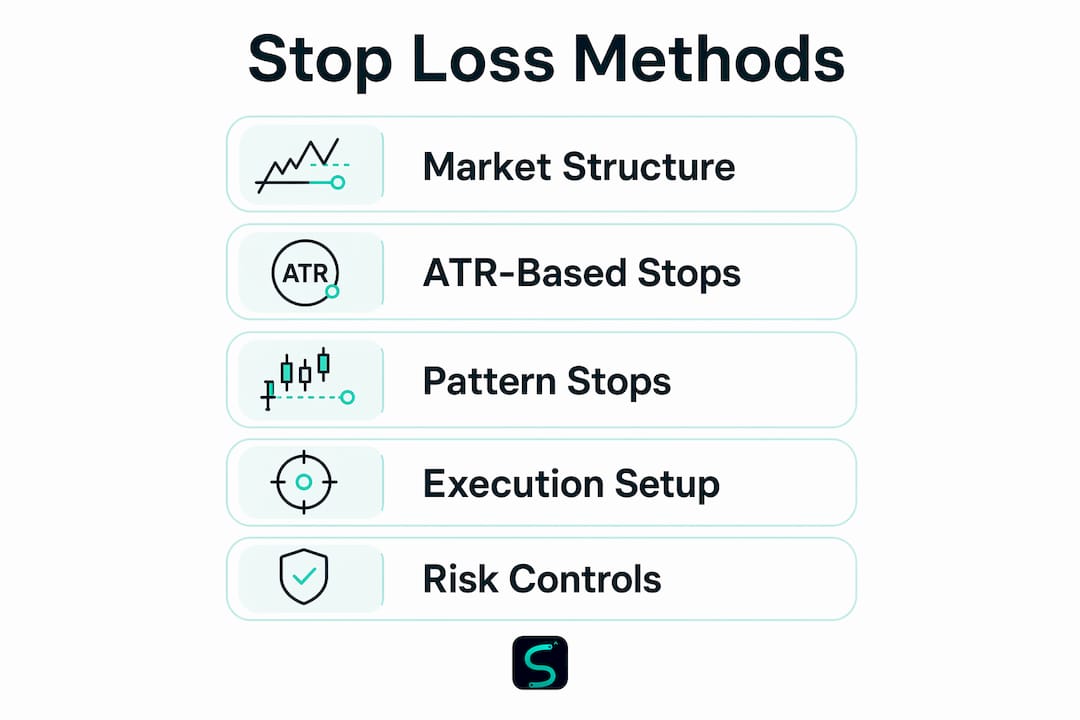
| Method | Best Condition | Typical Distance | Key Risk |
|---|---|---|---|
| Market Structure | Trending markets, clear levels | 3–8 pips (forex), 5–15 cents (stocks) | Levels can be subjective |
| ATR-Based | Volatile or choppy conditions | 1.5×–2× ATR value | Can widen stops in high volatility |
| Pattern-Based | Setup-driven entries | Beyond candle extreme | Tight stops increase stop-out rate |
Pro Tip: Never place your stop at an obvious round number like 1.2000 on EUR/USD. Institutional order flow clusters around those levels, and your stop will get hunted before the trade plays out.
How to configure stop loss orders on trading platforms
Knowing the method is step one. Executing it correctly on your platform is step two. Most retail scalpers lose money not because their stop placement is wrong, but because they configure the order incorrectly or too slowly.
The first decision is order type. Stop-market orders guarantee execution but not price. Stop-limit orders guarantee price but may not fill if the market moves fast. For scalping, stop-market orders are the default choice. You need to be out of a bad trade immediately. A stop-limit that fails to fill during a fast move can turn a small loss into a catastrophic one.
The second rule is timing. Set hard stops immediately upon trade entry to eliminate any unprotected exposure window. Stops set 2–5 cents from entry work for stock scalping. Forex scalpers typically use 3–8 pips. Waiting even 30 seconds to place your stop after entry is a risk you do not need to take.
Most platforms, including MetaTrader 4 and MetaTrader 5, let you drag a stop-loss line directly on the chart after entry. This is faster than typing values into an order window. TradingView's broker integration supports the same drag-and-drop workflow. Use it.
Key execution risks to watch:
- Slippage occurs when your stop fills at a worse price than set, common during news releases or low-liquidity periods.
- Fill delays on slower brokers can add 1–3 pips of extra loss beyond your intended stop level.
- Platform freezes during high volatility can prevent stop orders from being modified in time.
Pro Tip: If your priority is exit certainty, use stop-market orders every time. If you trade highly liquid pairs like EUR/USD or BTC/USDT during peak hours, the fill price difference between stop-market and stop-limit is usually negligible.
How to manage stop loss alongside scalping risk controls
Stop-loss placement does not exist in isolation. It connects directly to position sizing, daily loss limits, and exit sequencing. Treating it as a standalone decision is one of the most common scalping mistakes retail traders make.
Risk per trade for scalping sits between 0.5% and 1% of account equity. That number drives your position size, not the other way around. If your stop is 5 pips away and you risk 1% of a $10,000 account, you size your position to lose exactly $100 if that stop hits. This math must happen before you enter, not after.
Partial take profits combined with trailing stops give you the best of both worlds. Close 50% of your position at the first target, then move your stop to breakeven on the remainder. Trail the remaining position with a 3–5 pip margin. This locks in gains while keeping you in trades that run further.
Daily loss limits are non-negotiable. Most professional scalpers set a daily loss cap at 3–5% of account equity. Once that limit is hit, trading stops for the day. This rule prevents the emotional spiral where one bad trade leads to revenge trading and a blown account.
Common stop-loss mistakes that cost retail traders money:
- Stops too tight: Placing stops inside normal market noise causes repeated premature exits. You are right about direction but still lose money.
- Stops too wide: Oversized stops require smaller position sizes to maintain risk limits, which reduces profit potential on winning trades.
- Moving stops against the trade: Widening a stop because you "believe in the trade" removes the entire purpose of having one.
- No time-based exit: A trade sitting at breakeven for 10 minutes in a scalping timeframe is a losing trade. Set a time limit and exit.
| Risk Parameter | Recommended Setting | Stop-Loss Rule |
|---|---|---|
| Risk per trade | 0.5%–1% of equity | Size position so stop = max risk |
| Daily loss limit | 3%–5% of equity | Stop trading when limit is hit |
| Trailing stop margin | 3–5 pips (forex) | Move to breakeven after first target |
| Time-based exit | 5–15 minutes max | Exit if trade stalls near entry |
For more on avoiding the errors that kill scalping accounts, the common scalping mistakes guide covers the full list with practical fixes.
What execution challenges affect scalping stop-loss effectiveness?
Even a perfectly placed stop can fail if your execution environment is unreliable. This is where many retail scalpers discover the gap between theory and practice.
Fast execution and broker reliability directly determine whether your stop fills at the price you set. A broker with slow order routing adds slippage on every stop-out. Over 100 trades, that slippage compounds into a significant drag on your results. Choose brokers with direct market access (DMA) or electronic communications network (ECN) execution for scalping.
Tight spreads and high liquidity improve stop-loss reliability by reducing the gap between your intended exit and your actual fill. Trading EUR/USD, BTC/USDT, or S&P 500 futures during peak hours gives you the best conditions. Avoid scalping illiquid instruments where a 3-pip spread can eat half your intended profit.
Prop firm traders face an additional layer of rules. Prop firms like FundedNext mandate stops placed within 3 minutes of trade entry. Failing to comply can result in a 100% penalty against your allowed risk limit. If you trade with prop capital, check the best prop firms for scalping to understand each firm's specific stop-loss requirements before you trade.
Automation solves most execution consistency problems. Algorithmic trading tools place stops at predefined levels the moment a trade opens, removing human delay entirely. Webhook alerts connected to platforms like Discord can notify you of stop triggers in real time, keeping you informed even when you step away from the screen.
How execution speed impacts your edge is often underestimated by retail traders. A 200-millisecond delay on a stop order during a fast market can add 2–5 pips of extra loss. That is the difference between a controlled exit and a messy one.
Pro Tip: Pair your stop-loss setup with platform alerts that fire the moment price approaches your stop level. This gives you one last chance to assess whether the move is noise or a genuine invalidation before the stop executes.
Key takeaways
Effective stop-loss placement in scalping requires anchoring exits to trade invalidation points, sizing positions to match risk limits, and executing orders immediately upon entry.
| Point | Details |
|---|---|
| Anchor stops to structure or ATR | Place stops beyond swing highs/lows or use ATR × 1.5–2 to match market volatility. |
| Set hard stops immediately | Enter the stop order the moment you open a trade to eliminate unprotected exposure. |
| Risk 0.5%–1% per trade | Size your position so the stop distance equals your maximum allowed loss per trade. |
| Use trailing stops and partials | Close 50% at the first target and trail the rest to lock in gains while managing risk. |
| Choose stop-market for scalping | Stop-market orders guarantee exit speed, which matters more than price control in fast markets. |
Stop losses are where discipline becomes real
By Tran
After years of watching traders blow accounts, I can tell you the stop-loss conversation almost always goes the same way. Traders spend hours finding entries and five seconds deciding where to put their stop. That ratio is backwards.
The traders I see succeed long-term treat stop placement as the primary decision, not an afterthought. They ask one question before every trade: "Where is this trade wrong?" The answer to that question is where the stop goes. Not tighter because the position size feels too big. Not wider because they want to give it "more room." Exactly at the invalidation point, every time.
The technology available in 2026 makes this easier than ever. Platforms like TradingView with Pine Script v6 indicators can calculate ATR-based stops automatically and display them on your chart before you even enter. There is no excuse for guessing. The tools exist. The discipline to use them consistently is the only variable left.
One mental checklist I recommend before every scalping trade: confirm your stop level is beyond a structural level or ATR-based distance, confirm your position size matches your 0.5%–1% risk rule, and confirm the stop order is placed the moment you enter. Three checks. Ten seconds. That habit alone will put you ahead of most retail scalpers.
The traders who struggle are not struggling because they lack knowledge. They are struggling because they override their own rules under pressure. Your stop is a contract with yourself. Honor it.
— Tran
How Scalping-algo helps you place better stops
Scalping-Algo's premium TradingView indicators are built specifically to solve the stop-placement problem retail scalpers face every session. The indicators identify key support and resistance levels in real time, giving you precise structural anchors for your stops without manual chart analysis.
The Algo Master suite combines three indicators designed to improve stop-loss and take-profit precision on 1m–15m timeframes across forex, crypto, indices, and futures. Native webhook alerts fire directly to Discord the moment a signal triggers, so your stop levels are set before the trade even opens. If you want faster execution and more reliable stop signals, explore the full premium indicator suite at Scalping-Algo and see how the tools fit your current setup.
FAQ
What is the best stop loss distance for scalping?
The best stop distance is defined by your trade's invalidation point, typically 3–8 pips for forex scalping or 5–15 cents for stock scalping. Use ATR × 1.5 as a baseline and adjust for the nearest structural level.
Should i use stop-market or stop-limit orders when scalping?
Stop-market orders are the standard choice for scalping because they guarantee execution. Stop-limit orders risk not filling during fast moves, which can turn a small loss into a large one.
How much should i risk per trade when scalping?
Risk 0.5%–1% of account equity per trade. This percentage determines your position size based on the distance to your stop, not the other way around.
When should i move my stop to breakeven?
Move your stop to breakeven after price reaches your first take-profit target. A common approach is to close 50% of the position at that target and trail the remainder with a 3–5 pip margin.
Do prop firms require stop losses on scalping trades?
Yes. Prop firms like FundedNext require stops to be placed within 3 minutes of trade entry. Failing to comply can result in a full penalty against your allowed risk limit for that session.