

Futures trading tips for 2026 are defined by three pillars: disciplined risk management, strategy selection matched to skill level, and professional market analysis. The industry standard for retail trader survival now centers on a maximum 10% daily drawdown and 20% monthly drawdown limit, paired with a 3:1 equity-to-margin ratio to avoid forced liquidation during volatile sessions. Successful execution also requires reading four market data pillars: Price, Volume, Open Interest, and Order Book. Traders who master these fundamentals before chasing advanced setups consistently outlast those who skip the basics.
1. What are the top futures trading tips 2026 for risk management?
Risk management is the single factor that separates traders who last from those who blow up in the first quarter. The 10% daily and 20% monthly drawdown limits are not arbitrary. They reflect the threshold beyond which most retail accounts cannot recover without abandoning their strategy entirely.
The 3:1 equity-to-initial margin ratio gives you a buffer when the market moves against you. Without it, a single bad session can trigger a margin call before your stop-loss even fires. Maintaining this ratio requires discipline, especially when a trade looks "obvious."
Key risk controls every trader needs in place:
- Hard daily stop: Stop trading the moment you hit your daily drawdown limit. No exceptions.
- Volatility-adjusted sizing: Reduce contract size as volatility rises. Tools like ATR and Bollinger Bands help you calibrate this dynamically.
- Stop-loss on every trade: Futures margin is a performance bond, not a maximum loss. Your real risk is the distance to your stop multiplied by the tick value.
- Absolute dollar risk calculation: Know the exact dollar amount at risk before you enter, not after.
Pro Tip: Calculate your absolute dollar risk before every trade by multiplying the number of ticks to your stop by the tick value of the contract. If that number makes you uncomfortable, reduce size before entry, not after the loss.
2. Which futures strategies are best matched to your skill level?
Trend following and swing trading are the most beginner-friendly futures strategies. They require fewer real-time decisions, give trades more room to develop, and punish emotional reactions less severely than faster methods. That makes them the right starting point for most retail traders.

Scalping and order flow trading sit at the opposite end of the difficulty scale. They demand fast execution, deep market reading, and near-perfect emotional control. Strategy difficulty correlates more with emotional discipline and execution speed than with the complexity of the rules themselves. A simple scalping rule applied poorly destroys accounts faster than a complex swing setup applied consistently.
The practical progression looks like this:
- Trend following: Enter in the direction of the dominant trend on the daily or 4-hour chart. Hold for multiple sessions. Minimal screen time required.
- Swing trading: Capture multi-day moves using support and resistance levels. Requires reading price structure but not tick-by-tick data.
- Mean reversion: Fade extended moves back to a statistical average. Requires understanding of volatility and range conditions.
- Breakout trading: Enter on confirmed breaks of key levels with volume confirmation. Requires patience to avoid false breaks.
- Scalping: Execute multiple trades per session on 1–5 minute charts. Requires fast decisions and tight emotional control. See futures scalping strategies for structured approaches.
- Order flow trading: Read the live order book and tape to anticipate short-term moves. The most demanding method available to retail traders.
Build competence at each level before advancing. Skipping steps is the most common reason retail traders fail to progress.
3. How to read futures market data like a professional
Professional traders treat the market as a relational system, not a price chart. Monitoring price, volume, open interest, and the order book together reveals institutional activity that price alone cannot show. Each data pillar tells a different part of the story.
Open Interest (OI) tracks trader commitment. It rises when new positions are opened and falls when positions are closed. OI divergence from price signals a potential reversal. When price makes a new high but OI drops, the move lacks fresh commitment and is likely to fade.
Volume tracks activity, not commitment. High volume on a price move confirms participation. Low volume on a breakout warns of a trap. Delta divergence, where price rises but buying delta weakens, is a reliable early warning of a reversal.
Anchored VWAP is one of the most underused tools in retail trading. Anchored VWAP from institutional accumulation days provides better reversal signals than standard daily VWAP. Price rejection at anchored VWAP indicates smart money involvement and produces high-probability entries.
Key data combinations to watch:
- Rising price + rising OI = trend is healthy, continuation likely
- Rising price + falling OI = trend is weakening, prepare for reversal
- High volume breakout + rising delta = confirmed move, follow direction
- Low volume breakout + flat delta = probable trap, wait for retest
Pro Tip: Anchor your VWAP to the day a major institutional move began, not just the current session open. That anchor point acts as a magnet for price and gives you a far more reliable reference level than the standard daily VWAP.
4. Which futures contracts should retail traders focus on?
Micro E-mini futures contracts, such as the MES (Micro E-mini S&P 500), are the right starting point for retail traders. The MES has a tick value of $1.25, compared to $12.50 for the standard ES contract. That smaller tick value means a 10-tick stop costs $12.50 instead of $125, which is a critical difference when you are still learning execution. The ES Futures Scalping Indicator page covers how execution risk scales with contract size for anyone moving from micro to standard contracts.
Session timing also matters. The New York open (9:30 AM–11:30 AM ET) and the London open (3:00 AM–5:00 AM ET) carry the highest liquidity and the most reliable price action. Midday sessions between 12:00 PM and 2:00 PM ET are notoriously choppy and punish scalpers who keep trading out of habit.
Contract and session guidance at a glance:
| Contract | Tick Value | Best For |
|---|---|---|
| MES (Micro E-mini S&P 500) | $1.25 | Beginners building execution discipline |
| MNQ (Micro E-mini Nasdaq) | $0.50 | Beginners in tech-heavy trend environments |
| ES (E-mini S&P 500) | $12.50 | Experienced traders with proven edge |
| NQ (E-mini Nasdaq) | $5.00 | Experienced traders in high-volatility sessions |
Beginners should complete 20+ simulated sessions before trading live capital. Simulation builds execution muscle memory without financial consequence. Skipping this step is one of the most expensive shortcuts a new trader can take.
5. What are the best psychological and journaling tips for futures traders?
Emotional discipline is not a soft skill. It is the mechanism that keeps your risk rules intact when the market tests them. The most common failure point for retail traders is not a bad strategy. It is abandoning a good strategy after three losing trades in a row.
Maintaining a trade journal dramatically improves performance by tracking setups, emotional state, and outcomes. Journaling separates consistent winners from everyone else. It forces you to confront patterns you would otherwise rationalize away. For deeper guidance on managing the mental side of trading, the trading psychology tips resource covers this in practical detail.
Build these habits into your daily routine:
- Pre-session review: Write down your plan, key levels, and maximum loss for the day before the market opens.
- Post-trade log: Record the setup, entry, exit, result, and your emotional state during the trade.
- Weekly review: Identify which setups are working and which you are forcing. Cut the forced ones.
- Streak management: After two consecutive losses, reduce size by half. After four, stop trading for the day.
Pro Tip: Treat each trading session as a data collection exercise, not a profit opportunity. When you focus on executing your process correctly, the profits follow naturally. When you focus on the profit, you start bending your rules.
Key Takeaways
Successful futures trading in 2026 requires combining strict risk limits, skill-matched strategies, and professional market data interpretation before any live capital is committed.
| Point | Details |
|---|---|
| Enforce drawdown limits | Cap daily losses at 10% and monthly losses at 20% to protect long-term capital. |
| Match strategy to skill level | Start with trend following and swing trading before attempting scalping or order flow. |
| Read all four data pillars | Use Price, Volume, Open Interest, and Order Book together to detect institutional moves. |
| Start with micro contracts | MES and MNQ contracts reduce tick risk while you build execution discipline. |
| Journal every trade | Track setups, results, and emotional state to identify and fix performance patterns. |
What I've learned watching traders misuse these tips
The traders I see struggle most are not the ones who lack knowledge. They are the ones who know the rules and break them anyway. The 10% daily drawdown limit sounds easy to follow until you are down 8% and convinced the next trade will recover everything. That conviction is the trap.
The second pattern I see constantly is traders jumping to scalping before they can execute a swing trade cleanly. Scalping is not a shortcut to faster profits. It is a harder version of a skill you have not yet mastered. The futures trading strategies list lays out the full progression clearly. Read it before you decide you are ready for the next level.
Open Interest is the most ignored data point in retail trading. Traders watch price and volume obsessively but skip OI entirely. That is a significant blind spot. OI tells you whether the people moving price are committed to the move or just passing through. That distinction changes everything about how you manage a trade.
The simulator is not optional. Twenty sessions of clean, disciplined simulation trading is the cheapest education available in this market. Skipping it to trade live faster is not confidence. It is impatience dressed up as confidence.
Discipline over time beats talent every single time in futures markets. Build the process first. The profits are a byproduct.
— Tran
Scalping-algo tools for sharper futures execution
Knowing the right tips is one thing. Executing them in real time is another challenge entirely. Scalping-algo provides premium TradingView indicators built in Pine Script v6 that generate real-time, non-repainting buy and sell signals on timeframes from 1 minute to 15 minutes. These tools include volatility gating, divergence detection, and confluence filters that reduce emotional decision-making during live sessions.
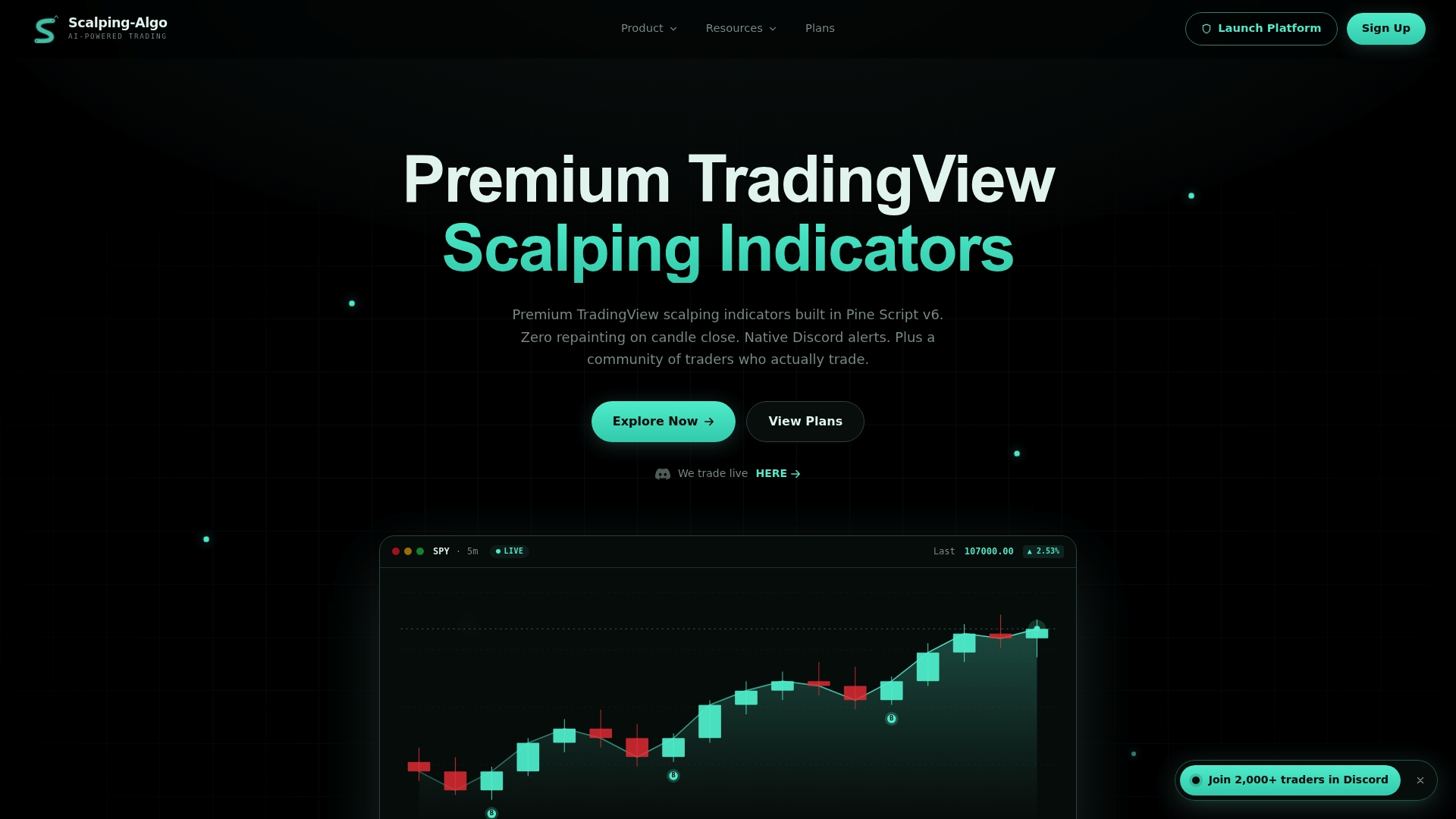
Retail traders using Scalping-algo gain access to a Command Center dashboard with integrated alerts, backtesting, and a Discord community for live mentorship. The indicators work across futures, crypto, forex, and indices. For traders ready to add precision to their execution, the premium scalping indicators at Scalping-algo are built specifically for the retail trader who wants institutional-grade tools without institutional complexity. The Smart Scalping Signals indicator is a strong starting point for futures traders focused on timing entries with greater accuracy.
FAQ
What is the recommended daily drawdown limit for futures traders?
The recommended maximum daily drawdown is 10% of account equity. Traders who enforce this limit show significantly better long-term survival rates than those who trade through losing sessions without a hard stop.
Which futures contract is best for beginners in 2026?
The MES (Micro E-mini S&P 500) is the best starting contract for beginners. Its $1.25 tick value keeps dollar risk manageable while you build execution discipline through simulated and early live trading.
How does Open Interest help predict price reversals?
Open Interest tracks trader commitment to existing positions. When price rises but OI falls, the move lacks new participation and signals a likely reversal. This divergence is one of the most reliable early warning signals in futures markets.
How many simulated sessions should I complete before trading live?
Complete at least 20 simulated sessions before committing live capital. Simulation builds the execution habits and emotional responses you need without the financial cost of learning through real losses.
Why is journaling critical for futures trading success?
A trade journal tracks your setups, emotional state, and outcomes in one place. Reviewing it weekly reveals which setups you execute well and which you force, giving you a clear path to improving consistency over time.