

An automated trading checklist is a structured set of criteria every retail trader must verify before deploying a bot with real capital. Automated traders outperformed manual traders by 38% on average, yet 73% of those bots failed within three months due to poor implementation and risk management. That gap tells you everything. The difference between a profitable bot and a blown account is not the strategy. It is the discipline of following a systematic checklist for algorithmic trading, covering risk controls, testing, infrastructure, and ongoing monitoring before and after go-live.
1. What are the essential pre-deployment checklist items for automated trading systems?
Pre-deployment is where most retail traders cut corners. Every item below must be confirmed before your bot touches live capital.
Strategy validation

Overfitting is common in algorithmic trading. Strategies must be validated on out-of-sample or held-out data periods to confirm they work beyond the data they were built on. Walk-forward testing, where you roll the optimization window forward in time, is the gold standard for confirming robustness. A strategy that only works on its training data is not a strategy. It is a curve fit.
Paper trading requirement
No trading bot should go live without at least 30 days of paper trading that accurately simulates broker latency, fill logic, and fees. Thirty days is not arbitrary. It gives you enough market sessions to observe how the bot behaves across different conditions, including low-volume days, news events, and overnight gaps.
Fixed risk parameters
Define your hard limits before writing a single line of live execution code. Best practices require a maximum loss of 1–2% per trade, a daily loss circuit breaker, a maximum portfolio exposure cap, and an execution slippage tolerance. These numbers must be locked in the config file, not left to the bot to decide dynamically.
Broker API integration
Confirm your broker API supports bracket orders. Broker-managed bracket orders enforce stop-loss and take-profit server-side, which means your risk controls stay active even if your bot goes offline or loses its connection. This is not optional. It is your last line of defense.
Operational readiness
Test your error handling paths. Simulate a dropped connection. Trigger a partial fill. Confirm your retry logic fires correctly and your kill switch actually stops the bot. Most retail traders test the happy path and skip the failure modes entirely.
Pre-deployment checklist summary:
- Out-of-sample and walk-forward validation complete
- Minimum 30 days of paper trading with realistic fills and fees
- Hard risk limits defined: max loss per trade, daily loss cap, max exposure
- Broker API bracket orders confirmed and tested
- Error handling, retry logic, and kill switch verified
- Logging and alerting configured before go-live
Pro Tip: Run your bot in paper trading mode against live market data, not historical data. Historical replay does not expose latency spikes or API rate limit errors that show up in real conditions.
2. How should retail traders implement risk management and execution controls?
Risk management in automated trading systems operates in four distinct layers. Each layer catches failures the one above it misses.
| Risk Layer | What It Covers | Example Control |
|---|---|---|
| Strategy risk | Signal quality and entry logic | Out-of-sample validation, simple rule-based logic |
| Portfolio risk | Total capital exposure across positions | Max exposure cap, correlation limits |
| Execution risk | Slippage, partial fills, order timing | Slippage tolerance, bracket orders |
| Operational risk | Bot downtime, API failures, connectivity | Kill switch, retry logic, monitoring alerts |
Strategy and portfolio risk
Favor simple, transparent rule-based strategies over complex opaque models for retail trading bots. Complex models overfit more easily and are harder to debug when they fail live. A strategy with three clear conditions beats a neural network you cannot explain. Portfolio risk means capping how much capital is deployed at any one time. Set a hard exposure limit and do not let the bot override it.
Execution and operational risk
Execution risk is the layer most retail traders ignore. Slippage on a scalping strategy can erase an edge entirely. Set a maximum acceptable slippage per trade and cancel orders that exceed it. Operational risk covers everything that happens outside the strategy itself. Your risk management checklist must include kill switch conditions, such as a daily loss threshold that shuts the bot down automatically, and a restart policy that requires manual confirmation before resuming.
Broker-enforced vs. bot-enforced exits
Broker-managed exits are more reliable than bot-managed exits. If your bot crashes, a locally managed stop-loss disappears with it. A bracket order placed at the broker level stays active regardless of your bot's state. Use broker-enforced orders as the primary exit mechanism and treat bot-managed exits as a secondary layer.
Pro Tip: Never rely on your bot's internal stop-loss as the only protection. Place a bracket order at the broker level for every position. Treat local bot exits as a backup, not the primary control.
3. What infrastructure and monitoring steps ensure smooth live trading?
Infrastructure is not glamorous, but it is where live trading systems break down. Monitoring, alerting, logging, and kill switches must be configured as a continuous operational layer, not an afterthought added after the first incident.
Connectivity and API management
Your bot depends on a stable connection to the broker API. Configure automatic reconnection logic with exponential backoff. Know your broker's API rate limits and build in request throttling so your bot does not get blocked during high-frequency periods. Asynchronous order handling prevents your bot from freezing while waiting for a fill confirmation.
Logging and alerting
Every order, fill, rejection, and error must be logged with a timestamp. Logs are your audit trail when something goes wrong. Set up real-time alerts for critical events: connection drops, daily loss threshold breaches, and unexpected position sizes. Tools like Discord webhooks make it easy to receive instant alerts on your phone without building a custom notification system.
Daily, weekly, and event-driven monitoring routines:
- Daily: Review fill quality vs. expected fills, check for missed signals, confirm open positions match expected state
- Weekly: Compare live performance vs. backtest benchmarks, review slippage averages, audit log files for recurring errors
- Event-driven: Trigger a manual review after any circuit breaker fires, after a connectivity outage, or after a significant drawdown
Automated trading success depends on handling API glitches, partial fills, and latency with automated retries and kill switches. Build these into your system from day one, not after the first failure.
4. How to verify that live trading performance matches backtested expectations?
Live performance almost never matches backtest results exactly. The gap between the two is not a bug. It is the cost of real markets. Your job is to measure and manage that gap.
Common execution frictions
Slippage, partial fills, and connectivity delays all reduce realized returns compared to backtested returns. Slippage is the difference between your expected entry price and your actual fill price. On liquid instruments like major forex pairs or large-cap crypto, slippage is small but consistent. On thinly traded assets, it can be large and unpredictable. Partial fills mean your position size is smaller than intended, which changes your risk profile on that trade.
Forward testing before full capital deployment
Forward testing in a realistic environment closes the gap between backtest and live. Use a paper trading account that connects to live market data and routes through your actual broker's API. This exposes latency, fee structures, and fill logic that historical backtests cannot replicate. The benefits of algorithmic trading only materialize when your live execution matches the conditions your strategy was built on.
Ongoing performance review
Set a review cadence. Compare your live Sharpe ratio, win rate, and average trade return against your backtest benchmarks every week for the first month. If live results deviate by more than 20% from backtest expectations, pause the bot and investigate before continuing. Deviations usually trace back to slippage, fees that were underestimated in the backtest, or a market regime shift.
Adjusting parameters based on live results
Adjust risk parameters based on live data, not backtest data. If your live slippage consistently exceeds your tolerance, tighten your entry conditions or reduce position size. Do not adjust the strategy itself until you have at least 100 live trades to analyze. Small sample sizes produce misleading signals.
5. How and why to keep updating your automated trading checklist over time?
A trading checklist needs continuous updates in response to market regime shifts, from low volatility trends to high volatility ranges. A bot calibrated for a trending market will lose money in a choppy one. Checklist maintenance is not optional. It is how you keep your system aligned with current conditions.
When to trigger a checklist review:
- After any significant drawdown exceeding your predefined threshold
- After a market regime shift, such as a move from low to high volatility
- After any unexpected bot behavior, including missed trades or oversized positions
- After a broker API update or change in fee structure
- On a fixed schedule, at minimum monthly, regardless of performance
What to update:
Review your risk parameters first. Volatility changes mean your position sizing formula may produce larger or smaller positions than intended. Update your slippage tolerance if market conditions have changed. Review your circuit breaker thresholds and confirm they still make sense given current average daily ranges. Tools like adaptive parameter guides can help you build a framework for systematic updates rather than reactive ones.
Pre-launch checklists are continuous operational requirements, not one-time tasks. Skipping updates leads to capital erosion as the bot operates on stale assumptions in a changed market.
Key takeaways
A reliable automated trading checklist covers pre-deployment validation, layered risk controls, infrastructure readiness, live performance monitoring, and regular updates to stay aligned with changing market conditions.
| Point | Details |
|---|---|
| Validate before deploying | Complete out-of-sample testing and 30 days of paper trading before using real capital. |
| Layer your risk controls | Apply strategy, portfolio, execution, and operational risk controls independently. |
| Use broker-enforced orders | Bracket orders at the broker level protect capital even when your bot goes offline. |
| Monitor continuously | Log every trade, set real-time alerts, and review live vs. backtest performance weekly. |
| Update your checklist regularly | Revise risk parameters and strategy conditions after drawdowns, regime shifts, or API changes. |
What I've learned from watching retail traders skip the checklist
Most retail traders treat the checklist as a formality. They run a backtest, see a good equity curve, and go live. That is the exact sequence that produces the 73% failure rate within three months.
The bots that survive are not the most complex ones. They are the ones built on simple, transparent rules with hard risk limits enforced at the broker level. I have seen traders spend weeks optimizing entry signals and zero hours testing their kill switch. When the kill switch fails in live trading, the entry signal does not matter.
The mindset shift that changes everything is this: your bot is an execution engine, not a profit machine. The bot's job is to ensure real-world execution matches your backtest, accounting for slippage and latency. Profit is the output of a well-designed strategy executed consistently. The checklist is what keeps the execution consistent. Treat it as a living document. Review it after every drawdown. Update it after every regime shift. The traders who do this are the ones still running their bots six months from now.
— Tran
Scalping-algo tools that support your trading checklist
Retail traders who want institutional-grade execution without building everything from scratch have a practical option. Scalping-algo offers premium TradingView scalping indicators built in Pine Script v6, designed for crypto, forex, indices, and futures on timeframes from 1m to 15m.
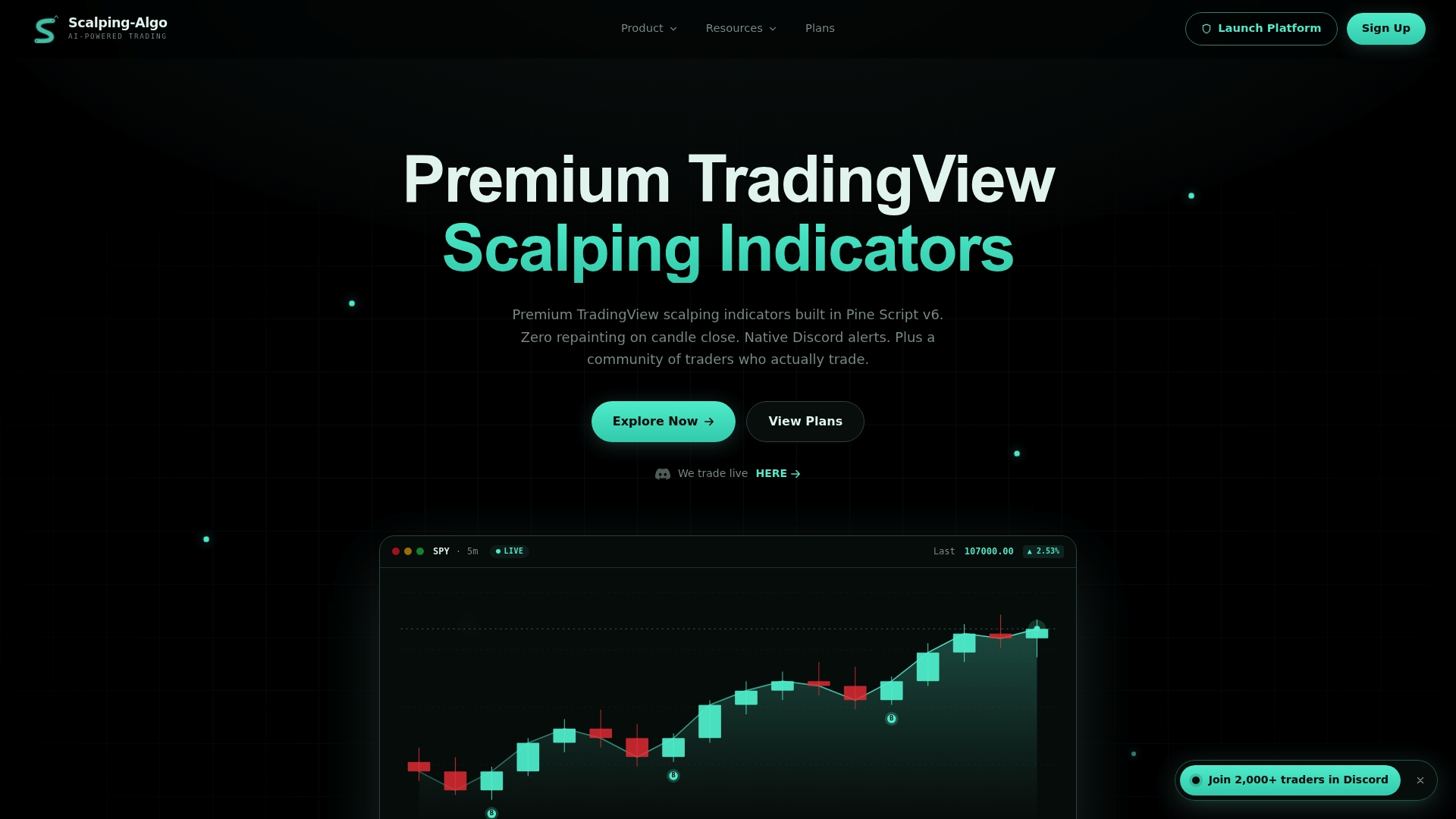
The platform's Smart Scalping Signals generate real-time, non-repainting buy and sell signals with built-in volatility gating and divergence detection. Native webhook alerts connect directly to Discord, which fits cleanly into the monitoring and alerting layer of your trading checklist. The Command Center dashboard integrates backtesting, alerts, and education resources in one place, so your checklist and your tools stay aligned.
FAQ
What is an automated trading checklist?
An automated trading checklist is a structured list of criteria traders verify before and after deploying a trading bot, covering strategy validation, risk controls, infrastructure setup, and ongoing monitoring.
How long should I paper trade before going live?
A minimum of 30 days of paper trading is required, using live market data that simulates actual broker latency, fill logic, and fee structures.
What risk limits should my trading bot enforce?
Set a maximum loss of 1–2% per trade, a daily loss circuit breaker, a maximum portfolio exposure cap, and a defined slippage tolerance before deploying any bot with real capital.
Why do broker bracket orders matter for automated trading?
Bracket orders enforce stop-loss and take-profit levels at the broker's server, so your risk controls remain active even if your bot crashes or loses its internet connection.
How often should I update my trading checklist?
Review and update your checklist after any significant drawdown, after a market regime shift, after unexpected bot behavior, and on a fixed monthly schedule at minimum.