
Most retail traders receive trading signals but have no real framework for reading them correctly. This guide to reading trading signals fixes that gap. A signal is not a guaranteed call to action. It is a probabilistic trigger that only makes sense when you understand its components, validate its context, and pair it with sound risk management. Get that process right and your execution improves. Get it wrong and you are just reacting to alerts with no edge behind your decisions.
Table of Contents
- Key takeaways
- Your guide to reading trading signals: signal anatomy first
- Evaluating and validating signals before execution
- Risk management and trade execution with signals
- Common pitfalls when reading trading signals
- Using technology to sharpen signal analysis
- My take on mastering trading signals
- How Scalping-Algo's tools sharpen your signal process
- FAQ
Key takeaways
| Point | Details |
|---|---|
| Signals have five core parts | A complete signal includes direction, entry, stop-loss, take-profit, and a clear rationale. |
| Confluence drives quality | Signals confirmed by trend, momentum, and price action carry a higher probability of success. |
| Reward-to-risk beats win rate | A 1.5:1 or 2:1 ratio matters more than how often you win individual trades. |
| Risk management is non-negotiable | Position sizing and structural stop-losses protect your account when signals fail. |
| Context determines usability | The same signal can work in a trending market and fail in a range-bound one. |
Your guide to reading trading signals: signal anatomy first
Before you validate or act on any signal, you need to know what a complete signal actually looks like. Skipping this step is where most traders go wrong.
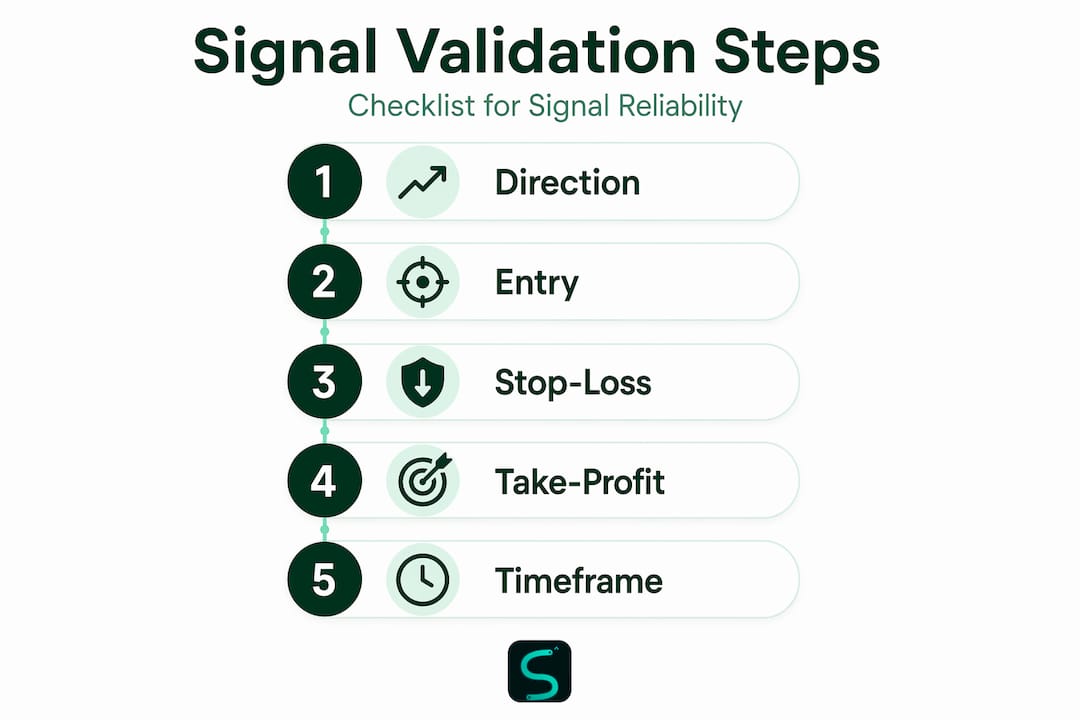
A complete trading signal must contain all five of these elements:
- Direction: Long or short. Bullish or bearish. No ambiguity.
- Entry price or trigger: A specific price level, a candle close condition, or a breakout confirmation. Not a vague "buy here."
- Stop-loss placement: Defined structurally, usually below support for longs or above resistance for shorts. Signals without a stop-loss are incomplete and high-risk by definition.
- Take-profit targets: One or multiple levels that define your reward. Often expressed as a risk-reward ratio.
- Rationale: The why behind the signal. Is it a moving average crossover? A breakout from a consolidation zone? A divergence on RSI? Knowing the rationale tells you whether the signal fits current conditions.
There is a sixth element many traders overlook: timeframe and validity. A signal generated on a 5-minute chart has a short window. If you miss the entry by 15 minutes, the setup may already be invalidated. Always note the timeframe the signal was generated on and how long it remains valid.
Pro Tip: When reviewing a signal, run through this checklist mentally before touching your order panel. If any of the five elements is missing, treat the signal as incomplete until you fill in the gap yourself.
| Signal element | Why it matters | Red flag if missing |
|---|---|---|
| Direction | Defines bias for the trade | No trade possible |
| Entry | Controls execution quality | You chase price |
| Stop-loss | Defines your max loss | Unlimited downside |
| Take-profit | Locks in reward and R:R | No exit plan |
| Rationale | Validates context fit | Blind execution |
Evaluating and validating signals before execution
Reading a signal is one step. Validating it is what separates profitable traders from the rest. This is where your trading signal analysis guide moves from passive to active.
Here is a reliable validation process to apply before every trade:
-
Check for confluence. The most important quality factor for any signal is confluence across multiple factors: trend direction, momentum, volatility environment, and price action structure. A buy signal that lines up with a higher timeframe uptrend, strong RSI momentum, and a clean breakout above resistance is far stronger than one triggered by a single indicator.
-
Assess the reward-to-risk ratio. Aim for a minimum of 1.5:1, ideally 2:1. Remember: win rate alone is an insufficient success metric. A system winning 45% of trades at 2:1 R:R is more profitable than one winning 65% at 0.8:1.
-
Match the signal to market conditions. Trend-following signals work in trending markets. Mean-reversion signals work in range-bound conditions. Applying the wrong signal type to the wrong environment is one of the most common and costly mistakes in signal trading.
-
Verify source credibility. If you are using an external signal provider, check their track record. Providers without transparent, independently verified performance data should be avoided. Verified records covering multiple market cycles reduce the risk of following a flawed service.
-
Build a scorecard. A scorecard approach to evaluating signals removes emotion from the process. Score each signal on confluence, R:R, context match, and source quality. Set a minimum threshold before you trade.
Pro Tip: Use a simple 1-to-5 scoring system across your key validation criteria. Any signal scoring below 3 out of 5 does not get traded, regardless of how strong it looks at first glance.
One more thing: understand market signals in the context of news and economic events. A technically perfect setup right before a major central bank announcement carries substantially more risk than the chart alone suggests. Factor that in as a volatility modifier on your scorecard.
Risk management and trade execution with signals
Knowing how to interpret trading signals means nothing if your execution and risk controls are weak. Here is how to build the execution side of your process.
- Size positions by fixed percentage risk. Risk no more than 1% to 2% of your account per trade. This way a string of losing signals cannot blow your account before you identify the problem.
- Use structural stop-losses. Place your stop behind a real technical level, such as a swing low or a key support zone, not at an arbitrary pip distance. This keeps you in trades that have room to breathe and out of ones where the structure has already broken.
- Choose limit orders over market orders when possible. Limit orders at key technical levels improve entry precision and your actual R:R versus what the signal specified. Market orders during volatile conditions can fill at significantly worse prices.
- Manage active trades actively. Move your stop to break-even once the trade moves in your favor by 1R. Scale out partial profits at your first target to lock in gains while letting the remaining position run.
- Never overtrade signals. More signals do not mean more profit. Overtrading leads to higher transaction costs, emotional decision fatigue, and degraded signal quality from a lack of filtering.
Backtesting and demo trading are also part of risk management. Before you risk real capital on a new signal type or provider, test it across at least 50 trades in historical data or a demo environment. Positive expectancy must be verified, not assumed.
Pro Tip: Keep a trade journal where you log the signal received, your validation score, position size, and actual outcome. After 30 trades, your journal will reveal which signal types and conditions produce your best results.

Common pitfalls when reading trading signals
Even traders with a solid process fall into these traps. Understanding market signals means recognizing these failure modes before they hit your account.
- Treating signals as predictions. No signal provider can guarantee 100% accuracy. Signals are probabilistic triggers. Your job is to take high-quality setups consistently, not to find the holy grail.
- Blind execution without context. Transparency about signal logic allows you to verify and learn. If you cannot explain why a signal was generated, you cannot judge whether it fits the current market.
- Indicator stacking and analysis paralysis. Stacking too many indicators creates conflicting signals and kills decision speed. One trend indicator plus one momentum oscillator is often all you need.
- Ignoring latency and slippage. A signal generated at 9:30 AM may be stale by 9:31 AM in fast markets. By the time the alert hits your phone, the entry price could be gone. Build latency awareness into your execution process.
- Chasing every alert. Not every signal is worth trading. Filter for your highest-scoring setups and let the rest pass. Quality over quantity is not a cliché in signal trading. It is the difference between a profitable system and a breakeven one.
Traders often misinterpret signals as predictions. The key is learning how to read the rationale and context behind each signal, not just acting on the alert itself.
Pro Tip: Before each trading session, identify one to three signal types you are actively looking for based on current market conditions. Pre-filtering before the session starts prevents impulsive trades from low-quality setups.
Using technology to sharpen signal analysis
The right tools make reading forex trading signals and other market signals significantly faster and more accurate. Here is what to consider.
| Tool type | Primary benefit | Best for |
|---|---|---|
| Charting platforms with alerts | Real-time signal notification and visual confirmation | Active day traders and scalpers |
| Backtesting platforms | Historical performance validation | Signal system development |
| Signal aggregators | Multiple source comparison | Traders using external providers |
| Mobile alert apps | On-the-go trade management | Part-time traders |
| Premium indicator suites | Integrated entry, exit, and risk signals | Systematic traders |
Using a combination of leading and lagging indicators enhances timing and confirmation quality. Leading indicators like RSI divergence or Stochastic get you into trades early. Lagging indicators like moving averages confirm the trend. Together, they reduce both false entries and missed setups.
For best buy/sell signal options, look at platforms that build confluence tools directly into the indicator rather than requiring you to manually layer them. Paid tools that include educational content alongside their alerts accelerate your understanding of how the signals are generated. That transparency is a mark of quality. When exploring your options, a review of paid TradingView indicators can help you evaluate whether the premium cost is justified by the signal structure and reliability you get in return.
Social trading communities also add value, particularly for newer traders. Seeing how experienced traders validate and execute signals in real time teaches signal interpretation faster than reading alone.
My take on mastering trading signals
I have spent years watching traders burn through accounts not because the signals were bad, but because they had no real process for reading them. The signal was just a flashing alert. The trader had no idea why it fired, whether it fit the current market, or what made it worth taking.
What I have learned is this: the traders who consistently profit from signals are not the ones with the most sophisticated tools. They are the ones who treat each signal as a hypothesis, validate it against current conditions, size their position conservatively, and execute without emotional interference. They also keep records. Every trade teaches them something about which signals work in which environments.
The other thing I would push back on is the idea that more signals equal more opportunity. The best setups are rare. When you understand signals as statistical triggers rather than guaranteed calls, you start filtering ruthlessly. That filtering is what builds a real edge. Develop your own validation routine, stick to it, and trust the process over the noise.
— Tran
How Scalping-Algo's tools sharpen your signal process
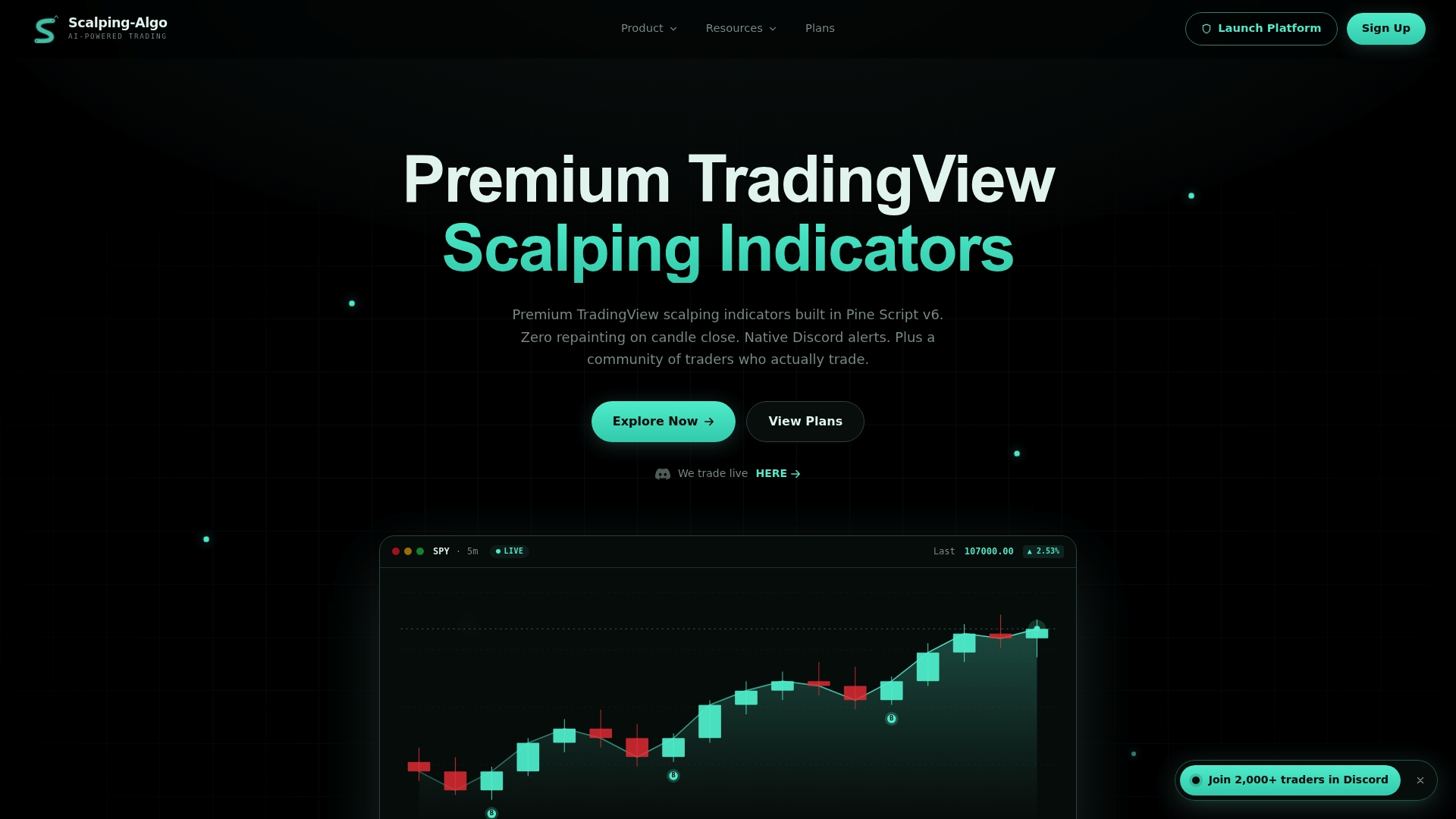
If you want to move beyond raw alerts and into structured, validated signals, Scalping-Algo's premium indicator suite is built for exactly that. The platform's TradingView scalping indicators generate real-time, non-repainting buy and sell signals with built-in confluence tools, volatility gating, and clear entry and exit levels across crypto, forex, indices, and futures. Every signal includes the structural components this guide covers: direction, entry, stop-loss, and take-profit, all displayed directly on your chart.
The Algo Master indicator suite goes further by integrating multiple signal layers into a single dashboard with native Discord alerts, backtesting support, and access to a live trading community for real-time mentorship. Whether you are building your validation process from scratch or upgrading your existing setup, these tools give you the signal structure and educational context to trade with real confidence.
FAQ
What is a trading signal?
A trading signal is a trigger generated by technical, fundamental, or algorithmic analysis that suggests a potential trade entry or exit. A complete signal includes direction, entry price, stop-loss, take-profit, and a rationale.
How do I know if a trading signal is reliable?
Look for signals confirmed by multiple independent factors such as trend, momentum, and price action. Reliable signal providers also show consistent hit rates above 60% with transparent, verified performance records.
What is a good reward-to-risk ratio for trading signals?
A minimum of 1.5:1 is the standard benchmark, with 2:1 being the preferred target. This means even a system with a sub-50% win rate can be profitable over time.
Should I follow every trading signal I receive?
No. Filter signals using a validation checklist covering confluence, market context, R:R ratio, and source credibility. Only the highest-scoring setups should be executed.
What is the biggest mistake traders make with trading signals?
Treating signals as guaranteed predictions rather than probabilistic triggers. Every signal carries a probability, not a certainty, and trader judgment combined with strict risk management remains the final filter.