

Educational resources for scalpers are structured materials, tools, and systems designed to teach traders how to execute fast, consistent micro-trades with disciplined risk management and specialized techniques. Scalping, the practice of entering and exiting positions within seconds to minutes to capture small price moves, demands a very different learning path than swing or position trading. 78% of retail scalpers lose money in their first three months due to inadequate tools and risk controls. That failure rate is not a talent problem. It is an education problem. Platforms like TradeAlgo, TradeZella, and DAS Trader Pro exist precisely to close that gap, and this guide maps out exactly how to use them.
What educational resources do scalpers actually need?
The best educational resources for scalpers fall into five distinct categories, each addressing a different layer of the skill set. Knowing which category to prioritize at each stage of your development is the difference between a structured learning path and spinning your wheels.
- Courses and video tutorials. Structured video content from educators like Thomas Wade provides free, systematic coverage of scalping mechanics, order flow, and trade management. The best courses separate strategy rules from execution mechanics so you can learn them independently.
- Books and PDFs. Written materials covering scalping strategies and execution psychology remain underrated. Titles focused on tape reading, Level 2 order books, and intraday momentum give you frameworks that video content rarely develops in depth.
- Trading simulators and backtesting platforms. Practicing on a simulator before risking capital is non-negotiable for scalpers. Platforms like Tradovate's replay mode and ThinkOrSwim's paperMoney let you run hundreds of simulated trades per week without financial exposure.
- Automated trade logging tools. Manual logging is impossible at scalping volume. TradeZella automates trade capture, tags setups, and surfaces performance patterns across hundreds of daily trades. This is how you separate a real edge from random noise.
- Live data feeds and order book access. Real-time Level 2 data and Time and Sales feeds are not optional add-ons. They are the primary data source professional scalpers use to time entries. Any educational program that does not teach you to read this data is incomplete.
Pro Tip: Start with a simulator for at least 30 days before touching live capital. Log every trade from day one, even in simulation. The habit of systematic review is more valuable than any single strategy you will learn.
How do scalping trading strategies work, and what should you master first?

Scalping is defined as a trading style where positions are held for seconds to a few minutes, targeting 5 to 10 pips or equivalent price increments per trade. Professional scalpers execute 50 to 200 trades daily targeting 3 to 5% monthly returns. That trade frequency means every decision must be pre-planned, not improvised in the moment.
The most common mistake beginners make is trying to learn technical analysis and high-speed execution at the same time. Experts advise mastering day trading on 15 to 60 minute charts before compressing to scalping timeframes. The logic is sound: if you cannot read a setup on a 30-minute chart with time to think, you will not read it correctly on a 1-minute chart under pressure.
Here is the skill progression that actually works:
- Master chart reading on higher timeframes. Spend four to eight weeks trading the 15-minute and 30-minute charts. Learn to identify VWAP deviation, opening range breakouts, and momentum continuation setups before you ever touch a 1-minute chart.
- Learn to read Level 2 and tape. Professional scalpers spend 80% of their attention on raw order flow data, not chart patterns. Level 2 shows you where large orders are stacked. The tape shows you how fast transactions are printing. Together, they tell you whether a move has real conviction.
- Add execution speed incrementally. Once your setup recognition is reliable on higher timeframes, compress to the 5-minute chart. Then the 1-minute. Speed comes from pattern recognition, not from rushing.
- Build a rules-based playbook. Document three to five specific setups with defined entry triggers, stop placement, and target levels. Scalping profits come from reading supply and demand imbalances in real time, not from predicting future price direction.
- Track and review every trade. Use a journaling tool from the start. Performance patterns that cost you money are invisible without data. Tools like trade performance analysis platforms make this process systematic rather than subjective.
What tools and platforms do professional scalpers use?
Execution infrastructure separates profitable scalpers from losing ones more than strategy does. Standard retail broker interfaces add latency that is fatal to scalping. When your target profit per trade is five to ten pips, a slow order fill does not just reduce your profit. It can turn a winning setup into a losing trade.
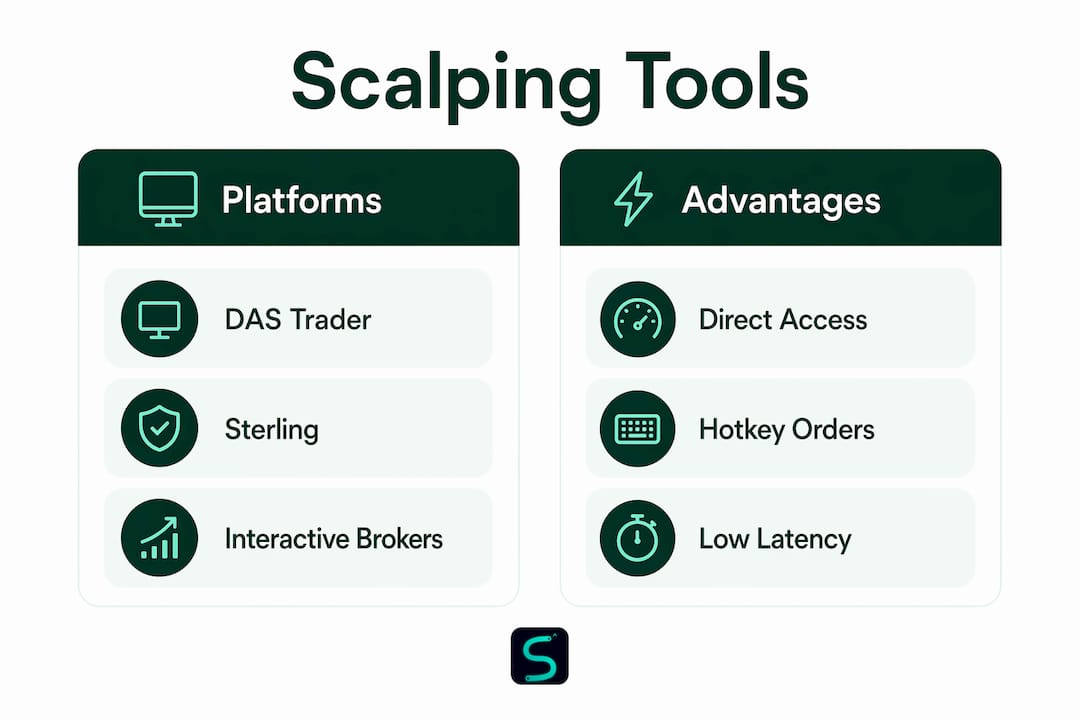
| Platform | Key advantage | Best for |
|---|---|---|
| DAS Trader Pro | Direct market access, hotkey execution, Level 2 integration | Equities scalpers needing sub-second fills |
| Sterling Trader Pro | Ultra-low latency routing, customizable hotkeys | High-frequency equity and options scalpers |
| Lightspeed Trader | Competitive commissions, fast order routing | Cost-sensitive scalpers with high trade volume |
| TradingView with Scalping-Algo indicators | Real-time signals, Pine Script v6, 1m to 15m optimization | Crypto, forex, and futures scalpers using signal-based entries |
Direct-access platforms like DAS Trader Pro and Sterling Trader Pro use hotkeys to eliminate the latency introduced by point-and-click interfaces. A hotkey trade executes in milliseconds. A mouse-click trade can take one to three seconds. At scalping volume, that difference compounds into significant P&L impact across hundreds of trades.
Execution costs erode small per-trade profits faster than most beginners expect. A scalper targeting $0.10 per share on a 100-share position earns $10 gross. If commissions run $1.50 per side, the net is $7. Add one bad fill and the trade breaks even at best. Choosing a platform with per-share pricing below $0.005 and fast routing is not a minor detail. It is a core profitability decision.
Pro Tip: Before committing to any platform, run a two-week cost simulation. Calculate your expected gross profit per trade, subtract your commission structure, and verify the math works at your target trade frequency. Many scalpers discover their strategy is only viable above a certain account size.
How to manage risk and maintain discipline in scalping
Risk management in scalping is not about avoiding losses. It is about keeping losses small enough that your winners can compound. The parameters used by professional scalpers in 2026 are specific and non-negotiable.
- Per-trade risk limit of 0.1% to 0.5% of account. These risk parameters mean a $25,000 account risks $25 to $125 per trade. This sounds small, but at 100 trades per day, a bad session without a cap becomes catastrophic.
- Daily loss cap of 2% to 5%. Set a hard stop on your trading day. When you hit your daily loss limit, the session ends. No exceptions. Automated kill switches on platforms like DAS Trader Pro enforce this without relying on willpower.
- Trade number limits. Overtrading is the most common discipline failure in scalping. Set a maximum number of trades per session, typically 20 to 50 for beginners, and stop when you reach it regardless of how the session is going.
- Automated trade logging. Automated logging tools are mandatory for analyzing your edge at high trade volumes. TradeZella and similar platforms tag every trade automatically, so your end-of-day review takes 15 minutes instead of two hours.
- Mental discipline protocols. Revenge trading after a loss is the fastest way to blow a daily loss limit. Build a physical reset routine: close your platform, stand up, wait five minutes before re-entering. The pause breaks the emotional feedback loop.
The scalping entry methods you use matter far less than the consistency of your risk controls. A mediocre setup with tight risk management outperforms a great setup with sloppy stops every time.
How to find and evaluate scalping educational materials in 2026
The volume of scalping content available in 2026 is enormous. The quality varies just as widely. Here is how to filter signal from noise when selecting your educational materials.
- Free content is a starting point, not a complete curriculum. Reddit communities like r/Daytrading and r/Forex offer real trader experiences and strategy discussions. YouTube educators like Thomas Wade provide structured free content. Use these to build vocabulary and identify what to study next, not as your primary curriculum.
- Paid courses should have measurable rules. Any course worth paying for gives you specific, testable entry criteria. "Buy when momentum is strong" is not a rule. "Enter long when price reclaims VWAP on a 1-minute close with tape printing above 10,000 shares per second" is a rule. Demand specificity before you pay.
- Discord communities provide live context. Dedicated trading Discords, including the one built into Scalping-Algo's Command Center, offer mentorship and live session feedback that no recorded course can replicate. Watching an experienced scalper call trades in real time accelerates pattern recognition faster than solo study.
- Simulator practice before live scaling. The top resources for advanced scalpers consistently emphasize simulator work as the bridge between theoretical knowledge and live execution. Aim for 200 to 300 simulated trades before moving to live capital.
- Internal blog resources and verified platforms. Scalping-Algo's blog covers scalping strategies across crypto and forex with asset-specific guidance. Pair these with verified platforms like TradeAlgo for a structured, layered curriculum.
Why most scalpers are studying in the wrong order
The conventional advice is to learn everything at once: strategy, execution, risk management, and psychology simultaneously. That approach fails most traders, and I have seen it happen repeatedly.
The traders who build durable scalping skills almost always follow the same pattern. They spend weeks on a single strategy until it becomes automatic. They do not add a second setup until the first one is profitable in simulation. They treat trade journaling not as a chore but as their primary feedback mechanism. The journal is where the real education happens, not in the course material.
What surprises most people is how long this takes. Realistic timelines for consistent scalping profitability run six to eighteen months of dedicated practice. That is not discouraging. It is clarifying. If you know it takes a year, you stop looking for shortcuts and start building the habit stack that actually works.
The other underestimated factor is tool quality. Trying to scalp with a standard retail broker interface is like trying to compete in a sprint wearing dress shoes. The institutional-grade tools that professional scalpers use are now accessible to retail traders at reasonable cost. There is no reason to handicap yourself with inferior execution infrastructure when better options exist.
Start with one strategy. Master it in simulation. Log everything. Then add tools that reinforce what you already know works.
— Tran
How Scalping-Algo accelerates your trading education
Scalping-Algo's premium TradingView indicators are built specifically for traders who want to move from educational theory to live execution without guesswork.
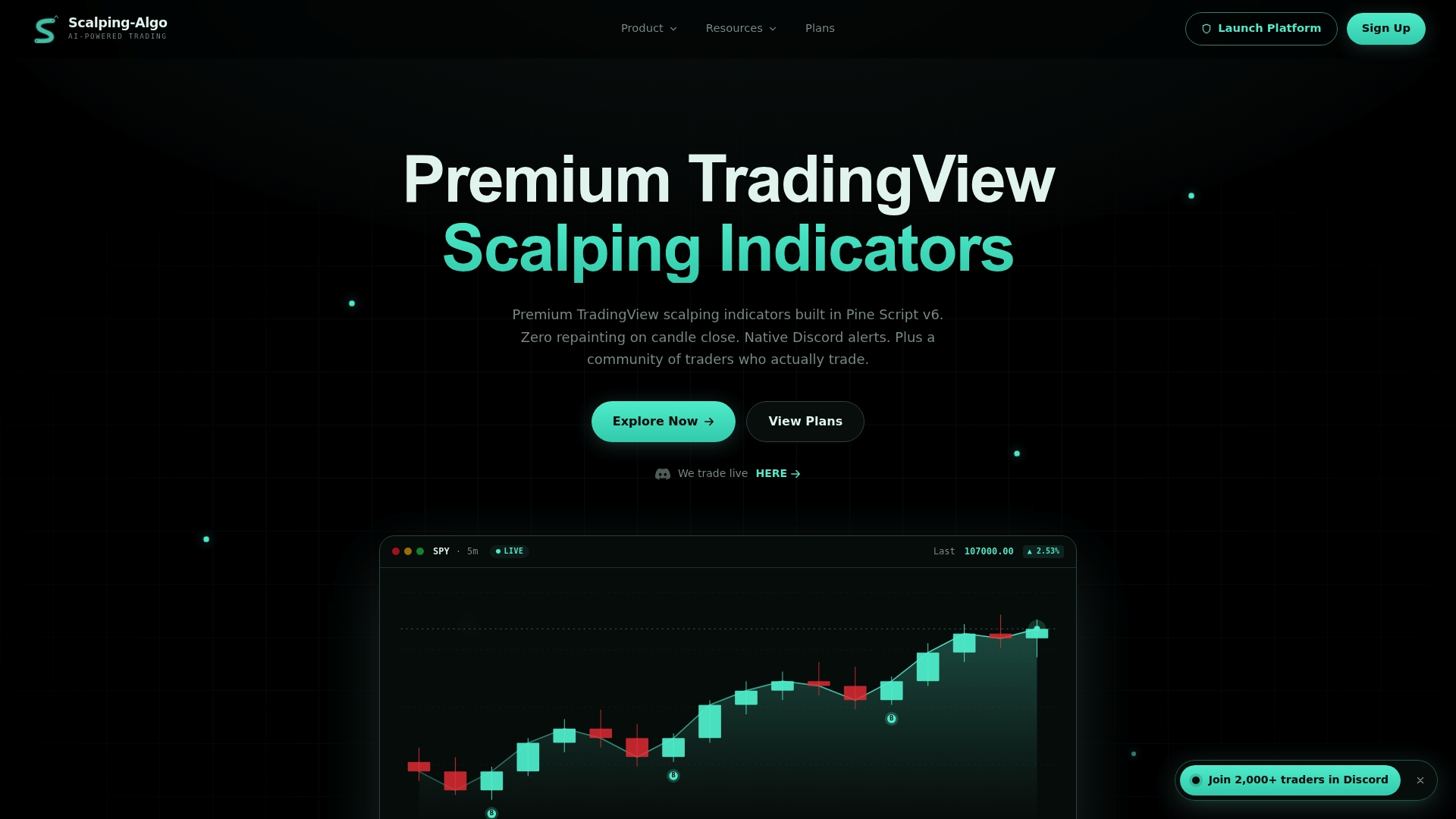
The Algo Master 3-indicator system combines real-time buy and sell signals, confluence detection, and volatility gating into a single, clear framework optimized for 1-minute to 15-minute charts. Every signal is non-repainting, so what you see in backtesting reflects what you get in live trading. The Command Center dashboard integrates alerts, backtesting, and the Discord community so your educational resources and execution tools live in one place. If you are ready to put the strategies in this guide into practice, explore Scalping-Algo's indicator suite and see how the system maps directly to the scalping techniques covered here.
Key takeaways
Scalping success requires structured educational resources, direct-access execution tools, and disciplined risk management applied in the correct sequence.
| Point | Details |
|---|---|
| Education sequence matters | Master higher timeframe chart reading before compressing to 1-minute scalping execution. |
| Order flow over indicators | Spend 80% of your attention on Level 2 and tape data, not lagging chart patterns. |
| Risk parameters are fixed | Limit per-trade risk to 0.1% to 0.5% and set a hard daily loss cap of 2% to 5%. |
| Automate your logging | Use TradeZella or equivalent tools to capture every trade automatically at scalping volume. |
| Platform choice affects P&L | Direct-access platforms with hotkeys and low commissions are a core profitability requirement, not a preference. |
FAQ
What are the best free educational resources for scalpers?
Thomas Wade's YouTube channel and Reddit communities like r/Daytrading provide solid free foundations for scalping education. Pair these with simulator practice on platforms like ThinkOrSwim's paperMoney to apply concepts without financial risk.
How long does it take to become a profitable scalper?
Realistic timelines for consistent scalping profitability run six to eighteen months of dedicated practice, including simulator work and systematic trade review. Traders who skip the simulation phase and jump directly to live trading extend that timeline significantly.
Why do most beginner scalpers lose money?
78% of retail scalpers lose money in their first three months primarily due to inadequate risk controls and poor execution infrastructure, not bad strategy selection. Fixing the infrastructure and risk management layer solves more problems than finding a new setup.
Do I need a direct-access platform to scalp effectively?
Yes. Standard retail broker interfaces introduce latency that makes consistent scalping profitability extremely difficult. Platforms like DAS Trader Pro and Sterling Trader Pro with hotkey execution are the standard tools professional scalpers use for a reason.
What is the most important skill to develop first in scalping?
Reading Level 2 order books and the tape is the foundational skill that separates profitable scalpers from losing ones. Chart patterns are secondary. The ability to read real-time supply and demand imbalances in the order flow is what drives precise entry timing.