

Most retail traders spend months grinding through losses before they admit the problem is not their strategy. It is their process. Mentorship in trading communities addresses exactly that gap. Where solo study or paid signals leave you reacting to markets without a repeatable framework, structured mentorship builds the decision rules, risk discipline, and psychological accountability that separate consistent traders from the ones who blow accounts and quit. This guide breaks down how quality mentorship works, what to look for, and how to get the most out of it if you trade forex, crypto, or scalping setups.
Table of Contents
- Key Takeaways
- Mentorship in trading communities: what it actually is
- How mentorship sharpens forex, crypto, and scalping skills
- How to identify credible mentorship programs
- How to get the most out of mentorship
- Common misconceptions about trading mentorship
- My take on what makes mentorship actually work
- Take your skills further with Scalping-Algo
- FAQ
Key Takeaways
| Point | Details |
|---|---|
| Mentorship beats passive learning | Active trade review and feedback correct errors faster than any course or signal service alone. |
| Process over profit focus | Quality mentors teach decision rules and risk management, not shortcuts to guaranteed returns. |
| Psychology is the core benefit | Mentorship provides accountability that keeps you executing your plan after a string of losses. |
| Vet mentors carefully | Look for transparent track records, structured curricula, and students who trade independently. |
| Active participation is non-negotiable | Trade journaling and consistent debrief loops are required to gain real benefit from mentorship. |
Mentorship in trading communities: what it actually is
There is a real difference between watching a trading course and having someone review your actual trades. Mentorship in trading communities is the second thing. It is an active, structured relationship where a more experienced trader examines your decision-making, identifies recurring behavioral errors, and helps you build repeatable rules for entering, managing, and exiting positions.
Good mentorship programs include disciplined instruction, planned reviews, explicit risk standards, and a community environment that controls hype and maintains constructive debate. That last element is often underrated. The peer layer of a trading community provides real-time market context, shared post-trade analysis, and a sounding board that no solo study program can replicate.
Here is what distinguishes genuine mentorship from other formats:
- Courses and videos: Passive delivery. You learn concepts but no one checks whether you are applying them correctly under live market conditions.
- Signal services: You get trade alerts but zero understanding of why the trade was taken. Dependency, not skill, is the outcome.
- Self-study: You build knowledge but lack external correction when bias creeps into your execution. Errors compound silently.
- Mentorship: Mentors develop decision rules and disciplined execution protocols instead of handing out signals. The feedback loop is live, specific, and aimed at correcting your actual behavior.
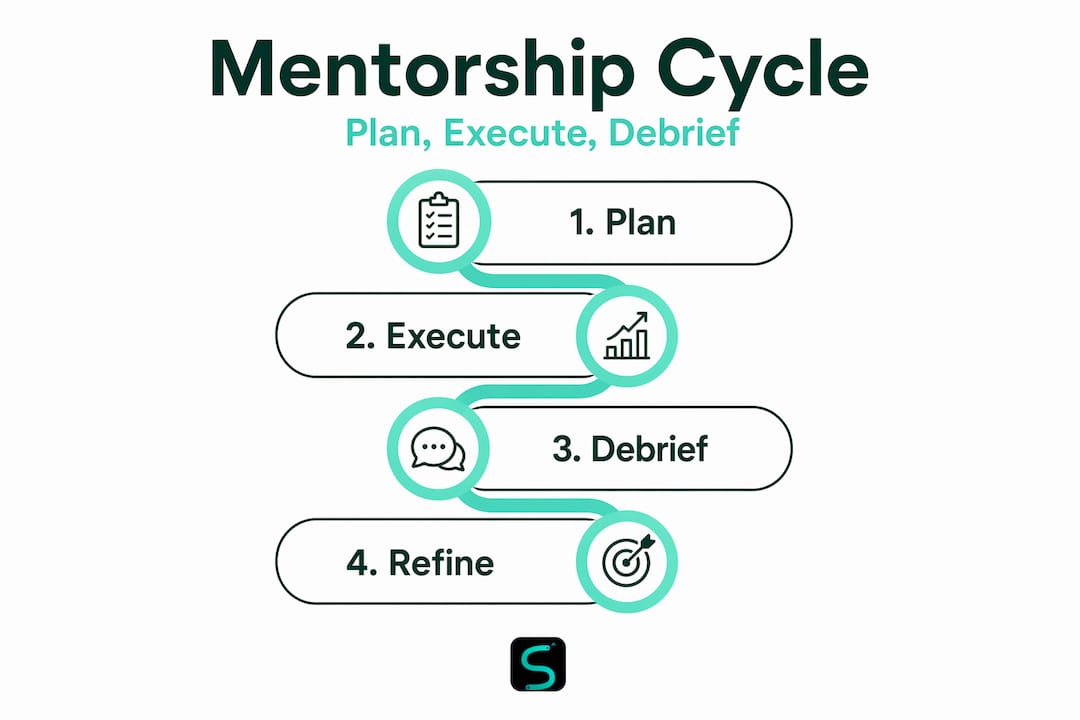
The operational framework that ties it together is the plan-execute-debrief cycle. You plan the trade with context, execute it following your rules, then debrief it with mentor and community input. Over weeks, this cycle compresses your learning curve because you are not waiting months to notice a pattern in your mistakes. Someone points it out on trade two.
Pro Tip: When evaluating a trading community, look for whether members post their trade logs publicly for review. A culture of honest post-trade analysis is a stronger signal of quality than any polished marketing page.
How mentorship sharpens forex, crypto, and scalping skills
Scalping, crypto, and forex are not the asset classes where slow-moving strategy adjustments survive. Decisions happen in seconds. Setups appear and disappear in one or two candles. The psychological pressure in these markets exposes every weakness in your process at full volume.
Mentorship accelerates development by compressing feedback loops, identifying errors early, reinforcing risk standards, and sharpening judgment before results are expected. For scalpers specifically, that means a mentor is not just reviewing whether a setup was valid. They are reviewing whether you sized correctly under volatility, whether you moved your stop too early, whether you added to a loser after a fast spike triggered FOMO.
The psychological traps that derail traders in fast markets are well documented. Mentorship tackles each one at the root:
- FOMO entries: A mentor who reviews your trade log will spot the pattern of chasing candles well before you recognize it yourself.
- Revenge trading: External accountability makes it much harder to double down after a loss when someone else is reviewing your decisions the next day.
- Over-sizing: Mentors enforce position sizing rules as a non-negotiable rather than a suggestion, which directly protects your account during high-volatility sessions.
- Emotional stop adjustments: Post-trade debriefs reveal exactly how often you moved a stop vs. held your plan, and that data motivates real behavioral change.
Traders often fail due to poor emotional management, not lack of technical knowledge. Mentorship's greatest value is the psychological accountability layer it adds. For scalpers trading 1-minute to 15-minute timeframes, that layer is the difference between blowing an account in a single session and managing drawdown like a professional.
Pro Tip: If you trade crypto or forex scalping setups, ask any prospective mentor to show you how they debrief a losing trade session. How they handle losses tells you more about their teaching quality than any winning trade example they post.

Check out how trading communities support scalpers when it comes to building the psychological discipline that mentorship reinforces.
How to identify credible mentorship programs
The trading education space has a well-known problem: too many people selling outcomes and not enough teaching process. The research is clear that reliable mentorships emphasize risk, decision frameworks, and student independence rather than vague high-profit promises or paid signal feeds.
Here is a comparison of what separates credible mentorship from programs designed to extract money:
| Factor | Credible mentorship | Red flags |
|---|---|---|
| Track record | Transparent, consistent history over time | Cherry-picked wins, no losers shown |
| Teaching focus | Process, risk management, decision rules | "Shortcuts," guaranteed returns, signal-only content |
| Student outcomes | Graduates trade independently | Students remain dependent on mentor alerts |
| Community culture | Constructive debate, loss reviews welcome | Hype-driven, only profits shared |
| Pricing transparency | Clear structure, honest scope | Vague upsells, pressure to upgrade |
On pricing: trading mentorship costs vary widely, ranging from modest monthly subscriptions to one-time lifetime access fees reaching $7,000 or more. Higher cost does not automatically mean higher quality. Some of the most process-focused mentors charge affordable monthly rates because their model is built on community scale, not exclusive high-ticket sales.
When screening mentors, run through this checklist:
- Does the mentor show full trade histories including losing periods?
- Is there a structured curriculum or is it purely reactive market commentary?
- Can you access former students who now trade independently without needing the mentor's daily input?
- Are risk management rules explicitly taught, enforced, and reviewed in sessions?
- Does the community moderate aggressively against pump-and-dump hype or misleading signal posts?
Verification of a mentor's consistent track record and the ability of their students to trade independently afterward are the two strongest quality indicators you can use. Any mentor worth your time will welcome both forms of scrutiny.
For a broader framework on spotting trustworthy tools and mentors, the guide on assessing indicator reliability offers a transferable evaluation process.
How to get the most out of mentorship
Joining a mentorship program is the easy part. Extracting real value requires consistent, active engagement that most traders underestimate going in.
Active engagement and trade log sharing are non-negotiable for mentorship to work. Passive video consumption without mentor trade log review produces the same results as a YouTube tutorial watched once and forgotten. Here is how to structure your participation for maximum development:
- Journal every trade in detail. Log entry reason, timeframe, setup type, position size, emotional state at entry, and exit reasoning. Vague notes produce vague feedback. Specific logs produce specific corrections.
- Share trade logs before asking for opinions. Bring data to your mentor, not just "this trade didn't work." Let the numbers drive the debrief, not your memory of how it felt.
- Run the plan-execute-debrief loop consistently. Write your trade plan before the session. Execute to the plan. Debrief with your mentor within 24 hours. Repetition of this cycle is what creates behavioral change over time.
- Set process goals, not outcome goals. Measure whether you followed your entry rules, held stops, and sized correctly. Do not measure only profit and loss. Mentorship improves decision quality by focusing on process and risk parameters, not just outcomes.
- Engage in community discussions, but own your decisions. Peer trading advice is useful context. It is not a substitute for your own analysis. The trap is deferring every decision to the community chat instead of developing your own read.
The traders who extract the least from mentorship are the ones who lurk, consume, and wait for someone else to call the trade. The traders who benefit most show up with logged trades, honest self-assessments, and a genuine willingness to be wrong.
Pro Tip: Treat your first 30 days in a mentorship program as a diagnostic period. Do not change your strategy yet. Just document and debrief every trade honestly so your mentor can identify your actual patterns rather than what you think your patterns are.
Common misconceptions about trading mentorship
Several persistent myths keep traders either avoiding mentorship entirely or entering programs with expectations that guarantee disappointment.
"Mentorship is just a fancier signal service." This is the single most damaging misconception in the retail trading space. Quality mentorship builds your judgment so you no longer need someone else's signals to execute confidently.
Here are the other myths worth addressing directly:
- "A good mentor will make me profitable immediately." Mentorship compresses your learning curve. It does not shortcut the requirement for practice, repetition, and real capital at risk to develop genuine skill.
- "Expensive programs are better programs." Some high-ticket programs offer exceptional structured support. Others are priced for exclusivity, not quality. The comparison table above applies regardless of price point.
- "I can consume the material passively and improve." Mentorship requires active work including manual trade journaling and post-trade analysis. Passive watching without doing produces nothing measurable.
- "Once I find a good mentor, I do not need to study on my own." Mentorship and self-directed practice are not either-or. The most effective development approach combines structured mentorship with independent study and trading practice between sessions.
Mentorship yields the highest returns for traders who already understand the basics but lack consistency and behavioral discipline. If you are completely new to trading, spend enough time with fundamentals first so that your mentor's feedback has a foundation to build on. You can read about why trading education matters before committing to a formal mentorship program.
My take on what makes mentorship actually work
I have watched a lot of retail traders cycle through the same loop. They learn a strategy, trade it live, lose money, blame the strategy, find a new one, repeat. What I have found consistently is that the strategy is rarely the problem. The execution is.
What mentorship does that nothing else replicates is create an external observer for your decision-making. When you know that someone is reviewing your trade log tomorrow, you think twice before sizing up after a loss or chasing a breakout out of fear of missing it. That is not a minor behavioral nudge. It is a structural change in how you operate.
The mentors I respect most are the ones who are actively working themselves out of the job. Their goal is for you to internalize the decision rules so completely that you no longer need them looking over your shoulder. The ones who keep students dependent on their daily calls are not mentors. They are subscriptions.
My honest observation: most traders underestimate how long behavioral change takes. You will follow your plan perfectly for two weeks and then have one high-volatility session that breaks every rule you set. That is normal. The value of mentorship is not that it stops those moments. It is that it gives you a structured way to analyze them, adjust, and not repeat them indefinitely.
Patience and consistency with the process matter more than any individual trade outcome. That is the part no one wants to hear, and it is also the part that separates traders who eventually get there from the ones who give up just before they would have turned the corner.
— Tran
Take your skills further with Scalping-Algo
If the principles in this guide resonate with you, Scalping-Algo is built around exactly this kind of structured, process-led trading development.
The Algo Master 3 Indicator Suite gives scalpers a concrete execution framework built on non-repainting signals, confluence confirmation, and volatility gating across 1m to 15m timeframes. It removes ambiguity from entries and exits, so your mentor or community can review decisions against a clear, objective framework rather than a vague "it felt right" justification. The Scalping-Algo platform also includes a live Discord community with mentorship sessions, trade reviews, and structured education resources. This is not a signal chat. It is a working environment where traders share trade logs, debrief live sessions, and build the repeatable habits this article describes. You can also explore risk management principles that complement the mentorship approach and help you build the process discipline your trading needs.
FAQ
What is mentorship in trading communities?
Mentorship in trading communities is a structured relationship where experienced traders review your trade logs, correct behavioral errors, and help you build repeatable decision rules. It differs from signal services because the goal is your independence, not your continued reliance on someone else's calls.
How do I find a trading mentor worth trusting?
Look for transparent, consistent track records that include losing periods, process-led teaching focused on risk management, and former students who trade independently. Mentors who promise shortcuts or guaranteed returns are a clear sign of misalignment with professional trading development.
How does mentorship help forex and crypto scalpers specifically?
Scalping in fast markets exposes psychological weaknesses like FOMO, revenge trading, and emotional stop adjustments more severely than slower strategies. Mentorship provides the external accountability and structured debrief loop that converts those reactive patterns into disciplined execution over time.
How much does trading mentorship cost?
Costs range widely from affordable monthly subscriptions to lifetime access programs costing $7,000 or more. Higher price does not guarantee higher quality. Evaluate structure, transparency, and student outcomes before committing to any price point.
Can mentorship replace self-study and practice?
No. Mentorship accelerates your development by correcting errors and providing accountability, but it works best when combined with consistent independent practice and self-directed study between sessions. Active trade journaling and personal review are still required work that no mentor can do for you.