

Open-source Pine Script indicators let you inspect, adapt, and collectively harden scalping tools — giving you auditable signals, faster iteration, and lower maintenance cost than any closed-source alternative. The two facts that matter most: you can verify non-repainting by reading the code directly, and community contributors catch edge-case bugs faster than any solo developer. For scalpers trading 1m–15m timeframes, that combination is not a convenience. It's a structural advantage.
The core operational impacts of open-source scripting for scalpers:
- Vetting: Read signal logic directly to confirm bar-close-only execution and no hidden external calls.
- Adaptation: Fork and parameterize for your asset class, volatility regime, or risk-per-trade rules.
- Community testing: Distributed review catches repainting, slippage assumptions, and brittle defaults faster.
- Governance: Maintainers and contributors share responsibility for security patches and version control.
Table of Contents
- What does "open source" actually grant you as a Pine Script author?
- Why open-source scripts give scalpers a concrete edge
- What risks come with open-source Pine Scripts, and how do you vet them?
- How do you adapt an open-source Pine Script for your scalping setup?
- What testing must scalpers run before trading live?
- How should you license and distribute your Pine Script indicator?
- How do you govern a community Pine Script project?
- When does closed source make more sense?
- Key Takeaways
- Why open source changes the game for retail scalpers
- Scalping-algo's open-source Pine Script suite gives you a ready starting point
- Useful sources
What does "open source" actually grant you as a Pine Script author?
Open-source software gives you the rights to study, modify, and redistribute code. For Pine Script developers, that means the human-readable indicator source is published so anyone can inspect and adapt it under its stated license. On TradingView, publishing a script as "open" exposes the full Pine Script source to any viewer. Mirroring that same code on GitHub adds issue tracking, pull request workflows, and version tagging.
License choice shapes what others can do with your code. Permissive licenses (MIT-style) let anyone fork, modify, and even commercialize derivatives without sharing changes back. Copyleft licenses (GPL-style) require derivative works to carry the same license, which protects community improvements but can complicate paid wrappers. For most Pine Script indicator authors, MIT is the practical default — it maximizes adoption and contribution while keeping monetization options open.
"All Open Source software can be used for commercial purposes; the Open Source Definition guarantees this. You can even sell Open Source software." — Open Source Initiative
Immediate steps when publishing:
- Publish source on TradingView (set script visibility to "open") and mirror on GitHub.
- Include a LICENSE file at the repo root — one line referencing MIT or your chosen license.
- Add a CHANGELOG.md with version, date, and what changed.
- Document tested timeframes and asset classes in the README.
Why open-source scripts give scalpers a concrete edge
For scalpers, open source shortens the path from idea to reliable execution. You skip the black-box trust problem entirely. You read the code, confirm the logic, and tune parameters before risking a dollar.
Key benefits specific to low-timeframe trading:
- Inspectability: Confirm signals fire only on
barstate.isconfirmedor bar close — the primary non-repainting safeguard. - Faster bugfixes: Community contributors identify and patch edge cases across multiple markets simultaneously.
- Parameter forks: Clone a base indicator and tune ATR multipliers, volume filters, or exit triggers for BTC vs. ES futures without waiting for an upstream update.
- Reduced cost: Open-source scripts reduce implementation cost and speed development cycles, letting you spend time on strategy tuning rather than debugging proprietary code.
- Shared test artifacts: Public backtest scripts and sample datasets let you reproduce results independently.
Open source also generates reputation and network effects — publishing reusable components attracts contributors who make the base project more robust over time.
Pro Tip: When evaluating any open-source scalping indicator, search the source for barstate.isconfirmed or barstate.islast. Absence of these guards on signal lines is a strong repainting warning.

Trust signals to prioritize: a public repo with commit history, a named maintainer with a track record, and reproducible backtests with stated methodology. Community-verified backtests and transparent testing methodology are the clearest proof that a script's claims hold up.
What risks come with open-source Pine Scripts, and how do you vet them?
Open source reduces many unknowns but introduces vetting responsibilities — you must confirm the code behaves as claimed. The OpenSSF policy primer frames it clearly: security is a shared responsibility between maintainers and deployers, and deployers must control their own update and patch lifecycles.
Top risks for scalpers:
- Repainting: Signals generated mid-bar that shift or disappear on bar close.
- Hidden external calls: Webhooks or HTTP requests embedded in the script that exfiltrate data or introduce latency.
- Credential leakage: API keys or webhook URLs hardcoded in source.
- Stale code: Indicators tuned for one market that fail silently in different volatility regimes.
- Brittle defaults: Fixed thresholds that worked in 2022 BTC conditions but break on low-volatility forex pairs.
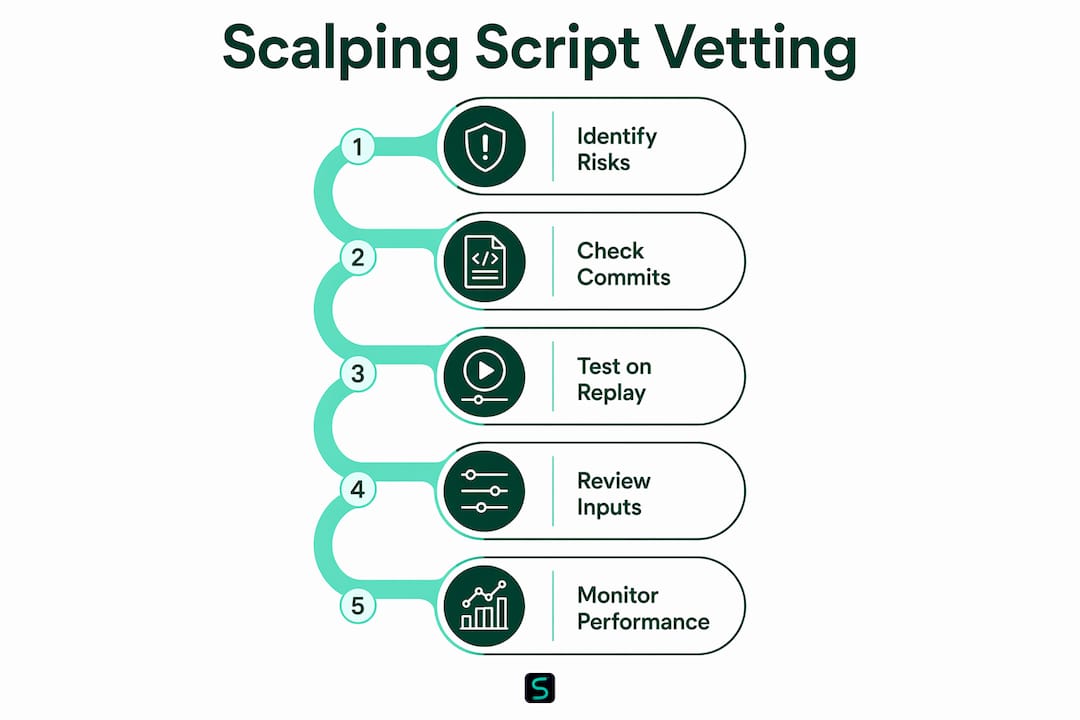
Vetting checklist:
- Read signal generation code — confirm all signal lines reference
barstate.isconfirmedor equivalent bar-close logic. - Search the full source for
http.get,http.post,request.securitywith external URLs, or any string-execution pattern. - Check commit history and open issues on GitHub for unresolved bug reports or abandoned maintenance.
- Run a synthetic replay on a known historical period and verify signals do not shift after the bar closes.
- Confirm maintainer responsiveness: look for recent replies to issues and merged PRs within the last 90 days.
Pro Tip: In TradingView's Pine Script editor, use Ctrl+F to search for request. calls. Any call pointing to an external URL that isn't a standard data feed warrants a hard look before deployment.
How do you adapt an open-source Pine Script for your scalping setup?
Adaptation follows a short loop: fork, isolate signal logic, parameterize, backtest, forward-test, iterate. That loop is fast precisely because the source is readable.
- Fork or copy the source from TradingView or GitHub into your own script or repo.
- Identify the core signal and exit blocks — isolate the entry condition, the exit trigger, and any filter logic (volume, volatility, trend).
- Parameterize key thresholds — replace fixed values with ATR-based dynamic thresholds. For example, a fixed pip stop becomes
stop = atr(14) * multiplier, wheremultiplieris an input you tune per asset. - Add explicit non-repainting safeguards — wrap all signal assignments in
barstate.isconfirmedguards and add a comment explaining why. - Document defaults and rationale — record which market and timeframe each default was tested on, and why you chose that value.
A premium Pine Script indicator built with these practices will have clear input descriptions, version comments, and tested default ranges for each parameter.
Pro Tip: Tag your strategy versions by market and timeframe — for example, BTC-1m-v1.0 or ES-5m-v2.1. When a parameter change breaks performance on one pair but improves another, you'll know exactly which version to roll back.
What testing must scalpers run before trading live?
Treat an open-source indicator like a thesis that must survive strict realism and forward testing before risking capital. Real-time trade analysis tools can supplement Pine Script's built-in replay for execution-level validation.
Testing checklist:
- Model realistic slippage in backtests to reflect typical market conditions for futures and forex.
- Include commission and spread costs per side — scalping P&L is thin enough that these flip results.
- Run latency sensitivity tests by shifting signal execution and measuring profit and loss impact over several bars.
- Apply out-of-sample windowing — train on 60% of data, validate on the remaining 40%.
- Run walk-forward analysis across at least three non-overlapping periods.
- Paper trade for a minimum of two weeks before committing live capital, with strict risk caps per trade.
| What to model | Why it matters | Suggested test range (scalping) |
|---|---|---|
| Slippage | Erodes thin scalping margins fast | 1–3 ticks |
| Spread | Widens during news and low liquidity | Fixed + variable spread scenarios |
| Commission | Compounds across high trade frequency | Per-side, round-trip cost |
| Latency | Delays entry/exit on fast 1m bars | 1–3 bar execution delay |
Pro Tip: Use TradingView's bar replay mode to step through historical data tick by tick. When replay confirms signals only appear after bar close, you've passed the most basic non-repainting test.
How should you license and distribute your Pine Script indicator?
Choose a license intentionally — it controls reuse, monetization, and contributor expectations. A permissive license maximizes community adoption; a copyleft license keeps improvements public. Neither is wrong; the choice depends on whether you plan to offer a paid wrapper or want all forks to remain open.
"Open source generates reputation and network effects: by publishing reusable components, developers attract contributors who make the base project more robust." — Google Open Source
Publishing checklist:
- Add a LICENSE file to the GitHub repo root (MIT or GPL — pick one and commit).
- Include a license header comment in the Pine Script source file itself.
- Publish the script on TradingView as a public open script with full source visible.
- Write a README covering: what the indicator does, tested timeframes and assets, input parameters, and backtest methodology.
- Tag releases with semantic versioning (
v1.0.0) and maintain a CHANGELOG.
Distribution tradeoffs: TradingView gives you direct exposure to active traders. GitHub gives you issue tracking, CI integration, and better version control. Running both together maximizes trust and discoverability — platforms that curate open-source scripts make discovery and adaptation faster for the developers who find your work.
How do you govern a community Pine Script project?
Good governance turns a single script into a reliable community resource rather than a fragile fork. Open-source distribution with clear contribution guidelines, issue templates, CI for linting, and an explicit security disclosure policy materially reduces the chance that a community script becomes a single point of failure.
Contributor workflow:
- Write a CONTRIBUTING.md that specifies PR requirements: code review, backtest artifacts, and changelog entry.
- Use issue templates for bug reports (include timeframe, asset, and version) and feature requests.
- Require at least one maintainer review before merging any PR that touches signal logic or risk parameters.
- Run automated lint checks on Pine Script syntax where tooling allows.
Governance checklist:
- Name a primary maintainer with a public contact method.
- Publish a roadmap — even a simple one — so contributors know what's planned.
- Set a release cadence (monthly patches, quarterly features).
- Define a security disclosure process: a private email or GitHub security advisory channel.
- Document criteria for accepting optimizations that affect risk behavior — require backtest evidence for any change to entry/exit logic.
When triaging risk-related PRs, ask: does this change affect signal timing, position sizing, or exit logic? If yes, require a full backtest comparison before merge and note the market/timeframe impact in the changelog.
When does closed source make more sense?
Closed source is appropriate when protecting proprietary IP or when commercial licensing is essential to business viability. Not every indicator belongs in a public repo.
Scenarios where closed source is defensible:
- Signal logic is directly tied to firm revenue and disclosure would eliminate competitive advantage.
- Contractual obligations to clients prohibit source disclosure.
- The script embeds credentials or external service keys that cannot be safely separated from the logic.
- You're building a paid enterprise wrapper where the source is the product.
Pro Tip: Consider a hybrid approach: publish a minimal open reference implementation that demonstrates your methodology, while keeping execution-sensitive components private. Document what the open version does and does not include — that transparency maintains user trust even when the full source isn't available.
Key Takeaways
Open-source Pine Script indicators give scalpers the ability to inspect, adapt, and collectively harden strategies — making non-repainting verification and community-driven testing the two most durable advantages over closed-source alternatives.
| Point | Details |
|---|---|
| Vet before you trade | Confirm bar-close-only signal logic and check for hidden external calls before deploying any open-source indicator. |
| Parameterize for your market | Replace fixed thresholds with ATR-based inputs and tag versions by asset and timeframe (e.g., BTC-1m-v1.0). |
| Run realistic backtests | Model slippage (1–3 ticks), spread, commission, and latency before forward-testing on paper for at least two weeks. |
| Publish with license and README | Include a LICENSE file, version tags, and a backtest methodology section to build community trust and attract contributors. |
| Scalping-algo as a starting point | Scalping-algo publishes open-source Pine Script v6 indicators with transparent changelogs and a Command Center for backtesting and live alerts. |
Why open source changes the game for retail scalpers
The conventional wisdom says retail traders are at a disadvantage because they lack institutional tools. Open source flips that assumption. When a Pine Script indicator's source is public, a retail scalper can audit it more thoroughly than most institutional desks audit their vendor-supplied black boxes. The inspectability argument isn't theoretical — it's the difference between trusting a signal and knowing why it fires.
What most traders underestimate is the maintenance angle. HBS research on OSS value confirms that widely used open-source software yields large demand-side value precisely because the community distributes the maintenance burden. For scalpers, that means an indicator tuned for BTC in 2023 gets updated for current volatility conditions by someone in the community — often before you'd even notice the edge degrading. That's a structural advantage closed-source tools simply can't replicate. Scalping-algo's approach, publishing Pine Script v6 indicators with full source and transparent changelogs, is a direct application of this principle.
Scalping-algo's open-source Pine Script suite gives you a ready starting point
Skip the blank-repo problem. Scalping-algo publishes open-source Pine Script v6 indicators with full source visibility, so you can inspect, fork, and adapt without starting from scratch. Every indicator is built for 1m–15m scalping across crypto, forex, indices, and futures — with non-repainting signals, volatility gating, and native webhook alerts to Discord baked in.
What the platform includes:
- Open-source Pine Script v6 indicators with public source on TradingView.
- Command Center dashboard for backtesting, alerts, and signal monitoring.
- Transparent changelogs noting market and timeframe impacts for every release.
- Discord community with live trading sessions and mentorship from experienced scalpers.
The practical next step: review the source on TradingView, run the Algo Master system through the testing checklist in this guide, and join the Discord to ask questions before committing live capital. The source is there. The community is active. The only variable is whether you do the vetting.
Useful sources
- Open-source software (Wikipedia) — Grounds the legal rights framework (study, modify, redistribute) used in the "what open source means" and benefits sections.
- Open Source Initiative FAQ — Primary source for license definitions, commercial use rights, and copyleft obligations cited in the licensing section.
- The Value of Open Source Software (HBS) — Economic research on OSS value and maintenance debt; supports the governance and perspective sections.
- Why Open Source? (Google Open Source) — Backs claims about reputation effects, community-driven hardening, and ROI of open-source publishing.
- OpenSSF Public Policy Primer — Authority source for security practices, shared maintainer/deployer responsibilities, and vulnerability disclosure recommendations.
- Open-source scripts powering modern web development (OpensourceScripts) — Supports cost-reduction and iteration-speed claims in the benefits section.
- The Real Significance of Open-Source Indicators for Traders (Scalping-algo) — Backs trust signal guidance and reproducible backtest recommendations.