
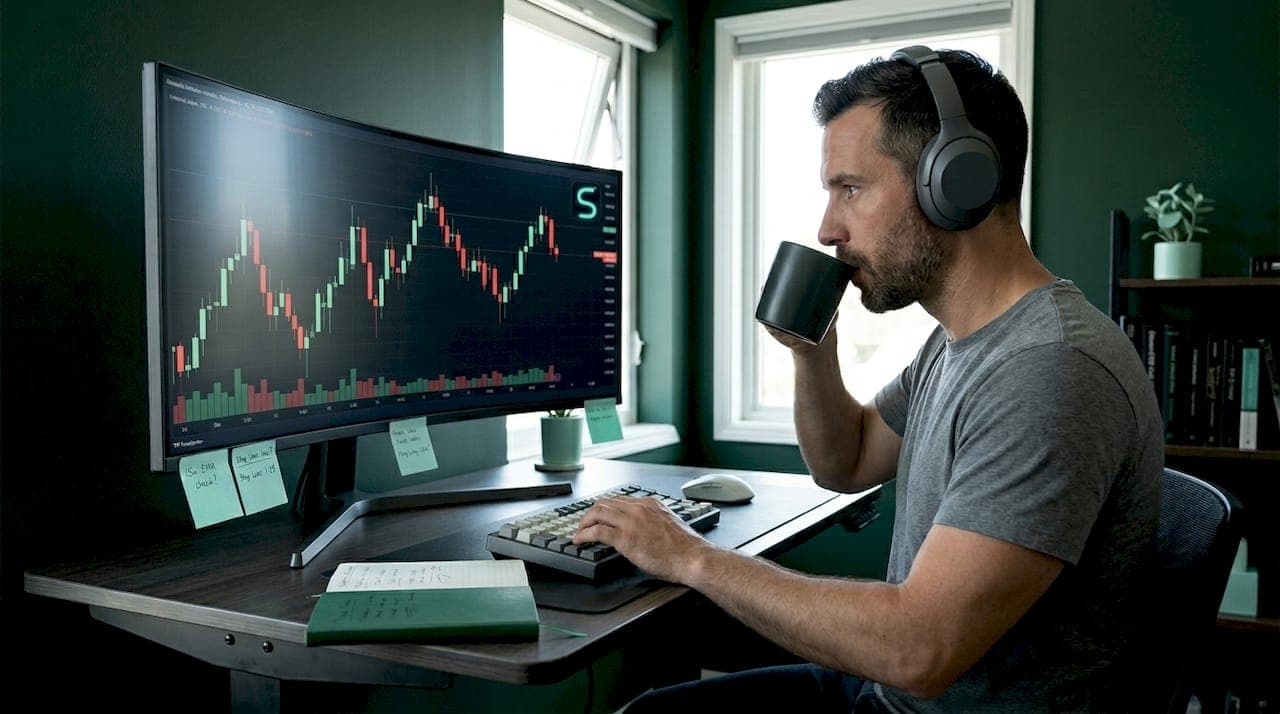
Retail traders using Pine Script indicators are quietly outperforming expectations across crypto, forex, and commodities markets. The assumption that custom trading automation belongs only to prop desks or developers with years of coding experience is simply wrong. Traders on active forums consistently report profit factors between 1.3 and 2.2 with win rates of 35 to 65 percent using TradingView-based strategies paired with solid risk management. This article breaks down exactly why Pine Script indicators work so well for scalping, where the real pitfalls hide, and how to put these tools to work on your next trade.
Table of Contents
- What makes Pine Script ideal for scalpers?
- How Pine Script empowers automated, risk-managed scalping
- Avoiding common pitfalls: Overfitting and alert fatigue
- Leveraging TradingView and Pine Script together for scalping edge
- Why most traders misuse Pine Script—and what actually works
- Ready to boost your scalping? Get premium Pine Script indicators
- Frequently asked questions
Key Takeaways
| Point | Details |
|---|---|
| Accessible automation | Pine Script indicators let any trader automate scalping strategies without pro coding. |
| Superior risk management | Custom Pine Script logic enables robust stop losses, partial TPs, and consistent trade rules. |
| Avoid overfitting | Success comes from walk-forward testing and simplicity, not complex, curve-fitted systems. |
| TradingView edge | The combination of Pine Script and TradingView offers instant deployment and alerts for any market. |
| Proven results | Retail scalpers using Pine Script indicators report strong profit factors and higher win rates. |
What makes Pine Script ideal for scalpers?
With that context, let's examine what specifically gives Pine Script its advantage for traders like you.
Pine Script sits in a unique position. It is the native scripting language inside TradingView, which means it was built from the ground up for charting and real-time signal generation, not as an afterthought. For scalpers operating on 1-minute to 15-minute timeframes across Bitcoin, EUR/USD, or gold, that matters enormously.
Here is what separates Pine Script from other options:
- No advanced coding required. You can write functional indicators with basic logic. Conditional statements, price comparisons, and moving average crossovers are all simple to express. Even traders new to scripting can build working strategies within days.
- Native TradingView integration. Charts, alerts, and script deployment happen inside a single platform. No API setup, no external connections, no additional software.
- Rapid prototyping. You can write a strategy, backtest it on historical data, adjust parameters, and re-test within minutes. That speed matters when market conditions shift.
- Cross-market coverage. One script runs across crypto pairs, forex majors, indices, and commodities without any structural changes.
As Pine Script compared to alternatives shows, it outperforms Python and MQL5 specifically for charting workflows and alert delivery. It is not the right tool if you need microsecond execution. But scalpers working at human execution speed do not need that.
"Pine Script's accessibility and tight TradingView integration make it the most practical choice for retail scalpers who need fast iteration and reliable alerts without a software engineering background."
A well-configured Pine Script indicator v6 running on your chart means your setup logic, signal generation, and alert firing all happen in one controlled environment. There is no handoff between platforms where latency or errors can creep in.
Pro Tip: Start by learning to code one clean signal condition before adding confluence filters. A single well-defined entry beats five overlapping conditions every time.
The advantage of scalping with Pine Script comes down to discipline enforced by code. The script does not hesitate, does not second-guess, and does not get emotional after a losing trade. That alone puts Pine Script users ahead of purely discretionary scalpers. And if you want to go deeper on combining multiple signals, the guide on trading indicators for precision scalping covers how to layer them without creating conflicting logic.

How Pine Script empowers automated, risk-managed scalping
So how do these strengths translate into practical, risk-managed trading?
Automation in scalping is not about removing the trader. It is about removing inconsistency. When you are executing 10 to 20 trades per session, manual tracking of stop distances and partial profit levels becomes impossible to do reliably. Pine Script handles that mechanical layer automatically.
Here is how a typical automated scalping workflow looks:
- Signal generation. The indicator evaluates entry conditions on each candle close. This could be a momentum crossover, a volatility breakout, or a divergence pattern confirmed by volume.
- ATR-based stop loss placement. Rather than a fixed pip or point value, the stop adjusts to current market volatility using the Average True Range. Tight markets get tighter stops. Volatile sessions give more breathing room.
- Partial take profit triggers. The script closes a defined percentage of the position at the first target, then trails the remaining portion to capture extended moves.
- Position sizing calculation. Based on account equity and the stop distance, the script calculates the correct lot or contract size to keep risk per trade at a fixed percentage, typically 0.5 to 2 percent.
- Alert firing. When all conditions confirm, the indicator fires an alert. This can route through webhooks directly to Discord or an execution platform, removing the need to watch the screen constantly.
| Feature | Manual trading | Pine Script automated |
|---|---|---|
| Stop loss accuracy | Variable, emotion-driven | Consistent, ATR-based |
| Partial TP execution | Often skipped under pressure | Automated at preset levels |
| Position sizing | Estimated or fixed | Calculated per trade |
| Entry timing | Delayed by decision lag | Fires on candle close |
| Alert delivery | Manual monitoring required | Webhook to Discord or broker |
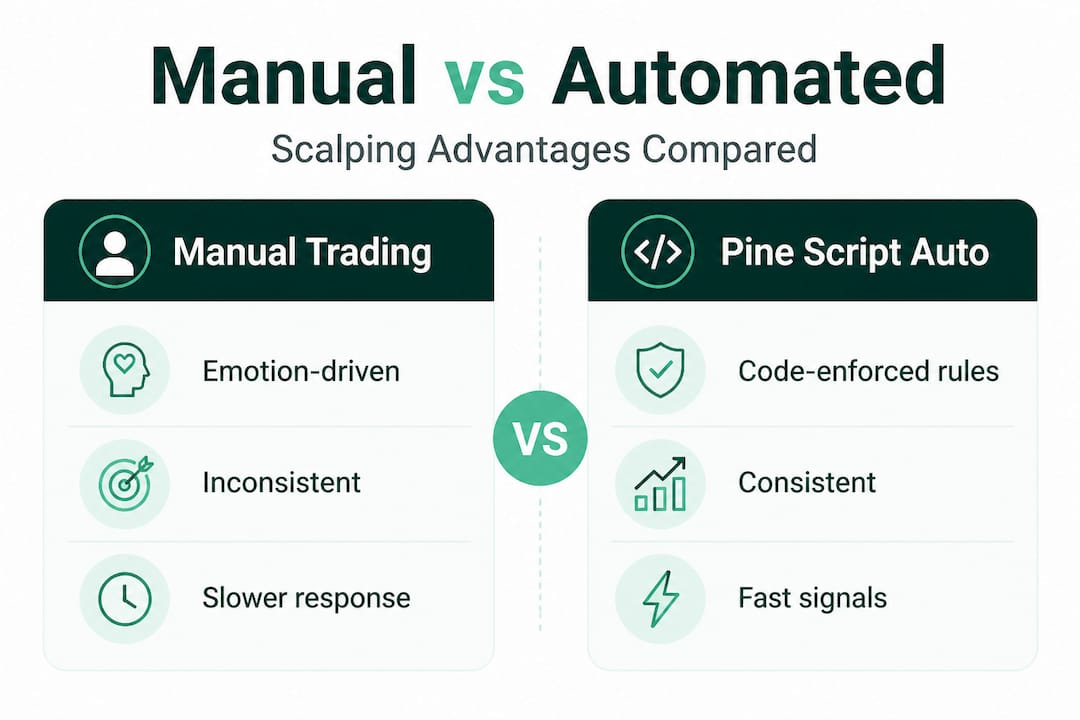
Retail traders using systematic rules report profit factors between 1.3 and 2.2, which represents meaningful consistency over time. The key word is systematic. Rules coded in Pine Script remove the human variables that cause profit factors to deteriorate in live trading.
Stat to remember: A profit factor of 1.5 means you earn $1.50 for every $1.00 risked across your trade sample. Sustained at that level over 200 or more trades, it represents a genuine edge, not luck.
The foundation of algorithmic scalping is not speed. It is repeatability. Pine Script gives you a repeatable process at a cost and complexity level that any retail trader can access. Pair that with a clear scalping strategy playbook and you have a complete framework.
Pro Tip: Always walk-forward test any new indicator before going live. Run your backtest on the first 60 percent of your historical data, then test the optimized settings on the remaining 40 percent without touching the parameters. If performance degrades severely, the logic is overfitted.
Avoiding common pitfalls: Overfitting and alert fatigue
Proper automation unlocks power, but only if you sidestep common pitfalls.
Two issues kill Pine Script strategies more reliably than any market condition: overfitting and alert fatigue. Both are avoidable. Both are extremely common.
Overfitting happens when you tune your indicator parameters so specifically to past data that the logic only "works" on the historical chart. The backtest looks excellent. Live trading tells a different story.
Signs you are overfitting:
- Your backtest win rate is above 75 percent but forward tests show 40 percent or lower
- You have more than 6 to 8 adjustable parameters in your strategy
- Small parameter changes (like shifting a length from 14 to 15) dramatically alter backtest results
- The strategy works only on one specific asset or one specific time period
"The most dangerous backtest is the one that looks too good. Consistent real-world performance requires simple, generalizable logic, not curve-fitting to specific market regimes." — A principle reinforced by active community experience across TradingView-based strategies.
The fix is walk-forward testing. Divide your historical data into segments. Optimize on the first segment, then validate on the next without adjusting parameters. Repeat across multiple segments. If your strategy holds up with modest performance across all of them, it has genuine robustness.
Alert fatigue is the second trap. When a Pine Script indicator fires too frequently, three things happen. First, you start ignoring alerts. Second, you begin selectively taking signals based on gut feel, which defeats the purpose of automation. Third, your execution degrades because you are overwhelmed.
The solution is brutal selectivity in your alert logic:
- Use confluence conditions. Require two or three independent signals to agree before firing an alert.
- Apply volatility gating. Only allow alerts during sessions with sufficient ATR-based movement.
- Limit alert frequency. Code a cooldown period so alerts cannot fire back to back within a set number of candles.
A reliable indicator for TradingView includes these filters by default. If yours does not, add them before going live. The goal is fewer, higher-confidence alerts, not maximum signal frequency. Your guide to setting up trading alerts for scalping is a solid starting point for structuring this correctly.
Leveraging TradingView and Pine Script together for scalping edge
Wielding automation safely is only half the equation. The right platform completes your edge.
TradingView is not just a charting tool. When combined with Pine Script, it becomes a full signal generation and alert delivery system across every major market. That combination is what separates it from legacy platforms that require separate tools for each function.
Here is a direct feature comparison across platforms relevant to scalpers:
| Feature | TradingView + Pine Script | MT4/MT5 + MQL | Python + custom setup |
|---|---|---|---|
| Chart integration | Native, instant | Separate IDE | Manual via libraries |
| Alert delivery | Built-in, webhook-ready | Limited webhook support | Custom code required |
| Cross-market deployment | Yes, all asset classes | Broker-dependent | Data feed dependent |
| Setup time | Minutes | Hours to days | Days to weeks |
| No-code entry point | Yes | No | No |
| Backtesting | Integrated strategy tester | Separate optimizer | Manual setup |
Key advantages of the Pine Script and TradingView combination for scalpers:
- Multiplatform asset coverage. Run identical logic on BTC/USD, EUR/JPY, and gold in the same session.
- Fast iteration. Change a parameter, hit save, and the updated indicator loads instantly on your live chart.
- Seamless chart overlays. Signal arrows, colored candles, and table readouts all display directly on the price chart without external plugins.
- Webhook alert routing. Alerts fire automatically to Discord or execution platforms without manual intervention. The webhook alerts guide walks through the full setup.
- Community and open-source access. Thousands of published scripts are available as starting points, all editable and testable for free.
For scalpers, the critical factor is deployment speed. Pine Script, compared to alternatives, consistently wins on time from idea to live chart. That matters because market conditions change and your indicators need to adapt. A tool like Smart Scalping Signals built on this infrastructure is production-ready the moment you apply it to a chart.
If you are sourcing or building your own indicator, referencing a well-structured day trading indicator gives you a clear baseline for what a complete, functional setup looks like.
Why most traders misuse Pine Script—and what actually works
You have seen the technical benefits. Now here is what most guides and forums get wrong about Pine Script for scalping.
The most common mistake is complexity addiction. Traders spend weeks building indicators with eight input parameters, four filter conditions, and three confirmation layers. The backtest looks immaculate. Then they go live and the strategy falls apart within two weeks. The reason is almost always the same: too many parameters, too little robustness.
The traders who consistently pull profit from Pine Script setups are doing something different. They commit to one or two entry setups with clear, simple logic. They define their stop and target rules once and leave them alone. They spend most of their review time analyzing live trade data, not tweaking parameters on a historical chart.
There is an uncomfortable truth here. A simple exponential moving average crossover with an ATR stop, properly walk-forward tested and applied with discipline, will outperform a complex multi-indicator system that was optimized on backtests but never validated on fresh data. Simplicity generalizes. Complexity overfits.
The other thing most guides miss is the importance of alert quality over quantity. We see traders set up indicators that fire 40 or 50 alerts per session, then wonder why they are not profitable. That volume makes consistent execution impossible. The best strategy playbook setups target 5 to 15 high-confidence alerts per session. That is a number a human can act on without cognitive overload.
The scalpers who make this work long term share a specific habit. They review live trade outcomes weekly, not after backtests, and they adjust based on what the market is actually doing now, not what it did 12 months ago. Pine Script makes that iteration fast. Use that speed wisely by validating forward, not backward.
Ready to boost your scalping? Get premium Pine Script indicators
With a clear strategy, the final edge comes from using proven tools. Here is where to find them.
Building your own indicators from scratch takes time that most active scalpers do not have. Getting it wrong in live trading costs real money. That is exactly why we built our indicator suite at Scalping-Algo: purpose-built for retail scalpers who need production-ready tools, not weekend projects.
Every indicator we offer runs on Pine Script v6 with real-time, non-repainting signals across crypto, forex, and commodities. Features like ATR stop losses, partial take profit automation, volatility gating, and divergence detection are built in, not bolted on. The Algo Master suite packages the full system into one deployable toolkit, while individual tools like the Momentum Oscillator give you targeted precision for specific market conditions. Start with a free trial and see the difference structured, tested logic makes on your own charts.
Frequently asked questions
What is Pine Script, and why is it used in TradingView?
Pine Script is TradingView's built-in scripting language that lets traders automate custom strategies, indicators, and alerts directly on their charts. Its tight TradingView integration makes it the fastest path from strategy idea to live signal for retail traders.
How do Pine Script indicators help with risk management for scalping?
They automate logical rules like ATR stop losses and partial take profits so every trade follows the same risk structure without manual calculation. Traders using these rules consistently report profit factors between 1.3 and 2.2 across crypto, forex, and gold.
Can Pine Script indicators be used for automated trading across markets?
Yes, a single Pine Script indicator deploys instantly on TradingView for crypto, forex, and commodities without any modifications. This cross-market capability is one of its biggest advantages over broker-specific tools like MQL5.
Is Pine Script suitable for high-frequency trading (HFT)?
No, Pine Script is built for charting, signal generation, and alert delivery, not microsecond execution. As the comparison with MQL5 and Python confirms, it is limited for HFT but highly effective for human-speed scalping.
How do you avoid overfitting when building Pine Script indicators?
Always walk-forward test on out-of-sample data and keep your logic simple with as few parameters as necessary. The community consistently emphasizes walk-forward testing as the only reliable way to separate genuine edge from curve-fitted backtest performance.