

Signal confluence scalping stacks two to three independent confirmations, like trend, momentum, and volume, before you pull the trigger on a short-term trade. The payoff is fewer false entries and tighter risk on 1m to 15m charts. Confluence works when the signals genuinely disagree with each other most of the time and only agree at real turning points. Below is the exact rule set: correlation checks, confirmation windows, and an execution checklist you can run today.
TL;DR:
- Using two to three independent confirmations, including trend, momentum, and volume signals, can significantly reduce false entries and improve trade accuracy.
- Combining uncorrelated indicators, such as trend filters, mean-reversion zones, and momentum triggers, creates a reliable confluence setup that filters market noise.
- A disciplined approach requires setting a short confirmation window, checking indicator correlation, and weighting signals by conviction to maintain strategy reliability.
- Automated tools like Scalping-Algo's scripts and dashboards streamline confluence detection, backtesting, and execution, reducing manual errors and time spent analyzing charts.
- Successful scalping depends on strict rules, small sample testing, and managing trade risk based on confluence rather than relying solely on visual certainty.
Table of Contents
- What Signal Confluence Scalping Actually Means
- Which Indicators Should You Stack?
- How Do You Build Stacking Rules That Hold Up?
- Running the Trade: Entry to Exit Checklist
- How Scalping-Algo Puts Confluence Into Practice
- Tran's Perspective: What Good Confluence Actually Looks Like
- Put Your Stacking Rules on Autopilot
- Sources
- FAQ
What Signal Confluence Scalping Actually Means
Scalping runs on thin margins. Most scalp trades target a small number of pips and hold for anywhere from a few seconds to a few minutes, according to the SEC's investor guidance on day trading. At that speed, a single indicator flashing "buy" is barely more reliable than a coin flip; market noise on a 1-minute chart drowns out most solo signals before you can react.
Confluence trading signals fix this by requiring agreement. When two uncorrelated indicators point the same direction at the same moment, the odds of a real move improve. Two independent signals running at moderate accuracy each can combine to improve accuracy substantially, provided the signals genuinely don't move together, according to research on signal stacking techniques. That's the entire case for stacking: it filters noise mathematically, not just intuitively.
It's not free. Every confirmation you add costs time, and time is the one thing a scalper can't spare. Waiting for a third signal to line up often means the move already happened. Stack too many correlated tools and you get a false sense of certainty instead of an edge.
Where confluence earns its keep:
- Cuts entries on random chop by forcing agreement across signal types.
- Builds confidence to size a trade properly instead of hesitating.
- Filters out low-quality setups before they cost you a stop-out.
- Creates a repeatable rule set instead of gut-feel trading.
The tradeoff is speed versus certainty. Good scalpers pick a stack that resolves fast, not one that feels thorough on paper.
Which Indicators Should You Stack?
Not all confluence trading setups are created equal. Some indicator pairs genuinely confirm each other. Others just repeat the same information in a different color, which gives you false confidence instead of real confirmation.
Trend indicators (moving averages, EMA crossovers, or a higher-timeframe trend read) act as permission slips. They don't trigger entries; they tell you which direction you're even allowed to trade. A 5-minute chart trading with the 15-minute trend behind it screens out a huge share of counter-trend scalps that otherwise look tempting.
Mean-reversion anchors like VWAP and Fibonacci retracement levels mark where price is statistically stretched. These give you entry zones, not triggers. Price touching VWAP after a trend pullback is a location, not a reason to click buy.
Momentum indicators (RSI, MACD) supply the trigger. This is where the actual entry decision gets made, usually on a divergence, a crossover, or a momentum shift confirming the zone from your mean-reversion anchor.
Volume and volatility filters decide whether you should even be in the market right now. Low volume kills follow-through. An ATR-based volatility gate stops you from sizing a normal position into an abnormally quiet or abnormally wild session.
Good pairing: higher-timeframe trend + VWAP zone + RSI trigger + volume confirmation. Each layer answers a different question. Redundant pairing: RSI plus stochastic. Both are momentum oscillators built on nearly identical math, so they tend to move together and create an illusion of agreement.

Pro Tip: Before adding an indicator to your stack, ask what question it answers that your existing tools don't. If you can't name a new question, drop it.
How Do You Build Stacking Rules That Hold Up?
Confluence only works with discipline around timing and correlation. Loose rules turn a stacking strategy into confirmation bias with extra steps.
- Set a confirmation window. For 1m to 5m scalps, treat same-candle or next-candle confirmation as the standard. Anything beyond roughly 10 minutes stops counting as genuine confluence for fast timeframes, per signal-stacking timing guidance; some practitioner workflows use a short time window as the cutoff for a second channel to fire before a stack qualifies as a trade candidate.
- Check correlation before you trust a stack. Two indicators with correlation above roughly 0.4 tend to fire together and fail together. Run a rolling correlation check on your two go-to indicators; if they move in lockstep, you're not stacking signals, you're duplicating one.
- Weight signals instead of counting them equally. A weighted "stacked score," giving more weight to your highest-conviction signal type and less to a secondary confirmation, produces better sizing decisions than a flat yes/no checklist.
- Cap risk to the stack's actual reliability. A half-Kelly sizing cap keeps position size from ballooning just because three lights turned green at once.
- Downgrade serial confirmations. A signal that confirms three candles after the first is weaker evidence than two signals firing on the same candle. Treat delayed confirmation as a lower-confidence entry, not equal to a simultaneous stack.
Running the Trade: Entry to Exit Checklist
A confluence stack means nothing without disciplined execution behind it. Here's the workflow that turns signal analysis for scalping into an actual, repeatable trade.
- Pre-session prep. Build a watchlist of 3 to 5 instruments, confirm you're trading inside a high-volume window, and check that your charts and alerts are already loaded before the session opens.
- Entry checklist. Require your full stack, trend permission, a mean-reversion zone, and a momentum trigger, to be present before entry. Favor limit orders over market orders where possible; passive limit orders reduce the spread leakage that quietly erodes a backtested edge, according to CME Group's research on true trading costs.
- Stop and target placement. Set stops just beyond the structure that invalidates your setup, not an arbitrary pip count. A 1:1.5 or 1:2 risk-to-reward ratio is typical for scalps; trail only once price clears your first target.
- Position sizing and daily stop. Size each trade off account risk, not conviction, and set a hard daily loss limit you don't override mid-session.
- Post-trade review. Log slippage, entry delay, and whether every checklist item actually confirmed before you clicked. Adjust the stack based on the log, not on memory.
Regulatory note: U.S. day traders operating in margin accounts fall under FINRA's pattern day trader rules, which have historically required $25,000 in minimum equity for frequent day trading, with margin requirements and enforcement details still evolving under FINRA's updated intraday margin guidance. Check your broker's specific margin terms before sizing up.
How Scalping-Algo Puts Confluence Into Practice
Confluence rules are only as good as the tools running them in real time. Scalping-Algo's suite is built in Pine Script v6 and generates non-repainting signals on 1m to 15m charts, so the confirmation you see on your screen is the confirmation you actually get, not one that repaints after the fact.
Here's how the features map onto the checklist above:
- Volatility gating filters out low-quality setups before a trend or momentum signal even fires, functioning as your ATR-style volatility check automatically.
- Divergence detection handles momentum-trigger confirmation without manual RSI reading.
- Native Discord webhook alerts deliver the stacked signal the moment it confirms, cutting the lag between confluence and execution.
- The backtesting dashboard logs how a given stack performed historically, which is evidence of past behavior, not a promise of future results.
All scripts are open-source, so you can verify the logic instead of trusting it blind.
Tran's Perspective: What Good Confluence Actually Looks Like
The most common mistake isn't too few signals, it's redundant ones dressed up as a stack. Second is waiting too long for a "perfect" setup that's already gone by the time it confirms. Third is oversizing because three indicators agreed, as if agreement guarantees the outcome.
Run small live samples first, then backtest 100 to 500 trades before trusting a stack with real size. Trade the rules you wrote down, not the feeling of certainty a clean-looking chart gives you. That feeling is exactly what gets scalpers into trouble.
— Tran
Put Your Stacking Rules on Autopilot
Building a confluence stack by hand, watching four indicators across three timeframes while a 5-minute candle closes, is where most scalpers lose the edge they just calculated. Scalping-Algo's Smart Scalping Signals automate exactly the checklist above: trend permission, momentum trigger, and volatility gating fire together as one non-repainting alert instead of four separate charts you have to reconcile in your head.
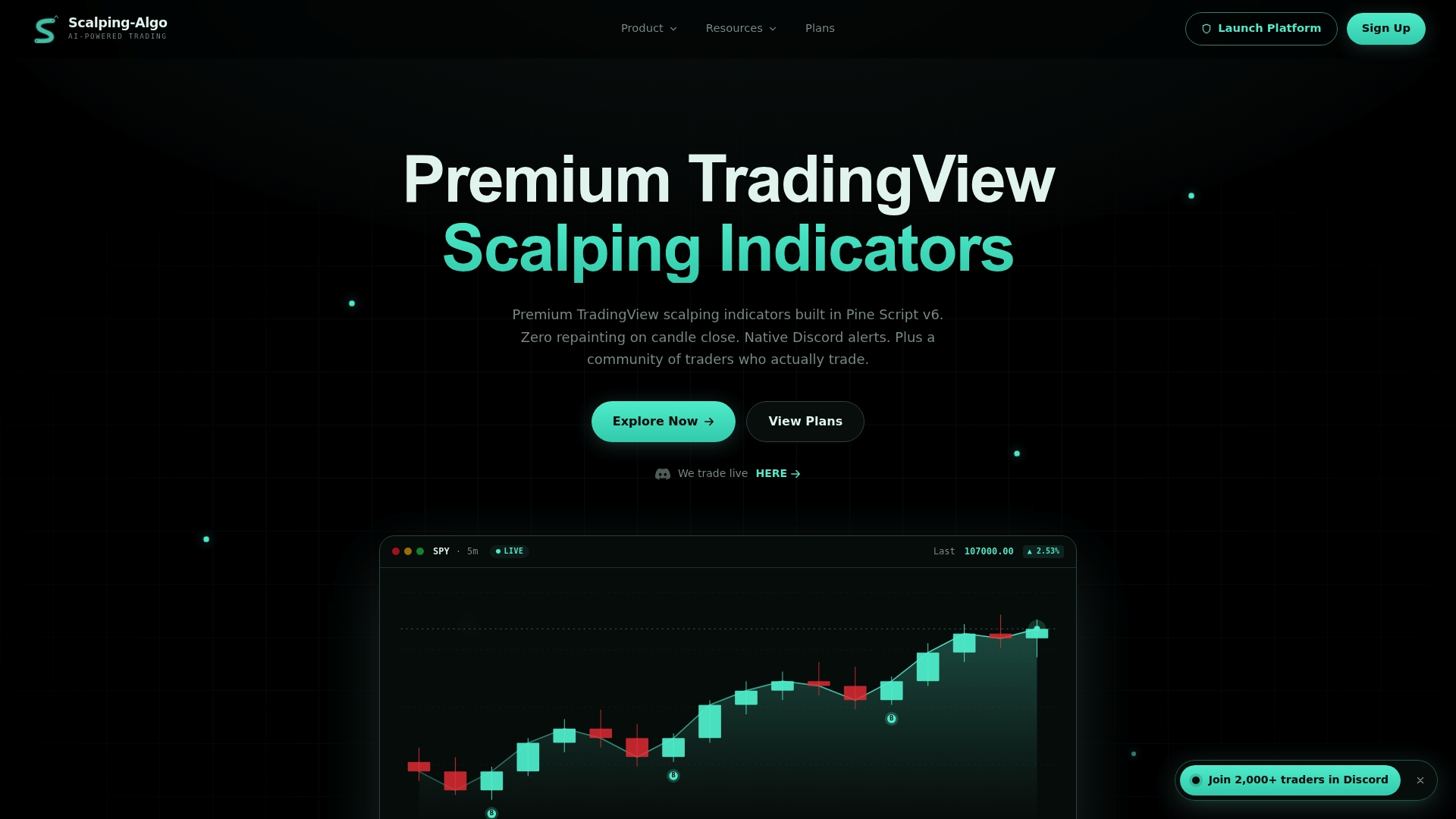
The Edge Finder indicator flags high-probability confluence zones directly on your chart, and the backtesting dashboard keeps a running log so you can verify a stack's real performance before risking size on it. Every script ships open-source, so nothing about the logic is hidden. Plans run $79 per month, $799 per year, or $1,999 for lifetime access to the full indicator suite, Discord alerts, and mentorship community. Check current plan details and start applying stacked confirmations on your next session.
Sources
- Day Trading and margin guidance — SEC / Investor.gov
- What is the true cost of trading in FX markets? — CME Group
- Signal Stacking Techniques: Multi-Layer Market Activity Score Confirmation — EdgeView
This article is general information, not a substitute for advice from a qualified financial advisor. Consult a qualified financial professional about your own circumstances before acting on anything here.
FAQ
What Is the Most Powerful Indicator for Scalping?
No single indicator holds up alone at scalping speed. Combining a trend filter, a momentum trigger like RSI or MACD, and a volume or volatility check tends to outperform any one tool used in isolation, which is the entire logic behind confluence trading signals.
Is It Possible to Make $200 a Day Day Trading?
It's possible on some days, but not reliably, since day trading carries real risk of losses that can exceed your account balance when leverage is involved, according to Investor.gov's guidance on day trading risk. Consistent daily targets depend far more on position sizing and win rate than on any single strategy promise.
Who Is Considered the Best Scalper Trader in the World?
There's no verified, universally recognized "best" scalper, since most professional trading results aren't publicly audited or disclosed. Reputation in scalping circles tends to track consistency and risk discipline over time, not any single standout trade.
What Is the Most Successful Scalping Strategy?
Strategies built on stacked, independent confirmations, trend, momentum, and volume together, tend to outperform single-indicator approaches because they filter out more false signals. Tools like Scalping-Algo's Smart Scalping Signals automate that stacking process directly on the chart so the confirmation logic stays consistent trade after trade.