

Single-indicator scalping is one of the most common traps short-term traders fall into. You get a buy signal, take the trade, and watch price immediately reverse. The signal was technically valid, but without confirmation from other sources, it was never a high-probability setup. Confluence methods fix this problem by requiring multiple signals to align before you enter. The result is fewer trades, better quality, and dramatically fewer false entries. This guide covers exactly how confluence works in scalping, the tools you need, how to build a strategy, and how to automate and optimize it over time.
Table of Contents
- What are scalping confluence methods?
- Core tools and requirements for scalping confluence
- Step-by-step: Building a confluence scalping strategy
- Automating confluence strategies: Challenges and solutions
- Measuring and optimizing your results
- The uncomfortable truth about scaling confluence: Lessons from automation
- Discover proven scalping confluence tools with Scalping-Algo
- Frequently asked questions
Key Takeaways
| Point | Details |
|---|---|
| Confluence reduces false signals | Combining multiple indicators minimizes the risk of entering low-probability trades. |
| Tools and platform matter | Reliable platforms and premium indicators are essential for successful confluence-based scalping. |
| Start small, scale cautiously | Always test strategies in simulation and increase live sizes gradually to avoid hidden pitfalls. |
| Continuous optimization is key | Tracking performance metrics and tweaking your setup regularly ensures long-term improvement. |
What are scalping confluence methods?
Confluence in scalping means combining two or more independent trading signals that point to the same trade direction before executing. No single signal gets the green light on its own. Instead, you wait for agreement across multiple sources. When they align, the trade probability goes up significantly.
Defining confluence and applying it to scalping is one of the most effective ways to reduce false entries in fast-moving markets. The logic is straightforward: if three unrelated tools all say "buy," you have a much stronger case than if only one does.
Common sources of confluence include:
- Price action signals: Candlestick patterns, pin bars, engulfing candles near key levels
- Moving averages: Price respecting a 9 EMA or 21 EMA on a 5-minute chart
- Market structure: Higher highs, higher lows, or a clear break of structure
- Order blocks: Institutional price zones where large orders previously moved the market
- Volume spikes: Unusual volume confirming directional momentum
- Oscillators: RSI crossing 50, MACD histogram flipping positive
Here is a quick comparison of single-indicator trading versus confluence-based trading:
| Factor | Single indicator | Confluence-based |
|---|---|---|
| False entry rate | High | Significantly reduced |
| Signal frequency | High | Filtered and selective |
| Win rate potential | Moderate | Higher |
| Confidence per trade | Low | High |
| Setup complexity | Simple | Moderate |
| Execution speed | Fast | Requires coordination |
The table makes one thing clear. You trade less, but each trade you take carries more weight. That is the core philosophy of confluence scalping. Use our trade signal confluence guide to go deeper on how to layer signals correctly for short-term setups.
Core tools and requirements for scalping confluence
With the foundation of what confluence methods are, the next step is to ensure you have the right tools and prerequisites to put them into practice. Missing any one of these can undermine your entire strategy, especially at the execution speed that scalping demands.
Indicator selection and platform setup are critical steps that traders frequently rush through. Getting this right from the start saves hours of debugging later.
Here is what you need to run a proper confluence scalping setup:
- Reliable trading platform: TradingView for charting and signal generation, MetaTrader for execution if needed
- Multi-indicator suite: At minimum two to three non-correlated indicators (for example, a trend filter plus a momentum oscillator plus a structure tool)
- Fast data feeds: Tick-level or second-level data for accurate signal generation on 1m to 5m timeframes
- Broker API access: Required if you want to automate order execution directly from TradingView alerts
- Backtesting capability: Essential for validating your confluence rules before going live
- Alert system: Native TradingView alerts, webhook to Discord, or third-party execution bridges
| Tool | Purpose | Cost range |
|---|---|---|
| TradingView Pro | Charting, alerts, Pine Script | $15 to $60/month |
| Premium indicator suite | Signal generation | Varies |
| Execution bridge | API order routing | Free to $50/month |
| Discord webhook | Alert delivery | Free |
| Backtesting engine | Strategy validation | Built-in or third party |
Resources on using trading indicators and intraday trading indicators will help you select the right combination for your specific markets and timeframes.
Pro Tip: Always verify that your chosen indicators are non-repainting before deploying them on live accounts. Repainting indicators look great in backtests but produce misleading signals in real time. Check this before anything else.
Step-by-step: Building a confluence scalping strategy
Once your tools are in place, it is time to bring them together into a practical, actionable strategy. The goal here is a clear workflow you can repeat consistently without second-guessing each trade.

Combining multiple indicators yields better entry signals, but only when each indicator serves a distinct role. Do not stack three momentum tools and call it confluence. You want signals from different categories, each confirming the same direction from a different angle.
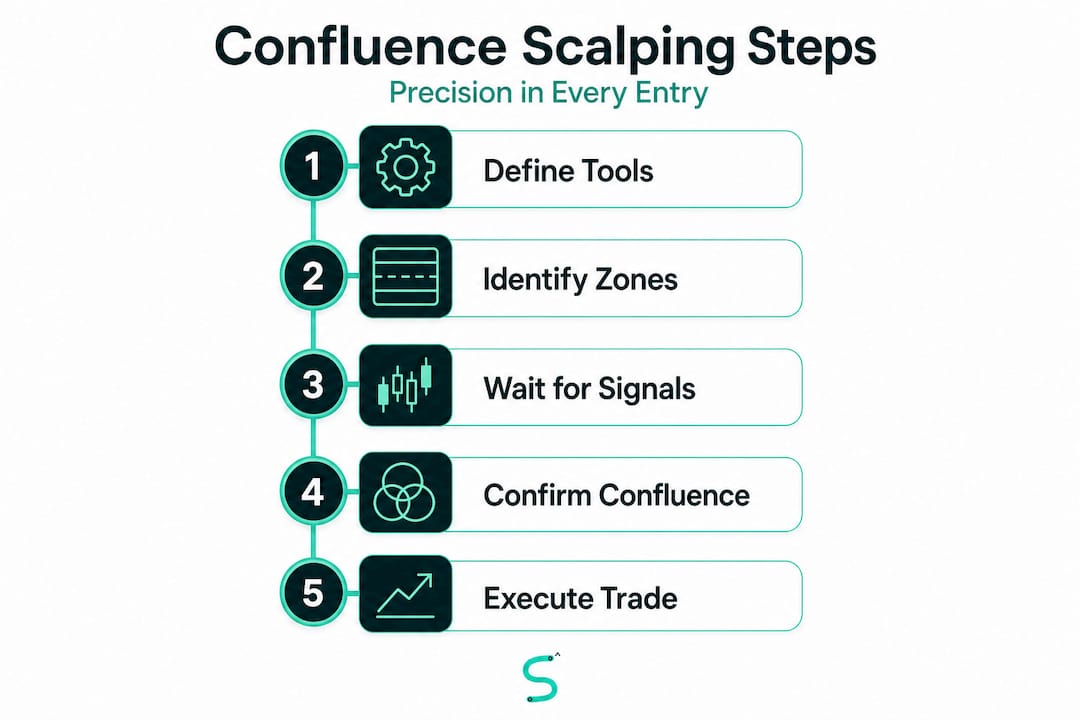
Here is a proven step-by-step process:
-
Choose your primary trend tool. This filters trade direction. Examples: 200 EMA, VWAP, or a higher timeframe trend indicator. You only take longs above it, shorts below it.
-
Add a momentum confirmation tool. This tells you the current candle or bar has directional energy. Examples: MACD crossover, RSI above 50 for longs, or a dedicated momentum oscillator.
-
Include a structure or zone tool. This identifies where price is likely to react. Examples: support and resistance levels, order blocks, or supply and demand zones.
-
Define your confluence rules. Write them out explicitly. For example: "I will only take a long if price is above the 200 EMA, RSI is above 50, and price has just bounced from a marked support zone." All three must align.
-
Map your entry, exit, and risk parameters. Decide entry trigger (first candle close above a level, for example), stop loss placement (below the structure zone), and take profit target (next resistance or a fixed risk/reward ratio like 1:2).
-
Document every rule in a strategy doc. No ambiguity. If you have to think about whether a trade qualifies, it probably does not.
-
Backtest the rules manually or with an automated engine. Run at least 50 to 100 setups on historical data before going live.
Check the scalping strategy playbook for detailed examples of multi-indicator setups, and the best TradingView indicator breakdown to help narrow your choices.
Pro Tip: Signal quality beats signal quantity every time. A setup with two rock-solid confluence factors is better than one with five weak overlaps. Keep your rules tight and resist the urge to keep adding layers until a trade qualifies.
Automating confluence strategies: Challenges and solutions
Having mapped out your strategy, exploring automation offers additional efficiency. But it comes with specific challenges that you should prepare for before you go live.
Why automate? Speed is the main reason. On 1m and 3m charts, a signal can appear and close in seconds. Manual execution often means entering late, which shifts your risk/reward unfavorably. Automation eliminates that delay. It also removes emotional decision-making, which is one of the biggest destroyers of confluence discipline.
However, slippage and latency impact automated scalping effectiveness far more than most traders expect. Here are the key challenges:
- Slippage: Your bot sends an order at $1.2050, but it fills at $1.2053. On a tight scalp targeting 10 pips, that 3-pip slippage eats 30% of your target instantly.
- Latency: Time between signal generation and order placement. Even 200ms can matter on 1m charts during volatile sessions.
- Partial fills: You want to buy 10 contracts, but only 7 fill at your price. The rest fill at a worse level, distorting your intended risk/reward.
- API downtime: Broker or exchange APIs can go offline during high-volatility periods, exactly when you want to be trading.
- Over-optimization: Strategies tuned too tightly to historical data fail to adapt to changing market conditions.
"Automation should be tested in simulated/backtest modes and then cautiously in small live sizes to reveal execution gaps."
Solutions that work in practice:
- Use efficient trading alerts with native webhook delivery to reduce latency in alert routing.
- Read up on algorithmic trading benefits to understand where automation genuinely helps versus where it adds complexity without gain.
- Start with a paper trading or simulation account. Run your bot for at least two to four weeks in sim mode before touching live capital.
- Scale position sizes gradually. Start at minimum lot sizes even after successful backtests.
- Use the Edge Finder indicator to filter only the highest-quality signal environments, reducing the number of live trades your bot needs to execute.
Automation works best when your manual strategy is already proven. Never automate a strategy you have not validated manually first.
Measuring and optimizing your results
Once you have run your automated or manual confluence strategy, tracking and optimizing your performance is what separates consistent traders from those stuck in a cycle of strategy-hopping.
Ongoing optimization and performance tracking are critical components that many traders skip entirely, focusing only on finding the next great setup rather than refining what already works.
Key metrics to track every week:
- Win rate: What percentage of confluence trades close profitably? Target above 55% for scalping.
- Average gain vs. average loss: A 50% win rate with a 1.5:1 reward-to-risk ratio is profitable. Track these separately.
- Missed signals: How often did a valid setup appear but you or your bot did not execute? High missed-signal rates indicate workflow problems.
- Execution quality: Compare your intended entry price to actual fill price. This measures slippage in real terms.
- Signal breakdown by confluence type: Which combinations perform best? Which are lagging?
| Metric | Simple confluence | Advanced confluence |
|---|---|---|
| Win rate | 50 to 55% | 58 to 65% |
| Avg risk/reward | 1:1.5 | 1:2 or better |
| Signal frequency | Higher | Lower but filtered |
| False entry rate | Moderate | Low |
| Optimization effort | Low | Requires regular review |
Use intraday indicator optimization techniques to adjust your signal overlap rules based on what your performance data actually shows. If your three-factor confluence rule is generating 60% win rates but your two-factor rule is at 45%, that tells you the third filter is doing real work. Keep it.
Review your results at minimum every two weeks. Markets shift. What worked on Bitcoin's volatility in January may stop working in April. Your job is to notice when a strategy starts drifting and tighten or adjust accordingly.
The uncomfortable truth about scaling confluence: Lessons from automation
Here is what most guides will not tell you: even a well-built, thoroughly backtested confluence strategy can fall apart in live markets, and the reason is almost never the logic. It is execution.
We have seen traders build technically sound three-factor confluence systems, run two months of clean backtests, then go live and watch the system underperform by 30 to 40% in the first week. Why? Because partial fills and slippage catch even seasoned traders off guard. A backtest assumes perfect fills at the signal price. Live markets do not work that way, especially on 1m and 3m charts during news events or low-liquidity windows.
The other overlooked issue is strategy coupling. When you automate a confluence system, each layer of the strategy depends on the others working correctly. If one indicator fires a signal 200ms late due to a data feed delay, the whole chain breaks. Your entry triggers but the confluence condition that was supposed to validate it has already shifted. You just took a solo-indicator trade inside a confluence wrapper.
What this means practically is that your Scalping Algo Indicator setup needs buffer rules built in, not just signal rules. For example, if a signal fires but price has already moved more than a set number of ticks past the trigger level, skip the trade entirely. This protects you from chasing fills that already negated your original entry logic.
Pro Tip: Always start with minimum position sizes in live trading, regardless of how confident your backtest results make you feel. The first 30 to 50 live trades are data collection, not profit generation. Treat them that way.
The hard truth is that confluence methods are not a shortcut to effortless profits. They are a discipline. They require you to say no to most trades so the ones you do take are genuinely high-probability. That discipline is harder to maintain than any indicator setup.
Discover proven scalping confluence tools with Scalping-Algo
If you have worked through this guide and want to skip the trial-and-error of building your own confluence stack from scratch, we have built exactly what you need.
Scalping-Algo offers institutional-grade, non-repainting indicators engineered specifically for confluence-based scalping on TradingView. The Smart Scalping Signals tool generates real-time buy and sell signals with built-in confluence filtering, optimized for 1m to 15m charts across crypto, forex, and futures. The Algo Master suite packages multiple confluence tools into one integrated system, complete with alerts, backtesting, and webhook support. For traders focused on identifying edge in real time, the Edge Finder Indicator isolates high-probability setups by filtering market noise automatically. Browse all available Scalping-Algo indicators and find the right fit for your strategy.
Frequently asked questions
What does confluence mean in scalping?
Confluence in scalping means combining multiple independent trading signals, such as indicators, price zones, or structure levels, to confirm a trade before entry, increasing the probability of a successful outcome.
Which tools are best for automated confluence scalping?
TradingView, MetaTrader, and premium indicator suites like Scalping-Algo are among the best for combining signals, as platform setup and indicator selection directly determine how well your confluence rules execute in real time.
How can I avoid slippage in automated scalping?
Minimize slippage by testing in backtest mode first, then gradually scaling up live account size over several weeks while monitoring actual fill quality against your intended entry prices.
What metrics should I track to optimize confluence strategies?
Track win rate, average gain versus average loss, missed signals, and execution quality weekly, as performance tracking data shows which confluence combinations are genuinely improving results and which are adding noise.