

Markets move fast. Blink at the wrong moment and a setup you spent hours analyzing closes without you. The role of real time alerts in trading is to solve exactly that problem. Instead of staring at charts for hours waiting for a level to be hit, you let the system watch for you. Alerts fire the moment conditions are met, putting you in position to act before the opportunity disappears. For scalpers, day traders, and longer-term investors alike, building a reliable alert system is not optional anymore. It is how serious traders protect their edge.
Table of Contents
- Key Takeaways
- The role of real time alerts: how they actually work
- Why real time alerts matter for your trading strategy
- Common pitfalls and how to optimize your alerts
- How different trading styles use real time alerts
- My take on what most traders get wrong with alerts
- Take your alerts further with Scalping-Algo
- FAQ
Key Takeaways
| Point | Details |
|---|---|
| Alerts replace screen watching | Real-time alerts notify you the moment a threshold is hit, freeing you from continuous monitoring. |
| Pre-set conditions reduce emotion | Defining alert rules in advance keeps decisions based on logic, not in-the-moment fear or greed. |
| Alert fatigue is a real risk | Overly sensitive alerts trained on no baseline data create noise and cause traders to ignore signals. |
| Multi-condition rules improve accuracy | Combining price, volume, and indicator triggers reduces false positives and sharpens entry quality. |
| Discipline requires ongoing tuning | Effective alerting is not a one-time setup. It demands regular review and threshold adjustments. |
The role of real time alerts: how they actually work
A real-time alert is a notification triggered the moment a pre-defined condition is met in a live data stream. That is the key distinction from delayed or batch notifications, which group updates and push them on a schedule. In trading, a five-minute delay can mean the difference between catching a breakout and chasing it at the top.
Here is how real time alert systems generate signals:
- Price threshold triggers: An alert fires when an asset crosses a specific price level, such as breaking above resistance or dropping below a moving average.
- Volume anomaly detection: Sudden spikes in volume often precede major moves. Alert engines monitor volume relative to rolling averages and flag abnormal activity.
- Technical indicator events: Conditions like RSI crossing 70, MACD crossovers, or a Bollinger Band squeeze completion can be coded as alert triggers.
- Economic event proximity: Some systems alert traders when a scheduled release, like a Non-Farm Payroll report, is approaching.
- Streaming data vs. polling: Premium alert systems use continuous data streams with near-zero latency. Cheaper setups poll data every few seconds, which introduces lag precisely when speed matters most.
Real-time monitoring tools ingest data from multiple sources continuously, enabling immediate anomaly detection and faster response. In practical trading terms, that means your alert fires in under a second after the condition is met. That speed is the entire point.
Why real time alerts matter for your trading strategy
Most traders underestimate how much time they lose to passive chart watching. Sitting in front of screens for hours waiting for a setup to materialize is mentally exhausting, and exhaustion breeds bad decisions. Real-time alerts shift that equation completely.
Here is exactly what you gain:
- Faster execution on real opportunities. When an alert fires, you already know what the condition means and what your response should be. There is no deliberation. You act.
- Reduced emotional trading. Setting price alerts at key technical levels means your entry decisions are made before the market pressure hits. You are not reacting to a candle in real time. You are executing a pre-planned trade.
- Better risk management timing. Stop-loss and take-profit alerts keep you informed when positions approach critical zones, even when you are away from your desk.
- Scalping precision. On one-minute and five-minute charts, a single missed candle can invalidate a setup. Scalping with real-time signals only works when your alerts fire with zero noticeable delay.
- Protection for swing traders. Swing and position traders can set daily alerts on weekly support levels and check in only when something meaningful happens, instead of babysitting positions around the clock.
The broader importance of real time alerts comes down to one thing: replacing reactive trading with planned execution. Real-time alerts empower investors to engage strategically rather than emotionally by alerting only when specific, pre-determined market conditions occur. That alone is worth more than any indicator.
Pro Tip: Set your alerts before the trading session opens, not during it. Configuring alerts mid-session while price is moving introduces bias and rushed threshold choices.

Common pitfalls and how to optimize your alerts
The biggest problem traders run into with alerts is not missing them. It is being overwhelmed by them. Alert fatigue is real, and it is what happens when your notification system cries wolf too many times.
Here are the main pitfalls and the fixes:
- Overly sensitive thresholds. If your alert triggers every time price moves 0.1%, you will get dozens of alerts per hour. Most will be irrelevant. To set meaningful thresholds, use at least 30 days of historical data to identify what a genuine signal looks like versus normal market noise.
- No alert runbooks. An alert without a clear action plan is just noise. As a discipline, every alert you create should have a defined response: enter the trade, check the higher timeframe, or wait for confirmation. Alerts lacking a runbook get ignored, which defeats the purpose entirely.
- Triggering on transient spikes. Price wicks can briefly touch a level and immediately reverse. Sustained anomaly triggers, built using rolling time windows, prevent one-candle false fires from pulling you into a bad trade.
- Ignoring severity routing. Not all alerts carry equal urgency. A level being approached is different from a level being broken with momentum. Alert correlation and deduplication techniques group related signals and push only the most relevant notification, reducing clutter dramatically.
The table below compares the impact of unoptimized versus optimized alert configurations:
| Alert setup | Notifications per session | False positives | Response quality |
|---|---|---|---|
| No baseline, instant trigger | 40+ | High | Reactive, inconsistent |
| Baseline + rolling window | 8 to 12 | Low | Planned, consistent |
| Multi-condition + severity routing | 3 to 6 | Very low | Precise, high confidence |
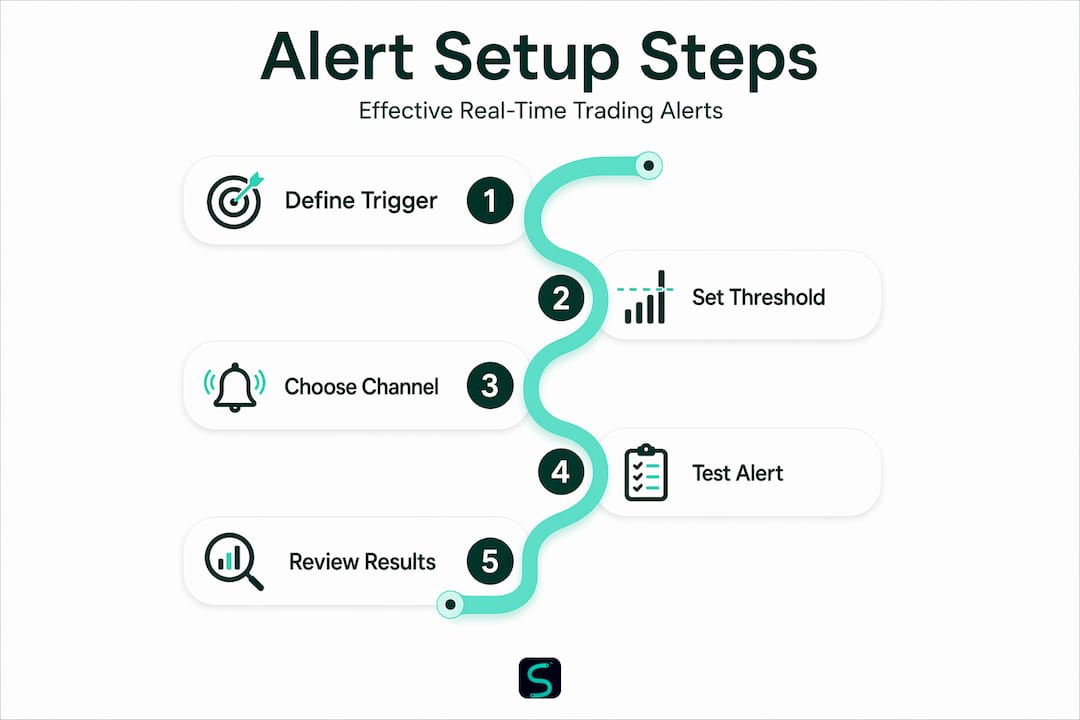
Pro Tip: Start with fewer alerts and add more as you learn what conditions genuinely precede your best setups. It is far easier to add alerts than to sift through a broken, noisy system.
How different trading styles use real time alerts
Real time alert applications vary significantly depending on how you trade. There is no universal setup. What works for a scalper running a one-minute chart is completely different from what a swing trader needs on a daily timeframe.
Here is how each style benefits:
- Scalpers set alerts for micro-level breakouts, volume surges, and indicator crossovers on one-minute to five-minute charts. Speed is critical. These traders also use webhook trading alerts to route signals directly into execution environments like Discord bots, cutting the manual step between alert and action.
- Day traders focus on intraday support and resistance levels, session highs and lows, and pre-market gap alerts. They typically set five to ten targeted alerts per session rather than flooding their phones with notifications.
- Swing traders monitor weekly and daily chart key levels. An alert that fires when price returns to a key moving average after a pullback gives them time to evaluate before committing. Setting trading alerts correctly on higher timeframes keeps them strategic without demanding constant attention.
- Long-term investors use economic event alerts and macro-level price thresholds. When gold drops to a historical demand zone, for example, an alert pulls them back to the chart at exactly the right moment.
The table below outlines recommended alert types by trading style:
| Trading style | Recommended alert types | Typical timeframe | Average alerts per day |
|---|---|---|---|
| Scalping | Volume spike, indicator crossover, breakout | 1m to 5m | 15 to 30 (pre-filtered) |
| Day trading | Session level breaks, gap fills, RSI extremes | 5m to 1H | 5 to 10 |
| Swing trading | Moving average tests, weekly S/R levels | 4H to Daily | 1 to 5 |
| Long-term investing | Macro price zones, economic event proximity | Daily to Weekly | 1 to 3 |
The benefits of instant notifications compound differently depending on your timeframe. For scalpers, they are critical for every trade. For investors, they are periodic reminders to pay attention. In both cases, they prevent the worst outcome: missing a move because you were not watching.
My take on what most traders get wrong with alerts
I have watched traders spend hours configuring indicators and zero minutes thinking about their alert setup. That is backwards. In my experience, the alerting layer is where most traders lose their edge, not in the indicator selection itself.
The most common mistake I see is treating alert setup as a one-time task. You configure it once, the market changes its character, and suddenly your alerts are firing at the wrong levels or not firing at all. Alerting requires continuous tuning based on actual market behavior, not a set-it-and-forget-it approach.
The second mistake is automation overconfidence. Just because an alert fires does not mean the trade is valid. I have seen traders take every alert as an order, removing their own judgment from the equation entirely. That is not trading. That is outsourcing your risk to an algorithm without understanding it.
What I have learned is that the best traders treat alerts as a filter, not a trigger. The alert gets your attention. You confirm the context. Then you execute. That human layer between alert and action is the thing that separates consistent traders from those who blow accounts on automated noise.
Build your alerts carefully. Review them weekly. And never let an alert fire that you cannot immediately explain and act on with confidence.
— Tran
Take your alerts further with Scalping-Algo
If you have been manually setting price alerts in TradingView and wondering why your entries still feel a step behind, the issue is usually the indicator underneath the alert. Generic price alerts react to price. What you need are alerts that react to conditions, specifically the kind of multi-factor confluence signals built for lower timeframes.
Scalping-Algo's premium TradingView indicators are built in Pine Script v6 and designed to generate non-repainting buy and sell signals on one-minute to fifteen-minute charts. Every signal comes with a native alert ready to fire the moment the condition is confirmed. No lag. No repainting. Just clean, high-quality notifications you can actually act on. The Algo Master 3 Indicator Suite goes further, combining entry signals, confluence scoring, and volatility gating into a single alert-driven system. If you want alerts that are already optimized for scalping execution, that is where to start.
FAQ
What is the role of real time alerts in trading?
Real-time alerts notify traders the instant a pre-defined market condition is met, such as a price level break or an indicator crossover, allowing for immediate and planned execution rather than reactive decision-making.
Why do real time alerts matter more than manual monitoring?
Continuous screen watching causes fatigue and emotional decisions. Real-time alerts let you define your conditions in advance and engage only when the market reaches a meaningful level, which improves both consistency and response quality.
How do I avoid alert fatigue as a trader?
Use at least 30 days of historical data to set meaningful thresholds, apply rolling time windows to filter out transient price spikes, and limit alerts to conditions that have a clear, pre-defined response attached to them.
Can real time alerts work for both scalping and long-term investing?
Yes. Scalpers use them for sub-minute breakout and volume signals, while long-term investors use them to monitor macro price zones and economic events without watching charts daily. The setup differs, but the core benefit is the same.
What makes an alert truly actionable?
An effective alert is accurate, timely, and paired with a clear next step. If you cannot immediately explain what the alert means and what you will do when it fires, it should not be active.