

A real-time signal is an immediate data alert delivered within seconds of a market event occurring, giving traders the information they need to act before the opportunity closes. In financial markets, where a price move can complete in under a minute, the difference between a signal arriving in 3 seconds versus 3 minutes is the difference between a profitable trade and a missed one. This guide breaks down the real-time signal definition, explains the technology behind true real-time delivery, and shows you exactly how to use these alerts to sharpen your edge across crypto, forex, and futures markets.
What is a real-time signal and how does it work?
A real-time signal is defined as a data notification pushed to a trader's dashboard or device within seconds of the triggering event, using persistent connection technology rather than periodic data checks. The industry term for the underlying delivery mechanism is push-based event-driven architecture, and understanding it separates traders who get genuinely live data from those who think they do.
Here is how the process works from source to screen:
- Event detection. A market condition triggers a signal at the data source. This could be a price crossing a moving average, a volume spike, or a news filing hitting a feed.
- AI relevance filtering. AI relevance filters classify incoming data within milliseconds to determine signal relevance, preventing alert fatigue and keeping only high-quality events in the pipeline.
- WebSocket push. The signal travels over a persistent WebSocket connection directly to your dashboard. True real-time detection means sub-10-second delivery from source to user dashboard using this push architecture. That speed is what makes the signal genuinely usable.
- Multi-channel notification. Users not actively watching receive email alerts within 60 seconds, while SMS and Slack notifications arrive faster due to millisecond-level filtering. This means you stay covered whether you are at your desk or away from screens.
- Execution trigger. The alert fires a webhook, which can automatically place or flag a trade on platforms like TradingView or route it to Discord for manual review.
Pro Tip: Set up at least two notification channels, one visual dashboard alert and one SMS or Slack message, so you never miss a signal during high-volatility sessions when your attention is split.
Real-time signal generation at this level requires infrastructure investment. Platforms that skip persistent connections and rely on polling cannot deliver this speed, regardless of how they market themselves.
How real-time signals differ from near-time and delayed alerts
Most traders assume the word "real-time" on a platform's marketing page means what it says. It rarely does. Polling systems check data every 5 to 30 minutes, making them near-time at best. By the time a polling-based alert reaches you, the price has already moved.
"The biggest mistake traders make is confusing near-time with real-time, often due to polling-based services that produce outdated information by the time it is delivered." — SignoVerse Blog
The practical impact is significant. A scalper trading a 1-minute chart on Bitcoin or EUR/USD cannot afford a 10-minute delay. The setup has formed, triggered, and resolved before the alert even fires. Many platforms claiming real-time monitoring actually rely on polling, which introduces critical delays not acceptable in fast trading environments.
| Feature | True real-time (WebSocket push) | Near-time (polling) |
|---|---|---|
| Delivery speed | Under 10 seconds | 5 to 30 minutes |
| Connection type | Persistent WebSocket | Periodic HTTP requests |
| Alert fatigue risk | Low (AI filtering) | High (unfiltered batch) |
| Scalping suitability | High | Not suitable |
| Proactive response | Yes | No |
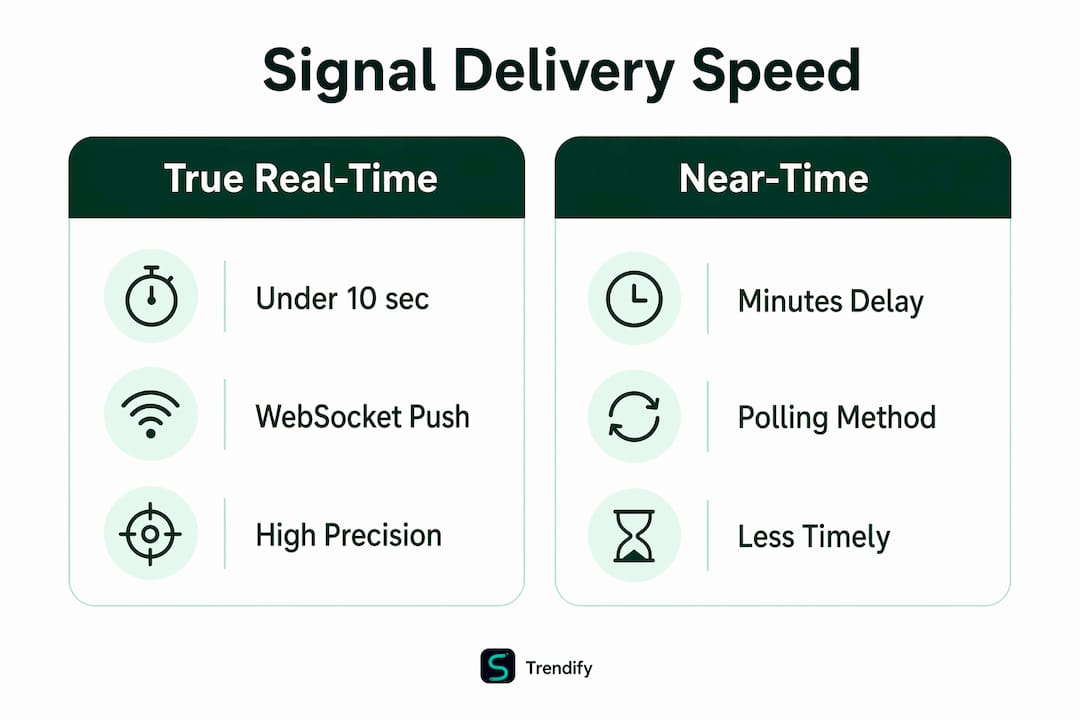
The table makes the choice clear for active traders. Near-time data is fine for end-of-day swing analysis. For intraday scalping or high-frequency strategies, only push-based delivery qualifies.
Examples of real-time signals in trading and investing
Real-time signal processing powers several distinct use cases across financial markets. Each one demonstrates a different way traders convert speed into edge.
- Scalping entries and exits. Scalping-Algo's Smart Scalping Signals generate non-repainting buy and sell alerts on 1-minute to 15-minute charts across crypto, forex, and futures. The signals fire the moment price and indicator conditions align, not after a candle closes and a polling cycle completes.
- News and filing alerts. Earnings releases, Fed announcements, and SEC filings move markets within seconds. Real-time data analysis pipelines monitor these feeds and push alerts to traders before the price reaction fully develops.
- Social sentiment spikes. Platforms monitoring Twitter/X and Reddit for ticker mentions use real-time signal generation to catch momentum before it shows up on a price chart. This is especially relevant in crypto markets where social sentiment leads price.
- Divergence and confluence detection. Advanced indicators combine RSI divergence, volume confirmation, and volatility gating into a single alert. When all conditions align simultaneously, the signal fires. Waiting for a polling cycle to catch this multi-condition setup means the entry window is gone.
- Automated strategy triggers. Real-time trading signals enable scalpers and high-frequency traders to react faster to market movements. When connected to webhook automation, these signals can trigger order placement on a broker API without manual intervention.
- Risk management alerts. Stop-loss proximity warnings, margin call thresholds, and drawdown limits all benefit from real-time delivery. A delayed risk alert is not a risk alert. It is a post-mortem notification.
Pro Tip: For scalping on lower timeframes, combine a real-time entry signal with a real-time volatility gate. If the volatility condition is not met when the entry fires, skip the trade. This filter alone can significantly improve your win rate by keeping you out of choppy, low-momentum setups.
Real-time signals shift decision-making from reactive to proactive, enabling early interventions before disruptions fully manifest. In trading terms, that means you are positioned before the crowd reacts, not after.

What technologies power real-time signal processing?
The infrastructure behind real-time signal processing has advanced considerably, and understanding the key developments helps you evaluate which platforms are genuinely capable.
The core challenge in any real-time system is the tradeoff between throughput and latency. Missing a processing deadline in real-time signal systems, such as radar or trading, can cause total system failure. Engineers must choose between DSP chips, FPGAs, or unified processor architectures to meet strict timing requirements. For financial applications, FPGAs dominate high-frequency trading infrastructure because they process signals in nanoseconds with deterministic timing.
At the research frontier, memristor-based SoCs achieve roughly 49x higher energy efficiency than conventional GPUs for real-time signal processing, with classification accuracy above 94%. This matters for edge devices and mobile trading tools where battery and compute constraints limit what is possible with traditional GPU-based processing.
| Technology | Latency | Best use case | Energy efficiency |
|---|---|---|---|
| FPGA | Nanoseconds | High-frequency trading | Moderate |
| GPU (conventional) | Microseconds | AI model inference | Low |
| Memristor SoC | Microseconds | Edge AI classification | Very high (49x GPU) |
| WebSocket push server | Milliseconds | Dashboard alert delivery | High |
| Polling HTTP server | Seconds to minutes | Batch data retrieval | High (but slow) |
Modern real-time generative models achieve low latency through frame-level autoregression, enabling responses within approximately 40 milliseconds. While this was developed for audio processing, the same architectural principles apply to financial signal classification where speed and accuracy must coexist.
For traders, the practical takeaway is this: the platform delivering your signals is only as good as its underlying architecture. Ask providers whether they use WebSocket push or polling. Ask whether their AI filtering runs pre-delivery or post-delivery. These questions separate real-time platforms from near-time ones dressed up in marketing language.
Key takeaways
Real-time signals are push-based data alerts delivered within seconds using WebSocket architecture, and only platforms built on this infrastructure qualify as genuinely real-time for active trading.
| Point | Details |
|---|---|
| Real-time signal definition | A data alert delivered within seconds via WebSocket push, not polling. |
| Polling is not real-time | Polling-based systems introduce 5 to 30-minute delays, disqualifying them for scalping. |
| AI filtering is critical | Millisecond relevance filtering prevents alert fatigue and keeps signal quality high. |
| Technology matters | FPGAs and memristor SoCs represent the hardware frontier for low-latency signal processing. |
| Proactive edge | Real-time signals enable proactive positioning before the broader market reacts. |
Why real-time signals are the edge most traders underestimate
Here is what I have observed after working closely with traders across crypto, forex, and futures: most of them are trading on near-time data and calling it real-time. They subscribe to a signal service, see the word "live" on the dashboard, and assume the infrastructure behind it matches the label. It almost never does.
The traders who consistently outperform are not necessarily smarter. They are faster, and they are faster because they built their workflow around genuine push-based delivery. When I evaluate a signal provider, the first question I ask is simple: does your platform use WebSocket connections or polling? If the answer is vague or defensive, that tells me everything.
The second thing I watch for is alert fatigue. A platform that pushes every data point without AI filtering will drown you in noise. The best real-time systems filter aggressively before delivery, so the signal that reaches you is already qualified. That is the difference between a tool that helps you trade and one that just adds stress.
My honest advice: treat your signal infrastructure the same way you treat your risk management rules. Non-negotiable, clearly defined, and tested before you put real capital behind it. Check out how to set trading alerts for a practical starting point on building that workflow correctly.
— Tran
Get real-time scalping signals built for speed and precision
Scalping-Algo's premium TradingView indicators are built in Pine Script v6 and designed specifically for traders who need genuine real-time performance on lower timeframes. The Smart Scalping Signals indicator generates non-repainting buy and sell alerts with native webhook support, routing signals directly to Discord or your broker API the moment conditions are met. Volatility gating, divergence detection, and confluence filtering are all built in, so you receive only qualified setups. Whether you trade crypto, forex, indices, or futures, Scalping-Algo gives you institutional-grade tools without the institutional price tag. Explore the full indicator suite and start trading with a genuine real-time edge.
FAQ
What is a real-time signal in trading?
A real-time signal in trading is an immediate alert triggered by a market condition and delivered to a trader within seconds via push-based WebSocket technology. It differs from delayed or near-time alerts, which rely on polling and can lag by 5 to 30 minutes.
How does real-time signal generation work?
Real-time signal generation uses event-driven architectures where a triggering condition fires an alert that travels over a persistent WebSocket connection to the trader's dashboard or notification channel. AI relevance filters classify the signal within milliseconds before delivery to reduce noise.
What are examples of real-time signals for traders?
Examples include scalping entry and exit alerts, news-driven price spike notifications, social sentiment spikes, RSI divergence alerts, and automated webhook triggers that place trades without manual input.
Why does signal delivery speed matter for scalpers?
Scalpers trade on 1-minute to 15-minute charts where setups form and resolve in under a minute. A signal delayed by even a few minutes arrives after the entry window has closed, making near-time alerts useless for this trading style.
Are most "real-time" trading platforms actually real-time?
No. Many platforms claiming real-time monitoring rely on polling, which introduces delays of 5 to 30 minutes. Only platforms using persistent WebSocket push connections deliver true real-time signal data suitable for active intraday trading.