

The clearest, repeatable multi-timeframe scalping setup pairs a higher-timeframe bias with a mid-timeframe confirmation and a micro-timeframe trigger, filtered by a momentum reading. Pair a fast EMA and VWAP for direction with a non-repainting momentum oscillator for confirmation. This model fits 1m to 15m scalps, tight stops, and short hold times, and it works because each layer cancels out the noise the others miss.
TL;DR:
- A reliable multi-timeframe scalping setup requires alignment of higher-timeframe bias, mid-timeframe confirmation, and micro-timeframe triggers, preferably filtered by momentum.
- Use structural levels, ATR, and volume signals to set stops and targets that ensure a favorable risk-reward ratio, typically around 1:1 to 1.5:1.
- Confirm every signal on candle close across a small indicator toolkit, including EMAs, VWAP, and momentum filters, to avoid repainting and false entries.
- Avoid trading when the higher timeframe shows conflicting structure, during major news events, or in low liquidity sessions with wide spreads.
- Test signals thoroughly through backtesting, forward-testing, and realistic modeling of spread and slippage before risking real capital in live trading.
Table of Contents
- The core framework: bias, confirmation, and execution
- Entry and exit rules, plus a worked trade example
- Building an indicator toolkit without cluttering your chart
- Risk management and the rules that actually limit you
- Testing and validating your signals before going live
- Why repeatable signals beat clever ones
- How Scalping-Algo helps you run this framework
- Where to check the rules that affect your account
- Sources
- FAQ
The core framework: bias, confirmation, and execution
Scalping fails most often because traders chase a signal on one chart without checking what the bigger picture is doing. The fix is a three-layer read, and each layer has one job.
The bias timeframe, usually the 15 minute to 1 hour chart, tells you the direction you're allowed to trade. Look at trend slope, a 20 or 50 period SMA, and recent structure: higher highs and higher lows for longs, the reverse for shorts. If the bias chart is choppy or the moving averages are flat, skip the session on that instrument.
The confirmation timeframe, typically 5m to 15m, checks that the move has follow-through. An EMA cross, a VWAP reclaim, or momentum divergence in the direction of your bias all count as green lights.

The execution timeframe, 1m to 5m, is where you pull the trigger. Micro rejections at a level, a pullback into the fast EMA, or a volume spike on the breakout candle are the entries you're watching for. Our timeframe selection guide breaks down how to match these three windows to your instrument's volatility.
Skip setups when:
- The higher timeframe structure conflicts with your execution signal
- A major news release is due within the next 15 to 30 minutes
- You're trading during a low liquidity session with wide spreads
Alignment across all three layers cuts down the false starts that plague single-timeframe scalping.
Entry and exit rules, plus a worked trade example
A repeatable entry sequence removes hesitation, which is where most scalping losses come from. Run through this checklist before every trade:
- Confirm bias direction on the higher timeframe
- Wait for a confirmation signal on the mid-timeframe (EMA cross, VWAP direction, or divergence)
- Watch the execution timeframe for a micro trigger: a rejection wick, a pullback to the fast EMA, or a volume spike
- Confirm the trigger candle closes above (or below) VWAP or the relevant level before entering
Stops belong at structure, not at a round number. Place them beyond the last swing low or high on your execution timeframe, or use an ATR multiple, commonly 1 to 1.5 times the current ATR reading, when structure is too tight. Target a 1:1 to 1.5:1 reward to risk ratio on most scalps; anything less rarely survives spread and slippage.
Exit management works best as a blend: take a fixed partial target at your first structure level, trail the remainder with a moving stop, and exit entirely if price stalls for more than a few candles without progress.
Worked example: the 1 hour chart shows a clean uptrend above a rising 50 SMA. On the 15m chart, price reclaims VWAP and the fast EMA crosses above the slow EMA. Dropping to the 1m chart, price pulls back to the 8 EMA, prints a bullish rejection wick, and volume ticks up on the next candle. Entry triggers on that candle's close, stop goes below the wick low, and the first target sits at the prior 15m swing high. See our advanced entry setups for variations on this pattern.
Pro Tip: Write your entry checklist on a sticky note next to your monitor until it becomes automatic. Scalping punishes hesitation and improvisation equally.
Building an indicator toolkit without cluttering your chart
More indicators rarely mean better signals. Two or three tools, each with a distinct job, outperform a chart crowded with overlapping lines.
- Use an 8 EMA and 21 EMA on your execution timeframe for pullback entries, and a 20 SMA or 200 EMA on the bias timeframe to define the larger trend
- Anchor VWAP on your confirmation timeframe to judge whether price is trading with or against intraday flow
- Add a momentum filter: RSI crossing 50, or MACD histogram divergence against price, to avoid entries where momentum has already faded
- Watch volume on the trigger candle. A breakout or reversal without volume support is a weaker signal
Order blocks and fair value gaps can add a layer of confluence, marking zones where price previously moved fast or reversed, without needing a dedicated indicator. Treat them as extra context, not a standalone signal.
Whatever tools you choose, confirm every reading on candle close. A signal that repaints before the candle finishes isn't a signal, it's a guess dressed up as one. Our roundup of scalping-focused TradingView indicators covers combinations that hold up across 1m and 5m charts.
Risk management and the rules that actually limit you
Every scalping edge dies quietly if the risk controls are loose. Size each trade so a stop-out costs a small, fixed percentage of your account, not a number that changes your mood for the rest of the day.
- Set stops using ATR or the nearest structural level, never an arbitrary tick count
- Cap risk per trade at a fixed percentage of account equity, decided before the session starts
- Model spread, slippage, and commissions directly into your backtest, since these costs erase thin scalping edges faster than bad entries do
- Check your broker's order types and typical spread on your instrument before trading it live
Traders who execute four or more day trades within five business days, where those trades exceed 6% of account activity, are classified as pattern day traders and must maintain at least $25,000 in account equity. New intraday margin requirements take effect June 4, 2026, with a transition period running to October 20, 2027, so confirm your broker's current policy before scaling up trade frequency.
For a deeper walkthrough of stop placement and sizing math, see our guide to setting stops for scalping.
Testing and validating your signals before going live
An untested signal is a guess with extra steps. Validate the framework in this order:
- Backtest on 1 minute or tick-level data where available, and build spread and slippage into the model so results reflect real fills, not fantasy ones
- Forward-test on a demo or small live account for a meaningful sample, logging entry and exit timestamps for every trade
- Track expectancy, win rate, average trade profit and loss, max drawdown, and average hold time across the sample
- Use non-repainting signals and webhook alerts to cut down on missed entries or false triggers caused by manual chart-watching
Day trading carries elevated risk and demands a tested plan before real capital is on the line. Our timeframe selection resource also covers sample size guidance for forward tests across different instruments.
Why repeatable signals beat clever ones
Fancy indicators get attention. Repeatable rules get results. Every setup should confirm on candle close, follow the same three-layer sequence, and be explainable in one sentence, if you can't explain your entry that fast, you don't have a rule, you have a hunch.
At Scalping-Algo, that's the standard behind every open-source, non-repainting signal we build, and it's the same discipline we push in our mentorship sessions: test before you trade, and keep the rules simple enough to repeat under pressure.
— Tran
How Scalping-Algo helps you run this framework
Building a clean bias-confirmation-trigger workflow by hand takes hours of chart-hopping. Scalping-Algo's premium TradingView indicators are built to do that work for you, with signals designed around the same three-layer logic covered above.
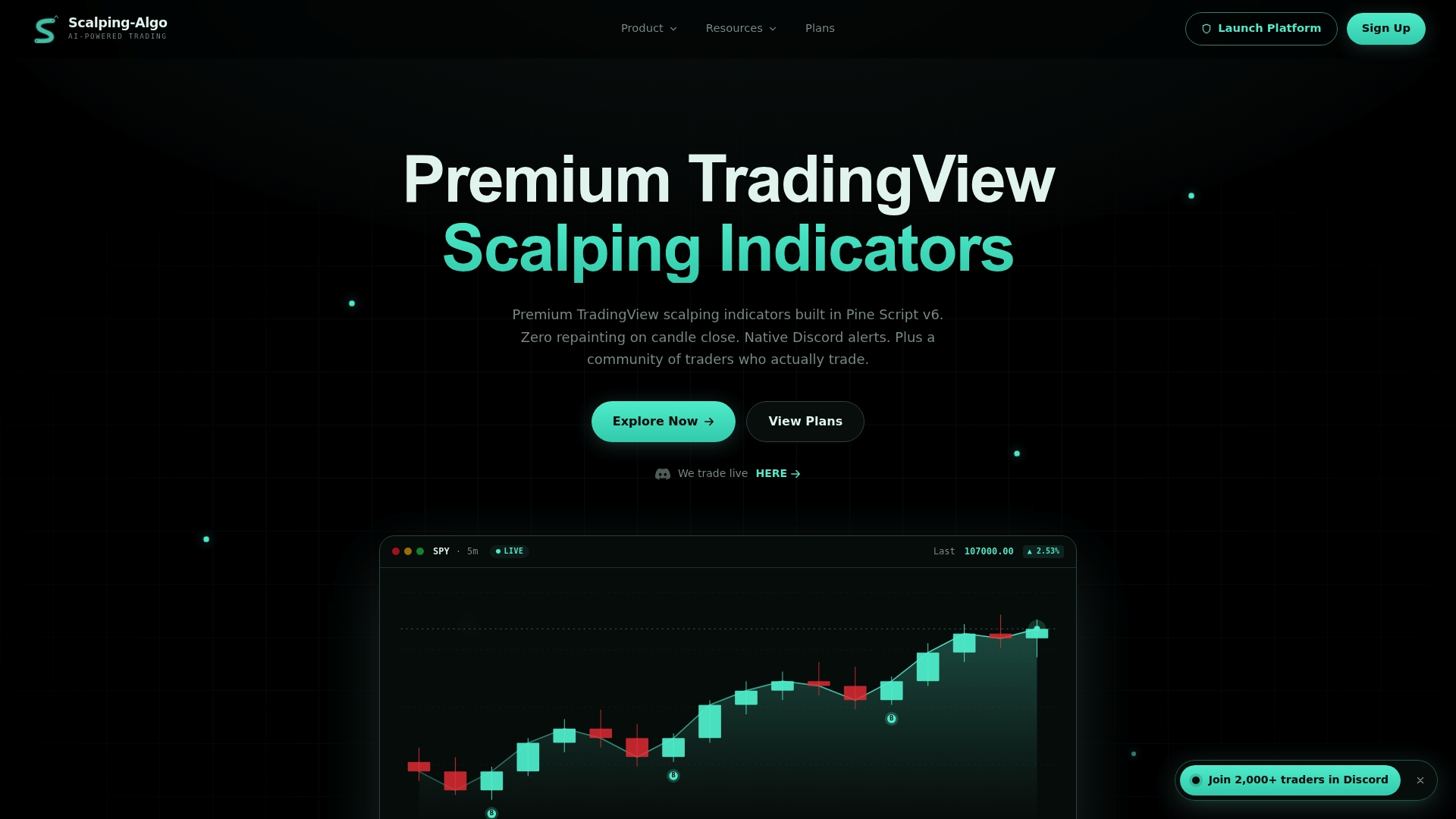
- Real-time, non-repainting buy and sell signals tuned for 1m to 15m execution windows
- A Command Center dashboard combining alerts, backtesting, and signal history in one place
- Discord webhook alerts for sub-second delivery straight to your phone or desktop
- A mentorship community with daily live sessions for traders working through the same setups
The Smart Scalping Signals indicator maps directly onto the confirmation and execution layers, while Edge Finder flags confluence zones for entries. Plans start at a monthly fee with yearly and lifetime options available on the Scalping-Algo site if you want to see the full suite in action.
Where to check the rules that affect your account
- Pattern Day Trader definition: confirms the $25,000 equity threshold and 2026 margin rule changes
- Day trading risk guidance: outlines the planning and risk awareness expected before trading intraday
Sources
FAQ
What is the best multi-timeframe trend indicator?
There's no single "best" indicator, but a moving average pairing, such as a fast EMA against a slower SMA, applied consistently across your bias and confirmation timeframes gives the clearest read on trend direction. VWAP adds a second layer of confirmation on intraday charts.
What is the most powerful indicator for scalping?
No single indicator carries a scalping strategy on its own. A momentum oscillator combined with volume and a non-repainting entry signal, confirmed across at least two timeframes, tends to outperform any one tool used in isolation.
How can multiple timeframe analysis be used for scalping?
Use a higher timeframe to set directional bias, a mid timeframe to confirm momentum is following that bias, and a lower timeframe to time the actual entry. This sequence, covered in the core framework section above, filters out low-probability setups that a single chart would miss.
What is the most profitable scalping strategy?
Profitability in scalping comes from consistency, not a secret setup: tight, structure-based stops, a fixed risk percentage per trade, and signals validated through backtesting and forward-testing before going live. Traders should model spreads and commissions into every test, since these costs decide whether a scalping edge survives contact with real execution.