

The best plugin automation ideas for traders right now
The most effective plugin automation ideas for traders combine three layers: AI-native strategy creation, middleware execution, and community-driven signal sharing. Together, they cut execution latency, remove emotional bias, and enforce risk rules automatically. Here is what each layer delivers:
- AI-native plugins use tools like Claude Code to analyze live market data, backtest strategies in Pine Script, and execute trades via broker APIs such as Alpaca, all without manual intervention.
- Middleware platforms like TradersPost route TradingView or TrendSpider signals to brokers across stocks, options, futures, and crypto without requiring custodial fund access.
- Community-driven models let traders publish, subscribe to, and share custom indicators and strategy templates, lowering the barrier for newer traders.
- Risk automation integrates Value at Risk (VaR) and Sharpe ratio dashboards to enforce capital protection rules in real time.
- Safety layers include circuit breakers, hard position limits, and audit trail logging that operate independently of AI decision logic.
- Latency reduction comes from webhook-based execution pipelines rather than browser automation, which is both unstable and often prohibited by brokers.
Automated trading systems account for a large share of all market transactions. That context matters when you are designing a plugin: you are competing with institutional-grade infrastructure, so your automation needs to be disciplined, not just fast.
Table of Contents
- How to build and deploy trading automation plugins that actually work
- Scalping-algo gives you institutional-grade plugins without building from scratch
- Key Takeaways
How to build and deploy trading automation plugins that actually work
Algorithmic trading success depends more on structured workflow and risk rules than code complexity. Follow this sequence to build plugins that hold up in live markets.
1. Identify recurring patterns first. Scan historical data for repeatable setups: momentum signals, mean reversion zones, or breakout conditions. TrendSpider's agentic market scanners surface these automatically using natural language criteria.
2. Build and backtest in Pine Script. Use an AI coding assistant or OpenTrade's open-source framework to write and compile Pine Script v6 strategies with realistic commission and slippage assumptions. Validate against 50-plus years of historical data before touching live capital.
3. Connect webhook alerts to a middleware layer. TradingView's Pine Script alert system requires stable middleware for reliable order execution. Direct browser automation is unstable and often prohibited. Map your alerts to a platform like TradersPost, which routes signals to Interactive Brokers, Alpaca, and 17-plus other brokers.
4. Integrate US broker APIs. Alpaca and Interactive Brokers both offer well-documented REST APIs. The Claude Execute framework reads your TradingView chart, runs a safety check against every entry condition in your rules.json, and only fires an order when all conditions pass.
5. Add independent safety middleware. Circuit breakers and position limits must operate separately from your AI signal logic. A PDT guard blocks trades if multiple day trades occur within a rolling five-business-day window for smaller accounts. Mandatory stop-losses on every position prevent runaway drawdowns.

6. Automate your risk reporting. Connect VaR and Sharpe ratio calculations to a live risk management dashboard so you see portfolio health at a glance, not after the damage is done.
7. Monitor and adapt continuously. Automated strategies must adapt to shifting market regimes. Set alerts for unusual drawdown, abnormal trade frequency, or signal failures, and build fallback protocols that halt execution and notify you immediately.
Pro Tip: Visual no-code builders work for simple strategies, but complex institutional-level logic requires custom code. Plan for a full architecture rewrite before you scale, not after.
Scalping-algo gives you institutional-grade plugins without building from scratch
Traders who want production-ready automation without months of development work have a direct path through Scalping-algo. The platform's premium TradingView indicators are built in Pine Script v6, generate real-time non-repainting signals on 1m–15m timeframes, and ship with native webhook alerts for direct execution pipelines.
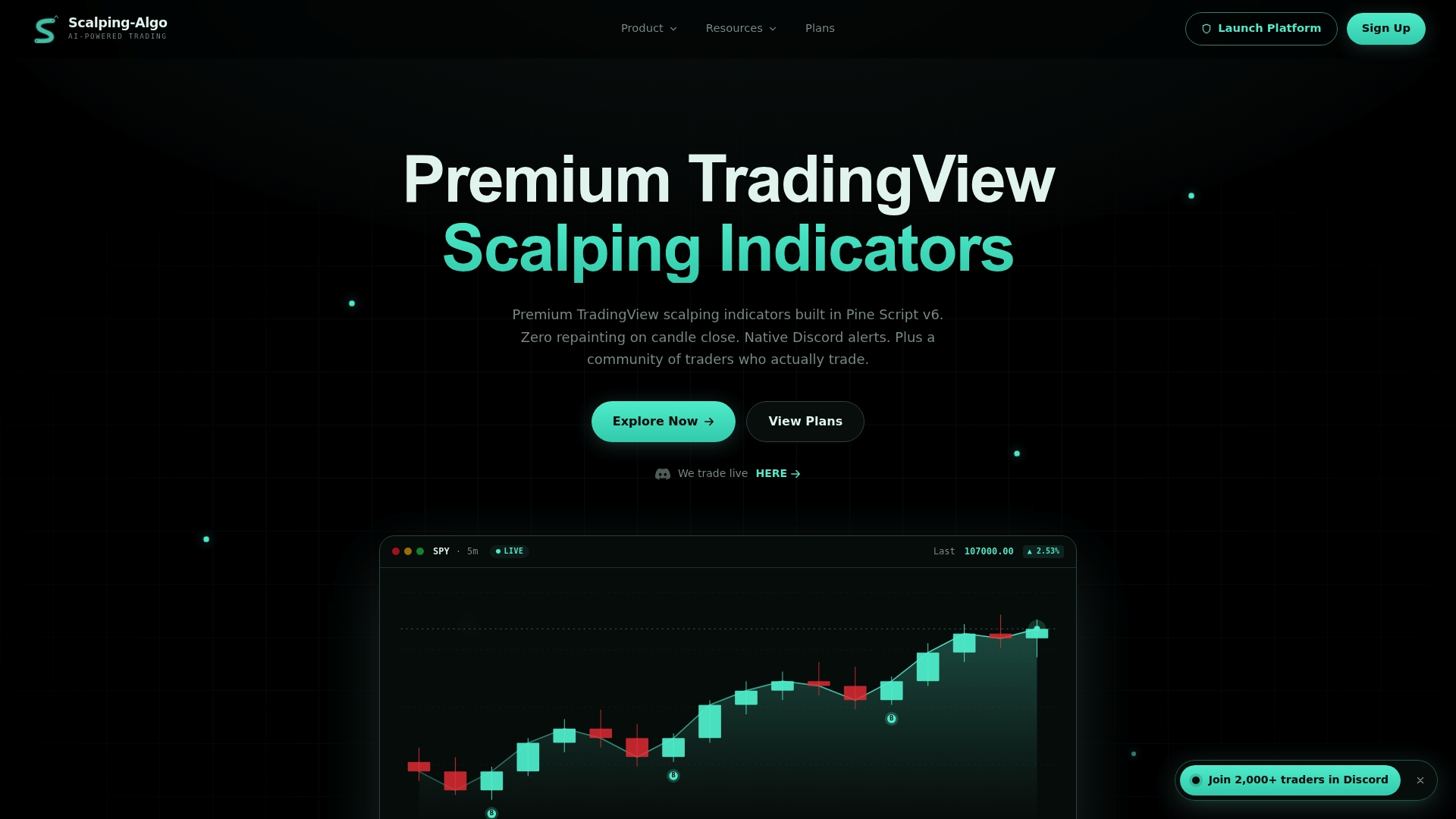
Every script is open-source, so you can inspect, modify, and extend the logic. The Command Center dashboard integrates backtesting, alerts, and signal history in one place. For traders who want mentorship alongside automation, the Discord community runs live sessions and strategy reviews. Check out the Algo Master system to see how the three-indicator suite fits into a complete automated workflow.
Key Takeaways
Plugin automation works best when AI-native strategy creation, middleware execution, and independent safety layers operate together as a single disciplined system.
| Point | Details |
|---|---|
| AI-native plugins | Tools like Claude Code backtest and execute strategies via APIs such as Alpaca automatically. |
| Middleware is required | TradingView alerts need stable middleware like TradersPost for reliable broker order routing. |
| Safety layers are independent | Circuit breakers and position limits must run separately from AI signal logic to prevent runaway trades. |
| Risk metrics automate oversight | VaR and Sharpe ratio dashboards enforce capital protection rules without manual review. |
| Scalping-algo accelerates deployment | Open-source Pine Script v6 indicators with webhook alerts give traders a ready-made automation foundation. |