

Automation in financial markets is defined as the use of technology to execute, monitor, and manage trades and financial operations with minimal human intervention. AI-powered algorithmic trading now accounts for 72.4% of daily equity turnover in G7 markets as of 2026. That single figure tells you everything about how far the shift has gone. The role of automation in financial markets now touches every layer of the trading stack, from order routing and risk checks to portfolio rebalancing and credit pricing. This guide breaks down what that means for traders and investors making real decisions today.
How does automation transform trading efficiency and execution?
Automation changes trading efficiency by removing the bottlenecks that slow human execution. Speed, accuracy, and volume all improve when machines handle order flow. The gains are not marginal. Approximately 75% of all U.S. stock market trades are executed by algorithmic platforms in mid-2026. That dominance reflects a structural shift, not a trend.
The European credit market shows the same pattern at an even higher rate. Automated Intelligent Execution (AiEX) handles 84% of European Credit trades and 60% of total trading volume as of april 2026. AiEX is a hybrid workflow model where the system executes routine trades automatically while routing complex or large orders to a human trader for review. That design keeps speed high without sacrificing control on high-stakes decisions.
The core benefits of automated trading execution break down into four areas:
- Speed: Machines execute in microseconds. Human reaction time cannot compete at that scale.
- Accuracy: Automated systems apply rules consistently. They do not fat-finger orders or misread a ticker.
- Cost reduction: Lower transaction costs come from tighter spreads, reduced slippage, and fewer manual errors.
- Scalability: A single automated system can monitor hundreds of instruments simultaneously across multiple asset classes.
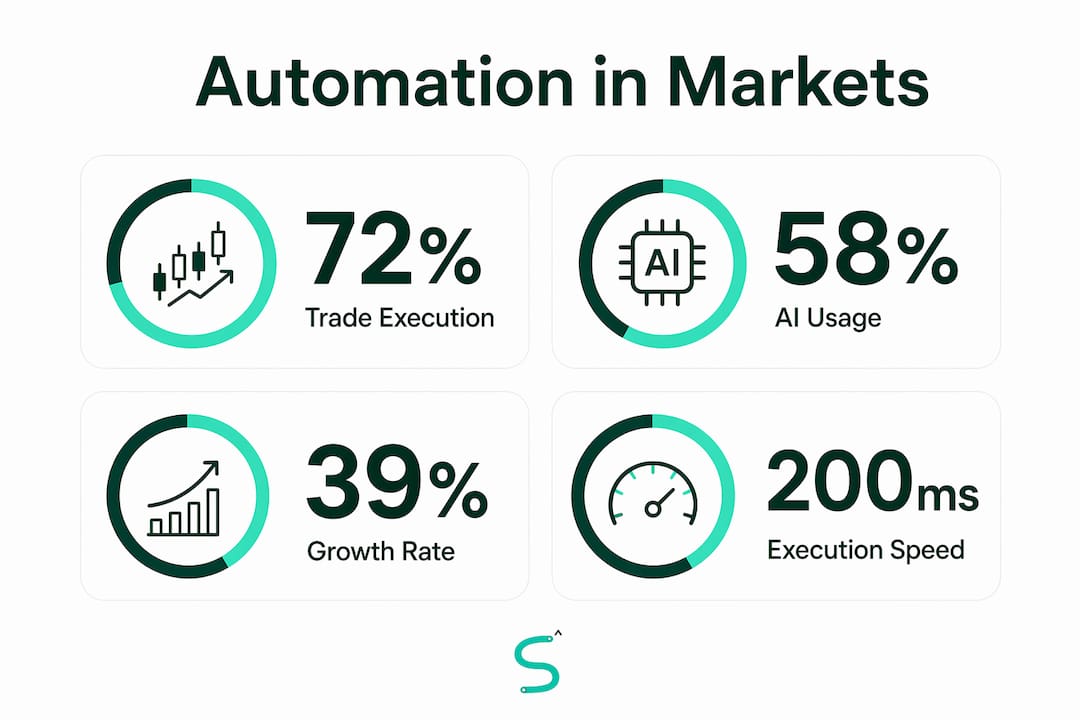
Pro Tip: If you trade lower timeframes, even a 200-millisecond execution delay can mean the difference between filling at your target price and chasing a move. Automation closes that gap.
The benefits of algorithmic trading for scalpers are especially pronounced on short timeframes where manual execution simply cannot keep pace with price movement. For retail traders, access to these tools has expanded significantly through platforms that bring institutional-grade execution within reach.
What is the impact of automation on market dynamics and liquidity?
Automation improves market liquidity by increasing the number of active participants and the speed of price discovery. When machines continuously post bids and offers, spreads tighten and prices reflect new information faster. That is the positive case, and the data supports it across equity and credit markets.
The risk side is less discussed but equally real. Automated systems can create herding behavior when multiple strategies react identically to the same market signal. Automated systems reacting in unison can cause liquidity shocks and amplify volatility rather than dampen it. That is strategy convergence, and it is one of the most underappreciated systemic risks in modern markets.
Three dynamics define how automation reshapes market behavior:
- Price discovery accelerates. Algorithms process news, order flow, and macro data faster than any human desk. Markets reprice in seconds rather than minutes.
- Liquidity becomes conditional. Automated market makers can withdraw quotes instantly during stress events. Liquidity appears deep until it suddenly is not.
- Volatility can self-reinforce. When many systems share similar logic, a single trigger can cascade into a broad selloff before any human intervenes.
"Automation increases market efficiency but also introduces systemic risks requiring advanced oversight frameworks. The solution is not less automation. It is smarter oversight built into the workflow itself."
Regulatory bodies including ISDA have tracked these dynamics closely. The evolving legal framework around automated trading now requires firms to document their algorithms, stress-test for extreme scenarios, and maintain kill-switch capabilities. Traders who understand these requirements are better positioned to build systems that survive regulatory scrutiny and real market stress.
The Q1 2026 data from Tradeweb reinforces this point. 58% of Tradeweb tickets used AiEX in Q1 2026, up from 39% four years prior. That growth happened during a period of elevated volatility. Traders did not pull back from automation under pressure. They leaned into it, but with hybrid controls in place.
How does automation enhance decision-making in finance?
Automation enhances financial decision-making by processing data at a scale no human team can match. AI systems analyze portfolio risk, flag anomalies, and generate trade signals in real time. The result is faster, more consistent decisions across every stage of the investment process.

ISDA describes AI as a "bionic arm" that augments human expertise rather than replacing it. Routine tasks run on autopilot. Skilled professionals focus on complex, high-stakes calls that require judgment, context, and experience. That division of labor is the model that leading institutions have adopted, and it works.
The benefits extend beyond institutional trading desks. Fintech automation has reshaped consumer credit as well. AI and fintech-driven credit channels reduce household credit costs by an average of 187 basis points compared to traditional bank channels. That reduction reflects faster underwriting, better risk modeling, and lower overhead. Borrowers get better rates. Lenders get more accurate risk assessment. Both sides win.
Key areas where automation improves financial decisions:
- Portfolio management: Automated rebalancing keeps allocations aligned with targets without requiring daily manual review.
- Risk assessment: AI models flag concentration risk, drawdown thresholds, and correlation shifts before they become problems.
- Exception management: Adaptive workflows route non-standard cases to human review while standard cases process automatically.
- Personalized services: Fintech platforms use behavioral data to tailor product recommendations and credit terms to individual profiles.
Pro Tip: Treat your automation setup as a filter, not a replacement for judgment. Let it handle the repetitive screening work. Reserve your attention for the setups that require context and discretion.
Understanding how automation improves cash flow across financial operations shows that the efficiency gains are not limited to trading. They extend to every process where data moves between systems and decisions need to be made at speed.
What are the challenges of integrating automation in trading?
Automation fails most often not because the technology is wrong, but because the implementation is brittle. Rules-based systems that work in calm markets can break down under volatility. Backtesting with realistic volatile historical data is critical to avoid flash crashes and cascading failures. Most retail traders skip this step or test only on favorable data.
Effective automation combines Robotic Process Automation (RPA) for repetitive tasks with AI-driven exception handling for non-standard cases. RPA handles the predictable, high-volume work. AI handles the edge cases that a rigid rules engine would misclassify or ignore. That dual approach is what separates reliable post-trade automation from systems that fail under pressure.
Common pitfalls traders face when deploying automation:
- Over-optimization: Strategies tuned too tightly to historical data perform poorly on live markets.
- No kill switch: Every automated system needs a manual override that a human can trigger instantly.
- Ignoring slippage: Backtests that assume perfect fills overstate real-world performance.
- Single-point failure: Relying on one data feed or one broker connection creates unnecessary fragility.
The automated trading checklist for retail traders covers the practical steps for building a system that holds up under real conditions. The goal is not a perfect backtest. The goal is a system that performs consistently when markets get messy.
Building a safe automation workflow for traders means layering human checkpoints into the process, not removing them. The most effective setups automate execution while keeping a human in the loop for position sizing, risk limits, and strategy adjustments.
Key Takeaways
Automation now drives the majority of trade execution in global markets, and traders who understand its mechanics and risks hold a clear structural advantage.
| Point | Details |
|---|---|
| Automation dominates execution | AI-driven algorithms handle 72.4% of G7 equity turnover and 75% of U.S. stock trades in 2026. |
| Hybrid workflows outperform pure automation | Models like AiEX blend machine speed with human oversight for better control under volatility. |
| Systemic risk is real | Strategy convergence among automated systems can amplify volatility and trigger liquidity shocks. |
| AI augments, not replaces, human judgment | ISDA's bionic arm model keeps humans focused on complex decisions while automation handles routine tasks. |
| Brittle systems fail under pressure | Combine RPA with AI-driven exception handling and always backtest on volatile historical data. |
The hybrid model is the only model worth building
I have watched traders build fully automated systems with zero human checkpoints and then wonder why they blow up during a news spike. The problem is not automation. The problem is the assumption that a strategy that worked in a backtest will handle every market condition without supervision.
The data from 2026 is clear. Institutions that grew their automation usage the fastest during volatile periods did so with hybrid models, not fully autonomous ones. They automated the bulk work and kept humans on the complex edge cases. That is not a compromise. That is the design.
What I find most underappreciated is the systemic risk angle. When everyone runs similar algorithms, the market stops being a collection of independent views and starts behaving like a single organism. That creates fragility at the aggregate level even when each individual system looks fine in isolation. Traders need to think about this, not just their own strategy performance.
My advice is to treat automation as a tool that extends your capacity, not one that removes your responsibility. Build in human review points. Test your system on 2020 and 2022 data, not just the calm stretches. And never run a live system without a kill switch you can trigger in under 10 seconds.
— Tran
Scalping-algo's tools for automated trading
Traders who want to put automation to work on short timeframes need indicators built for that environment. Scalping-algo offers premium TradingView scalping indicators built in Pine Script v6, designed specifically for crypto, forex, indices, and futures on 1m–15m charts.
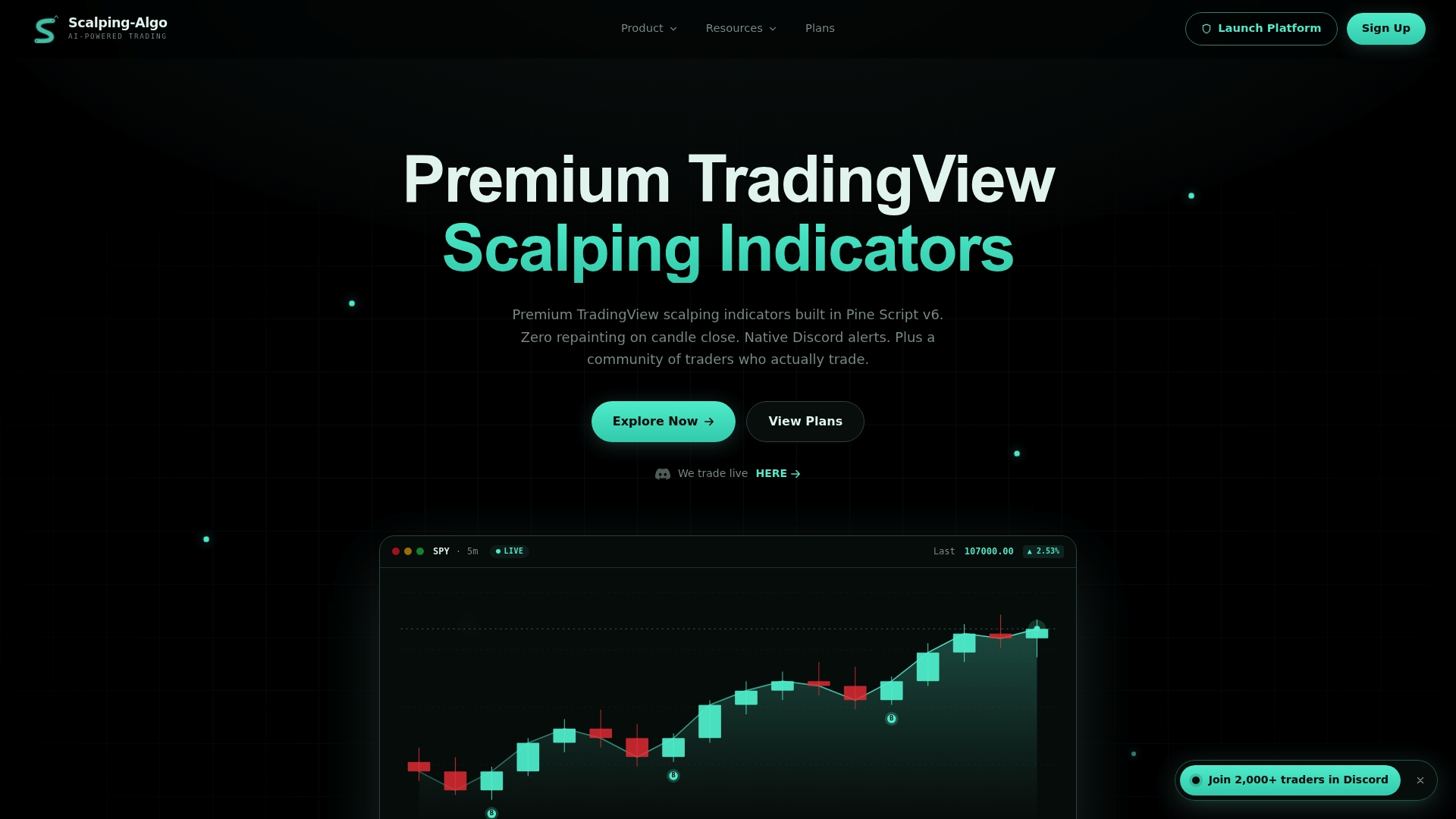
The indicators generate real-time, non-repainting buy and sell signals with built-in volatility gating and divergence detection. They integrate natively with webhook alerts to Discord, which fits directly into automated notification and execution workflows. Scalping-algo's Smart Scalping Signals indicator delivers confluence-based entries that align with the hybrid execution model discussed throughout this article. All scripts are open-source, and the platform includes backtesting tools, a Command Center dashboard, and a live Discord community for mentorship.
FAQ
What is the role of automation in financial markets?
Automation in financial markets refers to using technology to execute trades, manage risk, and process financial operations with minimal human input. AI-driven algorithms now account for 72.4% of daily equity turnover in G7 markets as of 2026.
How does automation affect trading speed and accuracy?
Automated systems execute orders in microseconds and apply rules consistently, eliminating human error and execution delays. This speed advantage is most significant on short timeframes where price moves faster than manual reaction time.
What are the main risks of automated trading?
The primary risks are strategy convergence, over-optimization, and brittle rules-based systems that fail under volatility. Herding behavior among similar algorithms can amplify market swings and create liquidity shocks.
Is automation changing investing for retail traders?
Yes. Retail traders now access institutional-grade execution tools through platforms that were previously unavailable outside major banks. Fintech automation has also reduced credit costs by an average of 187 basis points compared to traditional channels.
What is the best approach to combining automation with human oversight?
The most effective model combines RPA for high-volume repetitive tasks with AI-driven exception handling for complex cases, while keeping human review points for position sizing and risk limits. ISDA calls this the bionic arm model.