
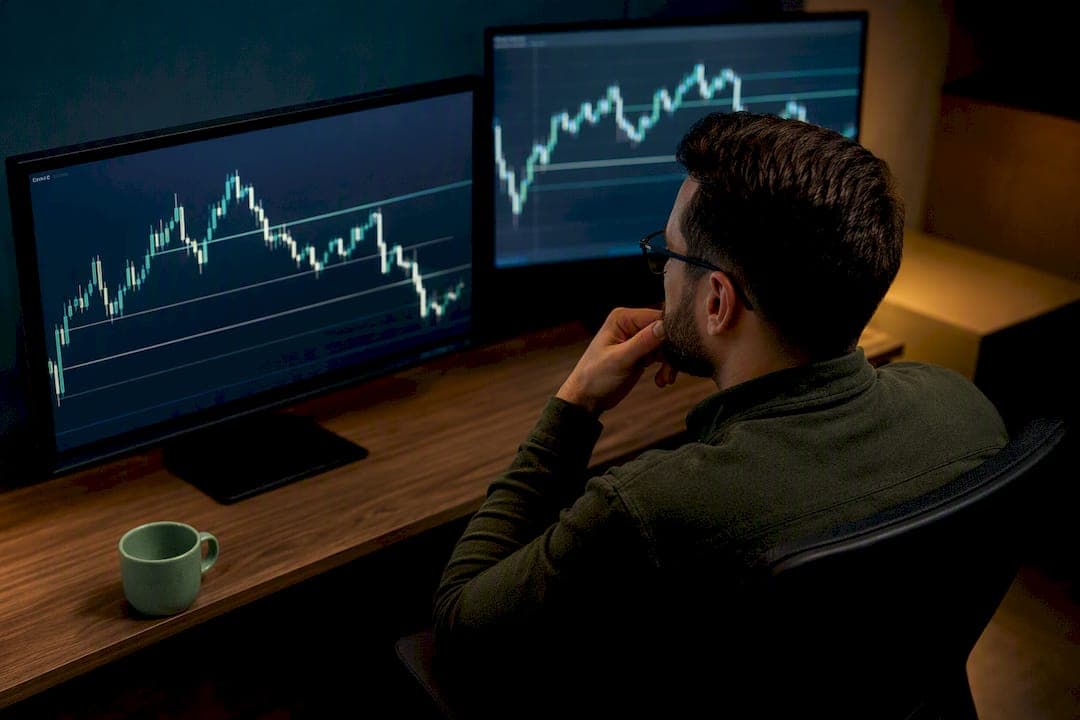
For traders who want the tightest entry precision and can stay glued to the chart, price action wins. For traders who need repeatable alerts, automation, or less discretionary screen time, signal-based scalping fits better. Most experienced scalpers land on a hybrid: price-action structure with one confirmation signal, and execution costs decide which style survives contact with the market.
TL;DR:
- Price action traders need fast execution and extensive screen time to accurately interpret candlestick signals and market structure on very short timeframes.
- Signal-based scalping offers objectivity and backtestability but introduces delays, making real-time automation crucial for rapid entries and exits.
- Combining price action with a single confirmation signal balances speed with reliability, while cost considerations like spreads and slippage heavily impact profitability.
- Traders should thoroughly analyze their broker's fee structure, liquidity, and execution speed before choosing a manual or automated approach, and always backtest strategies with fee adjustments.
- Most successful scalpers adopt a hybrid approach, first identifying levels via price action then confirming entries with signals, and maintaining rigorous trade journaling and risk rules.
Table of Contents
- Price Action vs Signals Scalping: How Reading the Chart Works
- How Signals-Based Scalping Works
- Price Action vs Signals: A Side-By-Side Comparison
- Choosing and Implementing Your Scalping Approach
- What Backs This Comparison
- Why I Lean Hybrid Most Days
- Where Scalping-Algo Fits If You Choose Signals or a Hybrid
- Sources
- FAQ
Price Action vs Signals Scalping: How Reading the Chart Works
Price action scalping means trading off the naked chart. No indicators, no overlays, just candlesticks, structure, and order flow. Traders read rejections at support and resistance, pin bars, engulfing candles, and shifts in market structure to time entries on 1m, 3m, and 5m charts.
The method rewards traders who've logged serious screen time. You're not waiting for a script to confirm anything. You're reacting to what price is doing right now, which is why price action tends to produce earlier and more precise entries than indicator-based approaches. The cost is subjectivity. Two traders can look at the same five-minute chart and read the same candle two different ways.
Common price-action micro-setups on lower timeframes include:
- Reclaims: price breaks a level, fails to hold, then reclaims it with momentum.
- VWAP or EMA pullbacks: price trends, pulls back to a moving average, and continues.
- Breakouts: price consolidates in a tight range, then explodes through resistance or support with volume.
- Mean-reversion fades: price stretches too far from a reference point (VWAP, a moving average) and snaps back.
Setups like VWAP reclaims and moving-average pullbacks tend to work best in trending conditions, while mean-reversion fades work better in choppy, range-bound sessions. Knowing which regime you're in matters as much as the setup itself.
Timeframes matter here. On a 1m chart, a trade might last 30 seconds to three minutes. On 5m charts, holds stretch to 10 or 15 minutes. Either way, execution needs are unforgiving. You need fast fills, low latency, and a broker or exchange that doesn't slip you two ticks on entry. A half-second of lag on a 1m chart can turn a winning read into a scratch trade.
The tradeoff in one sentence: price action gives you speed and adaptability at the cost of consistency, since your entries depend on how sharp your reads are on any given session, not on a repeatable rule a machine could apply the same way every time.
How Signals-Based Scalping Works
Signals-based scalping replaces discretionary reading with rules-based alerts. A script or indicator watches the chart, applies a fixed set of conditions, and fires a buy or sell signal when those conditions are met. You're trading the signal, not your own read of the candle.
Common signal types include indicator crossovers (like a fast EMA crossing a slow EMA), volatility-gated signals that only fire when the market has enough movement to justify a trade, non-repainting scripts that lock in a signal once it prints instead of quietly redrawing history, and alert-room calls from a community or Discord server.
Delivery matters as much as the signal logic itself:
- TradingView alerts push a notification the moment a condition triggers on the chart.
- Webhook alerts to Discord or a trading terminal cut the gap between signal and action, which matters when a scalp's window is measured in seconds.
- Automated execution removes the human click entirely, routing the signal straight to an order.
Speed and precision are the whole game in scalping, and automation is a common aid precisely because manual reaction time is a real bottleneck on 1m charts.
None of that means you switch your brain off. Every signal still needs filtering. Is the pair liquid enough right now? Does the signal align with the higher-timeframe trend, or is it fighting it? Has this signal type been reliable in the current volatility regime? Signal groups that explain their invalidation rules and review failed setups tend to protect traders far better than rooms that just fire entries with no context, because blind copying is how new scalpers blow up accounts.
The tradeoff: signals give you objectivity and repeatability, since the same conditions always produce the same alert, but they lag price by definition, and a trader who never learns to filter a bad signal is just gambling on autopilot.
Price Action vs Signals: A Side-By-Side Comparison
Put both methods on the same table and the differences sharpen fast.
| Dimension | Price action | Signals |
|---|---|---|
| Speed / latency | Instant, limited by your own reaction time | Fast if webhook-based, slower if manual alert checking |
| Objectivity / backtestability | Low. Subjective reads, hard to backtest reliably | High. Rules-based and testable across history |
| Learning curve / screen time | Steep. Requires months of chart reps | Gentler entry point, but still needs filtering skill |
| Cost sensitivity | High. Precision entries reduce slippage exposure | High. Frequency and lag can widen the fee/slippage gap |
| Automation / scalability | Hard to scale, tied to one trader's attention | Easy to scale across pairs, timeframes, and even accounts |
| Best trader profile | Full-time or highly experienced discretionary traders | Traders with less screen time, or those layering automation |
Costs deserve their own spotlight, because they're the silent killer of scalping edges. TraderNest's cost modeling walks through a scalper targeting a 0.3% gain per trade with a typical winning percentage and balanced reward to risk. Blow past that, and a strategy that looks profitable on paper bleeds out in live execution. This is true whether your entry came from a candlestick read or a script's alert. The signal doesn't pay the spread. Your account does.
Run this six-question checklist against your own setup before committing to either style:
- What's my average spread and slippage on the instrument I actually trade?
- Can I execute fast enough, manually or automated, to capture a 1m to 5m move?
- Do I have the screen time and pattern recognition to read price action live, or am I better served by rules I can test in advance?
- How many trades per day am I realistically taking, and what does that do to my cumulative fee drag?
- Am I filtering signals against higher-timeframe context, or copying them blind?
- Have I backtested or paper-traded this specific setup long enough to know its real expectancy after costs?
Answer those honestly and the choice usually makes itself. A trader with three years of chart reps and fast execution access leans price action. A trader who works a day job and wants a system to check twice a day leans signals, provided the signal source is non-repainting and includes clear invalidation logic.
Choosing and Implementing Your Scalping Approach
Start with your costs, not your strategy preference. Pull up your broker or exchange's actual spread and commission schedule on the instrument you plan to scalp, then check historical slippage during your typical trading hours. If round-trip costs eat more than a third of your target profit per trade, no entry method will save the strategy.
Follow this sequence once your cost picture is clear:
- Audit liquidity and fees first. Trade the tightest-spread instrument available to you, not the one with the flashiest chart pattern.
- Match the method to your skill, not your ambition. If you haven't logged real chart hours, start with a filtered signal service and layer in price-action study over time. If you already read structure well, train that edge rather than diluting it with a lagging indicator.
- Paper trade or backtest for 30 to 90 sessions. Track fee-adjusted expectancy, not just win rate. A 60% win rate with sloppy risk-reward can still lose money after costs.
- Set hard risk rules before you go live. Fix your risk per trade, a daily loss limit, and a scaling plan for adding size only after a proven sample size.
Pro Tip: Journal every trade with the setup type, the cost paid in spread or slippage, and whether the signal or your own read triggered it. After 50 trades, you'll know exactly which method is actually making you money, not just which one feels better.
Reasonable stop-loss placement belongs in this step too. A tight scalp stop that gets clipped by normal noise will erode your account just as fast as a bad entry method.
What Backs This Comparison
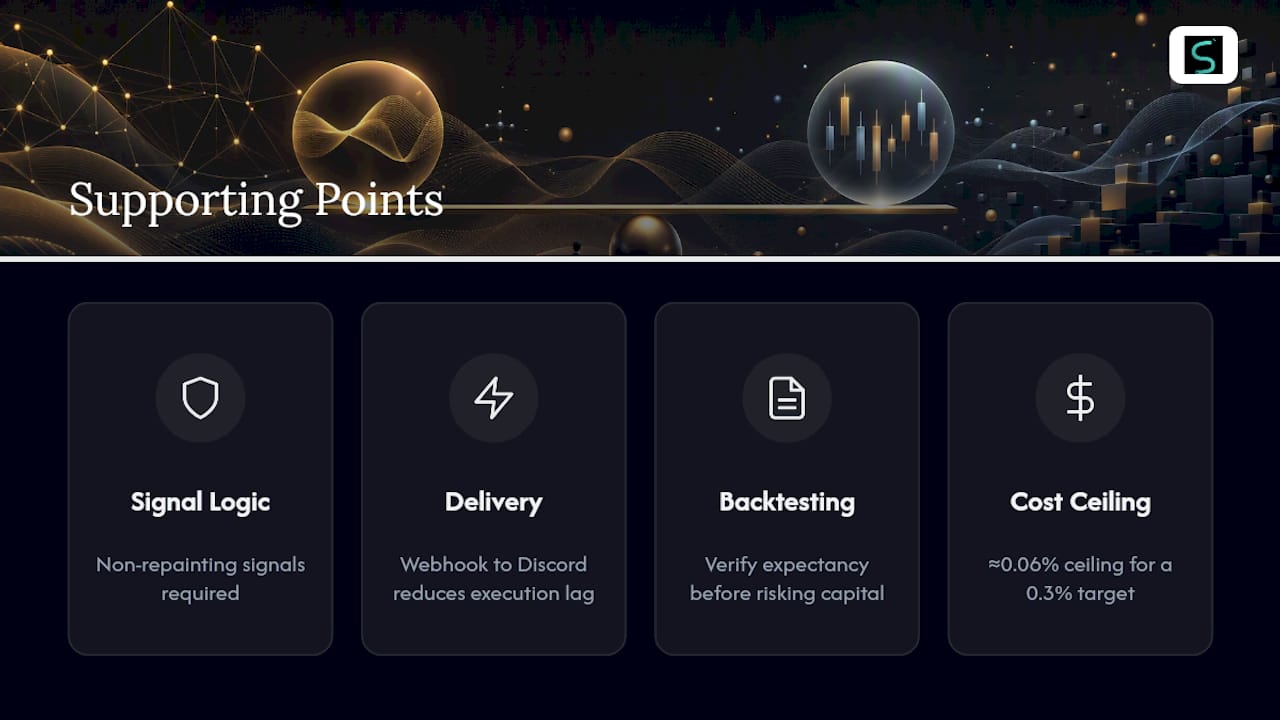
This comparison draws on scalping mechanics documented across trading education resources, plus the practical demands of running signal infrastructure for lower-timeframe traders. A few proof points worth naming: non-repainting signal logic matters because a signal that redraws itself after the fact is worthless for live decisions.
Webhook delivery to Discord cuts the lag between signal and execution, which matters when a 1m setup's window closes in seconds. A backtesting dashboard lets a trader verify expectancy before risking capital, addressing the objectivity gap signals are supposed to solve in the first place. Roughly 0.06% is the rough cost ceiling TraderNest cites for a 0.3% target trade to stay profitable, a number worth checking against your own account before trusting any signal or setup.
Why I Lean Hybrid Most Days
Pure price action rewards the traders who've earned it through hours of screen time, and pure signal-following rewards traders who respect the filtering step. Most scalpers, honestly, are somewhere in between, and pretending otherwise just sets up frustration.
My working rule: identify the level with price action first, whether that's a VWAP reclaim or a structure break, then require one confirmation signal, an EMA cross or a momentum reading, before pulling the trigger. Invalidate hard and fast if the confirmation never shows. Pairing a price-action level with a single confirming indicator tends to capture the speed of discretionary reads without surrendering all objectivity. Journal every trade. The data will tell you faster than your gut which half of that hybrid is actually earning its keep.
— Tran
Where Scalping-Algo Fits If You Choose Signals or a Hybrid
If the cost math above convinced you that speed and objectivity matter more than pure discretion, some platforms give a verifiable way to run signals without guessing whether the alert repaints after the fact. Some scripts for trading indicators are built in Pine Script v6, generate real-time non-repainting buy and sell signals on 1m to 15m charts, and include volatility gating and confluence tools so you're not trading a bare crossover alone.
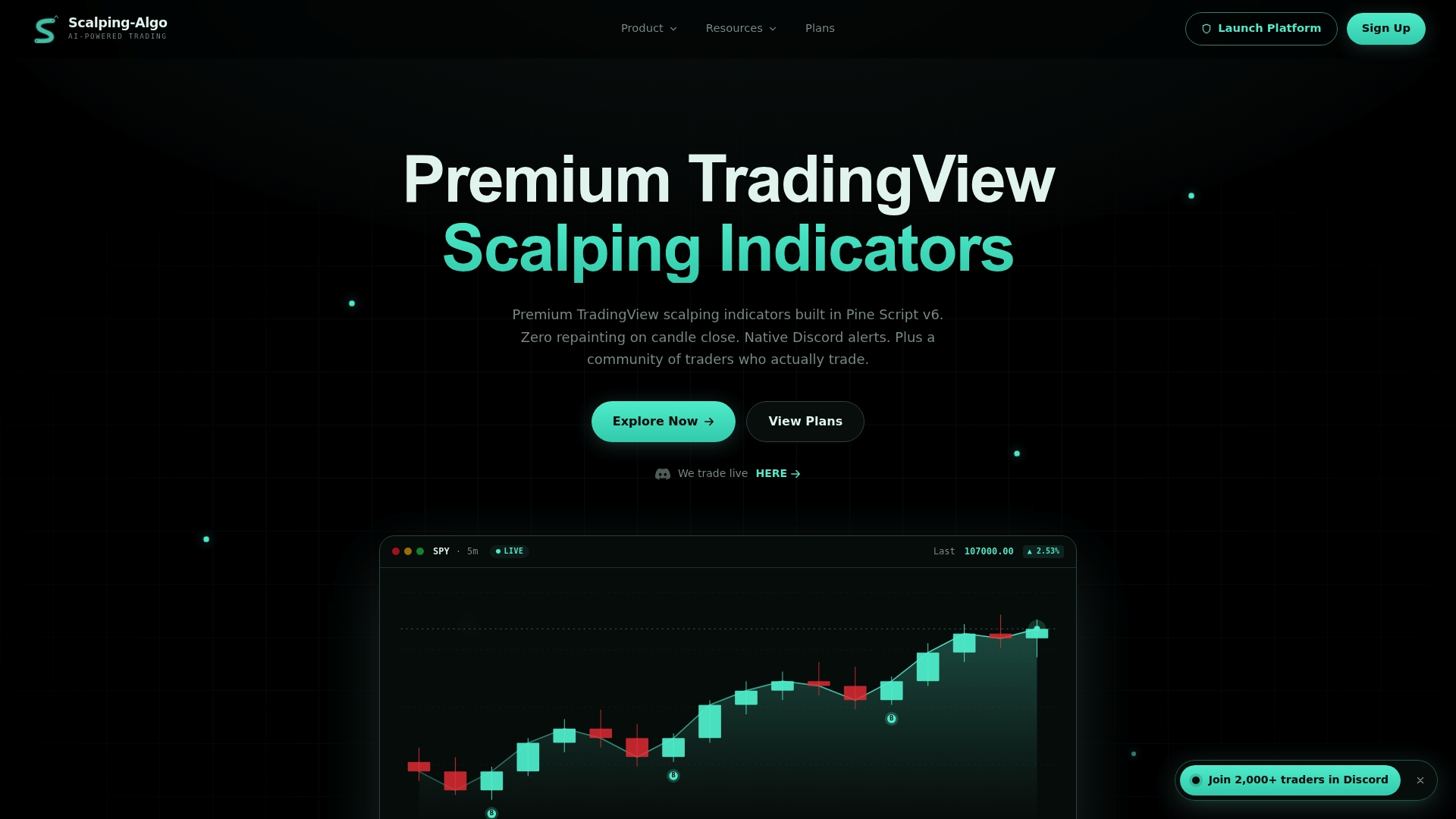
A Command Center dashboard may tie alerts, backtesting, and education together in one place, so traders can check fee-adjusted expectancy before risking a single trade, the same discipline this article recommends for either approach. Webhook alerts can push straight to communication platforms, cutting the lag between signal fire and execution that costs scalpers real money on 1m charts. Community mentorship can help traders leaning on signals because they lack chart hours, not because they want to skip the learning curve entirely.
Some indicator scripts are open-source, and it is advisable to verify performance in a demo environment before committing real size. Start by exploring the premium indicator suite or check out Algo Master's 3-indicator system if you want a ready-made hybrid workflow instead of building one from scratch.
Sources
- Scalping Strategies: 2026 Data-Backed Playbook | TraderNest
- Scalping Trading Strategy: How to Scalp Stocks & Forex in 2026 (Rules, Setups & Examples) | ChartingLens
- Price Action vs Indicators: Which Trading Approach Wins? | Pipcy
- Price Action Community Vs Signal Group — ProTradingInsights
- Top Trading Strategies for Scalping | Investopedia
FAQ
What Is the Most Successful Scalping Strategy?
There's no single winning strategy. The most successful scalpers match their method, price action, signals, or a hybrid, to their execution costs and available screen time, then validate expectancy through backtesting before scaling size.
Is Price Action Better Than Indicators for Scalping?
Price action tends to give earlier and more precise entries because it reads the market directly rather than through a lagging calculation, but indicators offer objectivity and easier backtesting that discretionary reads can't match.
What Is the Most Powerful Indicator for Scalping?
No single indicator dominates. Most scalpers build around a small toolkit, commonly the 9 and 21 EMA, VWAP, and RSI or Bollinger Bands for mean-reversion reads, rather than relying on one signal in isolation.
What Is the Best Timeframe for Price Action Scalping?
1m and 5m charts are the standard range for price-action scalping, with 3m as a common middle ground that balances signal frequency against noise.
Do Signal Groups Work for Scalping?
Signal groups can work well if they include invalidation logic and postmortem reviews of failed setups; groups that only fire entries without context tend to create dependency and higher risk.