

A non-repainting indicator is a trading tool whose signals stay fixed once a candle closes, giving you a stable, honest read of the market at every moment. This guide to non-repainting indicators covers everything day traders and scalpers need: what defines non-repainting behavior, which tools qualify, how to build a strategy around them, and how to test your setup before risking real capital. Classic tools like the SMA, RSI, and MACD all qualify. Understanding why that matters is the difference between a backtest that lies and a strategy that actually holds up live.
What makes a non-repainting indicator reliable?
A non-repainting indicator does not change past signals after the candle closes. The signal you saw at 9:32 AM is still there at 9:45 AM. That permanence is the entire point.
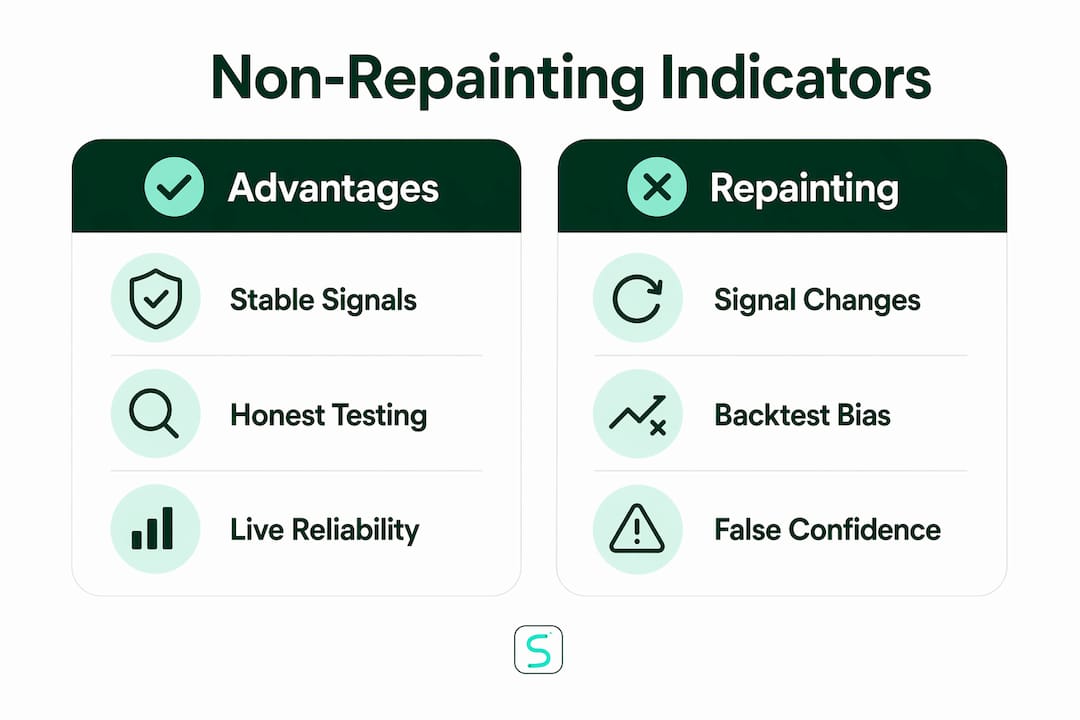
Repainting indicators do the opposite. They alter historical signals on past candles, which makes your backtest look far better than reality. You see a clean entry on every winning trade, but those signals only appeared that way in hindsight. When you trade live, the signal disappears or shifts before you can act on it.

There are two types of repainting behavior worth knowing. The first is live-bar updating, where a signal changes while the current candle is still forming. This is normal and expected. The second is historical signal changes, where closed candles get new signals retroactively. That second type is the dangerous one. It creates false confidence in your strategy and leads to real losses.
Pro Tip: Never judge an indicator by how it looks on a historical chart. Load it fresh on a live or demo chart and watch whether signals on closed candles ever change.
The most common mistake scalpers make is acting on a signal before the candle closes. The indicator may still be recalculating. Waiting for candle close before entering a trade is the single most effective way to avoid false signals on any timeframe.
What are the best non-repainting indicators for scalping?
Classic indicators like SMA, RSI, and MACD calculate signals using closed price data. That design makes them fundamentally non-repainting. They do not look ahead. They do not revise history.
The SMA (Simple Moving Average) smooths price over a defined period and updates only when a new candle closes. The RSI (Relative Strength Index) measures momentum on a 0–100 scale and is widely used to spot overbought and oversold conditions. The MACD (Moving Average Convergence Divergence) tracks the relationship between two EMAs and generates crossover signals on closed bars. All three are built into TradingView and require no custom scripting.
Experts recommend these time-tested tools over complex custom scripts that lack transparent logic. Flashy indicators with proprietary formulas are harder to audit and far more likely to repaint. Simplicity is not a limitation here. It is a feature.
Here is a quick comparison of the top non-repainting indicators for day trading and scalping:
| Indicator | Signal type | Best use case | Timeframe fit |
|---|---|---|---|
| SMA (20, 50, 200) | Trend direction | Trend confirmation | 1m–1H |
| RSI (14) | Momentum | Entry timing, overbought/oversold | 1m–15m |
| MACD (12, 26, 9) | Crossover momentum | Trend shifts, divergence | 5m–1H |
| Bollinger Bands | Volatility range | Breakout and mean reversion | 1m–15m |
| VWAP | Volume-weighted price | Intraday bias, institutional levels | 1m–5m |
For scalping on 1m–15m charts, RSI and VWAP are the most practical starting points. RSI gives you momentum context. VWAP tells you whether price is trading above or below fair value for the session. Together, they filter out a large portion of low-quality setups.
How to build a strategy with non-repainting indicators
A solid non-repainting trading strategy uses at least two indicators that confirm each other before you enter a trade. One indicator handles trend direction. The other handles entry timing. That combination cuts false positives significantly.
Here is a step-by-step approach that works on lower timeframes:
- Set your trend filter. Place a 50-period SMA on your chart. Only take long trades when price is above the SMA. Only take short trades when price is below it. This single rule removes a large number of countertrend setups that tend to fail on scalping timeframes.
- Add a momentum trigger. Use RSI with a 14-period setting. Look for RSI crossing above 50 as a long entry signal when price is already above the 50 SMA. Look for RSI crossing below 50 as a short signal when price is below the SMA.
- Wait for candle close. Do not act until the candle that generated the signal has fully closed. This is the rule most scalpers skip and the one that costs the most.
- Define your exit. Use a fixed risk-to-reward ratio of at least 1:1.5. Place your stop below the most recent swing low for longs, above the most recent swing high for shorts.
- Log every trade. Track which signal combinations produced the best results. After 20–30 trades, patterns in your data will tell you where to tighten or loosen your rules.
Pro Tip: On 1-minute charts, combine two non-repainting indicators rather than relying on one alone. A single indicator generates too much noise at that speed. Two confirming signals filter the weakest setups before you ever place an order.
The table below compares two common strategy approaches for scalpers:
| Strategy | Indicators used | Pros | Cons |
|---|---|---|---|
| Trend + momentum | SMA + RSI | High accuracy in trending markets | Underperforms in ranging conditions |
| Breakout + volume | Bollinger Bands + VWAP | Strong in volatile sessions | Generates more false signals in low volume |
For most scalpers, the trend plus momentum approach is the better starting point. It is easier to manage, easier to backtest, and easier to adjust when market conditions shift.
How to test and troubleshoot your indicator setup
Testing for repainting is straightforward when you know what to look for. The most reliable method is to watch indicator signals on live charts at low timeframes, specifically 1-minute or 5-minute charts, and note whether any closed-candle signals change over time.
Use TradingView's Strategy Tester to run a backtest, then compare those results against a forward test on a demo account. If the backtest shows a win rate significantly higher than your demo results, the indicator is likely repainting. That gap is your warning sign.
Watch for these specific red flags:
- Signals appear on closed candles that were not there when the candle was live
- Win rate in backtesting drops sharply when you switch to bar-replay mode
- The indicator uses higher-timeframe data without a confirmed close, which introduces future data leakage
- Alert triggers fire before the candle closes, causing premature entries
"Testing alerts live rather than relying solely on historical lookbacks exposes repainting behavior more effectively than any other method." — Jayadev Rana
One underrated tip: if you are using a custom Pine Script indicator, check how it handles request.security() calls. Higher-timeframe data without explicit confirmation is one of the most common sources of repainting in community-built scripts. Open-source scripts let you audit this directly. Closed-source scripts do not.
Overtrading on 1-minute charts is another common trap. The lower the timeframe, the more signals you get, and the more noise you have to filter. Limiting yourself to 3–5 high-quality setups per session is more effective than chasing every crossover.
For more on validating indicator reliability in short-term trading, the Scalping-algo blog covers the full testing process in detail.
Key takeaways
Non-repainting indicators are the foundation of any trustworthy scalping strategy because they deliver signals that do not change after the candle closes, making every backtest and live trade directly comparable.
| Point | Details |
|---|---|
| Definition matters | A non-repainting indicator fixes its signal at candle close and never revises history. |
| Classic tools are best | SMA, RSI, and MACD are inherently non-repainting and require no complex customization. |
| Two indicators beat one | Pairing a trend filter with a momentum trigger cuts false positives on low timeframes. |
| Always wait for close | Acting before candle close is the most common and most costly mistake scalpers make. |
| Test live, not just historically | Bar-replay and demo testing reveal repainting that backtests alone will never show. |
Why I trust simplicity over complexity in indicator design
After working with dozens of indicator setups across crypto, forex, and futures, the pattern is always the same. The traders who perform most consistently are not using the most complex tools. They are using the most transparent ones.
I have seen traders blow up accounts chasing custom indicators with impressive-looking backtests, only to find the signals completely different in live conditions. Every time, the root cause was repainting. The indicator was showing them a version of history that never existed.
What I have found actually works is this: pick two indicators you can fully explain to another trader. If you cannot describe exactly how a signal is generated and why it will not change after candle close, you should not be trading it live. Non-repainting indicators provide a realistic and honest picture of market conditions. That honesty is worth more than any proprietary algorithm promising 80% win rates.
The balance between signal frequency and reliability is real. On a 1-minute chart, you will get fewer confirmed signals with a strict two-indicator rule. That is not a problem. Fewer, higher-quality trades beat a high volume of uncertain ones every time. Scalping is about precision, not volume. Simplicity in indicator design consistently yields more trustworthy signals than complex alternatives. That is not an opinion. It is what the data shows when you compare live results to backtests honestly.
— Tran
Scalping-algo's non-repainting indicator suite
Scalping-algo builds every indicator in Pine Script v6 with non-repainting signals as a core requirement, not an afterthought. The platform's premium TradingView indicators are designed specifically for 1m–15m timeframes across crypto, forex, indices, and futures. Every signal fires only on confirmed candle closes. All scripts are open-source, so you can audit the logic yourself.
The Algo Master suite combines three non-repainting indicators into a single system with built-in confluence tools, volatility gating, and divergence detection. Native webhook alerts push directly to Discord for fast execution. Whether you are new to scalping or running an established system, Scalping-algo gives you the transparency and reliability your strategy needs to perform consistently.
FAQ
What is a non-repainting indicator?
A non-repainting indicator is a tool whose signals stay fixed after the candle closes. It never revises past signals, giving you a consistent and honest view of market history.
Why use non-repainting indicators for scalping?
Scalping requires fast, reliable decisions. Non-repainting indicators confirm that the signal you acted on was real at the time, making your backtest results directly comparable to live performance.
What are the best non-repainting indicators for day trading?
SMA, RSI, MACD, Bollinger Bands, and VWAP are the most trusted non-repainting indicators. They calculate signals from closed price data and are available natively on TradingView.
How do I know if an indicator is repainting?
Load the indicator on a live or demo chart and watch whether signals on closed candles change over time. You can also compare backtest results against bar-replay or forward-test results. A large gap between the two is a clear sign of repainting.
Can I build a full scalping strategy with only non-repainting indicators?
Yes. Pairing a 50-period SMA for trend direction with RSI for entry timing creates a complete, testable strategy. Both indicators are non-repainting and work well on 1m–15m charts.